
LAWC-102 · Lesson 5 of 12 · 18 min
Terms and interpretation
▶ Video coming soon A video version of this lesson is on the way.
Professor Varga distributes a two-page supply agreement between Lakeshore Furniture and a Quebec hardware maker, Quincaillerie Brodeur. Clause 4 says Brodeur will deliver 'premium-grade brass hinges, 10,000 units per quarter'. Clause 9 says the agreement 'constitutes the entire agreement between the parties'. Lakeshore's owner insists that before signing, Brodeur's sales manager promised the hinges would be solid brass, not plated. The hinges that arrive are plated. 'What did they agree?' Varga asks. 'And how does a court find out?'
Once a contract is formed, most disputes are about its content: which statements became terms, how important each term is, what the words mean, and what terms the law adds. This lesson covers the identification and classification of terms, the parol evidence rule, the modern Canadian approach to interpretation after Sattva and Ledcor, and implied terms.
Terms and representations
Not everything said during negotiations becomes part of the contract. A term is a promise that forms part of the contract; breaching it gives a right to damages and sometimes to terminate. A representation is a statement of fact that induces the contract but is not itself promised; a false representation may give rise to the remedies for misrepresentation covered in Lesson 7, but not to damages for breach of contract.
The test is objective: would a reasonable person understand that the maker of the statement was promising its truth? Relevant factors include the importance of the statement to the recipient, whether the maker had special knowledge or skill, whether the statement was repeated in a written document, and the time between the statement and the contract. In Dick Bentley Productions Ltd. v. Harold Smith (Motors) Ltd., [1965] 1 WLR 623 (CA), a car dealer's statement about a car's mileage was a term, because the dealer was in a position to know. In Oscar Chess Ltd. v. Williams, [1957] 1 WLR 370 (CA), a private seller's statement about a car's age, based on the registration document, was only a representation, because the buyer, a dealer, was better placed to check.
Collateral contracts provide another route. A statement made before the main contract may be enforceable as a separate contract, with the consideration being the entry into the main contract. The Supreme Court used this idea in Hawrish v. Bank of Montreal, [1969] SCR 515, although it refused to admit evidence of a collateral oral promise that contradicted a written guarantee.
Classifying terms: conditions, warranties and innominate terms
Terms vary in importance, and the classification matters most when deciding whether a breach allows the innocent party to terminate the contract.
- A condition is an essential term. Any breach of a condition entitles the innocent party to treat the contract as at an end and claim damages.
- A warranty is a less important term. Breach gives only a right to damages, not to terminate.
- An innominate or intermediate term may be breached in ways that are trivial or serious. Following Hongkong Fir Shipping Co. v. Kawasaki Kisen Kaisha Ltd., [1962] 2 QB 26 (CA), the right to terminate depends on whether the breach deprived the innocent party of substantially the whole benefit it was intended to receive.
The parties can classify terms themselves, for example by stating that time is of the essence. Statutes classify some terms: under Ontario's Sale of Goods Act, the implied terms that goods correspond with their description (section 14) and are of merchantable quality or fit for a disclosed purpose (section 15) are conditions. Lesson 11 returns to classification when we examine termination for breach.
Express terms in signed documents
A person who signs a contractual document is generally bound by its terms, whether or not they read them. This is the rule in L'Estrange v. F. Graucob Ltd., [1934] 2 KB 394 (CA). The rule has exceptions: fraud or misrepresentation about the document's contents, non est factum where a person signed a document fundamentally different from what they believed and was not careless, and, in Ontario, the rule from Tilden Rent-A-Car Co. v. Clendenning (1978), 18 OR (2d) 601 (CA), discussed in Lesson 6, that onerous terms in a hastily signed standard form may require reasonable notice.
Non est factum is narrow. In Marvco Color Research Ltd. v. Harris, [1982] 2 SCR 774, the Supreme Court held that a person who carelessly signs a document without reading it cannot rely on non est factum against an innocent third party. The doctrine protects people who, through no fault of their own, cannot understand what they sign, such as people who are blind or cannot read the language, and who are misled about the document's nature.
The parol evidence rule and entire agreement clauses
The parol evidence rule says that when the parties have put their agreement in a written document intended to be complete, evidence of prior or contemporaneous oral agreements cannot be used to add to, vary or contradict the written terms. The rule promotes certainty and protects reliance on written contracts.
The rule has always had exceptions: evidence may be admitted to show that the writing was not intended to be the whole agreement, to prove a collateral contract, to establish fraud, misrepresentation, mistake or duress, to support rectification, to show a condition precedent to the contract taking effect, or to explain ambiguous terms. In Gallen v. Allstate Grain Co. (1984), 9 DLR (4th) 496 (BCCA), the court admitted evidence of an oral assurance that buckwheat would smother weeds, even though the written contract contained an exclusion, because the oral assurance was specific and was the very reason for the contract.
An entire agreement clause states that the written document contains the whole agreement and supersedes prior discussions. Such clauses are generally enforced between commercial parties of similar strength, and they make it much harder to rely on pre-contractual promises as terms or collateral contracts. In Soboczynski v. Beauchamp, 2015 ONCA 282, the Ontario Court of Appeal held that an entire agreement clause in an agreement of purchase and sale did not bar a claim for negligent misrepresentation based on statements in a disclosure form made after the agreement, because the clause looked to the past, not the future. Whether a clause also excludes liability for misrepresentation depends on its wording.
Interpretation after Sattva
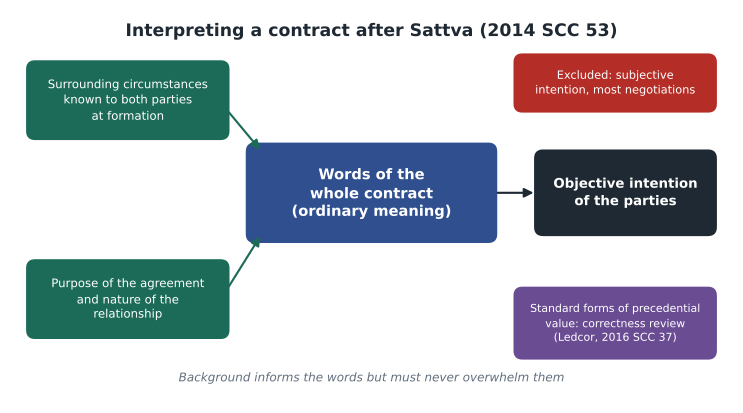
How do courts determine what the words of a contract mean? For most of the twentieth century courts emphasized the plain meaning of the words and resisted evidence of surrounding circumstances. The modern Canadian approach was set out by the Supreme Court in Sattva Capital Corp. v. Creston Moly Corp., 2014 SCC 53.
Justice Rothstein, for the Court, held that the overriding concern is to determine the intent of the parties and the scope of their understanding. A decision-maker must read the contract as a whole, giving the words used their ordinary and grammatical meaning, consistent with the surrounding circumstances known to the parties at the time of formation. The meaning of words is often derived from a number of contextual factors, including the purpose of the agreement and the nature of the relationship it creates.
Surrounding circumstances, sometimes called the factual matrix, consist of objective background facts known or reasonably capable of being known by both parties at or before the date of contracting. They are used as an interpretive aid, but they must never be allowed to overwhelm the words of the agreement. A court cannot use the surrounding circumstances to deviate from the text so far that it effectively creates a new agreement. Evidence of one party's subjective intention, and of negotiations, is generally not part of the factual matrix, although the line between background and negotiation can be hard to draw.
Sattva also changed the standard of appellate review. Contractual interpretation is a question of mixed fact and law, because it applies legal principles to the words and the factual matrix. An appeal court must therefore defer to the trial judge's interpretation unless there is a palpable and overriding error, or an extricable question of law, such as the application of an incorrect principle or failure to consider a required element.
Ledcor and standard form contracts
In Ledcor Construction Ltd. v. Northbridge Indemnity Insurance Co., 2016 SCC 37, the Court created an exception for standard form contracts. Ledcor concerned a builder's risk insurance policy and whether an exclusion for the cost of 'making good faulty workmanship' excluded the cost of replacing windows scratched by a cleaner. Justice Wagner held that the interpretation of a standard form contract should be reviewed for correctness where it is of precedential value and there is no meaningful factual matrix specific to the parties. Because standard form contracts are used across an industry and are not negotiated, interpreting them is closer to a question of law that should be decided consistently. On the merits, the Court held that the exclusion did not cover the cost of replacing the damaged windows.
In Earthco Soil Mixtures Inc. v. Pine Valley Enterprises Inc., 2024 SCC 20, the Court applied these principles to the Sale of Goods Act. A buyer of topsoil, behind schedule and insisting on immediate delivery despite the seller's warning that its test results were weeks old, agreed to clauses giving it the right to test before shipment and relieving the seller of responsibility for quality once the soil left its facility if the buyer waived that right. The question was whether those clauses were an 'express agreement' under section 53 of the Ontario Act sufficient to exclude the implied condition that goods match their description. The majority held that the agreement must clearly negate or vary the implied condition, but that the ordinary principles of contractual interpretation apply, with the parties' objective intentions paramount; no magic words referring to the statute are needed. The trial judge had made no extricable error of law, so the exclusion applied.
Contra proferentem and other aids
Courts use several interpretive aids when the ordinary approach leaves real ambiguity. Contra proferentem resolves ambiguity against the party who drafted the term, a principle especially important in insurance and standard form contracts. Courts also prefer interpretations that give effect to every clause, that avoid commercial absurdity, and that are consistent with the contract's purpose. Specific terms prevail over general ones, and handwritten or typed changes prevail over printed standard terms. These aids are tools of last resort; they do not displace the Sattva approach.
Implied terms
Courts will add terms to a contract in three situations, as the Supreme Court explained in M.J.B. Enterprises Ltd. v. Defence Construction (1951) Ltd., [1999] 1 SCR 619:
- Terms implied by custom or usage in a trade or market, if the custom is notorious, certain and reasonable.
- Terms implied as legal incidents of a particular class of contract, such as the duty of an employer to give reasonable notice of termination absent a contrary term, or a landlord's covenant of quiet enjoyment.
- Terms implied in fact, based on the presumed intention of the parties, where the term is necessary to give business efficacy to the contract or is so obvious that the parties would have said 'of course' if asked (the officious bystander test).
Statutes also imply terms, notably Ontario's Sale of Goods Act conditions of description, merchantable quality and fitness for purpose. Courts will not imply a term that contradicts an express term or simply because it would be reasonable. Implication fills genuine gaps; it does not rewrite the bargain.
Back to the hinges
Varga returns to Lakeshore's dispute. The words 'premium-grade brass hinges', read with the surrounding circumstances known to both parties, such as Lakeshore's high-end product line, may support an interpretation requiring solid brass, especially if 'premium-grade' has a known meaning in the trade. The sales manager's oral promise is harder to use: the entire agreement clause will likely exclude it as a term or collateral contract, though Lakeshore may still argue misrepresentation if the clause does not exclude that claim. And because this is a sale of goods by description, section 14 implies a condition that the hinges correspond with their description. If they do not, Lakeshore may reject them. 'Read the whole contract,' Varga says, 'then the statute, then the background. In that order.'
| Interpretive question | Approach | Authority |
|---|---|---|
| What do the words mean? | Whole contract; ordinary meaning; surrounding circumstances known to both parties | Sattva, 2014 SCC 53 |
| Can background override the words? | No; it informs but cannot overwhelm the text | Sattva |
| Standard of review on appeal | Palpable and overriding error, unless an extricable error of law | Sattva |
| Standard form contracts of precedential value | Correctness | Ledcor, 2016 SCC 37 |
| Excluding Sale of Goods Act implied conditions | Clear express agreement read under ordinary interpretation principles | Earthco, 2024 SCC 20 |
| Implied terms | Custom, legal incidents, or necessity and obviousness | M.J.B. Enterprises, [1999] 1 SCR 619 |
Common mistakes
MistakeCourts interpret contracts by the literal words alone.
InsteadSattva requires reading the words in light of the surrounding circumstances known to both parties at formation, without letting those circumstances overwhelm the text.
MistakeContractual interpretation is always a question of law reviewed for correctness.
InsteadIt is usually a question of mixed fact and law reviewed deferentially, except for extricable errors of law and standard form contracts under Ledcor.
MistakeA court will imply any term that seems reasonable.
InsteadTerms are implied only by custom, as legal incidents of a class of contract, or where necessary for business efficacy or obvious to the parties.
MistakeAn entire agreement clause always bars claims for misrepresentation.
InsteadIt depends on the wording. Soboczynski held that such a clause did not bar a claim based on later statements.
Practice problems
Work each problem on paper first, then reveal the answer to check.
A furniture retailer's contract with Lakeshore says delivery will be 'on or about March 1'. Delivery comes March 9, after the retailer's spring sale. Can the retailer terminate?
Show answer
'On or about' allows reasonable latitude, and time is not stated to be of the essence. The term is probably innominate; termination depends on whether the delay deprived the retailer of substantially the whole benefit (Hongkong Fir). The spring sale evidence matters if both parties knew of it at formation.
Why did Ledcor create a different standard of review for standard form contracts?
Show answer
Standard forms are not negotiated, rarely have a meaningful party-specific factual matrix, and are used widely; interpreting them consistently is closer to a question of law, so appellate courts review for correctness when the interpretation has precedential value.
Lakeshore's contract with a delivery company says nothing about the hours of delivery. Lakeshore's factory is open only 7 a.m. to 4 p.m. Will a court imply a term that deliveries occur during those hours?
Show answer
Possibly, as a term implied in fact if both parties knew the hours and the term is necessary for business efficacy or obvious. A court will not imply it merely because it is reasonable; evidence of the parties' course of dealing would help.
Summary and key terms
- Statements become terms if a reasonable person would understand them as promised; otherwise they are representations, with different remedies.
- Terms are conditions, warranties or innominate terms; classification governs the right to terminate (Hongkong Fir).
- A signer is generally bound by a signed document (L'Estrange), subject to fraud, non est factum (narrow after Marvco) and notice of onerous terms (Tilden).
- The parol evidence rule and entire agreement clauses limit the use of pre-contractual statements, subject to exceptions (Gallen; Soboczynski).
- Interpretation under Sattva reads the whole contract in light of the surrounding circumstances; review is deferential except for extricable errors of law and standard form contracts (Ledcor).
- Terms may be implied by custom, as legal incidents or in fact (M.J.B.), and by statute (Sale of Goods Act ss. 14 and 15; Earthco on excluding them).
- Condition
- An essential term whose breach entitles the innocent party to terminate the contract.
- Warranty
- A less important term whose breach gives a right to damages only.
- Innominate term
- A term whose breach permits termination only if it deprives the innocent party of substantially the whole benefit of the contract.
- Parol evidence rule
- The rule excluding evidence of prior or contemporaneous oral agreements to vary a complete written contract, subject to exceptions.
- Entire agreement clause
- A clause stating that the written contract contains the whole agreement and supersedes earlier discussions.
- Factual matrix
- The objective background facts known or reasonably knowable by both parties at formation, used to interpret the contract.
- Contra proferentem
- The principle that ambiguity is resolved against the party who drafted the term.
Lesson quiz · 5 questions
Score 60% or more to complete this lesson.
Create a free account to save your progress, take quizzes and earn a certificate.