
LAWC-102 · Lesson 10 of 12 · 19 min
Frustration and discharge
▶ Video coming soon A video version of this lesson is on the way.
Professor Varga begins with a booking contract from the shoebox. In early 2020 a Corwin couple booked a banquet hall for their wedding in May, paying a 6,000 dollar deposit. In March, provincial emergency orders banned large gatherings. The hall refused to return the deposit, pointing to a clause saying deposits were non-refundable 'for any reason'. The couple said the contract had been frustrated. 'Nobody broke this contract,' Varga says. 'The world broke it. Who bears the loss?'
Contracts end in four main ways: by performance, by agreement, by breach and by frustration. This lesson covers performance, agreement and frustration, with the statutory rules that adjust the consequences. Lesson 11 deals with breach and the remedies that follow.
Discharge by performance
Most contracts end when both parties have done what they promised. Problems arise when performance is incomplete or defective. Traditionally, an obligation to perform a whole task before payment, an entire obligation, gave the performing party nothing if it stopped short. In Cutter v. Powell (1795), 6 TR 320, a sailor who died before the end of a voyage, with payment due on arrival, recovered nothing. Courts now mitigate this harshness in several ways:
- Many contracts are divisible, with payment due in instalments for each stage, so each completed stage earns its price.
- The doctrine of substantial performance allows a party who has performed substantially, with minor defects, to recover the price less a deduction for the defects. The Supreme Court applied it in Fairbanks Soap Co. v. Sheppard, [1953] 2 SCR 314, while holding that a builder who had abandoned a machine half-finished had not substantially performed and could not recover the price.
- If the other party freely accepts the benefit of partial performance, when it had a real choice, restitution may require it to pay a reasonable sum. Where it had no real choice, such as a building on its own land, acceptance is not inferred (Sumpter v. Hedges, [1898] 1 QB 673 (CA)).
Tender of performance matters too. A party who offers to perform in accordance with the contract, and has the offer refused, is discharged from further performance and may sue for breach.
Discharge by agreement
Parties who made a contract can unmake it. A mutual agreement to rescind, where both sides still have obligations, is supported by each party's release of the other. Where one party has fully performed, a release by that party needs consideration or a seal, or relief under a statute such as Ontario's Mercantile Law Amendment Act. Accord and satisfaction occurs where a party agrees to accept something different in place of its contractual rights and receives it. Novation replaces a contract with a new one, often substituting a new party with everyone's consent. Contracts may also provide for their own termination: on notice, on a fixed date, or on the occurrence of a condition subsequent. Waiver, discussed in Lesson 3, can prevent a party from insisting on strict performance.
Contracts also commonly contain conditions precedent, events that must occur before obligations arise. A true condition precedent depends on the will of a third party or on external events, such as a buyer obtaining financing or a municipality granting rezoning. If the condition is not fulfilled by the stated date, the contract ends. In Turney v. Zhilka, [1959] SCR 578, the Supreme Court held that a buyer could not waive a condition about annexation and a plan approval, because the condition depended on a third party and was not solely for the buyer's benefit. Conditions inserted solely for one party's benefit can usually be waived by that party.
The doctrine of frustration
Frustration discharges a contract when, after formation and without the fault of either party, an event occurs that makes performance impossible or radically different from what the parties contemplated, and the contract does not provide for it. Both parties are released from future obligations.
The doctrine began with Taylor v. Caldwell (1863), 3 B & S 826, where a music hall hired for a series of concerts burned down before the first one. The court implied a condition that the parties would be excused if the hall ceased to exist without fault. The coronation cases extended the doctrine to frustration of purpose. In Krell v. Henry, [1903] 2 KB 740 (CA), rooms rented to watch the coronation procession of Edward VII from the window were not paid for when the procession was cancelled because the King fell ill: watching the procession was the foundation of the contract. In Herne Bay Steam Boat Co. v. Hutton, [1903] 2 KB 683 (CA), by contrast, a contract to hire a boat to view the naval review and cruise around the fleet was not frustrated by the review's cancellation, because the fleet could still be seen and the purpose was not wholly defeated.
The modern test comes from Davis Contractors Ltd. v. Fareham Urban District Council, [1956] AC 696 (HL), where a builder who had agreed to build houses in eight months for a fixed price took twenty-two months because of labour shortages and claimed the contract was frustrated. The House of Lords disagreed. Lord Radcliffe explained that frustration occurs when, without default of either party, a contractual obligation has become incapable of being performed because the circumstances would render it a thing radically different from that which was undertaken. 'It was not this that I promised to do.' Hardship, delay or increased cost is not enough.
Frustration in Canada
The Supreme Court adopted the radical difference test in Naylor Group Inc. v. Ellis-Don Ltd., 2001 SCC 58. Ellis-Don, a general contractor, had accepted Naylor's electrical sub-bid for a hospital project. Before the subcontract was signed, the Ontario Labour Relations Board ruled that Ellis-Don was bound to use only union-affiliated subcontractors, which Naylor was not. Ellis-Don argued that the contract was frustrated. Justice Binnie held that frustration occurs when a situation arises for which the parties made no provision in the contract, and performance would be radically different from what was contemplated. The labour ruling did not frustrate the contract: the risk of labour issues was foreseeable, Ellis-Don had been aware of the dispute, and it bore that risk. Ellis-Don was liable to Naylor.
Canadian courts have found frustration where supervening legislation makes the contract's purpose unattainable. In Capital Quality Homes Ltd. v. Colwyn Construction Ltd. (1975), 9 OR (2d) 617 (CA), a contract to sell twenty-six building lots, each to be conveyed by a separate deed, was frustrated when new subdivision control legislation required planning approval that made separate conveyances impossible without consent. In KBK No. 138 Ventures Ltd. v. Canada Safeway Ltd., 2000 BCCA 295, a sale of land for redevelopment was frustrated when the city rezoned it, drastically reducing permitted density; the buyer recovered its deposit.
What does not frustrate a contract
Courts are strict. The following are generally not frustrating events:
- Events the parties foresaw or should have foreseen and could have provided for. If the risk was foreseeable, the inference is usually that the party who undertook the obligation accepted it.
- Events the contract provides for, for example through a force majeure clause, a price adjustment clause or an allocation of risk.
- Increased cost, scarcity or market changes, as in Davis Contractors.
- Self-induced events. A party cannot rely on frustration caused by its own choice. In Maritime National Fish Ltd. v. Ocean Trawlers Ltd., [1935] AC 524 (PC), a company that chose to allocate its limited fishing licences to other boats could not claim its charter of a trawler was frustrated.
Leases of land can be frustrated, but rarely, because the lease conveys an interest in land that continues to exist.
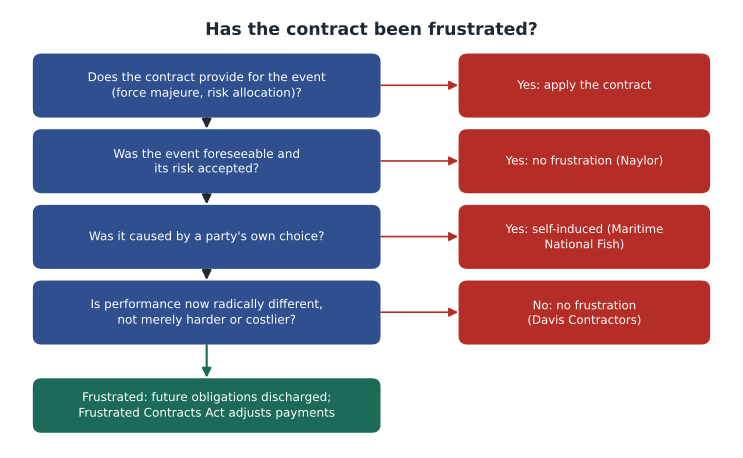
Force majeure clauses
Commercial parties often avoid uncertainty by including a force majeure clause, which excuses or suspends performance when specified events beyond a party's control occur, such as natural disasters, war, labour disputes or government action. These clauses are interpreted under ordinary principles: the event must fall within the clause, it must have caused the failure to perform, and the party relying on it must usually show it could not avoid the effect by reasonable steps. In Atlantic Paper Stock Ltd. v. St. Anne-Nackawic Pulp and Paper Co., [1976] 1 SCR 580, the Supreme Court held that a force majeure clause covering causes beyond a party's control did not excuse a mill that stopped buying waste paper because the market for its product had collapsed: the clause contemplated unforeseen events, not commercial unprofitability. A force majeure clause may provide more or less relief than the common law, and where it applies, frustration usually does not.
The pandemic cases
The COVID-19 pandemic produced a wave of frustration and force majeure claims across Canada. The broad pattern was that courts rarely found commercial leases frustrated by temporary closures, because the leased premises remained and the closures were temporary relative to long lease terms. Results for event contracts, such as weddings and conferences scheduled during lockdowns, depended heavily on the contract's terms: whether it had a force majeure clause covering government orders or epidemics, whether it allowed rescheduling, and how deposits were characterized. Where a contract for a single event on a fixed date became illegal to perform, frustration was more readily available, since performance on the agreed terms was impossible rather than merely more difficult.
The consequences of frustration at common law
At common law, frustration discharges the contract from the moment of the frustrating event. Obligations already due remain due; obligations not yet due are discharged. This led to harsh results. In Chandler v. Webster, [1904] 1 KB 493 (CA), a coronation case, a hirer who had paid in advance could not recover the money. The House of Lords relaxed the rule in Fibrosa Spolka Akcyjna v. Fairbairn Lawson Combe Barbour Ltd., [1943] AC 32, allowing recovery of money paid where there had been a total failure of consideration. But partial performance still caused problems.
The Frustrated Contracts Act
Ontario's Frustrated Contracts Act, RSO 1990, c. F.34, based on the English Law Reform (Frustrated Contracts) Act 1943, adjusts the parties' positions when a contract governed by Ontario law is frustrated.
- Money paid before the frustrating event is recoverable, and money payable before that time ceases to be payable.
- If the party to whom money was paid or payable incurred expenses before the event in performing the contract, the court may allow it to keep or recover all or part of the money, up to the amount of the expenses, if it considers it just to do so in all the circumstances.
- If a party obtained a valuable benefit, other than money, because of the other's performance before the event, the court may order it to pay a just sum, not exceeding the value of the benefit.
The Act does not apply to some contracts, including certain charterparties and contracts of insurance, and it gives way to provisions of the contract that deal with the consequences of frustration. Some provinces have different models: British Columbia's Frustrated Contract Act, for example, apportions losses between the parties more broadly. Sale of goods contracts have their own rules: under Ontario's Sale of Goods Act, a contract for specific goods that, without the seller's knowledge, have perished at the time of contracting is void, and an agreement to sell specific goods that perish without fault before the risk passes to the buyer is avoided.
Frustration and common mistake
Frustration and common mistake are closely related. Both concern fundamental changes the parties did not provide for. The difference is timing: common mistake deals with a state of affairs existing when the contract is made, frustration with events afterward. If the music hall in Taylor v. Caldwell had burned down the night before the contract was signed, the case would have been about common mistake. In both doctrines, the decisive question is whether the contract allocated the risk.
The wedding hall
Varga returns to the couple's deposit. The emergency orders made the May wedding illegal on the agreed date, which looks like a frustrating event: performance was not just harder but impossible, through no fault of either party, and a pandemic ban was not something the standard booking contract provided for. If the contract was frustrated and is governed by Ontario law, the Frustrated Contracts Act makes the deposit recoverable, subject to the court allowing the hall to keep part to cover expenses incurred in performing, such as staff hired or food ordered. The non-refundable clause matters only if, properly interpreted, it was meant to allocate the risk of events like a ban; a clause aimed at the couple changing their minds probably does not. 'The first question is always the contract,' Varga says. 'Only when it is silent do we turn to frustration.'
| Issue | Rule | Authority |
|---|---|---|
| Test for frustration | Unforeseen event, no fault, no contractual provision, performance radically different | Davis Contractors; Naylor Group, 2001 SCC 58 |
| Frustration of purpose | Foundation of the contract destroyed | Krell v. Henry; contrast Herne Bay |
| Supervening legislation | May frustrate where purpose becomes unattainable | Capital Quality Homes (Ont CA 1975); KBK No. 138 (BCCA 2000) |
| Self-induced events | Not frustration | Maritime National Fish (PC 1935) |
| Force majeure | Interpreted by its terms; does not cover mere unprofitability | Atlantic Paper Stock, [1976] 1 SCR 580 |
| Consequences in Ontario | Money paid recoverable; expenses and benefits adjusted | Frustrated Contracts Act, RSO 1990, c. F.34 |
Common mistakes
MistakeA big increase in cost frustrates a contract.
InsteadHardship, delay and increased cost are not enough; performance must be radically different (Davis Contractors).
MistakeFrustration applies whenever an event was not mentioned in the contract.
InsteadThe event must be unforeseen in a meaningful sense; foreseeable risks are usually taken to be allocated to the party who undertook the obligation (Naylor Group).
MistakeWhen a contract is frustrated, each party keeps whatever it has received.
InsteadThat was the old common law rule. Ontario's Frustrated Contracts Act allows recovery of money paid, with adjustments for expenses and benefits.
MistakeA force majeure clause excuses any failure to perform caused by market changes.
InsteadClauses are read by their terms; general clauses typically do not cover mere unprofitability (Atlantic Paper Stock).
Practice problems
Work each problem on paper first, then reveal the answer to check.
Lakeshore agrees to build custom pews for a Corwin church, with 40 percent paid up front. Before delivery, a fire destroys the church, and the congregation decides not to rebuild. Lakeshore has spent 15,000 dollars on materials and labour. Advise both parties.
Show answer
The contract is likely frustrated: its foundation was destroyed without fault and the contract did not provide for it. Under the Frustrated Contracts Act, the church can recover its advance payment, but the court may allow Lakeshore to keep part of it to cover expenses incurred in performing, up to the amount paid, if just. Any finished pews delivered could ground a just sum for a valuable benefit.
Why was the contract in Naylor Group v. Ellis-Don not frustrated?
Show answer
The labour board ruling was a foreseeable risk that Ellis-Don knew about and had accepted; frustration does not apply to risks the parties could have provided for, and performance was not radically different.
How does common mistake differ from frustration?
Show answer
Common mistake concerns a fundamental state of affairs that existed when the contract was made; frustration concerns an event after formation. Both turn on whether the contract allocated the risk.
Summary and key terms
- Contracts end by performance, agreement, breach or frustration; substantial performance and divisibility soften the entire obligations rule (Fairbanks Soap).
- Parties may discharge contracts by rescission, accord and satisfaction, novation or by their own terms; true conditions precedent depending on third parties cannot be waived unilaterally (Turney v. Zhilka).
- Frustration requires an unforeseen supervening event, without fault, not provided for, that makes performance radically different (Davis Contractors; Naylor Group).
- Increased cost, foreseeable risks and self-induced events do not frustrate; force majeure clauses are read by their terms (Atlantic Paper Stock).
- Ontario's Frustrated Contracts Act lets money paid be recovered, with adjustments for expenses incurred and valuable benefits received.
- Frustration
- The discharge of a contract by an unforeseen supervening event, without fault, that makes performance impossible or radically different.
- Force majeure clause
- A term excusing or suspending performance when specified events beyond a party's control occur.
- Substantial performance
- Performance with only minor defects, entitling the performing party to the price less a deduction.
- Condition precedent
- An event that must occur before contractual obligations arise.
- Accord and satisfaction
- An agreement to accept something different in place of contractual rights, together with its performance.
- Novation
- The replacement of a contract with a new one, often substituting a party, with the consent of all.
Lesson quiz · 5 questions
Score 60% or more to complete this lesson.
Create a free account to save your progress, take quizzes and earn a certificate.