
LAWC-102 · Lesson 12 of 12 · 21 min
Capstone: solving a contracts problem
▶ Video coming soon A video version of this lesson is on the way.
On Wednesday, November 18, 2026, Professor Varga hands Section B a three-page problem and gives them two hours, the same time they will have for the long question on the December exam. 'Every fact in this problem is there for a reason,' he says. 'Some are traps. Spot the issues first, then answer each one in order: issue, rule, application, conclusion. Argue both sides where the law is unsettled. And always end with remedies, because that is what the client is paying you to tell them.'
Everything in the problem is fictional. Only the cases and statutes are real. This lesson walks through the problem and a model analysis, showing how the doctrines from the course fit together.
The problem
Lakeshore Furniture Co. makes solid wood furniture in Corwin, Ontario. In January 2026 its operations manager, Priya Lal, emailed Northwood Timber Ltd., a sawmill near Sudbury, asking for a quotation for 30,000 board feet of kiln-dried white oak, to be delivered in three equal loads in April, May and June, for Lakeshore's new dining room collection.
Northwood's sales manager, Glen Ashby, replied with a quotation on Northwood's letterhead: 30,000 board feet of 'select grade white oak, kiln-dried to 6 to 8 percent moisture', at 4.10 dollars per board foot, delivery as requested, 'quotation valid 14 days'. The quotation said it was 'subject to Northwood's standard terms of sale, available on request'. Those terms, never sent to Lakeshore, included a clause limiting Northwood's liability for 'any claim arising from the goods or their delivery' to the price of the affected load, and excluding all liability for 'lost profits or consequential losses of any kind'.
On the phone, Ashby told Lal that Northwood's oak 'is the most stable on the market; we've never had a warping complaint'. In fact, Northwood had received three warping complaints in 2025 and had recently replaced a kiln controller after it malfunctioned. Ashby knew of the complaints but not the kiln problem.
Nine days after the quotation, Lal sent a Lakeshore purchase order accepting 'your quotation of January 12 on the terms stated', adding in the comments box: 'Please confirm loads can be palletized'. The purchase order's printed reverse side contained Lakeshore's own standard terms, including a warranty that goods would be fit for furniture manufacturing. Northwood did not reply but began preparing the first load.
In March, Ashby phoned Lal: oak prices had jumped by a quarter after a mill fire in Quebec, and Northwood 'cannot ship at 4.10'. Lal, with a major retail launch planned, emailed back: 'Under protest, we will pay 4.70 for this order. Please ship.' Northwood shipped all three loads, and Lakeshore paid 4.70 for each.
The second load, delivered in May, warped badly once the furniture was finished and placed in the retailer's showroom. Testing showed it had been kiln-dried to about 13 percent moisture, the result of the faulty kiln controller. Lakeshore had to recall 140 dining tables from Harbourview Home, its largest retail customer. Harbourview cancelled its remaining orders for the year, costing Lakeshore an estimated 220,000 dollars in profit. The recall itself cost 38,000 dollars, and the warped oak was worth nothing.
In July, Northwood's new sales director assured Lal that Northwood was 'committed to making this right and to supplying Lakeshore next year'. Northwood had already decided internally not to renew Lakeshore's account for 2027 and was negotiating to sell its entire 2027 output to a competitor. Relying on the assurance, Lakeshore did not seek other suppliers. In October, Northwood gave notice that it would not supply Lakeshore in 2027, as the parties' contract allowed. Lakeshore now faces a shortage for the spring.
Lakeshore asks you to advise on its claims against Northwood, and on Northwood's likely defences.
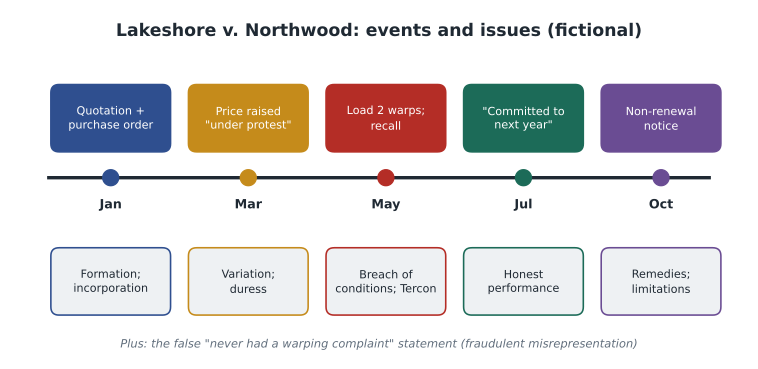
Step 1: Spot the issues
Varga writes the issues on the whiteboard before anyone starts writing.
- Formation: was there a contract, and on whose terms? Did Northwood's standard terms become part of it?
- Variation: is Lakeshore bound by its promise to pay 4.70, or can it recover the extra 0.60 per board foot?
- Terms and breach: did the warped load breach an express term, the Sale of Goods Act implied conditions, or Lakeshore's purchase order warranty?
- Exclusion and limitation: if Northwood's terms were incorporated, do they limit or exclude Lakeshore's claims?
- Misrepresentation: was Ashby's statement about stability a term, a misrepresentation, or puffery?
- Good faith: did Northwood breach the duty of honest performance in July?
- Remedies: what can Lakeshore recover for the warped load, the recall, the lost Harbourview profits and the 2027 shortage?
Arjun Mehta, who likes order, points out that the issues follow the course: formation, consideration, terms, exclusion clauses, misrepresentation, good faith and remedies. Varga reminds the class that the order of analysis matters: there is no point discussing exclusion clauses until you know which terms are in the contract.
Step 2: Formation and the battle of the forms
Issue. Was a contract formed, and on what terms?
Rule. A quotation can be an offer if it shows an intention to be bound on acceptance, with definite terms (Lesson 1). Acceptance must mirror the offer; a reply that adds terms is a counter-offer (Hyde v. Wrench), and in a battle of the forms the last shot often wins, though courts look at the whole course of dealing (Butler Machine Tool; Tywood Industries). A request that does not condition acceptance is not a counter-offer.
Application. Northwood's quotation stated quantity, grade, moisture specification, price, delivery and a validity period. That looks like an offer. Lakeshore's purchase order accepted 'on the terms stated' within the fourteen days. The comment about palletizing is phrased as a request, not a condition, so it probably did not turn the acceptance into a counter-offer. The harder question is Lakeshore's printed terms on the reverse. Northwood will argue that if the purchase order added a fitness warranty, it was a counter-offer that Northwood accepted by conduct, and that its own reference to standard terms still applied. Lakeshore will argue that the face of the order expressly accepted the quotation's terms, so the printed reverse did not change them, and in any event, the Sale of Goods Act implies a fitness condition anyway.
Were Northwood's standard terms incorporated? A reference to terms 'available on request' can incorporate them between commercial parties if the reference is clear and the other party could have asked. But Lakeshore never saw them, and the limitation and exclusion clauses are significant. Under Tilden, onerous terms in a standard form need reasonable notice where the other party is not expected to have read them. Tilden is about hurried consumer-style transactions, and courts are less willing to apply it to commercial parties, but the clauses here were not just unread: they were never provided.
Conclusion. A contract was formed on the quotation's terms when Lakeshore's purchase order was sent. Whether Northwood's standard terms were incorporated is genuinely arguable; the better view for Lakeshore is that a bare reference to unsent terms did not incorporate an exclusion of consequential loss, but a court could hold otherwise between commercial parties.
Step 3: The price variation
Issue. Is Lakeshore bound by its promise to pay 4.70 per board foot, or can it recover the extra 0.60, about 18,000 dollars in total?
Rule. In Ontario, Gilbert Steel holds that a promise to pay more for performance the promisee is already bound to give is unenforceable without fresh consideration. New Brunswick (NAV Canada) and British Columbia (Rosas v. Toca) enforce such variations absent economic duress, unconscionability or public policy concerns. Economic duress requires illegitimate pressure leaving no practical alternative, and the victim must not affirm the variation once the pressure ends (Lesson 3 and Lesson 8). The Mercantile Law Amendment Act helps debtors who pay less, not creditors who are promised more.
Application. Northwood was already bound to deliver at 4.10; it gave nothing new for the increase. Under Gilbert Steel, the promise to pay 4.70 is unenforceable, and Lakeshore can recover the excess paid as money paid under a void promise. If the court follows NAV Canada and Rosas, the question becomes duress. Northwood's threat not to ship was a threat to breach the contract, which is illegitimate. Lakeshore had a looming launch and no realistic alternative supplier in time, protested in writing, and paid only because shipment was needed. But Lakeshore paid the higher price for all three loads, including the third load in June, and did not disaffirm promptly once the oak arrived. Northwood will argue affirmation.
Conclusion. Under the Ontario appellate authority, Lakeshore can likely recover about 18,000 dollars. Under the NAV Canada approach, the outcome depends on duress, with Lakeshore's protest strong evidence in its favour and its continued payment the main risk.
Step 4: Breach of the quality terms
Issue. Did the second load breach the contract?
Rule. Express terms of description bind the seller. Under Ontario's Sale of Goods Act, in a sale by description there is an implied condition that the goods correspond with the description (section 14), and where the buyer makes known the purpose and relies on the seller's skill, an implied condition that the goods are reasonably fit for that purpose, and in sales by description from a dealer, that they are of merchantable quality (section 15). These conditions can be excluded only by express agreement read under ordinary interpretation principles (section 53; Earthco, 2024 SCC 20).
Application. The quotation described the oak as kiln-dried to 6 to 8 percent moisture. The second load was dried to about 13 percent. That is a breach of the express description and of the section 14 condition. Lakeshore told Northwood the oak was for a dining room collection, relying on Northwood's expertise as a mill, so section 15's fitness condition also applies, and warped oak is not merchantable for furniture. If Northwood's standard terms were incorporated, the question is whether they amount to an express agreement excluding these conditions. The limitation clause caps liability rather than excluding the conditions, and the consequential loss exclusion addresses damages, not the condition itself; neither clearly negates the implied conditions.
Conclusion. Northwood breached express and implied conditions for the second load.
Step 5: The exclusion and limitation clauses
Issue. If Northwood's terms were incorporated, do they limit Lakeshore's recovery?
Rule. Tercon: does the clause, properly interpreted, apply; was it unconscionable at formation; and is there an overriding public policy reason not to enforce it?
Application. On interpretation, a cap at the price of the affected load and an exclusion of 'lost profits or consequential losses of any kind' would, read naturally, catch the lost Harbourview profits and perhaps the recall costs. Lakeshore will argue that 'consequential losses' refers to losses under the second limb of Hadley v. Baxendale, and that recall costs flowing directly from defective oak are direct losses not caught by the clause. Contra proferentem supports Lakeshore if the wording is ambiguous. Unconscionability is unlikely between two commercial parties of reasonable sophistication. Public policy is unlikely unless Northwood knowingly shipped defective oak; Ashby did not know of the kiln problem, though the company may have, which is worth investigating.
Conclusion. If incorporated, the clauses probably limit Lakeshore's recovery for the second load to its price and exclude the lost profits, subject to arguments about the meaning of consequential losses and about Northwood's knowledge.
Step 6: Misrepresentation
Issue. Is Ashby's statement that the oak was 'the most stable on the market' and that Northwood had 'never had a warping complaint' actionable?
Rule. Puffery is not actionable, but specific statements of fact are (Lesson 7). A statement known to be false is fraudulent (Derry v. Peek; Bruno Appliance). A negligent misrepresentation in a special relationship gives tort damages (Cognos). A statement may also be a term or collateral warranty if a reasonable person would see it as promised (Dick Bentley).
Application. 'The most stable on the market' is likely puffery. 'We've never had a warping complaint' is a specific statement of fact, and it was false: there were three in 2025, and Ashby knew it. That is a fraudulent misrepresentation, inducing Lakeshore to choose Northwood. Fraud is significant here: exclusion clauses generally do not protect a party from liability for its own fraud, and deceit damages cover all direct losses, whether foreseeable or not. Lakeshore must still show the statement induced the contract and that the losses flowed from it; Northwood will say the warping was caused by the kiln fault, not by whatever caused the 2025 complaints, so the lie did not cause the loss. Lakeshore will respond that, but for the lie, it would have chosen another supplier and suffered none of these losses.
Conclusion. Lakeshore has a strong claim in deceit, which may sidestep the exclusion clauses, with causation as the main battleground. Rescission is impractical because the oak has been used.
Step 7: Honest performance
Issue. Did Northwood breach the duty of honest performance in July?
Rule. Bhasin and Callow: parties must not lie or knowingly mislead each other about matters directly linked to the contract's performance, including the exercise of a termination or non-renewal right. There is no duty to disclose, but half-truths and active assurances can be deceptive.
Application. Northwood had a right not to renew and no duty to reveal its plans. But its sales director affirmatively assured Lal that Northwood was committed to supplying Lakeshore the next year, after Northwood had decided not to. As in Callow, that is active deception about a matter directly linked to performance, the renewal. Lakeshore relied on it by not seeking other suppliers.
Conclusion. Northwood likely breached the duty of honest performance. Damages put Lakeshore where it would have been had Northwood been honest: the value of the opportunity to secure another supplier, such as the extra cost of buying oak late in a tight market and any profits lost because of the shortage, not the profit it would have made from a renewed Northwood contract.
Step 8: Remedies
Varga asks the class to bring everything together.
- Price variation: recovery of about 18,000 dollars if the variation is unenforceable or voidable for duress.
- Warped load: damages for breach of condition, at least the price of the load and the cost of the useless oak, subject to the limitation clause if incorporated.
- Recall costs: likely recoverable as a natural consequence of supplying furniture-grade oak that warped, unless excluded as consequential loss.
- Lost Harbourview profits: recoverable under Hadley's second limb only if Northwood knew enough at formation to contemplate loss of retail business, which the dining room collection and the purchase order may show; excluded if Northwood's terms were incorporated, unless Lakeshore succeeds in deceit. Lakeshore must also show it mitigated by trying to retain or replace Harbourview's business.
- Honest performance: damages for the lost opportunity to secure 2027 supply.
- No punitive damages are likely, absent proof that Northwood knowingly shipped defective oak and behaved in a highly reprehensible way; mental distress damages are not available in a commercial supply contract.
- Specific performance of supply for 2027 is not available: there is no contract for 2027, and oak is a market commodity.
Theo asks about the limitation period. Varga notes that Lakeshore discovered the warping in May 2026, so under Ontario's Limitations Act, 2002 it has until May 2028 to sue on the second load, and longer on the July deception, unless the contract validly shortened the period, which business parties are allowed to do.
How the problem will be marked
Varga closes with advice. Marks go to issue spotting, accurate statements of the rules with authority, and application to the facts, not to repeating the facts. Where the law is unsettled, as with variations in Ontario, say so, give both answers and explain which you think a court would follow. Where facts are missing, such as whether Northwood's management knew of the kiln fault, identify what you would need to find out. And always end with what the client can actually recover. 'The best answer,' he says, 'reads like advice you could bill for.'
| Issue | Key authorities | Likely outcome |
|---|---|---|
| Formation and incorporation | Hyde v. Wrench; Butler Machine Tool; Tilden | Contract on the quotation's terms; incorporation of unsent standard terms arguable |
| Price increase | Gilbert Steel; NAV Canada; Rosas v. Toca | Likely unenforceable in Ontario; duress analysis elsewhere |
| Quality breach | Sale of Goods Act ss. 14 and 15; Earthco | Breach of express and implied conditions |
| Exclusion clauses | Tercon | Would limit recovery if incorporated, subject to interpretation |
| Misrepresentation | Derry v. Peek; Bruno Appliance; Cognos | Fraud on the warping statement; causation contested |
| Honest performance | Bhasin; Callow | Breach in July; damages for the lost opportunity |
| Remedies | Hadley v. Baxendale; Fidler; Whiten; Semelhago | Direct losses likely; lost profits and punitive damages contested |
Common mistakes
MistakeStart with the exclusion clause, since it decides everything.
InsteadFirst decide whether the clause is part of the contract and what breach occurred; only then interpret and test it under Tercon.
MistakeThe lie about warping complaints is just sales talk.
InsteadA specific false statement of past fact, known to be false, is fraudulent misrepresentation, unlike vague puffery about being 'the best'.
MistakeNorthwood's decision not to renew was a breach because it was unfair.
InsteadNon-renewal was allowed. The breach was the active assurance that misled Lakeshore about renewal (Callow).
MistakeLakeshore can recover all 220,000 dollars of lost profit as of right.
InsteadThose losses face remoteness, mitigation and possibly an exclusion clause; deceit is the route that may avoid the clause, subject to causation.
Practice problems
Work each problem on paper first, then reveal the answer to check.
Suppose Northwood had emailed its full standard terms with the quotation, and Lal had replied 'we accept your quotation and terms'. How would your analysis of the exclusion clause change?
Show answer
Incorporation would be clear. The analysis would move to Tercon: interpretation of 'consequential losses', unlikely unconscionability between commercial parties, and public policy only if Northwood knowingly supplied defective goods. The deceit claim would remain, because exclusion clauses generally do not protect against a party's own fraud.
Write a one-paragraph IRAC on whether Lakeshore's palletizing comment was a counter-offer.
Show answer
Issue: did the comment turn the acceptance into a counter-offer? Rule: an acceptance must mirror the offer, but a request that does not condition acceptance does not reject the offer (Hyde v. Wrench; mere inquiries). Application: Lakeshore accepted 'on the terms stated' and asked Northwood to 'please confirm' palletizing, phrasing that reads as a request; acceptance was not made conditional on it. Conclusion: it was not a counter-offer, and a contract was formed on the quotation's terms.
Why can't Lakeshore get punitive damages for the warped oak on the present facts?
Show answer
Whiten requires highly reprehensible conduct and an independent actionable wrong. Defective goods from a kiln fault, without proof that Northwood knowingly shipped them, are an ordinary breach; the fraud claim gives compensatory deceit damages, and punitive damages would require more egregious conduct.
Summary and key terms
- Spot all issues first and analyze them in a logical order: formation, terms, breach, defences, remedies.
- Use IRAC for each issue, with authorities for each rule, and argue both sides where the law is unsettled.
- Incorporation must be decided before interpreting exclusion clauses under Tercon.
- Distinguish puffery, misrepresentation and terms; fraud can defeat exclusion clauses and broadens damages.
- Good faith claims require active deception, not mere non-disclosure.
- End with a practical account of what the client can recover, including remoteness, mitigation and limitation periods.
- IRAC
- A method of legal analysis: issue, rule, application, conclusion.
- Issue spotting
- Identifying every legal question raised by a set of facts before analyzing any of them.
- Consequential loss
- Often read as loss falling under the second limb of Hadley v. Baxendale, though its meaning depends on the contract.
- Deceit
- The tort of fraudulent misrepresentation, giving damages for all losses directly caused.
Lesson quiz · 5 questions
Score 60% or more to complete this lesson.
Create a free account to save your progress, take quizzes and earn a certificate.