
LAWC-102 · Lesson 3 of 12 · 17 min
Promissory estoppel and contract variation
▶ Video coming soon A video version of this lesson is on the way.
Professor Varga begins with a story from the shoebox. A small Corwin contractor agreed to renovate a restaurant for a fixed price. Halfway through, lumber prices jumped and the contractor said it could not finish without an extra 20,000 dollars. The restaurant owner, facing a grand opening, agreed in an email. When the work was done, the owner paid the original price only. 'The contractor sued for the extra money,' Varga says. 'The owner's lawyer said there was no consideration for the promise. Who wins?'
Sophie Tremblay-Hart points out that under Quebec civil law the question would look very different, because the Civil Code does not require consideration. Varga agrees and says the common law has spent the last half century struggling with exactly this problem. This lesson covers how the common law deals with promises to change existing contracts and with promises that are relied on but not paid for: the doctrine of promissory estoppel and the modern Canadian approach to contract variation.
The problem of modification
Contracts are often varied after they are made. Prices change, schedules slip and one party asks for more time or more money. Under the traditional rule in Stilk v. Myrick (1809), a promise to pay more for the same performance is unenforceable, because the promisee gives nothing new: it was already bound to perform. The rule protects promisors from being held up by a counterparty who threatens to walk away at a vulnerable moment. But it also defeats genuine, freely agreed adjustments that both parties wanted.
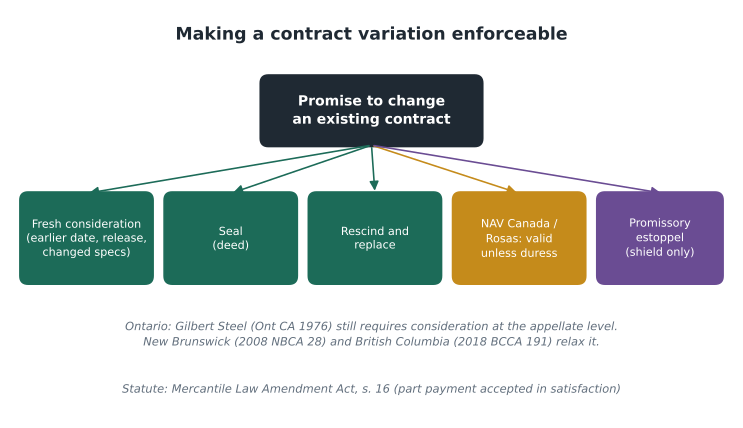
There are several ways to make a variation enforceable under the traditional rules:
- Fresh consideration: the promisee gives something new, however small, such as an earlier completion date, a change in specifications or a release of a claim.
- A seal: the variation is made by deed.
- Rescission and replacement: the parties cancel the old contract and make a new one, each giving up rights under the old.
- Promissory estoppel, which may prevent the promisor from going back on a promise not to enforce its full rights.
- Statute, such as the Ontario Mercantile Law Amendment Act provision on part payment discussed in Lesson 2, and the Sale of Goods Act rules on variation of sales contracts.
Gilbert Steel and the traditional Ontario rule
In Gilbert Steel Ltd. v. University Construction Ltd. (1976), 12 OR (2d) 19 (CA), a steel supplier and a builder agreed on a price for steel for several apartment buildings. When the mill raised prices, the supplier insisted on a higher price for the remaining deliveries, and the builder orally agreed. The builder later paid only the original price. The Ontario Court of Appeal held the promise to pay more unenforceable, because the supplier gave no fresh consideration. The court rejected arguments that the builder had received consideration through a promise of generous credit terms, and declined to apply promissory estoppel.
Gilbert Steel shows the doctrine's cost. The builder benefited from continued supply and freely agreed to the increase, but escaped paying it. English courts responded in Williams v. Roffey Bros. & Nicholls (Contractors) Ltd., [1991] 1 QB 1 (CA), holding that a promise to pay more for the same work can be supported by 'practical benefit' to the promisor, such as avoiding a penalty for late completion, provided there was no economic duress or fraud. Canadian courts took a different path.
NAV Canada: enforcing variations without consideration
In Greater Fredericton Airport Authority Inc. v. NAV Canada, 2008 NBCA 28, NAV Canada agreed to supply and install navigation equipment at the airport. A dispute arose about who would pay for a replacement system. NAV Canada insisted the airport pay, and the airport agreed under protest to avoid losing the equipment. The New Brunswick Court of Appeal held that a post-contractual modification unsupported by consideration may be enforceable if it was not procured by economic duress. The court reasoned that the consideration rule made sense for gratuitous promises but not for adjustments to an existing bargain, where the risk of holdup is better addressed by the doctrine of duress.
On the facts, the airport's promise was made under economic duress and was unenforceable. The court set out factors for duress in this setting, including whether the promise was extracted by pressure that left the promisee no practical alternative, whether it was made under protest, and whether the promisee took reasonable steps to disaffirm it once the pressure eased.
Rosas v. Toca: the British Columbia approach
In Rosas v. Toca, 2018 BCCA 191, a lottery winner lent her friend 600,000 dollars, repayable in a year. When the year came, the borrower asked for more time, and the lender agreed, several times, over a decade. When she finally sued, the borrower argued that the limitation period ran from the original due date, because the extensions were unsupported by consideration. The British Columbia Court of Appeal, sitting as a five-judge panel, held that when parties to a contract agree to vary it, the variation should be enforceable without fresh consideration, absent duress, unconscionability or other public policy concerns. The court described this as an incremental change in the law, following NAV Canada, and noted that the variation was in the borrower's interest and that the lender had relied on it.
The result is that New Brunswick and British Columbia have relaxed the consideration requirement for variations, policing unfair modifications through duress and unconscionability instead. The Supreme Court of Canada has not yet ruled on the question. Ontario courts have referred to NAV Canada and Rosas, and some trial decisions have followed them, but Gilbert Steel remains the leading appellate authority in Ontario, so the safer view is that an Ontario court may still require consideration, a seal or another basis for enforcing a variation. Lawyers drafting variations in Ontario therefore still provide nominal consideration or use a seal.
Promissory estoppel
Promissory estoppel addresses a related problem. One party to a legal relationship promises, by words or conduct, that it will not enforce its strict legal rights, and the other party relies on the promise. Equity may prevent the promisor from going back on the promise, at least without reasonable notice.
The doctrine traces back to Hughes v. Metropolitan Railway Co. (1877), 2 App Cas 439 (HL), where a landlord who had entered negotiations to sell the property to the tenant could not forfeit the lease for failure to repair during the negotiation period. It was revived in Central London Property Trust Ltd. v. High Trees House Ltd., [1947] KB 130, where Denning J held that a landlord who had agreed to halve the rent during wartime, when flats stood empty, could not recover the full rent for that period.
The Supreme Court of Canada set out the elements in Maracle v. Travellers Indemnity Co. of Canada, [1991] 2 SCR 50. The party relying on the doctrine must establish that:
- the other party, by words or conduct, made a promise or assurance intended to affect their legal relationship and to be acted on; and
- the representee, in reliance on the representation, acted on it or in some way changed its position.
The promise must be clear and unequivocal. In Maracle, an insurer's adjuster had admitted liability and negotiated over the amount, and the insured let the limitation period expire. The Court held that an admission of liability, without more, was not a promise not to rely on the limitation period, so estoppel failed.
Shield, not sword
In Canada, promissory estoppel is generally a defence, not a cause of action. It can prevent a promisor from enforcing rights it promised not to enforce, but it cannot be used to found a claim for something never promised in a binding contract. The British Columbia Court of Appeal applied this limit in M.(N.) v. A.(A.T.), 2003 BCCA 297, where a man promised to pay off his partner's mortgage in England if she moved to Canada; she moved and sold her home, but the court held that estoppel could not be used to enforce the gratuitous promise.
This is a significant difference from some other common-law systems. Australian courts allow estoppel to found a claim (Waltons Stores (Interstate) Ltd. v. Maher (1988), 164 CLR 387), and the American Restatement treats promissory estoppel as a basis for enforcing promises that induce reasonable reliance. Canadian law has proprietary estoppel, which can found a claim to an interest in land where a person relies on an expectation encouraged by the owner (Cowper-Smith v. Morgan, 2017 SCC 61), but ordinary promissory estoppel remains a shield.
Suspension or extinction of rights
Does promissory estoppel permanently extinguish the promisor's rights or only suspend them? Generally, where the promise relates to ongoing obligations, the promisor can resume its strict rights for the future by giving reasonable notice. In High Trees, the landlord could claim full rent once wartime conditions ended. Past instalments that the promisor agreed to forgo may be permanently lost, depending on the promise. The answer depends on what was promised and whether it would be inequitable to allow the promisor to go back on it.
Waiver and estoppel by convention
Waiver is closely related. A party may waive a right or condition intended for its own benefit, and once waived, may not insist on it without reasonable notice. In Saskatchewan River Bungalows Ltd. v. Maritime Life Assurance Co., [1994] 2 SCR 490, the Supreme Court held that waiver requires full knowledge of the right and an unequivocal and conscious intention to abandon it, and that a party who has waived a right may retract the waiver on reasonable notice unless the other party has relied on it to its detriment.
Estoppel by convention applies where both parties have acted on a shared assumption of fact or law. In Ryan v. Moore, 2005 SCC 38, the Supreme Court set out its elements: a shared assumption, communicated between the parties; reliance by the party asserting the estoppel; and detriment that would result if the other party were allowed to abandon the assumption. The claim in Ryan failed because there was no shared assumption about the limitation period.
Back to the restaurant
Varga returns to the contractor's file. Under Gilbert Steel, the contractor's claim for the extra 20,000 dollars likely fails in Ontario: it was already bound to finish for the original price and gave nothing new. If the court followed NAV Canada and Rosas, the variation would be enforceable unless the owner agreed under economic duress, which is a real possibility given the looming opening and the contractor's threat to stop work. And promissory estoppel would not help the contractor at all, because it would be using estoppel as a sword to claim money. 'The contractor's lawyer should have asked for something in return,' Varga says. 'An earlier completion date, a warranty, anything. Fresh consideration is cheap. Litigation is not.'
| Doctrine | What it does | Key authority |
|---|---|---|
| Traditional existing duty rule | Promise to pay more for the same work is unenforceable | Stilk v. Myrick (1809); Gilbert Steel (Ont CA 1976) |
| Variation without consideration | Enforceable unless procured by duress or otherwise unconscionable | NAV Canada, 2008 NBCA 28; Rosas v. Toca, 2018 BCCA 191 |
| Promissory estoppel | Prevents promisor from enforcing rights it promised not to enforce; a shield | Maracle, [1991] 2 SCR 50; M.(N.) v. A.(A.T.), 2003 BCCA 297 |
| Waiver | Abandoning a right with knowledge and unequivocal intention; retractable on notice | Saskatchewan River Bungalows, [1994] 2 SCR 490 |
| Estoppel by convention | Binds parties to a shared assumption acted on to a party's detriment | Ryan v. Moore, 2005 SCC 38 |
| Proprietary estoppel | Can found a claim to an interest in land | Cowper-Smith v. Morgan, 2017 SCC 61 |
Common mistakes
MistakePromissory estoppel lets anyone enforce a promise they relied on.
InsteadIn Canada promissory estoppel is a shield, not a sword. It requires an existing legal relationship and cannot found a claim on a gratuitous promise.
MistakeRosas v. Toca is the law everywhere in Canada.
InsteadIt binds in British Columbia, and NAV Canada in New Brunswick. The Supreme Court has not ruled, and Gilbert Steel remains the leading Ontario appellate decision.
MistakeAny admission of liability prevents a defendant from relying on a limitation period.
InsteadMaracle held that an admission of liability is not, without more, a promise not to rely on the limitation period.
MistakeA waiver can never be withdrawn.
InsteadA waiver of a right for one's own benefit may be retracted on reasonable notice unless the other party has relied on it to its detriment.
Practice problems
Work each problem on paper first, then reveal the answer to check.
Lakeshore owes its landlord 8,000 dollars a month. During a slow winter the landlord writes: 'Pay 5,000 a month until things pick up.' Lakeshore does so for four months. In May the landlord demands the 12,000 dollar shortfall. Advise Lakeshore.
Show answer
Promissory estoppel may protect Lakeshore for the past months: there is an existing lease, a clear promise not to enforce the full rent and reliance. Used as a shield, it can defeat the claim for arrears (High Trees; Maracle). The landlord can probably restore the full rent for the future on reasonable notice. In Ontario, section 16 of the Mercantile Law Amendment Act may also apply if the reduced payments were expressly accepted in satisfaction.
A supplier tells Lakeshore it will stop deliveries unless Lakeshore agrees to a price increase. Lakeshore, with a large retail order due, agrees by email 'under protest' and later refuses to pay the increase. What arguments are available?
Show answer
Under Gilbert Steel, Lakeshore argues no fresh consideration. If a court applies NAV Canada, the variation is enforceable unless obtained by economic duress; the threat to withhold deliveries, the lack of practical alternatives and the protest support duress, and Lakeshore should show it disaffirmed promptly.
Why does Canadian law insist that promissory estoppel be a shield rather than a sword?
Show answer
To preserve the consideration requirement for forming contracts. If reliance alone made promises enforceable, gratuitous promises would become binding whenever relied on, displacing the bargain theory of contract.
Summary and key terms
- The traditional rule makes a promise to pay more for existing contractual performance unenforceable (Stilk v. Myrick; Gilbert Steel in Ontario).
- New Brunswick (NAV Canada) and British Columbia (Rosas v. Toca) enforce variations without fresh consideration unless procured by economic duress or otherwise objectionable; the Supreme Court has not decided the question.
- Promissory estoppel requires a clear promise intended to affect legal relations and reliance (Maracle); in Canada it is a shield, not a sword.
- Rights suspended by estoppel or waiver can usually be restored for the future on reasonable notice.
- Waiver requires knowledge and an unequivocal intention; estoppel by convention requires a shared assumption, reliance and detriment (Ryan v. Moore); proprietary estoppel can found a claim to land (Cowper-Smith).
- Promissory estoppel
- An equitable doctrine preventing a party from going back on a clear promise not to enforce its legal rights, where the other party has relied on it.
- Economic duress
- Illegitimate commercial pressure that leaves a party no practical alternative but to agree, making the agreement voidable.
- Variation
- A change to the terms of an existing contract agreed by the parties.
- Waiver
- The intentional abandonment of a known right or condition, usually one that exists for the waiving party's benefit.
- Estoppel by convention
- An estoppel arising where both parties acted on a shared assumption of fact or law.
- Proprietary estoppel
- An estoppel that can found a claim to an interest in land where a person relied on an expectation encouraged by the owner.
Lesson quiz · 5 questions
Score 60% or more to complete this lesson.
Create a free account to save your progress, take quizzes and earn a certificate.