
LAWC-102 · Lesson 11 of 12 · 19 min
Breach and remedies
▶ Video coming soon A video version of this lesson is on the way.
Professor Varga writes a number on the board: 41,000 dollars. 'That's what Lakeshore Furniture lost when a lumber mill failed to deliver white oak on time last spring,' he says. 'Lakeshore had to buy oak at a higher price from another supplier, it missed a retail contract worth 18,000 dollars in profit, and its owner says the stress cost her a month of sleep. How much of that 41,000 can it recover? And could it have made the mill deliver instead?' Theo Marchetti, who has drafted more damages briefs than anyone in the room, says the answer is never the whole number. Varga agrees. 'Contract remedies are designed to give the innocent party the benefit of its bargain. Nothing more, and often less.'
This lesson covers the consequences of breach: when an innocent party may terminate, how damages are measured and limited, agreed damages clauses and deposits, the equitable remedies of specific performance and injunction, restitution, and limitation periods.
Kinds of breach
A breach occurs when a party fails to perform an obligation when due, performs defectively, or repudiates the contract by words or conduct showing it will not perform. Every breach gives a right to damages, even if only nominal. Whether a breach also allows the innocent party to terminate, ending both parties' future obligations, depends on its seriousness.
- Breach of a condition, as classified by the parties, statute or the courts, allows termination.
- Breach of a warranty gives damages only.
- Breach of an innominate term allows termination only if it deprives the innocent party of substantially the whole benefit of the contract (Hongkong Fir). The Supreme Court described the same threshold for a fundamental breach in Guarantee Co. of North America v. Gordon Capital Corp., [1999] 3 SCR 423: a breach that deprives the innocent party of substantially the whole benefit it was intended to obtain.
- Repudiation, an outright refusal to perform or conduct showing an intention not to be bound, allows termination.
Anticipatory breach and election
A repudiation before performance is due is an anticipatory breach. In Hochster v. De La Tour (1853), 2 E & B 678, a courier hired for a European tour was told a month before departure that he would not be needed; he could sue immediately. The innocent party must elect. It may accept the repudiation, terminate the contract and sue for damages at once, or affirm the contract, keep it alive and wait for performance. Affirmation carries risk: if the contract is later frustrated, the innocent party may lose its claim. An innocent party who affirms cannot usually perform and claim the price if the other party does not need its performance and it has no legitimate interest in performing rather than claiming damages, a limit discussed after White and Carter (Councils) Ltd. v. McGregor, [1962] AC 413 (HL). Termination must be clearly communicated, and a party who wrongly terminates, treating a minor breach as a repudiation, itself repudiates the contract.
Expectation damages
The basic measure of contract damages is expectation: the innocent party should be put, as far as money can do it, in the position it would have been in had the contract been performed (Robinson v. Harman (1848), 1 Ex 850). For a seller's failure to deliver, that is usually the difference between the contract price and the market price at the time of breach. For defective work, it may be either the cost of fixing the work or the reduction in value. Courts award the cost of cure if it is reasonable to incur it; where cure would be wildly disproportionate to the benefit, the measure may be the loss in value or a modest amount for loss of amenity, as in Ruxley Electronics and Construction Ltd. v. Forsyth, [1996] AC 344 (HL), where a swimming pool built slightly shallower than specified did not justify the cost of rebuilding it.
Reliance damages and restitution
Where expectation losses are too speculative to prove, the innocent party may claim reliance damages: expenses wasted in reliance on the contract. In McRae v. Commonwealth Disposals Commission (1951), 84 CLR 377 (HCA), a buyer recovered the costs of a salvage expedition to an oil tanker that did not exist. Reliance damages are capped by the expectation measure: a defendant can reduce them by proving the plaintiff would have lost money even if the contract had been performed. The innocent party may alternatively claim restitution of money paid for a performance it did not receive, or the value of its own partial performance (quantum meruit), especially after termination.
Remoteness
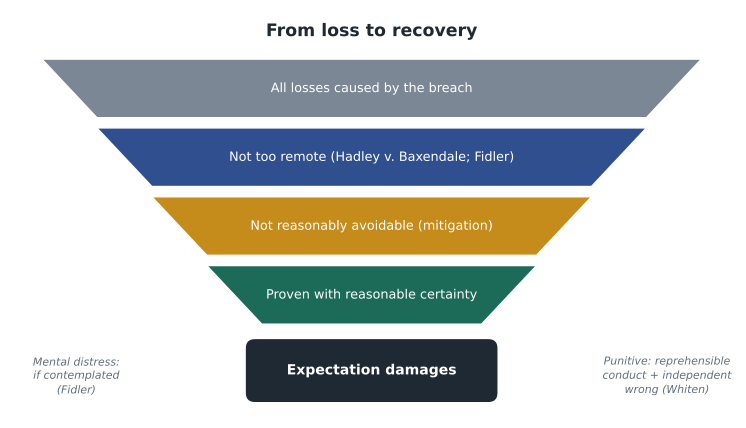
Not every loss caused by a breach is recoverable. Under Hadley v. Baxendale (1854), 9 Ex 341, damages are recoverable for losses that arise naturally, in the usual course of things, from the breach, or that were reasonably in the contemplation of both parties when they made the contract as a probable result of the breach. In Hadley, a mill stopped because its only crankshaft broke. A carrier delayed delivering the shaft to the makers for repair. The mill's lost profits were too remote, because the carrier was not told that the mill had no spare shaft and would stand idle.
Later cases refined the test. In Victoria Laundry (Windsor) Ltd. v. Newman Industries Ltd., [1949] 2 KB 528 (CA), a laundry recovered ordinary lost profits from the late delivery of a boiler, but not exceptionally lucrative government dyeing contracts the seller did not know about. In Koufos v. C. Czarnikow Ltd. (The Heron II), [1969] 1 AC 350 (HL), the test was whether the loss was of a kind the defendant, when contracting, would have realized was not unlikely to result from the breach. Knowledge at the time of contracting is what counts.
The Supreme Court reaffirmed Hadley v. Baxendale as the governing test in Fidler v. Sun Life Assurance Co. of Canada, 2006 SCC 30, and applied it to mental distress, as discussed below. Applying the rule to Lakeshore, the higher price it paid for replacement oak arises naturally from non-delivery. The lost retail contract is recoverable only if the mill knew or should have known, when contracting, that Lakeshore needed the oak for orders of that kind.
Mitigation
An innocent party cannot recover losses it could reasonably have avoided. This duty to mitigate is not a true duty, but a limit on recovery: the plaintiff must take reasonable steps to reduce its loss, and can recover reasonable costs of doing so. The burden of proving a failure to mitigate is on the defendant, which must show both that the plaintiff failed to take reasonable steps and that those steps would have reduced the loss (Red Deer College v. Michaels, [1976] 2 SCR 324, a wrongful dismissal case). In Southcott Estates Inc. v. Toronto Catholic District School Board, 2012 SCC 51, a single-purpose corporation that had agreed to buy land for development sued for specific performance when the seller failed to complete. The Court held that even a plaintiff seeking specific performance must mitigate unless it has a fair, real and substantial justification for refusing a substitute, and that a single-purpose company is treated like any other plaintiff. Southcott's damages were reduced to nominal damages because it could have bought other land.
Mental distress and punitive damages
Traditionally, damages for mental distress were not recoverable for breach of contract (Addis v. Gramophone Co., [1909] AC 488). In Fidler, Sun Life wrongly cut off a claimant's long-term disability benefits for five years. The Court held that damages for mental distress are recoverable under the ordinary Hadley v. Baxendale principle if the parties contemplated, when contracting, that a breach would cause mental distress, which is typical where the object of the contract is to secure psychological benefits, such as peace of mind under a disability policy. The plaintiff must prove a degree of mental suffering. In Honda Canada Inc. v. Keays, 2008 SCC 39, the Court applied Fidler to employment, holding that damages for the manner of dismissal are compensatory and available where the employer engages in conduct in the course of dismissal that is unfair or in bad faith, such as being untruthful, misleading or unduly insensitive.
Punitive damages punish rather than compensate and are exceptional in contract. In Whiten v. Pilot Insurance Co., 2002 SCC 18, an insurer refused to pay a family whose house burned down, pursuing an arson theory that its own experts did not support, in an effort to force an unfair settlement. The jury awarded one million dollars in punitive damages, and the Supreme Court restored the award. Punitive damages require high-handed, malicious, arbitrary or highly reprehensible misconduct that departs markedly from ordinary standards of decent behaviour, and an independent actionable wrong, which in Whiten was the insurer's breach of its separate contractual duty of good faith in handling claims. The amount must be rational and proportionate, and only where compensatory damages are insufficient to achieve denunciation, deterrence and retribution.
Disgorgement
Can a plaintiff recover the defendant's profits from a breach, rather than its own loss? In Atlantic Lottery Corp. Inc. v. Babstock, 2020 SCC 19, the Court held that disgorgement for breach of contract is available only exceptionally, where other remedies are inadequate and the plaintiff has a legitimate interest in preventing the defendant's profit-making activity. It is not a free-standing cause of action, and a claim for 'waiver of tort' disgorgement requires an underlying wrong.
Liquidated damages, penalties and deposits
Parties may agree in advance on the damages payable for breach. A liquidated damages clause that is a genuine pre-estimate of loss is enforceable. A clause that sets an amount extravagant in comparison with the greatest loss that could conceivably flow from the breach is a penalty and unenforceable beyond actual loss (H.F. Clarke Ltd. v. Thermidaire Corp., [1976] 1 SCR 319). Canadian courts have increasingly folded the penalty doctrine into unconscionability, asking whether enforcement would be oppressive in the circumstances.
Deposits are treated differently. A deposit paid as security for performance is generally forfeited to the innocent party if the payer defaults, even if it exceeds the innocent party's loss, because it is a guarantee of performance rather than an estimate of loss. Courts may grant relief against forfeiture where it would be unconscionable to keep the money, considering the conduct of the parties, the gravity of the breach and the disparity between the value forfeited and the damage. In Ontario, section 98 of the Courts of Justice Act gives courts power to relieve against penalties and forfeitures on just terms. Part payments of the price, as opposed to deposits, are usually recoverable by a defaulting buyer, less the seller's damages.
Specific performance
Specific performance is an equitable order requiring a party to perform its contract. It is discretionary and available only where damages are inadequate. Traditionally, contracts for the sale of land attracted specific performance as a matter of course, because every parcel of land was considered unique. In Semelhago v. Paramadevan, [1996] 2 SCR 415, the Supreme Court held that this presumption no longer applies: land, especially residential property in modern developments, is often interchangeable, and a plaintiff must show that the property is unique, meaning it has a quality that makes it especially suitable and that cannot readily be duplicated. Courts have since granted specific performance for land with special location, zoning or development features, and refused it for ordinary investment property.
For goods, specific performance is rare; it may be ordered for unique items such as works of art or heirlooms, or where substitutes cannot be obtained in a market crisis. Courts will not order specific performance of contracts for personal services, because forcing people to work together is undesirable and supervision is impractical. Specific performance can be refused for delay, unclean hands, hardship to the defendant or lack of mutuality.
Injunctions
An injunction orders a party to do or, more often, not to do something. Courts may enforce a negative covenant by injunction even if they would not order positive performance, provided the injunction does not effectively compel the defendant to work for the plaintiff. Interlocutory injunctions before trial are governed by the test from RJR-MacDonald Inc. v. Canada (Attorney General), [1994] 1 SCR 311: a serious issue to be tried, irreparable harm if the injunction is refused, and a balance of convenience favouring the order. For mandatory interlocutory injunctions, the plaintiff must show a strong prima facie case (R. v. Canadian Broadcasting Corp., 2018 SCC 5).
Limitation periods
Claims for breach of contract are subject to limitation periods. In Ontario, the Limitations Act, 2002 sets a basic period of two years from the day the claim was discovered, meaning the day the claimant knew or ought reasonably to have known of the loss, that it was caused by the defendant's act or omission, and that a proceeding would be an appropriate means to seek a remedy. An ultimate period of fifteen years from the act or omission applies regardless of discovery. Business parties can vary or exclude the basic limitation period by agreement under the Act, within limits; consumers cannot.
Lakeshore's 41,000 dollars
Varga returns to the number. The extra cost of replacement oak is recoverable as a natural consequence of non-delivery, provided Lakeshore bought reasonably and promptly. The lost retail profit is recoverable only if the mill knew or should have known, at the time of contracting, of that kind of use, and if Lakeshore could not have avoided it by finding oak sooner. The owner's lost sleep is not recoverable: a commercial lumber supply contract is not one whose object is peace of mind. And specific performance was never realistic, because oak is a market commodity. 'Probably 23,000,' Varga says, 'and a hard negotiation about the rest.'
| Remedy or limit | Rule | Authority |
|---|---|---|
| Expectation damages | Position as if the contract had been performed | Robinson v. Harman (1848) |
| Remoteness | Natural losses or those in both parties' contemplation at formation | Hadley v. Baxendale; Fidler, 2006 SCC 30 |
| Mitigation | No recovery for reasonably avoidable losses; burden on defendant | Red Deer College; Southcott, 2012 SCC 51 |
| Mental distress | Recoverable if contemplated, such as peace-of-mind contracts | Fidler; Honda v. Keays, 2008 SCC 39 |
| Punitive damages | Reprehensible conduct plus independent actionable wrong | Whiten v. Pilot, 2002 SCC 18 |
| Penalty clauses | Unenforceable if extravagant compared to greatest conceivable loss | Thermidaire, [1976] 1 SCR 319 |
| Specific performance of land | Only if the property is unique | Semelhago, [1996] 2 SCR 415 |
| Disgorgement | Exceptional, where other remedies are inadequate | Atlantic Lottery v. Babstock, 2020 SCC 19 |
Common mistakes
MistakeAny breach lets the innocent party end the contract.
InsteadOnly breach of a condition, a repudiation, or a breach depriving the innocent party of substantially the whole benefit allows termination; otherwise the remedy is damages.
MistakeAll losses caused by a breach are recoverable.
InsteadLosses must not be too remote (Hadley v. Baxendale) and must not have been reasonably avoidable (mitigation).
MistakeContracts for land always attract specific performance.
InsteadAfter Semelhago, the plaintiff must show the land is unique.
MistakeMental distress damages are never available for breach of contract.
InsteadFidler allows them where distress was within the parties' contemplation, typically in peace-of-mind contracts, and the suffering is proven.
Practice problems
Work each problem on paper first, then reveal the answer to check.
A customer orders a custom dining table from Lakeshore for 6,000 dollars, pays a 1,500 dollar deposit, then cancels before production. Lakeshore resells the planned oak and loses nothing on materials, but its profit on the job would have been 1,800 dollars. Can it keep the deposit?
Show answer
A deposit paid as security for performance is generally forfeited on the buyer's default. Lakeshore's actual loss of profit (1,800 dollars, if its capacity was limited) exceeds the deposit, so forfeiture is not disproportionate, and relief against forfeiture is unlikely. Consumer protection rules on cancellation should be checked.
Why did Southcott Estates recover only nominal damages?
Show answer
It failed to mitigate by buying other suitable land, and it had no fair, real and substantial justification for insisting on specific performance; being a single-purpose company did not change the mitigation analysis.
What two requirements did Whiten v. Pilot set for punitive damages in contract?
Show answer
Misconduct that is high-handed, malicious, arbitrary or highly reprehensible, departing markedly from ordinary standards, and an independent actionable wrong, such as breach of a separate duty of good faith.
Summary and key terms
- Breach of a condition, repudiation, or a breach depriving the innocent party of substantially the whole benefit allows termination; other breaches give damages only.
- On an anticipatory breach, the innocent party elects to terminate and sue or to affirm.
- Expectation damages are the norm; reliance damages and restitution are alternatives; cost of cure must be reasonable.
- Losses must not be too remote (Hadley v. Baxendale; Fidler) and must not have been reasonably avoidable (Red Deer College; Southcott).
- Mental distress damages are available where contemplated (Fidler; Keays); punitive damages need reprehensible conduct and an independent wrong (Whiten); disgorgement is exceptional (Atlantic Lottery).
- Penalties are unenforceable; deposits are usually forfeited, subject to relief; specific performance requires inadequate damages and, for land, uniqueness (Semelhago).
- Ontario's basic limitation period is two years from discovery, with a fifteen-year ultimate period.
- Repudiation
- Words or conduct showing that a party will not perform its contract.
- Expectation damages
- Damages putting the innocent party in the position it would have been in had the contract been performed.
- Remoteness
- The limit on damages to losses within the reasonable contemplation of the parties when contracting.
- Mitigation
- The principle that a plaintiff cannot recover losses it could reasonably have avoided.
- Liquidated damages
- A genuine pre-estimate of loss agreed in the contract.
- Penalty
- An agreed sum extravagant compared to the greatest conceivable loss, unenforceable beyond actual loss.
- Specific performance
- An equitable order requiring a party to perform its contract.
Lesson quiz · 5 questions
Score 60% or more to complete this lesson.
Create a free account to save your progress, take quizzes and earn a certificate.