
LAWC-102 · Lesson 7 of 12 · 19 min
Misrepresentation and mistake
▶ Video coming soon A video version of this lesson is on the way.
The shoebox file for this class is thick. A couple bought a small Corwin hardware store after the seller told them it 'clears about 90,000 a year'. The financial statements he handed over showed it, but he had left out a large supplier debt and a lease renewal at double the rent. Within a year the couple were losing money. Professor Varga asks the class what they would want if they were the buyers. 'Our money back,' says Hannah Kowalczyk. 'Or the difference between what we paid and what it was worth,' says Theo Marchetti. 'Both answers are possible,' Varga says. 'Which one you get depends on whether the statement was a term or a representation, whether it was innocent, negligent or fraudulent, and whether it is too late to unwind the deal.'
This lesson covers two doctrines that deal with contracts made on a false footing. Misrepresentation addresses false statements by one party that induce the contract. Mistake addresses situations where one or both parties were wrong about a fundamental matter, without any false statement. Both can make a contract voidable or void, and both overlap with the rules on terms covered in Lesson 5.
What is a misrepresentation?
A misrepresentation is a false statement of existing fact, made by one party to the other before or at the time of contracting, that induces the other party to enter the contract. Each element matters.
- Statement of fact. Statements of opinion, predictions about the future and sales puffery are generally not representations of fact. But an opinion can imply facts: an expert who gives an opinion implies that they know facts justifying it, and a statement of intention misrepresents a fact if the speaker does not actually hold that intention (Edgington v. Fitzmaurice (1885), 29 Ch D 459 (CA), where directors raising money misstated what they intended to do with it).
- False. Half-truths can be misrepresentations. A statement that is literally true but misleading because of what it leaves out may be false, and a statement that becomes false before the contract is made must be corrected.
- Silence. Generally there is no duty to disclose, so silence is not a misrepresentation. Exceptions include half-truths, statements that become false, relationships of trust and confidence, contracts of insurance (which require utmost good faith) and statutory disclosure duties. In residential real estate, sellers must disclose latent defects that make a property dangerous or unfit for habitation, and active concealment of a defect is treated as fraud.
- Inducement. The statement must have been material and must have induced the contract, although it need not be the only inducement. A party who did not rely on the statement, or who knew it was false, cannot complain.
Three kinds of misrepresentation
The remedies depend on the representor's state of mind.
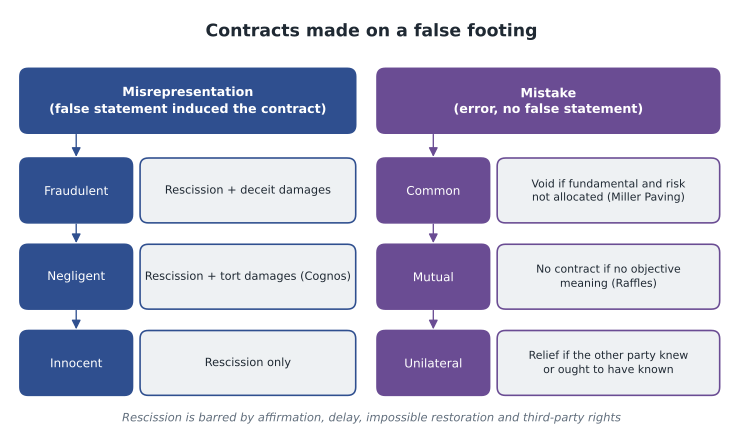
- Fraudulent misrepresentation. Derry v. Peek (1889), 14 App Cas 337 (HL), defines fraud as a false representation made knowingly, without belief in its truth, or recklessly, careless whether it be true or false. The victim may rescind the contract and also sue in the tort of deceit for damages, which cover all losses directly flowing from the fraud, whether foreseeable or not. In Bruno Appliance and Furniture, Inc. v. Hryniak, 2014 SCC 8, the Supreme Court restated the four elements of civil fraud: a false representation by the defendant; some level of knowledge of the falsehood, whether knowledge or recklessness; the representation caused the plaintiff to act; and the plaintiff's actions resulted in a loss.
- Negligent misrepresentation. In Queen v. Cognos Inc., [1993] 1 SCR 87, a job applicant was told during an interview that a new project was well funded and secure. He left a good job and moved for it; the project was cut within months. The Supreme Court held the employer liable in the tort of negligent misrepresentation and set out five requirements: a duty of care based on a special relationship; a representation that was untrue, inaccurate or misleading; negligence in making it; reasonable reliance; and damages resulting from the reliance. The written employment contract allowed termination on notice, but it did not exclude liability for the pre-contractual misstatement. Damages are measured in tort, putting the plaintiff in the position as if the statement had not been made.
- Innocent misrepresentation. A false statement made honestly and without negligence gives only the equitable remedy of rescission, not damages.
Rescission and its bars
Rescission sets the contract aside from the beginning and restores the parties, as far as possible, to their pre-contract positions. Each party returns what it received. Equity can adjust the restoration with money payments, called an indemnity, for obligations necessarily created by the contract, but rescission is not damages.
Rescission is lost, or barred, in several situations:
- Affirmation: the representee, knowing of the misrepresentation, chooses to continue with the contract, expressly or by conduct.
- Delay: the representee waits unreasonably long after discovering the truth.
- Impossibility of restoration: the subject matter has been consumed, transformed or cannot be returned substantially as it was, although equity is flexible about minor changes.
- Third-party rights: an innocent third party has acquired rights in the subject matter for value.
- Executed contracts: under the traditional rule in Redican v. Nesbitt, [1924] SCR 135, a contract for the sale of land that has been completed by conveyance cannot be rescinded for innocent misrepresentation; the purchaser is left to any contractual warranties. The rule does not apply to fraud, and courts in several provinces have questioned it or limited it, especially where there was an error in substance.
Statements that became terms of the contract give the additional remedy of damages for breach, measured to put the innocent party where it would have been if the statement had been true. That is often more generous than tort damages, which is why lawyers argue that a pre-contractual statement became a term or collateral warranty.
Mistake: the general approach
Mistake is about errors, not lies. The law is reluctant to relieve parties from bargains just because they turned out to be wrong about something, because contracts allocate risks, including the risk of being mistaken. Relief is available only where the mistake is fundamental and the contract did not allocate its risk. Lawyers commonly divide mistake into three categories.
Common mistake
In a common mistake, both parties share the same fundamental error. The classic case is res extincta: the subject matter does not exist when the contract is made. In Couturier v. Hastie (1856), 5 HLC 673, a cargo of corn sold while at sea had already been sold off by the ship's master because it was deteriorating; the buyer was not liable to pay. Where the subject matter exists but has a different quality than both parties thought, relief is rare. In Bell v. Lever Brothers Ltd., [1932] AC 161 (HL), the company paid large severance sums to two executives, not realizing it could have dismissed them for misconduct without paying anything. The House of Lords held the contracts valid: the mistake was about quality and did not make the subject matter essentially different from what the parties believed.
In Great Peace Shipping Ltd. v. Tsavliris Salvage (International) Ltd., [2002] EWCA Civ 1407, the English Court of Appeal held that a common mistake voids a contract only where the parties shared an assumption about the existence of a state of affairs, neither warranted it, the non-existence was not attributable to either party's fault, and the mistake made performance essentially different from what they contemplated. The court also rejected the separate equitable jurisdiction to rescind for common mistake that Lord Denning had developed in Solle v. Butcher, [1950] 1 KB 671.
The Ontario Court of Appeal considered Great Peace in Miller Paving Ltd. v. B. Gottardo Construction Ltd., 2007 ONCA 422. Miller supplied materials to Gottardo for a highway project. Believing that everything had been invoiced and paid, the two signed a document in which Miller acknowledged that payment in full had been received for the materials supplied. Miller then discovered that, by inadvertence, some materials had never been invoiced, and sued, arguing common mistake. The court accepted that both parties shared the mistaken belief, but held that the acknowledgement allocated to Miller the risk that it had not in fact been paid in full. Where the contract allocates the risk of the mistake, the doctrine of common mistake does not apply. The same document supplied a juristic reason defeating Miller's alternative claim in unjust enrichment. Canadian courts have not clearly followed Great Peace's rejection of the equitable jurisdiction, and some continue to recognize equitable relief for a fundamental common misapprehension of fact.
Mutual mistake
In a mutual mistake, the parties are at cross-purposes: each means something different, and the objective evidence does not show which meaning is right. In Raffles v. Wichelhaus (1864), 2 H & C 906, the parties contracted for cotton arriving on the ship Peerless from Bombay. There were two ships called Peerless, sailing months apart, and each party meant a different one. There was no contract. Usually, however, courts resolve apparent mutual mistakes by applying the objective test: if a reasonable person would understand the agreement in one sense, that is the contract, and the party who meant something else is bound.
Unilateral mistake
In a unilateral mistake, only one party is mistaken. The general rule is that a party bears the risk of its own mistakes. But relief may be available where the other party knew or ought to have known of the mistake about the terms and snapped up the offer. In Smith v. Hughes (1871), the buyer thought he was buying old oats; the seller sold new oats. The buyer's mistake about the quality of the oats did not void the contract, but the court said the outcome could differ if the seller knew the buyer believed the seller was promising old oats.
Tendering cases provide important Canadian examples. In Ron Engineering, a contractor's tender omitted a large sum because of a calculation error. The Supreme Court held that the contractor could not withdraw and recover its deposit, because the error was not apparent on the face of the tender when it was accepted. Where an owner knows or ought to know of an obvious error in a bid, it may not be able to accept it and hold the bidder to it.
Mistakes about the identity of the other party raise special problems, mostly in cases of fraud by an impostor. Where the contract is made face to face, courts usually presume the seller intended to deal with the person in front of them, so the contract is voidable for fraud but not void, protecting innocent third-party buyers. Where identity is fundamental and the contract is made in writing with a named person, as in Shogun Finance Ltd. v. Hudson, [2003] UKHL 62, the contract may be void.
Rectification and non est factum
Rectification is an equitable remedy that corrects a written document that fails to record the parties' actual agreement. In Canada (Attorney General) v. Fairmont Hotels Inc., 2016 SCC 56, the Supreme Court held that rectification corrects errors in recording an agreement; it does not allow a court to change the agreement itself, for example to achieve a tax result the parties failed to secure. The party seeking rectification must show a prior agreement with definite and ascertainable terms, that the agreement was still in effect when the document was signed, and that the document fails to record it, and must do so on a balance of probabilities with clear and convincing evidence. Rectification for unilateral mistake is available only where the other party knew or ought to have known of the error and enforcing the document as written would amount to fraud or the equivalent of fraud.
Non est factum, discussed in Lesson 5, applies where a person signs a document fundamentally different from what they believed, without carelessness. It is the narrowest of the mistake doctrines.
The hardware store
Varga returns to the hardware store. The seller's statement that the store 'clears about 90,000 a year', backed by statements that left out the supplier debt and lease renewal, was a half-truth and likely a misrepresentation. If the seller knew of the omissions, it was fraudulent: the buyers can rescind and claim deceit damages. If he was careless, negligent misrepresentation under Cognos gives tort damages. Rescission may be barred if the buyers delayed after learning the truth or if the business has changed beyond restoration. And if the purchase agreement warranted the financial statements, the buyers can claim contract damages for breach of warranty, putting them where they would have been had the statements been true. 'The first question,' Varga says, 'is always: what exactly did they say, and where did it end up?'
| Doctrine | Effect | Remedy | Key authority |
|---|---|---|---|
| Fraudulent misrepresentation | Contract voidable | Rescission and deceit damages | Derry v. Peek; Bruno Appliance, 2014 SCC 8 |
| Negligent misrepresentation | Contract voidable; tort liability | Rescission and tort damages | Queen v. Cognos, [1993] 1 SCR 87 |
| Innocent misrepresentation | Contract voidable | Rescission only | Redican v. Nesbitt (limits for executed land sales) |
| Common mistake | Void if fundamental and risk not allocated | Contract set aside | Great Peace; Miller Paving, 2007 ONCA 422 |
| Mutual mistake | No contract if no objective meaning | No enforcement | Raffles v. Wichelhaus |
| Unilateral mistake as to terms | Relief if the other party knew or ought to have known | Rescission or refusal of enforcement | Smith v. Hughes; Ron Engineering |
| Rectification | Document corrected to match the prior agreement | Equitable correction | Fairmont Hotels, 2016 SCC 56 |
Common mistakes
MistakeAny false statement during negotiations entitles the other party to damages.
InsteadOnly fraudulent and negligent misrepresentations give damages in tort, and terms give contract damages. Innocent misrepresentation gives only rescission.
MistakeSilence is never a misrepresentation.
InsteadHalf-truths, statements that become false, relationships of trust, insurance contracts and active concealment can make non-disclosure actionable.
MistakeA shared mistake about quality always voids a contract.
InsteadBell v. Lever Bros and Great Peace allow relief only where the mistake makes performance essentially different, and not where the contract allocated the risk (Miller Paving).
MistakeRectification lets a court fix a contract that did not achieve what the parties hoped.
InsteadFairmont Hotels limits rectification to correcting the recording of a definite prior agreement.
Practice problems
Work each problem on paper first, then reveal the answer to check.
A seller of a used delivery van tells Lakeshore it 'has a rebuilt transmission, good for years'. The seller honestly believed this, having been told so by a previous owner. The transmission fails in a month. Lakeshore has used the van daily for that month. What remedies are available?
Show answer
If the statement was a term, Lakeshore may claim damages for breach and perhaps reject the van. If only a representation made honestly and without negligence, rescission is the only remedy; it may still be available if Lakeshore acted promptly, since a month's use may not prevent substantial restoration. If the seller was careless in repeating the claim, negligent misrepresentation may give tort damages.
Lakeshore settles a claim with a supplier by signing a release of 'all claims, known or unknown'. Both sides overlooked an unpaid invoice. Can Lakeshore avoid the release for common mistake?
Show answer
Probably not. As in Miller Paving, where an acknowledgement of payment in full allocated the risk of unbilled amounts, a release of unknown claims allocates the risk of overlooked claims, so common mistake does not apply.
What are the four elements of civil fraud set out in Bruno Appliance v. Hryniak?
Show answer
A false representation by the defendant; some level of knowledge of its falsity (knowledge or recklessness); the representation caused the plaintiff to act; and the plaintiff's action resulted in a loss.
Summary and key terms
- A misrepresentation is a false statement of existing fact that induces the contract; silence is generally not enough, subject to important exceptions.
- Fraud (Derry v. Peek; Bruno Appliance) gives rescission and deceit damages; negligent misrepresentation (Cognos) gives rescission and tort damages; innocent misrepresentation gives rescission only.
- Rescission is barred by affirmation, delay, impossibility of restoration, third-party rights and, for completed land sales and innocent misrepresentation, Redican v. Nesbitt.
- Common mistake voids a contract only if fundamental and not allocated by the contract (Bell v. Lever; Great Peace; Miller Paving).
- Mutual mistakes are usually resolved objectively; unilateral mistakes as to terms give relief if the other party knew or ought to have known.
- Rectification corrects the written record of a definite prior agreement, not the agreement itself (Fairmont Hotels).
- Misrepresentation
- A false statement of existing fact that induces a party to enter a contract.
- Rescission
- The equitable remedy that sets a contract aside and restores the parties to their pre-contract positions.
- Deceit
- The tort of fraudulent misrepresentation, giving damages for all direct losses.
- Common mistake
- A fundamental mistake shared by both parties.
- Mutual mistake
- A misunderstanding in which each party means something different.
- Unilateral mistake
- A mistake by one party, sometimes known to the other.
- Rectification
- An equitable remedy correcting a written document so it records the parties' actual prior agreement.
Lesson quiz · 5 questions
Score 60% or more to complete this lesson.
Create a free account to save your progress, take quizzes and earn a certificate.