
LAWC-102 · Lesson 8 of 12 · 19 min
Duress, undue influence and unconscionability
▶ Video coming soon A video version of this lesson is on the way.
On Friday, October 16, 2026, Professor Varga's guest is Renata Osei, a Corwin lawyer who spends most of her practice on consumer and employment disputes. She opens with a printout of a smartphone app's terms of service: forty-one pages, ending with a clause requiring every dispute to be arbitrated in another country under foreign law, with filing fees the customer must pay up front. 'My clients clicked I agree on this at a bus stop,' she says. 'The question I get every week is whether the law will let a company keep a promise that nobody could realistically refuse and nobody could afford to challenge.'
The earlier lessons treated formation, terms and mistakes as questions about what the parties agreed. This lesson looks at agreements that are formally valid but were obtained by pressure, abuse of trust or exploitation of weakness. The common law and equity respond with duress, undue influence and unconscionability. Statutes add consumer protection rules, and public policy and illegality can prevent enforcement of agreements whose purpose or effect the law will not support.
Duress
Duress is illegitimate pressure that coerces a party into a contract. Historically it covered threats of violence to the person, and later threats to seize or damage goods. Modern law recognizes economic duress: illegitimate commercial pressure that leaves a party no realistic alternative but to agree.
The Privy Council described economic duress in Pao On v. Lau Yiu Long, [1980] AC 614, as a coercion of the will that vitiates consent, and listed factors such as whether the victim protested, whether it had an alternative course open to it, whether it had independent advice, and whether it took steps to avoid the contract after entering it. Later English cases moved away from the idea that the victim's will must be overborne, focusing instead on whether the pressure was illegitimate and whether it was a significant cause of the agreement.
In Greater Fredericton Airport Authority Inc. v. NAV Canada, 2008 NBCA 28, discussed in Lesson 3, the New Brunswick Court of Appeal held that a contract variation is voidable for economic duress if the promise was extracted by pressure such as a threat to breach the original contract, the promisee had no practical alternative, and the promisee did not affirm the variation once the pressure was gone. Protest at the time and prompt steps to disaffirm support the claim; the absence of protest and long acceptance of the new terms undercut it.
Pressure is not illegitimate just because it is commercially hard. A party may drive a hard bargain, refuse to contract, or insist on its legal rights. Threatening to do something one is legally entitled to do, such as declining to renew a contract, is usually legitimate. Threatening to breach an existing contract, to commit a tort or crime, or to make false allegations is generally illegitimate.
Undue influence
Undue influence is an equitable doctrine that sets aside gifts and contracts procured by the improper use of influence over another. The Supreme Court restated it in Geffen v. Goodman Estate, [1991] 2 SCR 353, a case about a trust deed made by a woman with a long history of psychiatric illness, which was challenged after her death. The Court recognized two classes.
- Actual undue influence: the person seeking relief proves that influence was in fact exercised to procure the transaction, through overt acts of improper pressure or coercion.
- Presumed undue influence: where the relationship between the parties is one in which one party has the potential to dominate the will of the other, a presumption of undue influence arises. Some relationships carry the presumption automatically, such as solicitor and client, doctor and patient, or trustee and beneficiary; others can be shown on the facts. In commercial transactions, the plaintiff must also show that the contract was unfair or manifestly disadvantageous. The presumption can be rebutted by showing that the weaker party entered the transaction as a result of their own full, free and informed thought, often through evidence of independent legal advice and full disclosure.
In Geffen itself, Justice Wilson held that the presumption was rebutted on the facts: the woman understood the trust and its effects, and the arrangement was what she wanted. The case shows that the doctrine protects autonomy, not just outcomes.
Guarantees given by family members for another's business debts raise frequent undue influence claims. Courts ask whether the lender knew or ought to have known of a relationship of influence and took reasonable steps, such as insisting on independent legal advice, to ensure that the guarantor understood the transaction. A bank that takes those steps is generally protected even if the guarantor was in fact under the debtor's influence.
Unconscionability before Uber
Equity has long set aside bargains made by taking advantage of a party's weakness. Canadian courts developed two lines of authority. Morrison v. Coast Finance Ltd. (1965), 55 DLR (2d) 710 (BCCA), required inequality of bargaining power arising from the weaker party's ignorance, need or distress, and a substantially unfair bargain obtained by the stronger party. Harry v. Kreutziger (1978), 95 DLR (3d) 231 (BCCA), suggested a single question: whether the transaction, seen as a whole, was sufficiently divergent from community standards of commercial morality that it should be rescinded. The law was uncertain about whether the stronger party had to know of the weakness and take advantage of it.
Uber Technologies Inc. v. Heller
The Supreme Court clarified the doctrine in Uber Technologies Inc. v. Heller, 2020 SCC 16. David Heller, an Ontario resident, delivered food using the Uber Eats app. To become a driver he had to accept, by clicking, a standard form services agreement of about fourteen pages. It required all disputes to be mediated and then arbitrated in Amsterdam under Dutch law, with up-front administrative and filing fees of about 14,500 US dollars, close to his annual income from Uber. The agreement did not mention the fees, and there was no information about the costs of arbitration. Heller started a proposed class action in Ontario claiming that Uber's drivers were employees entitled to benefits under the Employment Standards Act, 2000. Uber sought a stay in favour of arbitration.
The majority, in reasons by Justices Abella and Rowe, held that the arbitration clause was unconscionable and invalid. They set out a two-part test: an inequality of bargaining power, and a resulting improvident bargain. Inequality of bargaining power exists when one party cannot adequately protect its interests in the contracting process. Standard form contracts, where the weaker party has no opportunity to negotiate, are a common source of inequality, especially where the terms are complex, buried or written to the stronger party's advantage. A bargain is improvident if it unduly advantages the stronger party or unduly disadvantages the weaker, assessed contextually at the time of formation. Crucially, the majority held that the stronger party does not have to have knowingly taken advantage of the weaker one; the doctrine focuses on the fairness of the bargaining process and its outcome.
Applying the test, the majority found clear inequality: a take-it-or-leave-it standard form, a significant gulf in sophistication between Heller and Uber, and no information about the arbitration's cost. The bargain was improvident because the fees made arbitration practically unavailable, so the clause effectively insulated Uber from claims. Justice Brown agreed in the result but would have decided on public policy grounds, holding that a clause that denies access to any dispute resolution is unenforceable. Justice Côté dissented, emphasizing respect for arbitration agreements.
Uber has had wide influence. It lowered the threshold for unconscionability in standard form contracts, and courts across Canada have applied it to arbitration clauses, waivers, forum selection clauses and limitation clauses in consumer and employment settings. It does not mean that every standard form contract is suspect; the test still requires an improvident bargain, and commercial parties of similar strength are held to their terms.
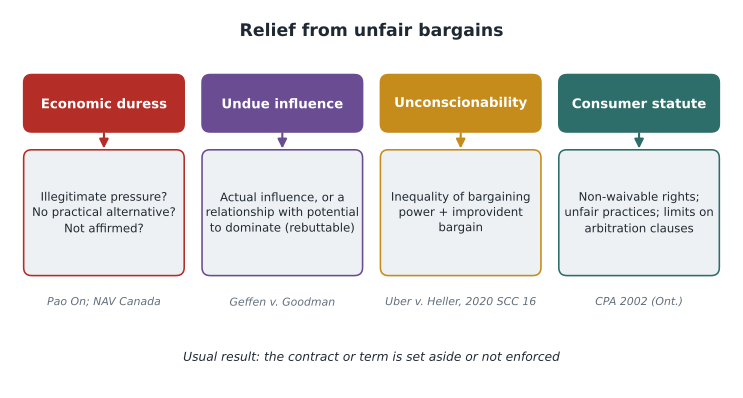
Consumer protection in Ontario
Renata Osei turns to statute. Ontario's Consumer Protection Act, 2002 applies to most transactions between a consumer, an individual acting for personal, family or household purposes, and a business supplier in Ontario. Among other things it:
- provides that consumers' rights under the Act cannot be waived, and that any term or acknowledgement purporting to do so is void;
- invalidates terms requiring consumer disputes to be submitted to arbitration, to the extent they would prevent a consumer from suing in the Superior Court of Justice, and terms preventing consumers from joining class proceedings, although the parties can agree to arbitration after a dispute arises;
- prohibits unfair practices, including false, misleading or deceptive representations and unconscionable representations, such as taking advantage of a consumer's inability to protect their interests because of disability, ignorance, illiteracy or language, or charging a price that grossly exceeds the price of similar goods or services;
- lets a consumer who entered an agreement after an unfair practice rescind it, or recover the amount by which payment exceeded the value received, or damages, where rescission is not possible, with the court able to award exemplary or punitive damages; and
- implies warranties into consumer agreements, including that services will be of a reasonably acceptable quality, and preserves the Sale of Goods Act implied conditions in consumer sales despite any exclusion.
The Supreme Court considered these provisions in Wellman v. TELUS Communications Co., 2019 SCC 19, holding that Ontario's Arbitration Act does not let courts refuse to stay the non-consumer claims of business customers merely because consumer claims in the same proceeding cannot be stayed. Arbitration clauses in purely business contracts generally remain enforceable.
Ontario's Legislature passed the Consumer Protection Act, 2023 in December 2023 to replace the 2002 Act. It would, among other things, expand the list of unfair practices, restrict unilateral amendments to consumer contracts and lengthen the time to rescind after an unfair practice. As of fall 2026 it has not been proclaimed in force, so the 2002 Act continues to govern; anyone advising on consumer contracts should check for a proclamation and the accompanying regulations.
Restraint of trade and public policy
Some contracts are unenforceable because they offend public policy. Restrictive covenants in employment contracts are the leading example. Covenants restraining trade are presumptively unenforceable, and an employer must show that a non-competition or non-solicitation clause is reasonable in scope, duration and geography and protects a legitimate interest. In Shafron v. KRG Insurance Brokers (Western) Inc., 2009 SCC 6, the Supreme Court refused to rewrite an ambiguous covenant that restricted competition in 'the Metropolitan City of Vancouver', a place that does not legally exist, and held that courts should not use notional severance to read down an unreasonable covenant to make it reasonable. Covenants given on the sale of a business receive more lenient treatment (Payette v. Guay inc., 2013 SCC 45).
Ontario has gone further by statute. Since amendments to the Employment Standards Act, 2000 that took effect in late 2021, employers are prohibited from entering into non-compete agreements with employees, subject to exceptions for sales of a business and certain senior executives. Non-solicitation and confidentiality clauses are unaffected.
Illegality
A contract that requires the commission of a crime or tort, or is made for an illegal purpose, is unenforceable. The modern approach is more nuanced where a contract merely contravenes a regulatory statute. In Transport North American Express Inc. v. New Solutions Financial Corp., 2004 SCC 7, a loan agreement provided for interest above the criminal rate in section 347 of the Criminal Code. Rather than declare the whole contract void, the majority endorsed a flexible approach and used notional severance to reduce the interest to the highest lawful rate, considering the statute's purpose, the parties' intentions and relative bargaining positions, and the consequences of each remedy. Courts now ask whether enforcement would undermine the purpose of the statute, not simply whether a rule was broken. (Section 347 was amended, effective January 1, 2025, to lower the criminal rate to 35 percent a year expressed as an annual percentage rate; the approach in Transport North American continues to guide the remedy.)
Back to the bus stop
Osei returns to the app's arbitration clause. For an Ontario consumer, the Consumer Protection Act would likely invalidate it outright, to the extent it prevents the consumer from suing in court or joining a class action. For a driver or gig worker who is not a consumer, Uber v. Heller provides the analysis: a standard form, a large gap in sophistication, buried terms and fees that put arbitration out of reach point toward inequality and improvidence. 'The law doesn't rescue people from bad deals,' she tells the class. 'It rescues them from deals they had no fair chance to refuse, on terms no one should have to accept.'
| Doctrine | Core requirement | Key authority |
|---|---|---|
| Economic duress | Illegitimate pressure, no practical alternative, no affirmation | Pao On; NAV Canada, 2008 NBCA 28 |
| Actual undue influence | Proof that influence was used to procure the transaction | Geffen v. Goodman Estate, [1991] 2 SCR 353 |
| Presumed undue influence | Relationship with potential for domination; rebuttable by independent, informed decision | Geffen |
| Unconscionability | Inequality of bargaining power and a resulting improvident bargain; no need to show knowing exploitation | Uber v. Heller, 2020 SCC 16 |
| Consumer protection | Non-waivable rights, unfair practices, limits on arbitration and class action waivers | Consumer Protection Act, 2002 (Ont.) |
| Restraint of trade | Covenant must be reasonable; no rewriting of unreasonable covenants | Shafron, 2009 SCC 6; ESA non-compete ban |
| Illegality | Flexible remedy guided by the statute's purpose | Transport North American, 2004 SCC 7 |
Common mistakes
MistakeHard bargaining is economic duress.
InsteadDuress requires illegitimate pressure, such as a threat to breach a contract. Refusing to deal or insisting on legal rights is usually legitimate.
MistakeUnconscionability requires proof that the stronger party knowingly exploited the weaker party.
InsteadUber v. Heller held that knowing exploitation is not required; inequality of bargaining power and an improvident bargain suffice.
MistakeAny arbitration clause in a consumer contract in Ontario is enforceable if clearly drafted.
InsteadThe Consumer Protection Act, 2002 invalidates pre-dispute terms that prevent consumers from suing in court or joining class proceedings.
MistakeThe Consumer Protection Act, 2023 now governs consumer contracts in Ontario.
InsteadIt was passed in 2023 but, as of fall 2026, has not been proclaimed in force; the 2002 Act still applies.
Practice problems
Work each problem on paper first, then reveal the answer to check.
Lakeshore's elderly founder signs a guarantee of her son's new business loan at the bank, with the son present. She receives no advice and later says she thought she was signing a reference. The son's business fails. Can the bank enforce the guarantee?
Show answer
She may argue presumed undue influence (a relationship of trust and dependence with her son, and a manifestly disadvantageous transaction), and possibly non est factum if she was misled about the document's nature and was not careless. The bank's position depends on whether it knew or ought to have known of the risk and took reasonable steps, such as requiring independent legal advice. Without those steps the guarantee is vulnerable.
A furniture rental company's standard contract with Ontario consumers requires disputes to be arbitrated in Alberta, with each side paying its own costs. Is the clause enforceable?
Show answer
Under the Consumer Protection Act, 2002, a pre-dispute term requiring arbitration is invalid to the extent it prevents the consumer from suing in the Superior Court of Justice or joining a class action, so the consumer can sue in Ontario.
State the Uber v. Heller test for unconscionability and explain why the arbitration clause failed it.
Show answer
Inequality of bargaining power plus an improvident bargain. Heller faced a non-negotiable standard form with a large sophistication gap and undisclosed fees; the 14,500 US dollar up-front cost made arbitration effectively unavailable, unduly advantaging Uber.
Summary and key terms
- Economic duress makes a contract voidable where illegitimate pressure left no practical alternative and the contract was not affirmed (Pao On; NAV Canada).
- Undue influence may be actual or presumed from a relationship with potential for domination; the presumption is rebutted by showing a free and informed decision (Geffen).
- Uber v. Heller requires inequality of bargaining power and a resulting improvident bargain; knowing exploitation is not needed.
- Ontario's Consumer Protection Act, 2002 makes consumer rights non-waivable, limits arbitration and class action waivers, and gives remedies for unfair practices; the 2023 Act is not yet in force.
- Restrictive covenants must be reasonable and will not be rewritten (Shafron); Ontario bans most employee non-competes.
- Illegal or statute-contravening contracts are dealt with flexibly in light of the statute's purpose (Transport North American).
- Economic duress
- Illegitimate commercial pressure that leaves a party no practical alternative but to agree.
- Undue influence
- The improper use of influence over another to procure a gift or contract.
- Independent legal advice
- Advice from a lawyer acting only for the weaker party, used to show a free and informed decision.
- Unconscionability
- An equitable doctrine setting aside improvident bargains made where one party could not adequately protect its interests.
- Improvident bargain
- A bargain that unduly advantages the stronger party or unduly disadvantages the weaker party.
- Restrictive covenant
- A term restraining a party from competing or soliciting after a relationship ends.
Lesson quiz · 5 questions
Score 60% or more to complete this lesson.
Create a free account to save your progress, take quizzes and earn a certificate.