
LAWC-102 · Lesson 4 of 12 · 18 min
Capacity, formalities and electronic contracts
▶ Video coming soon A video version of this lesson is on the way.
Professor Varga holds up three documents from the shoebox. The first is a car loan signed by a seventeen-year-old. The second is a one-line text message: 'Deal. 340 for the cottage lot. Shake on it Saturday.' The third is a guarantee for a business line of credit, signed electronically on a phone. 'Each of these failed, or almost failed, for a reason that has nothing to do with offer, acceptance or consideration,' he says. 'Today is about who can contract and what form some contracts must take.'
This lesson covers the capacity of minors, people lacking mental capacity and corporations; the formal requirements that survive in Ontario through the Statute of Frauds and other statutes; the equitable doctrine of part performance; and the rules for electronic documents and signatures.
Capacity: the basic idea
A contract requires parties with legal capacity to bind themselves. The law protects some people from the consequences of their own agreements because they are presumed unable to protect their interests: historically minors and people with mental incapacity. The protection is not a prohibition. A contract with a person lacking capacity is usually voidable at that person's option, not void, so the protected party can choose to enforce or escape it, while the other party is bound.
Minors
In Ontario the age of majority is eighteen, under the Age of Majority and Accountability Act, RSO 1990, c. A.7. Ontario has no general statute on minors' contracts, so the common law applies. British Columbia is different: its Infants Act makes most contracts with minors unenforceable against them, subject to court approval and other exceptions. In Ontario the common law rules are as follows.
- Contracts for necessaries are binding on a minor. Necessaries are goods and services suitable to the minor's condition in life and actual needs at the time, such as food, clothing, lodging, medical care and education. The minor must pay a reasonable price, which may be less than the contract price. Under Ontario's Sale of Goods Act, a minor who buys necessaries must pay a reasonable price for them.
- Beneficial contracts of service, such as employment or apprenticeship contracts that are on the whole for the minor's benefit, are binding.
- Contracts involving continuing obligations, such as leases, partnerships and share purchases, are binding unless the minor repudiates them before or within a reasonable time after reaching majority.
- Other contracts are voidable at the minor's option and unenforceable against the minor unless ratified after reaching majority. A loan for a car that is not a necessary falls into this category, which is why lenders insist on an adult guarantor.
A minor who repudiates a contract may still be required to return property in their possession, and equity may prevent a minor who lied about their age from keeping both the goods and the money. But a minor generally cannot be sued in tort as a way of enforcing a contract that the law refuses to enforce directly.
Mental incapacity and intoxication
A person who lacked the mental capacity to understand the nature of a transaction when it was made may avoid it if the other party knew or ought to have known of the incapacity. If the other party acted in good faith, without notice, and the bargain was fair, the contract stands. This is the rule from Imperial Loan Co. v. Stone, [1892] 1 QB 599 (CA), followed in Canada. Severe intoxication is treated similarly. Necessaries supplied to a person lacking capacity must be paid for at a reasonable price. Where a court or a power of attorney has appointed a guardian of property under Ontario's Substitute Decisions Act, 1992, the guardian or attorney manages the incapable person's property, and contracts are made through them.
Capacity problems often overlap with undue influence and unconscionability, covered in Lesson 8. A court asked to set aside a transfer by an elderly person may find that, even if the person had capacity, the transaction was procured by a relationship of influence or was improvident and exploitative.
Corporations and public bodies
Corporations incorporated under the Ontario Business Corporations Act or the Canada Business Corporations Act have the capacity and the rights, powers and privileges of a natural person. The old ultra vires doctrine, which voided corporate acts outside the objects in the corporate charter, has been largely abolished for business corporations. Questions about corporate contracts today usually concern authority: whether the person who signed had actual or apparent authority to bind the corporation. The indoor management rule allows outsiders to assume that internal procedures were followed, unless they knew or ought to have known otherwise. Statutory bodies and municipalities, by contrast, have only the powers their statutes give them, and a contract beyond those powers may be unenforceable.
Formalities: the Statute of Frauds
Most contracts need no particular form. An oral agreement, or a contract formed by conduct, is as binding as a signed document; writing matters mainly as evidence. But some contracts must be evidenced in writing. The original English Statute of Frauds of 1677 required writing for many types of contract, to prevent fraud and perjury in a period when parties to a lawsuit could not testify. Several provinces have repealed or replaced it: British Columbia, for example, repealed its version and replaced it with section 59 of the Law and Equity Act. Ontario retains its Statute of Frauds, RSO 1990, c. S.19.
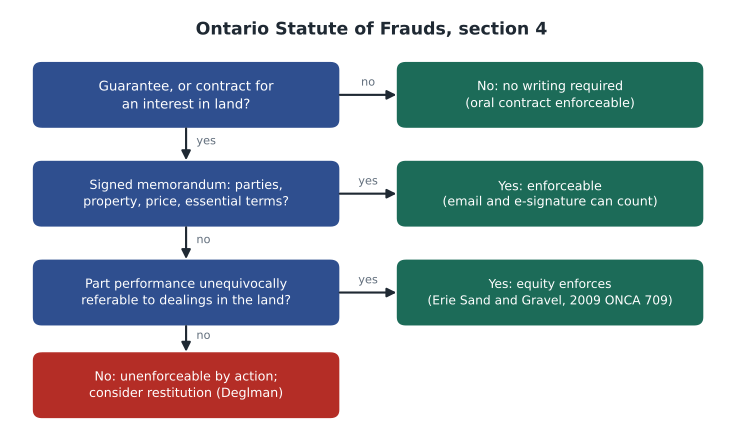
Section 4 of the Ontario Act provides that no action shall be brought on certain promises unless the agreement, or some memorandum or note of it, is in writing and signed by the party to be charged or someone lawfully authorized by them. The categories that remain are:
- a special promise by an executor or administrator to answer damages out of their own estate;
- a special promise to answer for the debt, default or miscarriage of another person, which covers guarantees; and
- any contract or sale of lands or any interest in land.
The writing need not be a formal contract. A memorandum is enough if it identifies the parties, the property and the essential terms, including price, and is signed by the party against whom enforcement is sought. Several documents can be read together if they refer to each other. The Ontario Act also requires writing for certain other matters, such as some trusts of land. Failure to comply does not make the contract void; it makes it unenforceable by action against the party who did not sign. A deposit paid under an oral contract for land may still be dealt with under ordinary principles, and the contract can be relied on as a defence.
Other statutes impose their own formalities. Ontario's Family Law Act requires domestic contracts, including marriage contracts and separation agreements, to be in writing, signed and witnessed. Consumer protection legislation requires certain consumer agreements, such as direct agreements made at the consumer's home and internet agreements, to be in writing or to provide written copies with specified information. The Sale of Goods Act no longer requires writing for sales above a set value in Ontario; that requirement was repealed.
Part performance
Equity developed the doctrine of part performance to prevent the Statute of Frauds from becoming an instrument of fraud. If a party has partly performed an oral contract concerning land in a way that points to the existence of a contract, equity may enforce the contract despite the lack of writing. The Supreme Court considered the doctrine in Deglman v. Guaranty Trust Co. of Canada, [1954] SCR 725. A nephew had performed services for his aunt on her oral promise to leave him a house in her will. The Court held that his services were not acts of part performance sufficient to take the contract out of the Statute, because they did not unequivocally refer to the land, but allowed him to recover the value of his services in restitution (quantum meruit). Deglman remains a foundation of the Canadian law of unjust enrichment.
The Ontario Court of Appeal relaxed the test in Erie Sand and Gravel Ltd. v. Tri-B Acres Inc., 2009 ONCA 709. The court held that the acts of part performance must be 'unequivocally referable' to dealings in the land in question, but need not point to the precise terms of the alleged contract. Acts such as taking possession, making improvements, or paying money in circumstances that make sense only if there were dealings concerning the land may suffice. The doctrine remains narrow: payment of money alone is usually not enough, because money can be paid for many reasons.
Electronic documents and signatures
Ontario's Electronic Commerce Act, 2000 provides that information and documents are not invalid or unenforceable merely because they are in electronic form. A legal requirement that a document be in writing is satisfied by an electronic document that is accessible so as to be usable for subsequent reference. A requirement for a signature is satisfied by an electronic signature that is reliable for the purpose of identifying the person, in light of all the circumstances. The Act defines an electronic signature broadly as electronic information that a person creates or adopts in order to sign a document and that is in, attached to or associated with the document.
The Act does not apply to everything. Ontario excludes wills and codicils, trusts created by wills, powers of attorney for property and personal care to the extent they deal with those matters, and negotiable instruments. Until July 1, 2015, the Act also excluded documents that create or transfer interests in land and require registration, which kept agreements of purchase and sale of land outside it; amendments that took effect on that date removed the exclusion, so those agreements can now be signed electronically, while registration itself runs through Ontario's separate electronic land registration system. Wills legislation has its own rules: Ontario began allowing remote witnessing of wills by audio-visual communication during the pandemic and made it permanent, but an electronic will is still not generally valid.
Courts have accepted emails, text messages and typed names as signatures in appropriate cases. The question is whether the person intended to adopt the document and be bound. A name in an automatic email signature block may not be enough if there is no evidence the sender intended it as a signature for that document; a name typed at the end of a message accepting a deal may be. In Ontario, courts have been willing to treat an exchange of emails as a sufficient memorandum for the Statute of Frauds where the essential terms are stated and the party to be charged has signed in this sense.
Back to the shoebox
Varga returns to the three documents. The seventeen-year-old's car loan was voidable at the minor's option unless the car was a necessary; it was not, and the lender's claim against the minor failed, although the adult guarantor paid. The cottage lot text message was a contract for an interest in land: it needed a signed memorandum identifying the parties, the property and the price. A text naming the price but not the lot clearly enough, and signed with nothing but a phone number, was challenged as insufficient. The electronic guarantee was valid: the bank's signing platform recorded the guarantor's identity and intention, which met both the Statute of Frauds and the Electronic Commerce Act. 'Formalities,' Varga says, 'are the rules people forget until they need them.'
| Issue | Ontario rule | Source |
|---|---|---|
| Age of majority | 18 | Age of Majority and Accountability Act |
| Minor's contract for necessaries | Binding; reasonable price | Common law; Sale of Goods Act |
| Other minors' contracts | Voidable at minor's option; enforceable if ratified after majority | Common law |
| Mental incapacity | Voidable if the other party knew or ought to have known | Imperial Loan Co. v. Stone (1892) |
| Guarantees and contracts for land | Unenforceable by action without signed writing | Statute of Frauds, s. 4 |
| Part performance | Acts unequivocally referable to dealings in the land | Erie Sand and Gravel, 2009 ONCA 709 |
| Electronic writing and signatures | Valid if accessible and reliable to identify the signer, with exclusions | Electronic Commerce Act, 2000 |
Common mistakes
MistakeA contract with a minor is void.
InsteadMost are voidable at the minor's option. Contracts for necessaries and beneficial service contracts bind the minor, and continuing contracts bind unless repudiated.
MistakeThe Statute of Frauds makes oral land contracts void.
InsteadIt makes them unenforceable by action against the party who did not sign; they are not void and may be enforced through part performance.
MistakeAn email can never satisfy a requirement for writing and signature.
InsteadUnder the Electronic Commerce Act, an accessible electronic document and a reliable electronic signature satisfy those requirements, subject to listed exclusions such as wills.
MistakePayment of money is always enough part performance.
InsteadPayment alone is usually equivocal. The acts must be unequivocally referable to dealings in the land (Erie Sand and Gravel).
Practice problems
Work each problem on paper first, then reveal the answer to check.
A seventeen-year-old apprentice at Lakeshore signs a two-year apprenticeship contract with a training levy. At eighteen he quits and refuses to pay the levy. Is he bound?
Show answer
Likely yes, if the contract is a beneficial contract of service, judged as a whole. Courts enforce apprenticeship and employment contracts that are on balance for the minor's benefit. If its terms are oppressive, it may be voidable.
Lakeshore's owner agrees by phone to buy the lot next to the factory for 220,000 dollars. The seller then emails: 'Confirming sale of 14 Mill Road to Lakeshore Furniture for 220,000, closing Oct 30. Dana Hughes.' The seller later backs out. Can Lakeshore enforce?
Show answer
Probably. The email identifies the parties, property, price and closing date and is signed by the seller, the party to be charged, with a typed name intended to adopt it. It is likely a sufficient memorandum under section 4, and the Electronic Commerce Act allows electronic writing and signatures for this purpose.
What did Deglman v. Guaranty Trust decide, and why does it matter beyond the Statute of Frauds?
Show answer
The nephew's services were not part performance referable to the house, so the oral contract was unenforceable, but he recovered the value of his services in restitution. It is a foundational unjust enrichment case.
Summary and key terms
- Contracts with minors (under 18 in Ontario) are generally voidable at the minor's option, but contracts for necessaries and beneficial service contracts bind them.
- A person lacking mental capacity may avoid a contract if the other party knew or ought to have known of the incapacity.
- Business corporations have the capacity of a natural person; disputes now turn on authority, not ultra vires.
- Ontario's Statute of Frauds, s. 4, requires signed writing to bring an action on guarantees and contracts for interests in land; failure makes the contract unenforceable, not void.
- Part performance unequivocally referable to dealings in land can take an oral contract out of the Statute (Erie Sand and Gravel); otherwise restitution may be available (Deglman).
- The Electronic Commerce Act validates electronic documents and signatures, with exclusions such as wills and certain powers of attorney.
- Capacity
- The legal ability to enter into a binding contract.
- Necessaries
- Goods and services suitable to a person's condition in life and actual needs, for which a minor or incapable person must pay a reasonable price.
- Voidable
- Valid until the protected party chooses to avoid it.
- Statute of Frauds
- Legislation requiring certain contracts, such as guarantees and land contracts, to be evidenced by signed writing before an action can be brought on them.
- Part performance
- An equitable doctrine allowing enforcement of an oral land contract where acts of performance unequivocally refer to dealings in the land.
- Electronic signature
- Electronic information a person creates or adopts to sign a document, which satisfies a signature requirement if reliable for identifying the person.
Lesson quiz · 5 questions
Score 60% or more to complete this lesson.
Create a free account to save your progress, take quizzes and earn a certificate.