
LAWC-102 · Lesson 1 of 12 · 21 min
Offer and acceptance
▶ Video coming soon A video version of this lesson is on the way.
Professor Elias Varga opens the first Contracts class of Section B on Wednesday, September 9, 2026, by dropping a battered cardboard box on the desk at the front of the Lister Room. 'This is the shoebox,' he says. 'Fourteen years of contracts from my practice, with the names blacked out. Leases, supply agreements, a franchise deal, a wedding photographer's terms, a handshake deal written on a napkin. Every one of them ended up in a dispute. By December you will be able to read any of them and tell me two things: is there a contract, and who bears the risk of what went wrong?'
Theo Marchetti, who spent ten years as a litigation clerk in Hamilton, raises a hand. 'Most of my files never asked whether there was a contract. They asked what it meant.' Varga nods. 'True for most disputes. But when formation is in issue, nothing else matters until it is answered. So we start there.'
This lesson covers the first building block of contract formation: agreement, expressed through an offer and an acceptance. The next lessons add consideration, intention to create legal relations, capacity and formalities. Throughout the course we will return to a fictional Corwin business, Lakeshore Furniture Co., a family furniture maker that buys lumber, sells to retailers and consumers, and gets into more trouble than any real company could survive.
The objective theory of contract
Canadian contract law asks whether the parties reached agreement judged objectively. The question is not what each party secretly intended, but how a reasonable person in the position of the other party would understand their words and conduct. A party who signs a document or says 'I accept' is generally bound by the reasonable meaning of that conduct, even if privately they meant something else. The classic statement is from Smith v. Hughes (1871), LR 6 QB 597, where the court said that if a person so conducts himself that a reasonable person would believe he was assenting to the terms proposed, he is bound as if he had intended to agree.
The Supreme Court of Canada applied the same approach in Ethiopian Orthodox Tewahedo Church of Canada St. Mary Cathedral v. Aga, 2021 SCC 22, an Ontario case about expelled church members. The Court held that whether parties formed a contract depends on what a reasonable person would conclude from their words and conduct, viewed objectively. Membership in a voluntary association is not, without more, a contract. The objective approach protects reliance and keeps the inquiry manageable: courts cannot read minds, but they can read documents, emails and conduct.
What counts as an offer
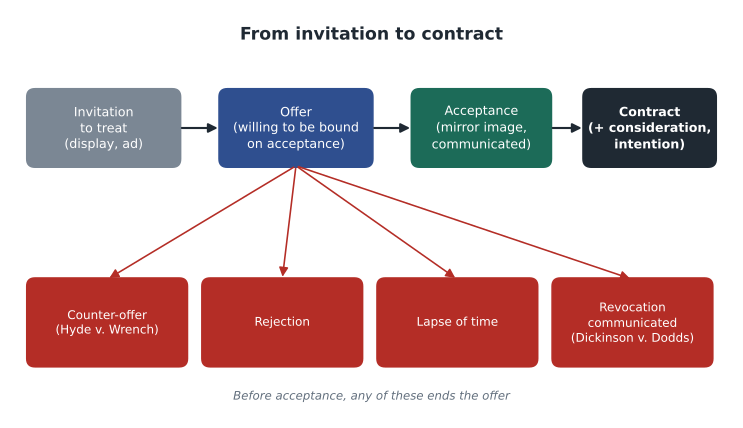
An offer is a proposal that shows a willingness to be bound on definite terms as soon as the other party accepts. Once accepted, it creates a contract without further negotiation. The test is again objective: would a reasonable person in the offeree's position understand that the offeror intended to be bound by an acceptance?
Courts distinguish offers from invitations to treat. An invitation to treat invites others to make offers. The classic examples are displays of goods in shops, advertisements, catalogues and price lists. In Pharmaceutical Society of Great Britain v. Boots Cash Chemists (Southern) Ltd., [1953] 1 QB 401 (CA), the display of medicines on self-service shelves was an invitation to treat. The customer made the offer at the cash desk, and the pharmacist accepted it there. The rule makes commercial sense: a shop should not be bound to sell to everyone who picks up an item, and should be able to refuse when stock runs out or when a price label is wrong.
Advertisements are usually invitations to treat for the same reason. A furniture store advertising a sofa for 899 dollars in a flyer does not promise to sell to every reader. But an advertisement can be an offer if its terms show an intention to be bound by performance. In Carlill v. Carbolic Smoke Ball Co., [1893] 1 QB 256 (CA), the company advertised that it would pay 100 pounds to anyone who caught influenza after using its smoke ball as directed, and said it had deposited 1,000 pounds in a bank 'shewing our sincerity in the matter'. The court held this was a unilateral offer to the world, accepted by anyone who performed the conditions. The deposit showed it was meant seriously, and the company could not escape by calling it a puff.
Carlill illustrates the difference between bilateral and unilateral contracts. In a bilateral contract each side promises: I promise to deliver the lumber, you promise to pay. In a unilateral contract one side promises in exchange for an act: I will pay a reward to whoever returns my lost dog. The offeree accepts by doing the act, not by promising to do it. Courts lean toward bilateral interpretations in commercial dealings, because a unilateral offer leaves the offeror bound while the offeree remains free.
Price quotations are a common source of dispute. A quotation that says 'prices subject to change' or 'subject to availability' is generally an invitation to treat. A detailed response to a request, setting firm prices, quantities and delivery terms, may be an offer. In Lakeshore Furniture's world, when the company asks a lumber mill for a price on 2,000 board feet of white oak and the mill replies with a quotation valid for thirty days, that quotation may well be an offer that Lakeshore can accept within the period.
Tenders and Contract A
Construction tenders have their own framework. In R. v. Ron Engineering & Construction (Eastern) Ltd., [1981] 1 SCR 111, the Supreme Court held that a call for tenders can create a preliminary contract, Contract A, when a bidder submits a compliant tender. Contract A governs the bidding process; Contract B is the construction contract awarded to the successful bidder. In M.J.B. Enterprises Ltd. v. Defence Construction (1951) Ltd., [1999] 1 SCR 619, the Court held that whether Contract A arises depends on the intention of the parties as shown by the tender documents, and that an owner may have an implied obligation to accept only compliant bids. Ron Engineering itself held that a bidder could not withdraw an irrevocable tender because of its own mistake in calculating the price. The tender cases show how offer and acceptance analysis adapts to multi-stage commercial processes.
Acceptance
An acceptance is an unqualified expression of assent to the terms of the offer, communicated to the offeror in the manner the offer requires or permits. Three requirements follow.
- The acceptance must match the offer. This is the mirror image rule. A reply that adds or changes terms is not an acceptance but a counter-offer.
- The acceptance must generally be communicated. Silence is not acceptance. In Felthouse v. Bindley (1862), 11 CB (NS) 869, an uncle wrote that if he heard no more he would consider the horse his. The nephew's silence did not create a contract. The rule protects offerees from having obligations imposed by an offeror's choice.
- The acceptance must respond to the offer. A person cannot accept an offer they did not know about. A person who returns a lost dog without knowing of the reward has not accepted the reward offer, although courts have been generous where the claimant knew of the offer and it was one of their reasons for acting.
Acceptance can be shown by conduct. A buyer who receives goods under the seller's proposed terms and uses them, or a party who begins performance in response to an offer, may be found to have accepted objectively. An offeror may prescribe the method of acceptance. If the offer says acceptance must be in writing at a particular address, another method will not do unless the offeror waives the requirement. If the offer merely suggests a method, any equally effective method usually suffices.
Counter-offers and the battle of the forms
A counter-offer rejects the original offer and replaces it with a new one. In Hyde v. Wrench (1840), 3 Beav 334, an offer to sell a farm for 1,000 pounds was met with an offer to buy for 950. When the seller refused, the buyer tried to accept the original 1,000 pound offer. Too late: the counter-offer had killed it. A mere request for information, such as 'would you accept payment in two instalments?', is not a counter-offer and leaves the original offer open.
Modern commerce runs on standard forms, which produces the battle of the forms. A buyer sends a purchase order on its terms; the seller replies with an acknowledgement on its own terms; goods are shipped and paid for. Whose terms govern? The traditional answer, from Butler Machine Tool Co. v. Ex-Cell-O Corp. (England) Ltd., [1979] 1 WLR 401 (CA), is the last shot: each new form is a counter-offer, and the party who sends the last form before performance wins if the other proceeds without objection. Canadian courts generally follow the same analysis while looking at the whole course of dealing. In Tywood Industries Ltd. v. St. Anne-Nackawic Pulp & Paper Co. (1979), 25 OR (2d) 89 (HCJ), an arbitration clause on the back of a seller's forms did not bind the buyer, because the buyer's purchase order governed and the seller's terms had never been brought to the buyer's attention or accepted. The lesson for drafting is simple: read the forms that come back, and object in writing if they change your terms.
Termination of offers
An offer can come to an end in several ways before acceptance.
- Revocation. An offeror may revoke at any time before acceptance, even if it promised to keep the offer open, unless the promise is supported by consideration (an option contract) or made under seal. The revocation must be communicated, but it need not come from the offeror directly. In Dickinson v. Dodds (1876), 2 Ch D 463 (CA), the offeree learned from a reliable third party that the property had been sold to someone else, and that was enough.
- Rejection or counter-offer by the offeree.
- Lapse of time. An offer lapses at the end of any stated period or, if none is stated, after a reasonable time, which depends on the subject matter. An offer to sell perishable goods lapses quickly; an offer to sell land may last longer.
- Death or incapacity of a party, in some circumstances, and failure of a condition on which the offer depends.
Unilateral offers raise a special problem: can the offeror revoke after the offeree has started but not finished performance? The modern view, reflected in Errington v. Errington, [1952] 1 KB 290 (CA), is that once performance has begun, the offeror impliedly promises not to revoke while the offeree continues. Canadian courts have taken a similar approach.
When and where acceptance takes effect
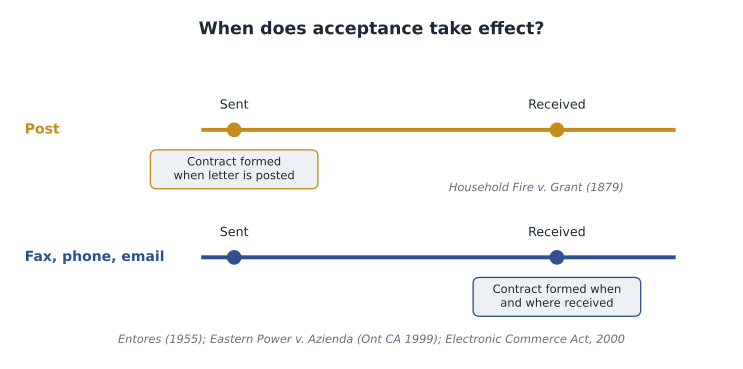
The general rule is that acceptance takes effect when and where it is received by the offeror. The postal acceptance rule is the major exception: where acceptance by post is reasonable, the contract is formed when the letter is posted, even if it is delayed or lost (Household Fire and Carriage Accident Insurance Co. v. Grant (1879), 4 Ex D 216 (CA)). The rule allocated the risk of a lost letter to the offeror, who chose to deal by post. It does not apply if the offer requires actual receipt, or if applying it would produce manifest inconvenience or absurdity.
For instantaneous communication the receipt rule applies. In Entores Ltd. v. Miles Far East Corp., [1955] 2 QB 327 (CA), an acceptance sent by telex was effective where it was received, so the contract was made in London. In Eastern Power Ltd. v. Azienda Comunale Energia & Ambiente (1999), 178 DLR (4th) 409 (Ont CA), the Ontario Court of Appeal applied the receipt rule to an acceptance sent by fax, holding that the contract was formed in Italy, where the fax was received. The place of formation mattered because it bore on whether Ontario courts should take jurisdiction.
Electronic contracting
Most contracts today are formed online. Ontario's Electronic Commerce Act, 2000 confirms that an offer, an acceptance or any other matter material to forming a contract may be expressed electronically, including by touching or clicking an appropriate icon or place on a screen. The Act also deals with when electronic information is sent and received, and with errors made by an individual dealing with an automated system, who in some circumstances may avoid a transaction if they promptly notify the other party of the error and have not received a material benefit.
Clickwrap agreements, where a user must click 'I agree' after being shown the terms, are generally enforceable. In Rudder v. Microsoft Corp. (1999), 2 CPR (4th) 474 (Ont SCJ), a forum selection clause in an online membership agreement bound users who had clicked to accept, even though the clause was visible only by scrolling. The court compared the scroll box to a multi-page written contract: a party who agrees cannot avoid terms simply because they did not read them. Browsewrap terms, which are merely posted behind a link with no required click, are on weaker ground, because it is harder to show that the user saw them and agreed. Later lessons show that even clickwrap terms can be struck down as unconscionable or contrary to public policy, as in Douez v. Facebook, Inc., 2017 SCC 33, and Uber Technologies Inc. v. Heller, 2020 SCC 16.
Certainty of terms
Even when there is an offer and an acceptance, a contract will fail if its essential terms are too uncertain to enforce. Courts try to uphold commercial bargains and will fill gaps with reasonable terms where the parties intended to be bound. But they will not write the contract for the parties. An 'agreement to agree' on an essential term, such as price in a long-term supply deal with no mechanism for setting it, may be unenforceable. In Bawitko Investments Ltd. v. Kernels Popcorn Ltd. (1991), 79 DLR (4th) 97 (Ont CA), the parties had agreed on the main points of a franchise but contemplated a formal franchise agreement with terms still to be negotiated; the court held there was no binding contract. A price mechanism, such as a market price or a reference to arbitration, can save an agreement that leaves the figure open.
Varga closes the class by pulling the napkin from the shoebox. 'Two business owners wrote this at a hockey game. Price, quantity, delivery date, two signatures. Was it a contract?' Arjun Mehta, who likes to reduce everything to steps, ventures that it depends on whether a reasonable person would think they meant to be bound. 'Good,' says Varga. 'And when you have answered that, the next question is what they exchanged. That is consideration, and it is Friday's class.'
| Communication | Rule | Leading authority |
|---|---|---|
| Acceptance by post (where reasonable) | Effective when posted | Household Fire v. Grant (1879) |
| Telex, fax, phone | Effective when and where received | Entores (1955); Eastern Power (Ont CA 1999) |
| Email and online forms | Generally treated as instantaneous; Electronic Commerce Act rules on sending and receipt | Electronic Commerce Act, 2000 (Ontario) |
| Revocation of an offer | Effective only when communicated to the offeree | Byrne v. Van Tienhoven (1880); Dickinson v. Dodds (1876) |
| Silence | Not acceptance unless the offeree chose that method | Felthouse v. Bindley (1862) |
Common mistakes
MistakeA price tag on a shelf is an offer, so the store must sell at that price.
InsteadDisplays and advertisements are usually invitations to treat. The customer offers at the till (Boots). A different rule may apply under consumer protection legislation for misleading prices, but that is a statutory question, not formation.
MistakeA reply that says 'I accept, delivery to be by Friday' is an acceptance.
InsteadIf delivery by Friday is a new term, the reply is a counter-offer that rejects the original offer (Hyde v. Wrench).
MistakeA promise to keep an offer open for a week is binding.
InsteadWithout consideration or a seal, the offeror may revoke at any time before acceptance, provided the revocation is communicated.
MistakeAn acceptance sent by email is effective when sent, like a letter.
InsteadCourts treat near-instantaneous communication under the receipt rule (Entores; Eastern Power), and the Electronic Commerce Act has its own rules on when electronic information is sent and received.
Practice problems
Work each problem on paper first, then reveal the answer to check.
Lakeshore posts on its website: 'Floor model oak tables, 450 dollars each, while supplies last.' A customer clicks 'Buy now' on ten tables, but Lakeshore has only two. Is there a contract for ten?
Show answer
Probably not. The posting is best read as an invitation to treat (supply is limited and the business must be able to manage stock), so the customer's order is the offer. Lakeshore can accept for two or decline. The website's own terms of sale, if properly incorporated, may confirm that orders are offers accepted only on confirmation.
A mill emails Lakeshore a firm quotation open for 30 days. On day 10 Lakeshore emails back: 'We accept, but please deliver in two loads.' On day 12 the mill sells the lumber elsewhere. Advise Lakeshore.
Show answer
If the request for two loads is a new term, the reply is a counter-offer that rejected the quotation, and the mill was free to sell elsewhere. If it is read as a request or suggestion that does not condition acceptance, there was a contract on day 10 and the mill is in breach. The wording matters; 'please' points toward a request.
Why does the postal acceptance rule not apply to fax and email?
Show answer
The rule placed the risk of delay or loss on the offeror who chose to use the post. With instantaneous communication the sender usually knows quickly if the message failed, so the general receipt rule applies (Entores; Eastern Power).
Summary and key terms
- Contract formation is judged objectively: what would a reasonable person understand from the parties' words and conduct (Smith v. Hughes; Aga, 2021 SCC 22)?
- An offer shows a willingness to be bound on acceptance; displays and most advertisements are invitations to treat (Boots), but a unilateral offer to the world can be accepted by performance (Carlill).
- Acceptance must mirror the offer and generally be communicated; a counter-offer rejects the offer (Hyde v. Wrench), and the last shot usually wins the battle of the forms.
- Offers end by revocation (communicated, unless there is an option or seal), rejection, lapse or other events.
- Acceptance by post is effective on posting; instantaneous acceptances are effective where received (Entores; Eastern Power); Ontario's Electronic Commerce Act validates electronic formation, including by clicking.
- Essential terms must be certain enough to enforce; an agreement to agree on an essential term may fail (Bawitko).
- Offer
- A proposal showing a willingness to be bound on definite terms as soon as it is accepted.
- Invitation to treat
- An invitation to others to make offers, such as a shop display, catalogue or most advertisements.
- Mirror image rule
- The rule that an acceptance must match the offer exactly; a reply that changes terms is a counter-offer.
- Unilateral contract
- A contract in which one party promises in exchange for an act, accepted by performing the act.
- Postal acceptance rule
- The rule that an acceptance sent by post, where posting is a reasonable method, takes effect when posted.
- Clickwrap agreement
- Online terms accepted by clicking a button such as 'I agree' after being given the opportunity to read them.
- Contract A
- In tendering, the preliminary contract formed by submitting a compliant bid, governing the bidding process.
Lesson quiz · 5 questions
Score 60% or more to complete this lesson.
Create a free account to save your progress, take quizzes and earn a certificate.