
LAWC-102 · Lesson 2 of 12 · 18 min
Consideration and intention
▶ Video coming soon A video version of this lesson is on the way.
On Friday, Professor Varga writes two sentences on the whiteboard. 'I promise to give you my car.' 'I promise to sell you my car for one dollar.' He asks which promise a court will enforce. Hannah Kowalczyk, who studied economics in Calgary, answers that the second is obviously a bargain and the first a gift. 'Correct,' Varga says, 'and the common law has spent five hundred years explaining why the one-dollar promise is binding and the free one is not. That explanation is the doctrine of consideration.'
This lesson examines the two remaining ingredients of a basic enforceable contract: consideration, the price paid for a promise, and an intention to create legal relations. Together with offer and acceptance, they separate enforceable bargains from social arrangements, gifts and moral obligations.
Why the common law requires consideration
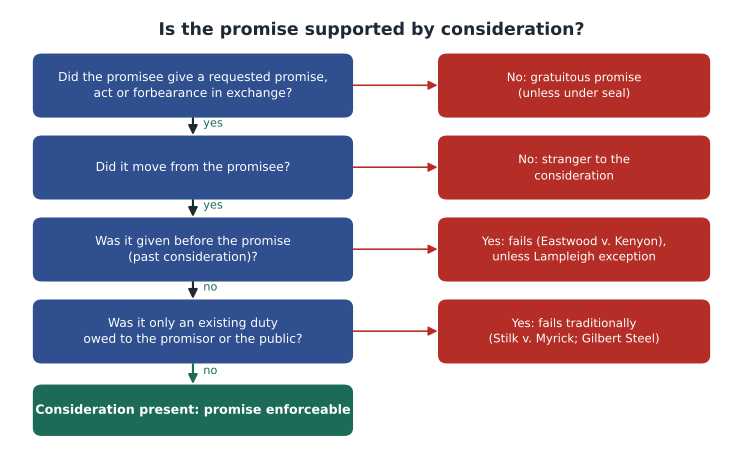
The common law does not enforce every serious promise. It enforces bargains. A promise is binding if it is given in exchange for something the promisor requested: a counter-promise, an act or a forbearance. The classic definition, from Currie v. Misa (1875), LR 10 Ex 153, describes consideration as some right, interest, profit or benefit accruing to one party, or some forbearance, detriment, loss or responsibility given, suffered or undertaken by the other. The modern emphasis is on the bargain: the promisor's promise and the promisee's consideration are each the price of the other.
Several reasons support the requirement. It filters out casual or impulsive promises. It provides evidence that the parties meant business. It reflects a policy choice that the law of contract exists to support exchange, while gifts are left to the law of property and to personal honour. Critics argue that the doctrine is technical and sometimes defeats reasonable expectations, and later lessons show how promissory estoppel and statute soften it. But it remains a core requirement in every common-law province.
Promises under seal are the historic exception. A deed, signed, sealed and delivered, is enforceable without consideration. Today the seal survives mainly in formal documents such as guarantees and option agreements, and courts look for evidence that the party intended to make a sealed instrument. A sticker or printed 'seal' may be enough if the signing party meant to adopt it.
The rules of consideration
Five rules organize most of the cases.
- Consideration must move from the promisee. The person who wants to enforce a promise must have provided consideration for it, although it need not move to the promisor. Payment to a third party at the promisor's request is good consideration.
- Consideration must be sufficient but need not be adequate. Courts do not weigh the fairness of the exchange. A peppercorn or one dollar will do if it was genuinely bargained for (Chappell & Co. v. Nestlé Co., [1960] AC 87 (HL), where chocolate wrappers were part of the price of a record). Gross inadequacy may be evidence of fraud, duress or unconscionability, but it does not defeat consideration on its own.
- Past consideration is no consideration. An act done before the promise was made cannot support it, because it was not given in exchange for the promise. In Eastwood v. Kenyon (1840), 11 Ad & El 438, a guardian who had spent money raising a young woman could not enforce her later husband's promise to repay him. The exception, from Lampleigh v. Brathwait (1615), applies where the act was done at the promisor's request, both parties understood it would be paid for, and the payment would have been legally enforceable if promised in advance.
- Performing an existing legal duty owed to the public is not consideration. A police officer cannot claim a reward for doing their job, although going beyond the duty can be consideration.
- Performing an existing contractual duty owed to the promisor is traditionally not consideration for a new promise. This is the rule in Stilk v. Myrick (1809), 2 Camp 317, where sailors who stayed on after desertions could not recover extra wages promised mid-voyage, because they were already bound to work the ship home. Lesson 3 shows how Canadian courts have modified this rule for contract variations.
Forbearance to sue and compromises
A promise not to pursue a claim can be consideration, even if the claim would have failed, provided it was made honestly and was not frivolous or vexatious. Settlement agreements depend on this rule. If Lakeshore threatens to sue a supplier over defective lumber and agrees to drop the claim in exchange for a discount on the next shipment, its forbearance is consideration for the discount, even if a court later doubts that the claim was strong. Settlements would be impossible if every compromise could be reopened by arguing that the abandoned claim was weak.
Illusory promises
A promise that leaves performance entirely at the promisor's discretion may be illusory and cannot be consideration. If Lakeshore promises to buy 'as much white oak as we may choose to order', it has promised nothing, and the mill's promise to supply at a fixed price is unsupported until orders are placed. Courts try to avoid this result in commercial agreements by implying limits, such as a duty to act reasonably or in good faith, or by finding that each order creates a separate contract. Requirements contracts, where the buyer agrees to buy all it needs from one supplier, are not illusory: the buyer gives up the right to buy elsewhere.
Options and nominal consideration
The rules on consideration explain why options are drafted the way they are. Recall from Lesson 1 that a promise to keep an offer open is not binding by itself. If Lakeshore wants a right to buy the lot next door at a fixed price any time in the next year, the owner's promise to hold the offer open needs support. The usual solution is an option contract: Lakeshore pays a sum, sometimes as little as one or ten dollars, in exchange for the owner's promise not to revoke. Because courts do not weigh adequacy, the nominal payment is enough, provided it is actually paid or genuinely promised. A recital saying that one dollar was paid, when it never was, invites a dispute about whether there was any consideration at all, which is why careful drafters also execute options under seal.
Charitable pledges are a related problem. A promise to donate money to a hospital or university is gratuitous: the donor receives nothing in exchange. Canadian courts have generally refused to enforce bare pledges. In Brantford General Hospital Foundation v. Marquis Estate (2003), 67 OR (3d) 432 (SCJ), a donor's estate was not bound by her pledge to a hospital foundation: there was no consideration, the suggestion that a unit would be named for her was the hospital's idea and not something she had bargained for, and promissory estoppel could not help because there was no pre-existing legal relationship and no proven detrimental reliance. Charities that want enforceable pledges ask for a sealed document or give something the donor genuinely bargains for.
Part payment of a debt
At common law, paying part of a debt does not discharge the whole, even if the creditor agrees to accept less, because the debtor gives nothing new. This was the rule in Pinnel's Case (1602) and Foakes v. Beer (1884), 9 App Cas 605 (HL). The rule could be avoided by providing something different, such as early payment, payment in a different place or a chattel instead of money.
Ontario changed the rule by statute. Section 16 of the Mercantile Law Amendment Act, RSO 1990, c. M.10, provides that part performance of an obligation, either before or after a breach, when expressly accepted by the creditor in satisfaction, or rendered under an agreement for that purpose even without new consideration, extinguishes the obligation. Several other provinces have similar provisions. In Ontario, then, a creditor who expressly accepts a partial payment in full satisfaction cannot later sue for the balance.
Intention to create legal relations
An agreement supported by consideration is still not a contract unless the parties intended to create legal relations. Courts apply two rebuttable presumptions.
- In domestic and social arrangements, the presumption is that the parties did not intend legal consequences. In Balfour v. Balfour, [1919] 2 KB 571 (CA), a husband's promise of a monthly allowance to his wife while he worked abroad was not enforceable. Agreements between spouses who are separating, by contrast, are often intended to be binding, and family law statutes in Ontario impose formalities on domestic contracts.
- In commercial dealings, the presumption is that the parties intended to be bound. The party denying an intention bears a heavy onus. In Rose and Frank Co. v. J.R. Crompton & Bros. Ltd., [1925] AC 445 (HL), an 'honourable pledge clause' stating that the arrangement was not a formal legal agreement was effective, because the parties expressly excluded legal relations.
The presumptions are tools for applying the objective test, not rigid categories. A promise between friends to share lottery winnings may be enforceable if the evidence shows a serious, binding arrangement. A commercial letter of comfort, in which a parent company says it is its 'policy' to support a subsidiary, may not be a promise at all. The Supreme Court's decision in Aga, discussed in Lesson 1, illustrates the objective approach to intention outside the commercial setting: members of a church had no contract with it merely because they paid dues and agreed to follow its constitution, absent evidence of an intention to create legal relations.
Agreements that are expressly 'subject to contract' or 'subject to a formal agreement' raise the question whether the parties intended to be bound before signing the formal document. The answer depends on the wording and context. If the essential terms are settled and the formal document is merely a record, there may be a binding contract now; if important terms remain to be negotiated, there is usually not.
Consideration in employment and other ongoing relationships
The consideration rules matter most in long-term relationships, where parties often change their terms midstream. A frequent Ontario example involves employment contracts. If an employer asks an existing employee to sign a new agreement that limits termination pay, and the employee receives nothing new in exchange, the new terms may be unenforceable for want of fresh consideration. Courts have described continued employment alone as insufficient unless the employer forbore from a real intention to dismiss. Employers therefore offer something new, such as a signing bonus, a raise or a promotion, when introducing new terms. The rule protects the weaker party from having its rights stripped away by a promise it was in no position to refuse.
Theo recognizes the pattern from his years at a Hamilton firm. 'Half my termination files turned on whether the employee got anything for signing the new contract,' he says. Varga agrees. 'And that is why consideration is not a historical curiosity. It decides real disputes every week.'
Putting the elements together
A basic enforceable contract requires an offer, an acceptance, consideration and an intention to create legal relations, with terms certain enough to enforce. The parties must have capacity, and some contracts must meet formal requirements, which Lesson 4 covers. When you analyze a formation problem, take the elements in order, state the rule for each, apply it to the facts and reach a conclusion before moving on. The problem may turn on one element, but you cannot know which until you have checked them all.
| Situation | Is there consideration? | Why |
|---|---|---|
| One dollar paid for a promise to sell a car | Yes | Sufficiency, not adequacy; the dollar was bargained for |
| Promise to pay for a favour already done, unrequested | No | Past consideration (Eastwood v. Kenyon) |
| Promise to pay for work done at the promisor's request, both expecting payment | Yes | Lampleigh v. Brathwait exception |
| Promise to drop an honest but doubtful claim | Yes | Forbearance to sue is good consideration |
| Promise to buy 'as much as we may choose' | No | Illusory promise, unless limits are implied |
| Creditor expressly accepts part payment in full satisfaction (Ontario) | Debt is extinguished | Mercantile Law Amendment Act, s. 16 |
Common mistakes
MistakeConsideration must be a fair price for the promise.
InsteadConsideration must be sufficient, not adequate. Courts do not weigh the bargain, though gross inadequacy may suggest fraud, duress or unconscionability.
MistakeIf someone helps you and you later promise to pay, the promise is binding because you got a benefit.
InsteadThat is past consideration and is not enough unless the Lampleigh v. Brathwait conditions are met.
MistakeEvery agreement between family members is unenforceable.
InsteadThere is only a rebuttable presumption against intention in domestic and social arrangements. Clear evidence of a serious, binding deal can rebut it.
MistakeIn Ontario a creditor can always sue for the balance after accepting part payment.
InsteadSection 16 of the Mercantile Law Amendment Act extinguishes the debt where the creditor expressly accepts part performance in satisfaction.
Practice problems
Work each problem on paper first, then reveal the answer to check.
Lakeshore's owner tells her nephew, a carpenter, 'You've worked so hard for us; I'll give you 5,000 dollars next month.' She dies before paying. Can the nephew enforce the promise against her estate?
Show answer
Probably not. The work was done before the promise and was not requested on the understanding that it would be paid for beyond his wages, so it is past consideration. The family relationship also raises a presumption against intention to create legal relations. Unless the promise was under seal, it is a gratuitous promise.
A supplier and Lakeshore sign a letter saying 'This memorandum records our intentions and is not legally binding; a formal supply agreement will follow.' Lakeshore later relies on the letter's prices. Is there a contract?
Show answer
Likely not. Like the honourable pledge clause in Rose and Frank, the express statement rebuts the commercial presumption of intention. Lakeshore may need another basis, such as a later course of dealing or estoppel.
Why is a forbearance to sue good consideration even if the claim would have failed?
Show answer
Because the promisee gives up an honestly held claim that it could have pursued; requiring proof that the claim would have succeeded would undermine every settlement.
Summary and key terms
- A promise is enforceable if given in exchange for consideration: a requested promise, act or forbearance; a promise under seal needs none.
- Consideration must move from the promisee and be sufficient, not adequate; past consideration does not count, subject to the Lampleigh v. Brathwait exception.
- Performing an existing public duty, or traditionally an existing contractual duty to the promisor, is not consideration (Stilk v. Myrick).
- Forbearance to pursue an honest claim is consideration; illusory promises are not.
- In Ontario, part payment expressly accepted in satisfaction extinguishes a debt (Mercantile Law Amendment Act, s. 16), displacing Foakes v. Beer.
- Intention to create legal relations is presumed in commercial dealings and presumed absent in domestic and social ones; both presumptions are rebuttable.
- Consideration
- Something of value given in exchange for a promise: a counter-promise, an act or a forbearance requested by the promisor.
- Past consideration
- An act done before a promise was made, which cannot support the promise because it was not given in exchange for it.
- Seal
- A formal mark on a deed that makes a promise enforceable without consideration.
- Illusory promise
- A promise that leaves performance entirely at the promisor's discretion and so cannot be consideration.
- Forbearance
- Refraining from exercising a legal right, such as the right to sue, which can be consideration.
- Honourable pledge clause
- A clause stating that an arrangement is not intended to be legally binding, which rebuts the presumption of intention.
Lesson quiz · 5 questions
Score 60% or more to complete this lesson.
Create a free account to save your progress, take quizzes and earn a certificate.