
LAWC-102 · Lesson 6 of 12 · 18 min
Exclusion clauses, standard forms and third parties
▶ Video coming soon A video version of this lesson is on the way.
Professor Varga starts with a parking ticket. He holds it up to the class: on the back, in grey type a few millimetres high, it says that the parking operator is not responsible for loss of or damage to vehicles or contents however caused, including by the negligence of its employees. 'Every one of you has accepted a contract like this,' he says. 'Most of you have never read one. Today we ask when these clauses work, and who besides the parties can rely on them.'
This lesson covers three related topics. Exclusion and limitation clauses allocate risk by excluding or capping liability. Standard form contracts raise the question whether a party has really agreed to terms it never read. And the doctrine of privity, with its exceptions, decides whether people who are not parties, such as employees and subcontractors, can take the benefit of those clauses.
Why exclusion clauses matter
An exclusion clause excludes liability for some breach or loss; a limitation clause caps liability at a stated amount. Between commercial parties, these clauses are legitimate tools for allocating risk, often tied to price and insurance. A carrier that limits liability to a stated amount per kilogram charges less than one that insures the full value of goods. The law's challenge is to respect that allocation while protecting parties who never really agreed to it or who would suffer an unconscionable result.
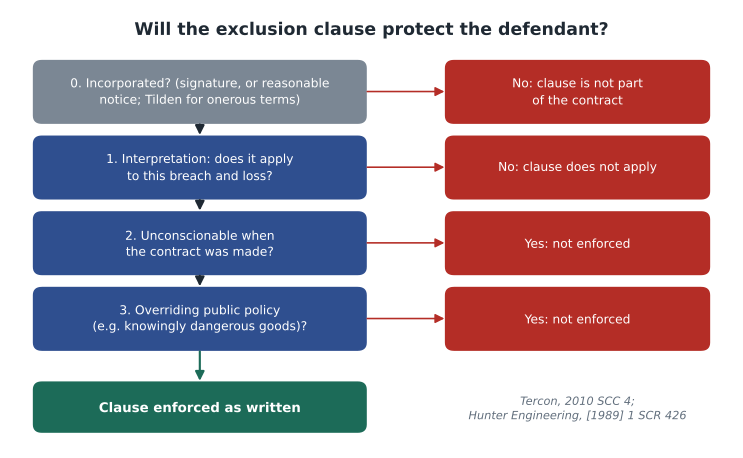
Courts approach exclusion clauses in three stages: Was the clause incorporated into the contract? On its proper interpretation, does it cover the breach and the loss? If so, should it be enforced?
Incorporation: notice and signature
A clause in a signed document is generally incorporated, under L'Estrange v. Graucob. A clause in an unsigned document, such as a ticket, a sign or a website page, is incorporated only if reasonable steps were taken to bring it to the other party's attention before or at the time of contracting. In Parker v. South Eastern Railway Co. (1877), 2 CPD 416 (CA), the question was whether the railway had done what was reasonably sufficient to give notice of the conditions printed on a cloakroom ticket. In Thornton v. Shoe Lane Parking Ltd., [1971] 2 QB 163 (CA), terms on a ticket issued by a machine after the customer had committed to entering the car park came too late; the contract was made when the customer drove in. Lord Denning added that the more unusual or onerous a term, the more notice is required, famously suggesting that some clauses would need to be printed in red ink with a red hand pointing to them.
In Tilden Rent-A-Car Co. v. Clendenning (1978), 18 OR (2d) 601 (CA), a customer at Vancouver airport signed a car rental contract without reading it. On the back, in small print, was a clause voiding the collision insurance he had paid for if he had consumed any alcohol before driving. He had an accident after one drink. The Ontario Court of Appeal held that where a party knows or ought to know that the signer has not read the terms and is relying on the transaction being a usual one, and the terms are onerous and unusual, the signature alone does not bind the signer to them. Reasonable measures must be taken to draw such terms to the signer's attention. Tilden is an exception to L'Estrange, not a general rule: it applies to hurried transactions involving standard forms, not to negotiated commercial contracts.
Waivers of liability for recreational activities raise similar issues. Courts have enforced signed waivers where the operator took reasonable steps to draw attention to them and the participant had time to read them, as in Karroll v. Silver Star Mountain Resorts Ltd. (1988), 33 BCLR (2d) 160 (SC), involving a ski race. In Crocker v. Sundance Northwest Resorts Ltd., [1988] 1 SCR 1186, by contrast, the Supreme Court held that a release signed by a visibly intoxicated participant in a tubing competition, which he had not read and did not know was a release, did not protect the resort from its duty to prevent him from competing.
Interpretation of exclusion clauses
Exclusion clauses are interpreted under the ordinary principles in Sattva, but courts traditionally read them strictly. A clause will not be read to exclude liability for negligence unless it does so expressly or by clear implication. Ambiguity is resolved against the party relying on the clause, under contra proferentem. A clause excluding liability for 'any loss howsoever caused' may cover negligence; a clause excluding liability for 'defects' may not cover a failure to deliver at all.
Fundamental breach and Tercon
For decades courts struggled with the doctrine of fundamental breach: the idea that a party who commits a breach going to the root of the contract cannot rely on an exclusion clause. The Supreme Court rejected fundamental breach as a rule of law in Hunter Engineering Co. v. Syncrude Canada Ltd., [1989] 1 SCR 426, holding that the question is one of interpretation, with a residual power to refuse enforcement of unconscionable clauses.
The Court restated the approach in Tercon Contractors Ltd. v. British Columbia (Transportation and Highways), 2010 SCC 4. British Columbia called for proposals to build a highway, and the call said only eligible proponents could bid. It also said that no proponent would have any claim for compensation arising from participating in the process. The province accepted a bid from a joint venture that included an ineligible party, then argued that the exclusion clause protected it from the unsuccessful bidder's claim. The Court divided five to four on the result but agreed on the framework, which Justice Binnie set out in his reasons. It asks three questions:
- Interpretation: as a matter of interpretation, does the exclusion clause apply to the circumstances established in evidence?
- Unconscionability: if it applies, was the clause unconscionable at the time the contract was made, as might arise from situations of unequal bargaining power?
- Public policy: if the clause is valid and applicable, should the court nevertheless refuse to enforce it because of an overriding public policy, the proof of which lies on the party seeking to avoid enforcement?
On the facts, the majority, in reasons by Justice Cromwell, held that the clause did not cover the province's breach. It barred claims arising from participation in the process the call described, which was limited to eligible bidders; accepting an ineligible bid was outside that process. Justice Binnie, for the four dissenting judges, would have enforced the clause. The public policy stage is narrow: Justice Binnie gave examples such as a supplier that knowingly sells a defective product that poses a danger to the public and relies on an exclusion clause to avoid liability. Mere disparity in sophistication or an unhappy outcome is not enough.
Limiting liability for breach of good faith
Parties cannot contract out of the duty of honest performance discussed in Lesson 9, but they may limit the remedies for breaching it. In 1401380 Ontario Ltd. (Wilderness North Air) v. Hydro One Remote Communities Inc., 2025 ONCA 827, the Ontario Court of Appeal held that a clear limitation of liability clause capping damages applied to damages for breach of the duty to exercise discretion in good faith. Capping liability did not amount to contracting out of the duty or undermine its minimum core, because the clause did not exclude liability altogether. The decision shows how Tercon's first stage, interpretation, interacts with the good faith duties.
Standard form contracts and consumers
Standard form contracts are offered on a take-it-or-leave-it basis. They are efficient, but the party presented with them rarely reads them and cannot negotiate. The common law polices them through incorporation rules, strict interpretation, Tercon's unconscionability and public policy stages, and the doctrine of unconscionability in Uber Technologies Inc. v. Heller, 2020 SCC 16, discussed in Lesson 8. Forum selection clauses in standard form consumer contracts have received particular scrutiny. In Douez v. Facebook, Inc., 2017 SCC 33, a plurality held that strong cause existed not to enforce a clause requiring British Columbia users to sue in California over privacy claims, given the gross inequality of bargaining power, the quasi-constitutional privacy rights at stake and the inconvenience to consumers.
Statutes add a further layer. Ontario's Consumer Protection Act, 2002 gives consumers rights that cannot be waived, voids terms requiring arbitration of consumer disputes or barring class proceedings, and implies warranties and conditions into consumer agreements that cannot be excluded. Lesson 8 returns to these provisions and to the Consumer Protection Act, 2023, which will replace the 2002 Act when it is proclaimed in force.
Privity of contract
Privity is the rule that only the parties to a contract can sue on it or be bound by it. A third party cannot enforce a contract made for its benefit, and cannot be burdened by one it did not agree to. The rule derives from Tweddle v. Atkinson (1861), 1 B & S 393, where a son could not sue on his father's and father-in-law's agreement to pay him money, and Dunlop Pneumatic Tyre Co. v. Selfridge & Co., [1915] AC 847 (HL). The Supreme Court of Canada applied it strictly in Greenwood Shopping Plaza Ltd. v. Beattie, [1980] 2 SCR 228, refusing to let employees rely on a contractual insurance clause in their employer's lease.
Privity has always had workarounds: agency, trusts of contractual promises, assignment, collateral contracts and statutory exceptions. Ontario's Insurance Act, for example, allows a person who obtains a judgment against an insured driver to recover it directly from the driver's insurer. New Brunswick went further: section 4 of its Law Reform Act permits a third party to enforce a contractual provision made for its benefit.
London Drugs and Fraser River
The Supreme Court relaxed privity in London Drugs Ltd. v. Kuehne & Nagel International Ltd., [1992] 3 SCR 299. A customer stored a transformer with a warehouse company under a contract limiting the warehouse's liability to 40 dollars. Two of the company's employees negligently dropped the transformer while moving it. The customer sued the employees personally for the full loss of about 34,000 dollars. Justice Iacobucci, for the majority, held that employees could rely on the limitation clause where the clause, expressly or impliedly, extended its benefit to them, and they were acting in the course of their employment and performing the very services provided for in the contract when the loss occurred. Their liability was limited to 40 dollars.
In Fraser River Pile & Dredge Ltd. v. Can-Dive Services Ltd., [1999] 3 SCR 108, the Court extended the principled exception beyond employees. A charter of a barge contained a waiver of subrogation in favour of the barge owner's 'charterers'. A third-party charterer, Can-Dive, sank the barge. Before suing, the owner and its insurer agreed to delete the waiver. The Court held that Can-Dive could rely on the waiver. The parties had intended to extend its benefit to charterers such as Can-Dive, which was performing activities within the scope of the contract. And once the third party's rights had crystallized into an actual benefit, here when the loss occurred, the original parties could not take it away by amending the contract without its consent.
The London Drugs exception is a shield. It allows third parties to rely on clauses protecting them, such as limitation clauses and waivers of subrogation. It has not been extended to let third parties sue for positive benefits under contracts to which they are not parties, except through the traditional workarounds or statute.
The parking ticket again
Varga returns to the parking ticket. Was the clause incorporated? If it was printed on a ticket issued after the driver entered, Thornton suggests it came too late, unless signs at the entrance gave notice. Does it cover negligence? Its words expressly mention employees' negligence, so probably yes. Is it unconscionable, or contrary to public policy under Tercon? Probably not for ordinary property damage, though a clause purporting to exclude liability for personal injury caused by recklessness might be. And if an attendant scratches the car, London Drugs may let the attendant rely on the clause personally, because it expressly extends to employees and the attendant was parking cars. 'Small print,' Varga says, 'is where risk lives.'
| Question | Test | Authority |
|---|---|---|
| Is the clause part of the contract? | Signature, or reasonable notice before formation; more notice for onerous terms | Parker; Thornton; Tilden |
| Does it cover the breach? | Ordinary interpretation, read strictly against the party relying on it | Sattva; Tercon |
| Should it be enforced? | Not if unconscionable at formation or overridden by public policy | Tercon, 2010 SCC 4 |
| Can a third party rely on it? | Intended to benefit the third party, who was performing the contract's activities | London Drugs; Fraser River |
| Can the parties take the benefit away? | Not after the third party's right has crystallized | Fraser River, [1999] 3 SCR 108 |
Common mistakes
MistakeA fundamental breach automatically destroys an exclusion clause.
InsteadHunter and Tercon replaced fundamental breach with interpretation, unconscionability and public policy.
MistakeSigning a standard form always binds you to every term.
InsteadUsually it does, but Tilden requires reasonable notice of onerous and unusual terms in hurried standard form transactions where the other party knows the signer is not reading.
MistakeLondon Drugs lets any third party sue to enforce a contract made for its benefit.
InsteadIt lets an intended third-party beneficiary rely on a protective clause as a shield when performing the contract's activities.
MistakeParties can contract out of the duty of honest performance.
InsteadThey cannot, but a clear limitation clause may cap damages for breaching a good faith duty (Wilderness North Air, 2025 ONCA 827).
Practice problems
Work each problem on paper first, then reveal the answer to check.
Lakeshore ships tables through a carrier whose online terms limit liability to 2 dollars per kilogram. Lakeshore clicked 'I accept' when opening the account. A driver negligently drops a pallet worth 9,000 dollars. Can Lakeshore recover in full from the carrier, or from the driver?
Show answer
The clickwrap terms were likely incorporated (Rudder). If the clause on its proper interpretation covers negligent damage, Tercon's unconscionability and public policy stages are unlikely to defeat it between commercial parties. If the clause extends to employees and agents, the driver can rely on it under London Drugs because he was performing the carriage.
A gym's membership form, signed at the front desk while a line forms behind the customer, contains a clause in tiny print excluding liability for injuries caused by defective equipment, even if the gym knew of the defect. Is the clause enforceable?
Show answer
Incorporation may fail under Tilden if the gym knew the customer was not reading and took no steps to highlight an onerous term. Even if incorporated, excluding liability for known dangerous defects may fail at Tercon's public policy stage, and consumer protection legislation may apply.
What did Fraser River add to London Drugs?
Show answer
It extended the principled exception beyond employees to other intended beneficiaries, set out the two-part test, and held that once the third party's right crystallizes, the contracting parties cannot remove it unilaterally.
Summary and key terms
- Exclusion clauses are tested by incorporation, interpretation and enforceability.
- Unsigned terms need reasonable notice before formation (Parker; Thornton); onerous terms in hurried standard forms need specific notice (Tilden).
- Tercon asks whether the clause applies, whether it was unconscionable at formation, and whether public policy overrides it; fundamental breach is no longer a rule of law (Hunter).
- Standard form consumer terms face added scrutiny (Douez) and statutory limits under Ontario's Consumer Protection Act.
- Privity bars third parties from suing or being bound, subject to agency, trusts, assignment and statute.
- London Drugs and Fraser River let intended third-party beneficiaries rely on protective clauses when performing the contract's activities, and protect crystallized rights from later amendment.
- Exclusion clause
- A term excluding liability for certain breaches or losses.
- Limitation clause
- A term capping liability at a stated amount.
- Fundamental breach
- A former doctrine treating a breach going to the root of the contract as defeating exclusion clauses; replaced by the Tercon framework.
- Privity of contract
- The rule that only parties to a contract can enforce it or be bound by it.
- Waiver of subrogation
- A clause preventing an insurer, after paying its insured, from suing a third party in the insured's name.
- Forum selection clause
- A term requiring disputes to be litigated in a particular jurisdiction.
Lesson quiz · 5 questions
Score 60% or more to complete this lesson.
Create a free account to save your progress, take quizzes and earn a certificate.