
LAWC-101 · Lesson 9 of 12 · 17 min
Taxation, spending and cooperative federalism
▶ Video coming soon A video version of this lesson is on the way.
Okafor-Lindqvist wrote her doctoral thesis on the federal spending power, and Section B has been warned that the ninth class is her favourite. She begins with a question: 'Health care is mostly provincial. Why, then, does every provincial health minister in the country wait anxiously each year to hear what the federal Minister of Finance will announce?' Sophie Tremblay-Hart answers in one word: 'Money.' 'Correct,' says the professor. 'And money is where the division of powers gets most interesting.'
This lesson covers the taxing powers of both levels, the federal spending power and fiscal transfers, and the broader idea of cooperative federalism, which describes how the two levels work together within, and sometimes around, the formal division of powers.
The federal taxing power
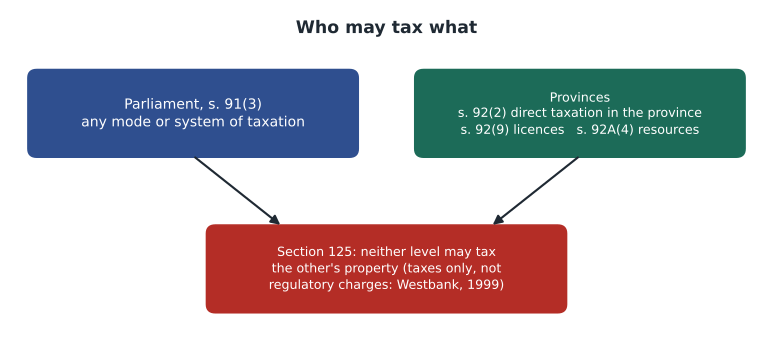
Section 91(3) gives Parliament power over 'The raising of Money by any Mode or System of Taxation'. The power is unlimited as to mode: Parliament may impose income taxes, sales taxes, customs and excise duties, or any other tax. The federal Income Tax Act, the Goods and Services Tax and the Harmonized Sales Tax are the main examples. The power is limited, however, by section 125 and by the rule that a tax must be a genuine tax rather than a disguised regulation of a provincial matter.
The provincial taxing powers
The provinces have narrower powers:
- Section 92(2): 'Direct Taxation within the Province in order to the raising of a Revenue for Provincial Purposes'.
- Section 92(9): shop, saloon, tavern, auctioneer and other licences, to raise revenue.
- Section 92A(4), added in 1982: taxation 'by any mode or system' of non-renewable natural resources, forestry resources and electrical energy, provided it does not discriminate between production exported to another part of Canada and production not exported.
The distinction between direct and indirect taxation has generated much case law. Following the economist John Stuart Mill, the Privy Council in Bank of Toronto v. Lambe (1887), 12 App Cas 575, defined a direct tax as one demanded from the very persons who it is intended or desired should pay it, and an indirect tax as one demanded from one person in the expectation that they will indemnify themselves at the expense of another, as customs duties are passed on to consumers. Income and property taxes are direct.
Retail sales taxes looked indirect, since the merchant pays them and passes them on. The provinces solved this in a way the courts accepted: the tax is imposed on the consumer, with the merchant acting merely as the province's collection agent. In Atlantic Smoke Shops Ltd. v. Conlon, [1943] AC 550, the Privy Council upheld New Brunswick's tobacco tax on that basis. Today, harmonized sales taxes in Ontario and the Atlantic provinces are administered federally under agreements, and Quebec administers both the federal GST and its own Quebec sales tax.
The words 'within the Province' prevent provinces from taxing persons or property outside their borders, and 'for Provincial Purposes' requires a revenue purpose. A province cannot use a so-called tax to achieve an objective outside its jurisdiction.
Taxes, regulatory charges and section 125
Not every government levy is a tax. Westbank First Nation v. British Columbia Hydro and Power Authority, [1999] 3 SCR 134, distinguished taxes from regulatory charges. A levy is a tax if it is compulsory, imposed under the authority of the legislature, levied by a public body, and intended for a public purpose. It is a regulatory charge if it is connected to a regulatory scheme, which the Court identified by asking whether there is a complete, complex and detailed code of regulation, a specific regulatory purpose that seeks to affect behaviour, actual or properly estimated costs of the regulation, and a relationship between the regulation and the person being regulated. In 620 Connaught Ltd. v. Canada (Attorney General), 2008 SCC 7, fees for liquor licences in Jasper National Park were valid regulatory charges.
The distinction matters for three reasons:
- Section 125 provides that no lands or property belonging to Canada or any province shall be liable to taxation. Governments cannot tax each other, but they can impose regulatory charges on each other. In Westbank, a First Nation's property taxes on a provincial Crown corporation's property were taxes, so section 125 barred them. In Reference re Exported Natural Gas Tax, [1982] 1 SCR 1004, a federal tax on natural gas produced by Alberta's Crown corporation was likewise barred.
- Section 53 of the 1867 Act requires bills for imposing taxes to originate in the House of Commons, and the principle of 'no taxation without representation' requires taxes to be imposed by the legislature itself. In Eurig Estate (Re), [1998] 2 SCR 565, Ontario's probate fees set by regulation were held to be a tax, invalid because not imposed by the legislature.
- Provincial regulatory charges need not meet the direct taxation limit. In the GGPPA References (2021), the majority held that the federal fuel charge and excess emissions charges were regulatory charges, not taxes, because they were connected to a scheme designed to change behaviour, so section 53 was not engaged.
The spending power
No provision of the Constitution expressly gives Parliament a 'spending power'. It is inferred from Parliament's power over 'The Public Debt and Property' (section 91(1A)), its taxing power (section 91(3)), and section 106, which allows Parliament to appropriate the Consolidated Revenue Fund 'for the Public Service'. The question is whether Parliament may spend money, and attach conditions to the money, in areas where it could not legislate directly.
The Privy Council's answer in Reference re Employment and Social Insurance Act, [1937] AC 355, was no: a federal unemployment insurance scheme, funded by compulsory contributions, was in substance a regulation of employment contracts and invalid, even though framed as taxing and spending. That decision led to the 1940 constitutional amendment adding unemployment insurance to section 91.
Modern courts have been more accommodating. In YMHA Jewish Community Centre of Winnipeg Inc. v. Brown, [1989] 1 SCR 1532, Justice L'Heureux-Dubé observed that Parliament may spend money in areas of provincial jurisdiction as long as the spending does not amount to regulation of the provincial matter. In Winterhaven Stables Ltd. v. Canada (Attorney General) (1988), 53 DLR (4th) 413, the Alberta Court of Appeal rejected a taxpayer's challenge to federal transfers for provincial programs, holding that conditional grants do not regulate provincial matters because provinces are free to decline them. In Reference re Canada Assistance Plan (B.C.), [1991] 2 SCR 525, discussed in lesson 2, the Supreme Court treated federal cost-sharing as a matter of federal spending discretion that Parliament could change unilaterally. In Eldridge v. British Columbia (Attorney General), [1997] 3 SCR 624, it described the Canada Health Act as imposing conditions on federal funding rather than directly regulating provincial health care.
Arjun summarizes the doctrine in engineering terms: 'Ottawa cannot order the provinces to build the bridge to its specifications, but it can offer to pay for the bridge if they do.' Okafor-Lindqvist approves, with a caveat. Quebec has always rejected the legitimacy of federal spending in provincial fields, and the 1999 Social Union Framework Agreement, which set rules for new federal social programs and included a commitment to give the provinces notice and collaborate, was signed by every province except Quebec.
Fiscal federalism and transfers
The federal government collects more revenue than it needs for its own programs, while the provinces carry the costs of health, education and social services. Canada closes this vertical fiscal gap through transfers:
- The Canada Health Transfer, conditional on provinces meeting the Canada Health Act's criteria of public administration, comprehensiveness, universality, portability and accessibility, and its bans on extra-billing and user charges.
- The Canada Social Transfer, supporting post-secondary education, social assistance and early childhood programs.
- Equalization, which addresses the horizontal gap between richer and poorer provinces. Section 36(2) of the Constitution Act, 1982 commits Parliament and the government of Canada to the principle of making equalization payments to ensure that provincial governments have sufficient revenues to provide reasonably comparable levels of public services at reasonably comparable levels of taxation. Payments are unconditional and set by formula under federal legislation.
Hannah points out that equalization has been politically contentious in Alberta, which in an October 2021 referendum voted by a majority in favour of removing the principle of equalization from the Constitution. The vote had no direct legal effect: amending section 36 would require the general amending formula in section 38. Alberta argued that, under the Secession Reference, a clear vote obliged other governments to negotiate, an argument that drew little response. Section 36 itself is generally considered non-justiciable, setting out commitments rather than enforceable obligations.
Federal spending programs continue to expand into areas of provincial jurisdiction through bilateral agreements. Recent examples include the Canada-wide early learning and child care agreements signed with every province and territory from 2021 to 2022, the federal dental care plan launched in 2023 and 2024, and the Pharmacare Act of 2024, under which the federal government funds coverage for contraception and diabetes medications through agreements with provinces that choose to participate.
Tax collection itself is a cooperative exercise. Under tax collection agreements, the Canada Revenue Agency collects personal income tax for every province except Quebec, which runs its own personal income tax system through Revenu Québec, and collects corporate income tax for every province except Quebec and Alberta, which administer their own. Provinces that use the federal system must follow the federal definition of taxable income, but they set their own rates, brackets and credits. The arrangement saves taxpayers from filing two returns and lets governments share administrative costs, while leaving each level's taxing power legally intact. It shows, in miniature, how much of Canadian fiscal federalism rests on agreement rather than on the text of sections 91 and 92.
Cooperative federalism
The term 'cooperative federalism' is used in two senses. Politically, it describes the network of intergovernmental agreements, councils and joint programs through which federal and provincial governments work together: First Ministers' meetings, ministerial councils, and since 2003 the Council of the Federation, through which provincial and territorial premiers coordinate. Legally, it describes an interpretive approach that favours the concurrent operation of laws enacted by both levels.
Canadian Western Bank v. Alberta, 2007 SCC 22, made cooperative federalism a guiding principle of modern doctrine, describing the 'dominant tide' as favouring overlapping valid laws and restricting doctrines, like interjurisdictional immunity, that exclude one level's laws. But the Court has also said that cooperative federalism cannot override the text of the Constitution:
- In Quebec (Attorney General) v. Canada (Attorney General), 2015 SCC 14, Quebec argued that Parliament could not destroy long-gun registry data collected under the cooperative federal firearms registry after Quebec had asked to receive it. A five-to-four majority held that cooperative federalism is not a freestanding principle that can limit Parliament's legislative authority or impose positive obligations on it.
- In Reference re Pan-Canadian Securities Regulation, 2018 SCC 48, the Court held that a cooperative scheme could not bind participating legislatures to adopt future amendments approved by a council of ministers, because that would fetter parliamentary sovereignty. But because the scheme left each legislature free to withdraw or amend its own law, it was valid.
- In Rogers Communications Inc. v. Châteauguay (City), 2016 SCC 23, examined in lesson 10, the Court applied interjurisdictional immunity despite the cooperative tide, holding that the choice of location for radiocommunication antennas is at the core of the federal power.
Intergovernmental agreements are generally not legally binding on legislatures, though they may have contractual effect between governments in some cases. Cooperation is achieved through the techniques covered in earlier lessons: administrative inter-delegation, incorporation by reference, conditional funding, mirror legislation and joint agencies.
Okafor-Lindqvist sums up: 'Cooperative federalism is how Canada actually works. But when cooperation breaks down and a government goes to court, the court will still apply sections 91 and 92. Cooperation shapes the doctrine; it does not replace it.'
Common mistakes
MistakeProvinces may impose any kind of tax.
InsteadProvinces are limited to direct taxation within the province (s. 92(2)), licences (s. 92(9)) and resource taxation (s. 92A(4)).
MistakeRetail sales taxes are invalid indirect taxes.
InsteadThey are direct because they are imposed on the consumer, with the merchant acting as collection agent (Atlantic Smoke Shops).
MistakeThe Constitution expressly gives Parliament a spending power.
InsteadThe spending power is inferred from sections 91(1A), 91(3) and 106, and is accepted as long as spending does not amount to regulation.
MistakeCooperative federalism can stop Parliament from repealing a law that a province relied on.
InsteadQuebec v. Canada (2015): cooperative federalism cannot limit legislative authority or impose positive obligations.
Practice problems
Work each problem on paper first, then reveal the answer to check.
A city charges a provincial university a fee for water use calculated to cover the cost of supplying it. Does section 125 bar the fee?
Show answer
Probably not. A fee tied to the cost of a regulatory service, with a relationship between the payer and the regulation, is likely a regulatory charge rather than a tax (Westbank; 620 Connaught), and section 125 bars only taxes.
Ottawa offers each province funding for school lunches if the province meets federal nutrition standards. Is this constitutional?
Show answer
Likely yes under the modern view of the spending power: the conditions attach to federal money that provinces are free to refuse, so they do not regulate education directly (Winterhaven; YMHA; Eldridge). Quebec would object politically.
What did Eurig Estate decide, and why does it matter?
Show answer
Ontario's probate fees, set by regulation, were a tax and invalid because taxes must be imposed by the legislature. It confirms the principle of no taxation without representation and the importance of distinguishing taxes from regulatory charges.
Summary and key terms
- Parliament may tax by any mode (s. 91(3)); provinces are limited to direct taxation within the province, licences and resource taxation.
- A direct tax is demanded from the person intended to bear it; retail sales taxes are direct through the collection agent device.
- Regulatory charges differ from taxes (Westbank); section 125 bars governments from taxing each other but not from imposing regulatory charges.
- The spending power, inferred from the Constitution, lets Parliament spend and attach conditions in provincial fields as long as it does not regulate them.
- Transfers such as the Canada Health Transfer, the Canada Social Transfer and equalization close fiscal gaps; section 36 commits governments to equalization.
- Cooperative federalism guides interpretation but cannot override the text or bind legislatures (Quebec v. Canada 2015; Pan-Canadian Securities 2018).
- Direct tax
- A tax demanded from the very person intended to pay it, such as an income or property tax.
- Indirect tax
- A tax demanded from one person in the expectation that it will be passed on to another, such as a customs duty.
- Regulatory charge
- A levy connected to a regulatory scheme, as opposed to a tax raised for general revenue.
- Spending power
- Parliament's inferred power to spend federal funds, including in areas of provincial jurisdiction, and to attach conditions.
- Equalization
- Unconditional federal payments to less wealthy provinces to allow comparable public services at comparable tax levels.
- Cooperative federalism
- The practice and interpretive principle of federal and provincial governments acting together and of overlapping laws operating concurrently.
Lesson quiz · 5 questions
Score 60% or more to complete this lesson.
Create a free account to save your progress, take quizzes and earn a certificate.