
LAWC-101 · Lesson 7 of 12 · 18 min
Peace, order and good government
▶ Video coming soon A video version of this lesson is on the way.
Hannah Kowalczyk has been waiting for this class. Before law school she worked in a provincial oil and gas regulatory office in Calgary, and she followed the carbon pricing references closely. When Okafor-Lindqvist asks for a volunteer to summarize the Alberta Court of Appeal's 2020 opinion, which found the federal carbon pricing law unconstitutional, Hannah's hand is up before the question ends. 'And then the Supreme Court disagreed,' Okafor-Lindqvist says, 'which is why we are spending a whole lesson on twelve words at the start of section 91.'
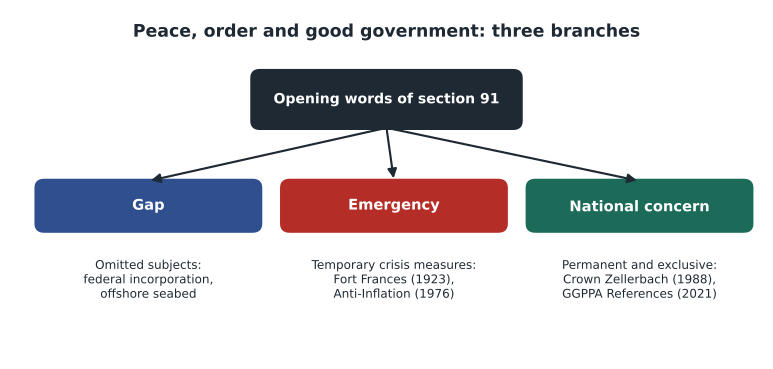
The opening words of section 91 give Parliament power 'to make Laws for the Peace, Order, and good Government of Canada, in relation to all Matters not coming within the Classes of Subjects by this Act assigned exclusively to the Legislatures of the Provinces'. The phrase, usually shortened to POGG, is the federal residual power. Courts have recognized three ways it operates: the gap branch, the emergency branch and the national concern branch.
The gap branch
Some matters fall into gaps in the lists because the framers did not foresee them or the lists simply omit them. The residual power fills those gaps. The incorporation of companies with objects other than provincial is an example: section 92(11) gives provinces power over 'the Incorporation of Companies with Provincial Objects', so the power to incorporate companies with federal or national objects falls to Parliament by implication. Jurisdiction over offshore areas is another. In Reference re Offshore Mineral Rights of British Columbia, [1967] SCR 792, and Reference re Newfoundland Continental Shelf, [1984] 1 SCR 86, the Supreme Court held that rights to the seabed beyond provincial boundaries belonged to Canada, partly under the residual power. Federal-provincial accords on offshore petroleum, such as the Canada-Newfoundland and Labrador and Canada-Nova Scotia accords, now share management and revenues by agreement.
The emergency branch
In a genuine emergency, Parliament may temporarily legislate on matters that would normally be provincial. In Fort Frances Pulp and Paper Co. v. Manitoba Free Press Co., [1923] AC 695, the Privy Council upheld federal control of newsprint prices continuing after the First World War, holding that the courts should defer to Parliament's view that an emergency still existed unless there was very clear evidence that it had ended. Co-operative Committee on Japanese Canadians v. Canada (Attorney General), [1947] AC 87, upheld wartime orders, including deportation orders directed at Japanese Canadians, on the same basis. Today that case stands as a warning about how broad emergency powers can be used against a minority; in 1988 the federal government formally apologized and provided redress for the wartime treatment of Japanese Canadians.
Reference re Anti-Inflation Act, [1976] 2 SCR 373, is the leading peacetime emergency case. Parliament had enacted wage and price controls covering much of the private and public sector. A majority of the Supreme Court upheld the Act as emergency legislation. Chief Justice Laskin, for four judges, held that Parliament had a rational basis for regarding double-digit inflation as an emergency, and that the Act's temporary nature supported that view. Justice Beetz, for two judges, dissented, finding that the Act had not been enacted as emergency legislation. His rejection of the national concern argument, that inflation was too broad an aggregate of matters and that treating it as a federal subject would destroy the division of powers, was endorsed by Justice Ritchie for three more judges, who nevertheless joined Laskin C.J. in upholding the Act as emergency legislation. Beetz J.'s analysis of national concern therefore commanded a majority and became highly influential. The key features of emergency legislation emerged clearly: it must be temporary, it must respond to a genuine crisis, and courts give Parliament considerable deference on whether a crisis exists.
Since 1988, federal emergency powers have been governed by the Emergencies Act, which replaced the War Measures Act. It defines four types of emergency (public welfare, public order, international and war), requires consultation with provinces, makes declarations subject to parliamentary review, and requires an inquiry afterward. The federal government invoked it for the first time in February 2022, declaring a public order emergency in response to the convoy protests and blockades in Ottawa and at border crossings. A public inquiry led by Commissioner Paul Rouleau concluded in 2023 that the threshold had been met. In Canadian Civil Liberties Association v. Canada (Attorney General), 2024 FC 42, however, Justice Mosley of the Federal Court held that the decision was unreasonable and that some measures infringed the Charter. The Federal Court of Appeal upheld that ruling in January 2026 (2026 FCA 6), and in October 2026 the Supreme Court of Canada agreed to hear the federal government's appeal. The litigation concerns the statutory threshold rather than the constitutional emergency branch itself, but it shows how sharply contested the meaning of 'emergency' remains.
The national concern branch: from Local Prohibition to Crown Zellerbach
The national concern branch allows Parliament to legislate permanently on a matter that, although it may look provincial, has become a matter of concern to Canada as a whole. Its roots lie in Russell v. The Queen (1882), 7 App Cas 829, which upheld the Canada Temperance Act, a federal local-option liquor prohibition law, and in Lord Watson's statement in the Local Prohibition case, Ontario (Attorney General) v. Canada (Attorney General), [1896] AC 348, that some matters 'in their origin local and provincial' might attain 'such dimensions as to affect the body politic of the Dominion'. In Ontario (Attorney General) v. Canada Temperance Federation, [1946] AC 193, Viscount Simon restated the test: the true test must be found in the real subject matter of the legislation, and if it goes beyond local or provincial concern and must from its inherent nature be the concern of the Dominion as a whole, it falls within POGG.
Matters recognized under this branch include aeronautics (Johannesson v. West St. Paul, [1952] 1 SCR 292), the development of the National Capital Region (Munro v. National Capital Commission, [1966] SCR 663) and nuclear energy (Ontario Hydro v. Ontario (Labour Relations Board), [1993] 3 SCR 327, where the federal declaratory power also played a role).
R. v. Crown Zellerbach Canada Ltd., [1988] 1 SCR 401, restated the national concern doctrine. A logging company had dumped woodwaste into provincial marine waters off British Columbia, in breach of the federal Ocean Dumping Control Act. The question was whether Parliament could regulate dumping in waters within a province. Justice Le Dain, for a four-to-three majority, held that marine pollution, as distinct from fresh water pollution, was a matter of national concern. He set out these propositions:
- The national concern doctrine is separate from the emergency doctrine and applies to new matters that did not exist at Confederation and to matters that, although originally local, have become matters of national concern.
- To qualify, a matter must have a singleness, distinctiveness and indivisibility that clearly distinguishes it from matters of provincial concern, and a scale of impact on provincial jurisdiction that is reconcilable with the fundamental distribution of legislative power.
- In deciding whether a matter has the required singleness, distinctiveness and indivisibility, it is relevant to consider what would be the effect on extra-provincial interests of a provincial failure to deal effectively with the control or regulation of the intra-provincial aspects of the matter. This became known as the provincial inability test.
- A matter recognized as of national concern falls under exclusive federal jurisdiction, including its intra-provincial aspects.
Justice La Forest, for the three dissenting judges, warned that marine pollution was too broad a subject and that recognizing it under POGG would give Parliament sweeping control over provincial activities affecting coastal waters. The exclusive and permanent character of national concern jurisdiction is exactly why courts are cautious in recognizing new matters.
The Greenhouse Gas Pollution Pricing Act References
In 2018 Parliament enacted the Greenhouse Gas Pollution Pricing Act. It created a federal backstop: in provinces whose own carbon pricing systems did not meet a federal benchmark, a federal fuel charge applied to fossil fuels (Part 1), and an output-based pricing system applied to large industrial emitters (Part 2). Saskatchewan, Ontario and Alberta referred the Act's constitutionality to their courts of appeal. The Saskatchewan and Ontario courts upheld it; the Alberta Court of Appeal found it unconstitutional. The Supreme Court heard the three appeals together.
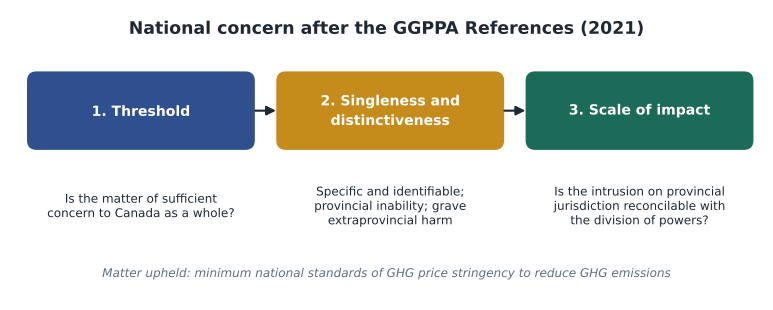
In References re Greenhouse Gas Pollution Pricing Act, 2021 SCC 11, a six-to-three majority led by Chief Justice Wagner upheld the Act under the national concern branch. The Court characterized the Act's pith and substance as 'establishing minimum national standards of GHG price stringency to reduce GHG emissions'. It then refined Crown Zellerbach into a three-step framework:
- Threshold question. Is the matter of sufficient concern to Canada as a whole to warrant consideration under the national concern doctrine? The Court found that climate change is an existential threat to human life in Canada and around the world, and that the matter easily met this threshold.
- Singleness, distinctiveness and indivisibility. The matter must be specific and identifiable and qualitatively different from matters of provincial concern. Provincial inability must be shown: the provinces must be constitutionally incapable of enacting the scheme jointly or severally, and the failure of one or more provinces to participate must have grave extraprovincial consequences. The Court found that GHG emissions are a matter of extraprovincial and international character, that a province's failure to price emissions would undermine the efforts of others, and that a system of minimum standards could not be guaranteed by provincial cooperation because any province could withdraw.
- Scale of impact. The impact on provincial jurisdiction must be reconcilable with the fundamental distribution of power. The Court stressed that the federal matter was narrow: it set only minimum pricing standards and left provinces free to design their own systems and to regulate emissions in other ways. Against that limited intrusion, the Court weighed the grave harm that climate change would cause to interests including Indigenous peoples and the environment.
Justice Côté dissented in part, finding the broad discretion given to the federal cabinet unconstitutional. Justices Brown and Rowe dissented entirely. Justice Brown found the Act was in substance a regulation of GHG emissions, a matter of provincial jurisdiction. Justice Rowe argued that the national concern branch should be a residual power of last resort, available only where a matter fits no enumerated head.
Hannah observes that the political story moved on even as the legal ruling stands. The federal government set the consumer fuel charge rate to zero as of April 1, 2025, while the output-based pricing system for industry continues. 'Which tells you something important,' Okafor-Lindqvist adds. 'The Constitution permits Parliament to act; it does not require it. A finding that a law is valid is not a finding that it is wise or permanent.'
Limits on national concern
The Reference re Impact Assessment Act, 2023 SCC 23, decided two years later, shows the limits. The federal government did not defend the impact assessment scheme for designated projects on national concern grounds; it argued it was a valid exercise of several enumerated powers. The majority found the scheme overreached by letting federal decision-makers consider a project's effects on matters beyond federal jurisdiction, such as broad public interest factors and greenhouse gas emissions, when deciding whether projects like provincial mines or highways could proceed. The case confirms that the GGPPA References did not hand Parliament general jurisdiction over the environment. Each federal environmental measure must still be tied to a federal head of power or to a narrowly defined national concern matter.
In 2024 Parliament amended the Impact Assessment Act to respond to the reference, narrowing the factors federal decision-makers must consider and tying them more closely to federal jurisdiction.
Writing a POGG answer
Okafor-Lindqvist gives Section B a sequence for any problem where POGG might apply:
- First ask whether an enumerated federal head covers the matter. POGG is residual, and courts prefer enumerated heads where they fit.
- If the problem involves a sudden crisis and temporary measures, consider the emergency branch, including the evidence for a rational basis and the measure's temporary character.
- If the matter is new or has become national in scope, apply the GGPPA three-step framework: threshold, singleness and distinctiveness (with provincial inability), and scale of impact.
- Define the matter narrowly. The narrower the federal matter, the easier it is to show a reconcilable scale of impact.
- Remember the consequence: if a matter is recognized as one of national concern, it becomes a permanent, exclusive federal head, including its local aspects, although provinces may still legislate on related matters through the double aspect doctrine.
Common mistakes
MistakePOGG lets Parliament legislate on anything important to the whole country.
InsteadOnly matters with singleness, distinctiveness and indivisibility, provincial inability and a reconcilable scale of impact qualify, and the threshold is high.
MistakeThe emergency branch gives Parliament permanent new powers.
InsteadEmergency legislation must be temporary; national concern is permanent and exclusive.
MistakeThe GGPPA References gave Parliament jurisdiction over the environment.
InsteadThe matter was narrowly defined as minimum national standards of GHG price stringency; the Impact Assessment Act Reference confirms the limits.
MistakeProvincial inability means provinces are unwilling to act.
InsteadIt means provinces are constitutionally incapable of enacting the scheme jointly or severally, and one province's failure would have grave extraprovincial consequences.
Practice problems
Work each problem on paper first, then reveal the answer to check.
Parliament enacts a permanent law setting maximum class sizes in all public schools, saying education is a matter of national concern. Is it likely valid under POGG?
Show answer
No. Education is assigned to the provinces by section 93, so it is not a matter 'not coming within' provincial classes. Even apart from that, class sizes lack singleness and distinctiveness, provinces are fully capable of regulating them, and the scale of impact on provincial jurisdiction would be enormous.
What were the three steps of the national concern framework in the GGPPA References?
Show answer
A threshold question of sufficient concern to Canada as a whole; singleness, distinctiveness and indivisibility, including provincial inability; and a scale of impact on provincial jurisdiction reconcilable with the division of powers.
Why did the Supreme Court uphold the Anti-Inflation Act in 1976 but reject inflation as a matter of national concern?
Show answer
A majority found Parliament had a rational basis for treating inflation as a temporary emergency. But a majority also held inflation was too broad an aggregate of matters to be a national concern subject, because recognizing it would erase the division of powers.
Summary and key terms
- POGG is the federal residual power, operating through the gap, emergency and national concern branches.
- The gap branch fills omissions such as the incorporation of federal companies and offshore resources.
- The emergency branch supports temporary measures in genuine crises, with deference to Parliament (Fort Frances; Anti-Inflation Reference); the Emergencies Act governs modern emergency declarations.
- Crown Zellerbach requires singleness, distinctiveness and indivisibility, provincial inability and a reconcilable scale of impact.
- The GGPPA References refined the test into three steps and upheld minimum national standards of GHG price stringency.
- National concern matters become permanent, exclusive federal heads, which is why courts define them narrowly.
- POGG
- Peace, order and good government: the opening words of section 91, giving Parliament residual legislative power.
- Gap branch
- Use of POGG to fill matters omitted from the enumerated lists.
- Emergency branch
- Use of POGG to support temporary federal laws responding to a genuine national crisis.
- National concern branch
- Use of POGG for matters that have become of concern to Canada as a whole and meet the Crown Zellerbach and GGPPA tests.
- Provincial inability
- The provinces' constitutional incapacity to address a matter jointly or severally, where one province's failure would cause grave extraprovincial harm.
- Scale of impact
- The extent to which recognizing a national concern matter would intrude on provincial jurisdiction.
Lesson quiz · 5 questions
Score 60% or more to complete this lesson.
Create a free account to save your progress, take quizzes and earn a certificate.