
LAWC-101 · Lesson 4 of 12 · 18 min
Unwritten principles and the Secession Reference
▶ Video coming soon A video version of this lesson is on the way.
On Tuesday, October 20, 2026, the morning after Albertans voted on whether their province should begin the legal process toward a binding referendum on leaving Canada, Okafor-Lindqvist arrives with the results printed on a single sheet. Preliminary counts show roughly three in four voters chose to remain a province of Canada. Hannah Kowalczyk, who grew up in Calgary, says her family split on the question. Sophie Tremblay-Hart, who was born in Gatineau the year after Quebec's 1995 referendum, says her parents still talk about that night. 'Good,' Okafor-Lindqvist says. 'Then you both know why the case we are reading today exists.'
This lesson is about the principles that underlie the written Constitution, and about the case that made them famous: Reference re Secession of Quebec, [1998] 2 SCR 217. It also covers how those principles have been used, and limited, since 1998.
Why unwritten principles?
The written Constitution is incomplete. It says nothing about many matters fundamental to Canadian government, from the existence of the Prime Minister to what happens if a province votes to leave. Its text was drafted for a nineteenth-century colony and amended piecemeal. Courts have filled some of the gaps by identifying principles that, in the Supreme Court's words, are the 'vital unstated assumptions upon which the text is based'. The preamble to the Constitution Act, 1867, with its reference to a constitution 'similar in Principle to that of the United Kingdom', has served as a textual doorway for some of them.
Before 1982, courts occasionally reasoned from such principles. In Reference re Alberta Statutes, [1938] SCR 100, Chief Justice Duff suggested that the parliamentary institutions created by the 1867 Act presupposed free public discussion of public affairs, which a province could not abolish. In Switzman v. Elbling, [1957] SCR 285, Rand J. relied on a similar idea of an 'implied bill of rights' when the Court struck down Quebec's 'Padlock Act' as an invasion of federal criminal law power. These dicta never became a binding doctrine, but they show that Canadian judges have long looked beneath the text.
The Secession Reference
After the 1995 Quebec referendum, in which the 'No' side won by a margin of about one percentage point, the federal government referred three questions to the Supreme Court. Could Quebec secede unilaterally under the Constitution of Canada? Did international law give Quebec a right to secede unilaterally? If the two conflicted, which would prevail? The Quebec government refused to participate, so the Court appointed an amicus curiae, André Joli-Coeur, to argue the contrary position.
The Court first held that the reference was justiciable. The questions were legal questions about the Constitution, and the Court's role was not to decide the political wisdom of secession but to clarify the legal framework within which political decisions would be made.
The four principles
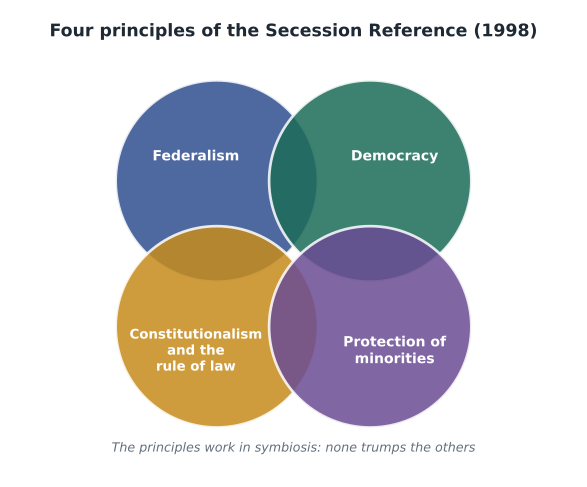
The heart of the opinion identifies four fundamental and organizing principles of the Constitution, which function 'in symbiosis'. No one principle trumps or excludes the others.
- Federalism. The Constitution recognizes the diversity of the component parts of Confederation and the autonomy of provincial governments to develop their societies within their spheres. Federalism enables citizens to participate in different collectivities and pursue objectives at both national and provincial levels. The Court noted that the social and demographic reality of Quebec, with its French-speaking majority, explains its existence as a political unit and was a central reason for choosing a federal structure in 1867.
- Democracy. Canadian democracy is more than majority rule. It includes the idea that the legitimacy of laws depends on their being enacted by representative institutions, and it operates within a federal system where there are many majorities, provincial and national. Democracy also implies a continuous process of discussion and a duty to engage with dissenting voices.
- Constitutionalism and the rule of law. Government action must comply with the law, including the Constitution. The rule of law requires an actual order of positive laws, one law for all, and a relationship between state and individual regulated by law. Constitutionalism places certain matters beyond the reach of simple majorities by entrenching them in a constitution that can only be changed by special procedures.
- Protection of minorities. The Court pointed to the protections for denominational schools, language rights and section 35 Aboriginal and treaty rights as evidence that respect for minorities is an independent principle underlying the constitutional order.
The answers
On the first question, the Court held that Quebec could not secede unilaterally under the Constitution. Secession would require an amendment to the Constitution of Canada, which in turn would require negotiation. A referendum result, however clear, has no direct legal effect and could not by itself bring about secession.
But the Court did not stop there. Because the four principles work together, a clear majority vote in Quebec on a clear question in favour of secession would give rise to a reciprocal obligation on all parties to Confederation, including the federal government and the other provinces, to negotiate constitutional changes in response. The negotiations would have to be conducted in accordance with the four principles and would need to address the interests of the federal government, Quebec, the other provinces, other participants including Aboriginal peoples, and the rights of all Canadians inside and outside Quebec. The Court emphasized that neither side could insist on its position: Quebec could not demand secession on its own terms, and the rest of Canada could not ignore a clear expression of democratic will. Whether a majority and question were clear would be for political actors, not courts, to judge.
On the second question, the Court held that international law does not give Quebec a right to secede unilaterally. The right of a people to self-determination is normally fulfilled through internal self-determination within an existing state. A right to external self-determination, meaning secession, arises at most for colonial peoples, peoples subject to alien subjugation, domination or exploitation, and possibly peoples denied any meaningful exercise of internal self-determination. Quebec fit none of these categories. The Court also noted that a successful secession might in fact be recognized by other states, but recognition would depend on facts and on the legitimacy of the process, including respect for the four principles.
Because the answers to the first two questions did not conflict, the third question did not need to be answered.
The Clarity Act and Quebec's response
Parliament responded with the Clarity Act, S.C. 2000, c. 26. It directs the House of Commons to consider, within thirty days after a provincial government officially releases a referendum question on secession, whether the question is clear. A question that asks only for a mandate to negotiate, or that offers options other than secession such as economic or political arrangements with Canada, would not be clear. After a vote, the House is to consider whether there is a clear expression of will by a clear majority, taking into account the size of the majority, the turnout and other relevant matters. The Act states that no minister may propose a constitutional amendment to effect secession unless the House has found a clear question and a clear majority and negotiations have addressed matters such as the division of assets and debts, boundary changes, and the rights, interests and territorial claims of Aboriginal peoples.
Quebec's National Assembly answered with An Act respecting the exercise of the fundamental rights and prerogatives of the Québec people and the Québec State (2000), commonly called Bill 99. It declares that the Quebec people may determine its political regime and legal status, and that the winning option in a referendum is the one that obtains a majority of valid votes cast, fifty percent of the votes plus one. A challenge to Bill 99 ended in Henderson c. Procureure générale du Québec, 2021 QCCA 565, where the Quebec Court of Appeal upheld the Act, reading it as consistent with the Constitution and the Secession Reference rather than as authorizing a unilateral declaration of independence.
Alberta, 2026
The Secession Reference stopped being a Quebec story in 2025 and 2026. Alberta lowered the signature thresholds in its Citizen Initiative Act in 2025, and competing petitions followed: one, led by former deputy premier Thomas Lukaszuk, to affirm that Alberta should remain in Canada, and one by separatist groups seeking a referendum on independence. On May 13, 2026, in Athabasca Chipewyan First Nation v. Alberta (Chief Electoral Officer), the Court of King's Bench of Alberta quashed the separatist petition, holding that the Crown's duty to consult First Nations whose treaty rights would be affected had not been met. The premier promised an appeal. The provincial government then put a question on the October 19, 2026 ballot asking whether Alberta should remain a province of Canada or whether the government should begin the legal process required under the Constitution to hold a binding referendum on separation.
Okafor-Lindqvist asks the class to analyze the question through the Secession Reference and the Clarity Act. Arjun notes that the question was deliberately two steps removed from secession: a 'leave' vote would only have started a process toward a later referendum. Daniel points out that the Secession Reference expressly listed Aboriginal peoples among those whose interests must be addressed in any negotiation, and that most of Alberta is covered by Treaties 6, 7 and 8, made with the Crown. Sophie observes that Premier Danielle Smith opposed independence and said after the vote that she would not hold another referendum while in office. 'The law did not decide this vote,' Okafor-Lindqvist concludes. 'But it shaped every choice about how the question was asked, who had to be consulted and what a result would have meant.'
Other unwritten principles
The Supreme Court has recognized several other principles, some before and some after the Secession Reference:
- Judicial independence. In Reference re Remuneration of Judges of the Provincial Court of Prince Edward Island, [1997] 3 SCR 3, the Court held that the preamble protects the independence of all courts, including provincially appointed ones, and required independent commissions to make recommendations on judicial salaries. Provincial Court Judges' Association of New Brunswick v. New Brunswick (Minister of Justice), 2005 SCC 44, later clarified that governments may depart from commission recommendations for rational reasons.
- Parliamentary privilege, recognized in New Brunswick Broadcasting (1993) and discussed in lesson 2.
- The honour of the Crown, which governs the Crown's dealings with Indigenous peoples and grounds the duty to consult (Haida Nation v. British Columbia (Minister of Forests), 2004 SCC 73).
- Constitutional architecture. In the Senate Reform Reference (2014 SCC 32), the Court held that the Constitution must be read as having an internal architecture, so that changes to the fundamental nature or role of an institution engage the amending formula even where no specific text is altered.
Lower courts have also applied the principle of protection of minorities. In Lalonde v. Ontario (Commission de restructuration des services de santé) (2001), 56 OR (3d) 505, the Court of Appeal for Ontario quashed a directive that would have reduced Hôpital Montfort, Ontario's only francophone teaching hospital, to a much smaller role, holding that the commission had failed to give weight to the principle in exercising its discretion.
The limits: Toronto v. Ontario
How far can courts go with unwritten principles? The question came to a head after Ontario passed the Better Local Government Act, 2018 in the middle of Toronto's municipal election campaign, cutting the number of city council wards from 47 to 25. The city and others argued that the law violated freedom of expression under section 2(b) of the Charter and the unwritten principle of democracy.
In Toronto (City) v. Ontario (Attorney General), 2021 SCC 34, a five-to-four majority upheld the Act. On unwritten principles, Chief Justice Wagner and Justice Brown wrote that they have full legal force but serve two functions: they help courts interpret constitutional text, and they can develop structural doctrines unstated in the text but necessarily implied by it, such as the core jurisdiction of superior courts. They cannot be used, on their own, as an independent basis to invalidate legislation. The principle of democracy therefore could not strike down the Act, and municipalities, being creatures of provincial statute, have no constitutional status of their own. The dissent, written by Justice Abella, would have found a breach of section 2(b) and expressed a broader view of the role of unwritten principles.
Okafor-Lindqvist draws the line for exam purposes. Unwritten principles are real law. They help answer questions the text leaves open, they shape how provisions are read, and they ground doctrines such as the duty to negotiate after a clear secession vote. But in a federalism problem you must still anchor any argument of invalidity in sections 91 and 92 or another provision of the written Constitution.
Common mistakes
MistakeThe Secession Reference held that Quebec has no right to secede in any circumstances.
InsteadIt held there is no right to secede unilaterally. A clear majority on a clear question would create a duty on all parties to negotiate, and secession could occur through a constitutional amendment.
MistakeCourts decide whether a referendum question and majority are clear.
InsteadThe Court said clarity is for political actors to assess. The Clarity Act gives that role to the House of Commons.
MistakeUnwritten principles can be used to strike down legislation directly.
InsteadToronto v. Ontario holds they are interpretive and structural aids, not independent grounds of invalidity.
MistakeInternational law gives any province a right to secede if a majority votes for it.
InsteadExternal self-determination arises only for colonial or oppressed peoples, or possibly those denied meaningful internal self-determination.
Practice problems
Work each problem on paper first, then reveal the answer to check.
A provincial government asks voters: 'Do you authorize the government to negotiate a new partnership with Canada?' A majority says yes. Under the Clarity Act, is this a clear question?
Show answer
No. The Act says a question asking only for a mandate to negotiate, or offering arrangements other than secession, would not be clear. The House of Commons would be expected to find the question unclear.
List the four principles the Supreme Court identified in the Secession Reference.
Show answer
Federalism; democracy; constitutionalism and the rule of law; protection of minorities.
A municipality argues that a provincial law cancelling its election violates the unwritten principle of democracy. What is the main obstacle after 2021?
Show answer
Toronto v. Ontario: unwritten principles cannot alone invalidate legislation, and municipalities have no independent constitutional status. The claim would need a textual anchor, such as section 2(b) or section 3 of the Charter (which applies only to federal and provincial elections).
Summary and key terms
- Unwritten principles are the unstated assumptions underlying the constitutional text; the 1867 preamble is one of their textual sources.
- The Secession Reference identified four principles: federalism, democracy, constitutionalism and the rule of law, and protection of minorities.
- No province may secede unilaterally under Canadian or international law, but a clear majority on a clear question would create a duty to negotiate.
- The Clarity Act gives the House of Commons the role of assessing question and majority; Quebec's Bill 99 was upheld in 2021 as consistent with the Constitution.
- Other recognized principles include judicial independence, parliamentary privilege, the honour of the Crown and constitutional architecture.
- Toronto v. Ontario (2021) limits unwritten principles to interpretive and structural roles; they cannot alone invalidate laws.
- Amicus curiae
- A 'friend of the court' appointed or permitted to make submissions, such as the lawyer appointed to argue Quebec's side in the Secession Reference.
- Justiciable
- Suitable for decision by a court because it raises a legal rather than a purely political question.
- Duty to negotiate
- The reciprocal obligation, identified in the Secession Reference, that would follow a clear majority vote on a clear question of secession.
- Self-determination
- The right of peoples to determine their political status, normally exercised internally within an existing state.
- Clarity Act
- The federal statute (S.C. 2000, c. 26) setting out how the House of Commons assesses the clarity of a secession question and majority.
- Constitutional architecture
- The internal structure of the Constitution, which the amending formula protects even where no specific text is changed.
Lesson quiz · 5 questions
Score 60% or more to complete this lesson.
Create a free account to save your progress, take quizzes and earn a certificate.