
LAWC-101 · Lesson 5 of 12 · 17 min
The division of powers
▶ Video coming soon A video version of this lesson is on the way.
For the fifth class, Okafor-Lindqvist hands out a two-column chart. The left column lists the classes of subjects in section 91 of the Constitution Act, 1867; the right lists those in section 92. 'This is the map,' she says. 'Most of your exam will be about the places where the map is unclear: where a law could fit in either column, or where it seems to fit in neither. But you cannot read the unclear places until you know the clear ones.'
This lesson surveys the distribution of legislative powers in Part VI of the 1867 Act: the main federal and provincial heads, the residual and concurrent powers, the special provisions for works and undertakings, and the history that shaped how the lists are read today.
The structure of sections 91 and 92
Section 91 begins with a general grant: Parliament may make laws for the 'Peace, Order, and good Government of Canada, in relation to all Matters not coming within the Classes of Subjects by this Act assigned exclusively to the Legislatures of the Provinces'. It then says that, 'for greater Certainty, but not so as to restrict the Generality of the foregoing Terms', exclusive federal authority extends to an enumerated list of classes of subjects. The original list had twenty-nine items; later amendments added unemployment insurance (91(2A), 1940) and old age pensions (via section 94A, 1951, amended 1964). The closing paragraph of section 91 provides that matters within the enumerated federal classes are not to be deemed to come within the class of matters of a local or private nature in section 92(16).
Section 92 gives provincial legislatures exclusive power over sixteen classes of subjects. It has no general grant equivalent to the federal peace, order and good government clause, although section 92(16), 'Generally all Matters of a merely local or private Nature in the Province', plays a similar role for local matters.
The basic design is therefore exclusive, enumerated powers on both sides, with the residue going to Parliament. Anything that does not fall within a provincial class belongs to Parliament under the opening words of section 91. In practice, however, the provincial head of 'Property and Civil Rights in the Province' in section 92(13) has proved so broad that it functions as a provincial residue for most private law and economic regulation.
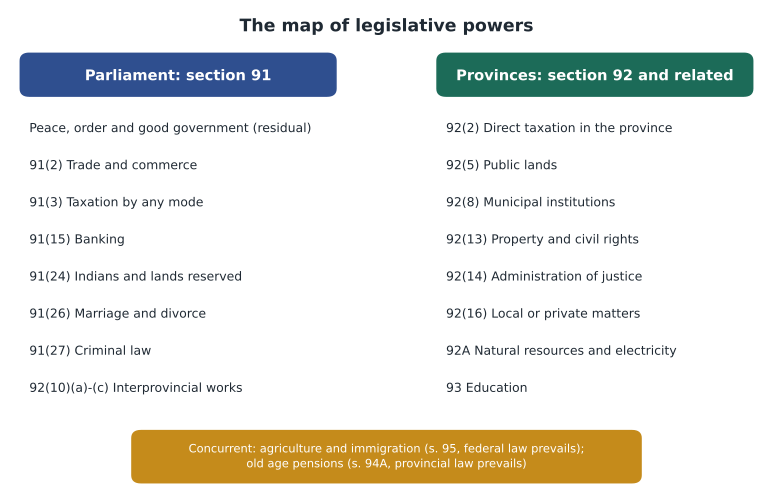
The main federal heads
Some of the federal classes you will meet most often:
| Section | Class of subject | Typical modern laws |
|---|---|---|
| 91 (opening) | Peace, order and good government | Emergencies, national concern matters such as marine pollution, aeronautics and minimum national standards of greenhouse gas pricing |
| 91(2) | The regulation of trade and commerce | Interprovincial and international trade, competition law, trademarks |
| 91(2A) | Unemployment insurance | Employment Insurance Act |
| 91(3) | The raising of money by any mode or system of taxation | Income Tax Act, GST |
| 91(10) | Navigation and shipping | Canada Shipping Act, 2001 |
| 91(12) | Sea coast and inland fisheries | Fisheries Act |
| 91(14) to (20) | Currency, banking, bills of exchange, interest | Bank Act, Currency Act |
| 91(21) | Bankruptcy and insolvency | Bankruptcy and Insolvency Act |
| 91(22) and (23) | Patents and copyrights | Patent Act, Copyright Act |
| 91(24) | Indians, and lands reserved for the Indians | Indian Act; federal law on Indigenous child and family services |
| 91(25) | Naturalization and aliens | Citizenship Act |
| 91(26) | Marriage and divorce | Divorce Act; Civil Marriage Act |
| 91(27) | Criminal law, except the constitution of courts, including procedure in criminal matters | Criminal Code, Cannabis Act (prohibitions), Controlled Drugs and Substances Act |
| 91(28) | Penitentiaries | Corrections and Conditional Release Act |
Section 91(24) was interpreted in Daniels v. Canada (Indian Affairs and Northern Development), 2016 SCC 12, to include Métis and non-status Indians as well as status Indians and Inuit. Note that section 91(24) gives Parliament power over a group of people and their lands, not over every activity of those people, a point that matters when provincial laws of general application are applied to First Nations, which lesson 10 discusses.
The main provincial heads
| Section | Class of subject | Typical modern laws |
|---|---|---|
| 92(2) | Direct taxation within the province | Provincial income tax, retail sales tax, property tax |
| 92(5) | Management and sale of public lands and timber | Public lands and forestry statutes |
| 92(7) | Hospitals and charities (other than marine hospitals) | Public hospitals legislation |
| 92(8) | Municipal institutions | Municipal Act, City of Toronto Act |
| 92(9) | Shop, saloon, tavern and auctioneer licences for revenue | Licensing schemes |
| 92(10) | Local works and undertakings, with exceptions | Provincial railways, local utilities, intraprovincial trucking |
| 92(13) | Property and civil rights in the province | Contracts, torts, property, labour relations, securities, insurance, most professions |
| 92(14) | The administration of justice in the province | Provincial courts, civil procedure, policing |
| 92(15) | Penalties to enforce valid provincial laws | Provincial offences |
| 92(16) | Matters of a merely local or private nature | Local health, highway traffic aspects, some public order matters |
| 92A | Non-renewable natural resources, forestry resources and electrical energy | Oil and gas conservation, resource royalties, electricity generation |
| 93 | Education, subject to denominational rights | Education Act |
Health is the best example of a subject that appears in neither list. As the Supreme Court said in Schneider v. The Queen, [1982] 2 SCR 112, health is an 'amorphous topic' that can be addressed by either level depending on the aspect involved. The provinces regulate hospitals, health professions and insurance plans under sections 92(7), 92(13) and 92(16). Parliament regulates dangerous drugs and products under the criminal law power, and influences provincial health care through the spending power and the Canada Health Act. The environment, similarly, was described in Friends of the Oldman River Society v. Canada (Minister of Transport), [1992] 1 SCR 3, as a diffuse subject that cuts across many heads of power.
Concurrent powers
A few subjects are expressly concurrent. Under section 95, both Parliament and the provincial legislatures may make laws about agriculture and immigration, but a provincial law has effect only so long as it is not repugnant to an Act of Parliament. Under section 94A, Parliament may make laws about old age pensions and supplementary benefits, but no federal law affects the operation of any present or future provincial law on the subject. This is the only express case of provincial paramountcy, and it is why Quebec runs its own Quebec Pension Plan while the rest of Canada participates in the Canada Pension Plan. Section 92A(2) and (3) give provinces power over the export of resources from the province to other parts of Canada, subject to federal paramountcy and a ban on discrimination in prices or supplies.
Beyond these express cases, overlapping laws are common because of the double aspect doctrine, examined in lesson 6. Driving offences, for example, appear both in the Criminal Code and in provincial highway traffic acts.
Works and undertakings
Section 92(10) gives provinces power over 'Local Works and Undertakings' but excepts three categories that therefore fall to Parliament: (a) lines of ships, railways, canals, telegraphs and other works and undertakings connecting the province with others or extending beyond the province; (b) lines of steamships between the province and any British or foreign country; and (c) works that, although wholly situated within a province, are declared by Parliament to be for the general advantage of Canada or of two or more provinces.
Through section 92(10)(a), Parliament regulates interprovincial railways, pipelines, trucking firms, bus lines, telephone companies and broadcasters. In Alberta Government Telephones v. Canada (CRTC), [1989] 2 SCR 225, a provincially owned telephone system that connected with systems in other provinces was held to be an interprovincial undertaking under federal jurisdiction. The Privy Council placed radio under federal jurisdiction in Re Regulation and Control of Radio Communication in Canada, [1932] AC 304, and aeronautics in Re Regulation and Control of Aeronautics in Canada, [1932] AC 54, the latter later confirmed on peace, order and good government grounds in Johannesson v. West St. Paul, [1952] 1 SCR 292.
The declaratory power in section 92(10)(c) lets Parliament unilaterally bring a local work under federal jurisdiction. It was used several hundred times, mostly for railways and grain elevators, and is now rarely invoked; its broad and unilateral character makes it controversial.
Federal undertakings carry their employees with them. Labour relations are generally provincial under property and civil rights, as the Privy Council held in Toronto Electric Commissioners v. Snider, [1925] AC 396. But employees of federal undertakings, such as banks, airlines, railways and telecommunications companies, are governed by the Canada Labour Code, because labour relations are an integral part of operating the undertaking (Reference re Industrial Relations and Disputes Investigation Act, [1955] SCR 529, the Stevedoring case). In Tessier Ltée v. Quebec (Commission de la santé et de la sécurité du travail), 2012 SCC 31, the Court explained that a provincial company becomes federal for labour purposes only if its federal work is a significant part of its operations or it is integral to a federal undertaking.
Treaties and the division of powers
Canada's executive makes treaties under the royal prerogative, but treaties do not change domestic law unless implemented by legislation. Who implements them? Section 132 of the 1867 Act gave Parliament power to perform obligations of Canada 'as Part of the British Empire' under treaties between the Empire and foreign countries. Once Canada began making treaties in its own right, that provision no longer applied.
In Canada (Attorney General) v. Ontario (Attorney General), [1937] AC 326, the Labour Conventions case, the Privy Council held that Parliament could not implement International Labour Organization conventions on hours of work and minimum wages, because the subject matter fell within provincial jurisdiction. Lord Atkin famously wrote that while the ship of state now sails on larger ventures and into foreign waters, 'she still retains the water-tight compartments which are an essential part of her original structure'. The result is that implementing treaties on provincial subjects requires provincial legislation, which is why federal-provincial cooperation is essential for Canada's trade and environmental commitments. Some judges and scholars have questioned the case, and the Supreme Court has hinted it might revisit it, but it remains good law.
History: from Macdonald's design to provincial autonomy
Sir John A. Macdonald wanted a strongly centralized federation, and the text of 1867 reflects that: the federal residual power, the power to appoint Lieutenant Governors and superior court judges, the power to disallow provincial laws (sections 56 and 90), and the declaratory power. Many of these centralizing features have fallen into disuse. Disallowance has not been used since 1943, and Reference re Power of Disallowance and Power of Reservation, [1938] SCR 71, confirmed it remained legally available.
The Privy Council, especially through Lord Watson in the 1890s and Viscount Haldane in the early twentieth century, read the federal powers narrowly and the provincial powers broadly. Citizens Insurance Co. v. Parsons (1881), 7 App Cas 96, held that the regulation of insurance contracts was within property and civil rights, and limited trade and commerce to interprovincial and international trade plus, perhaps, general regulation of trade affecting the whole Dominion. The Local Prohibition case, Ontario (Attorney General) v. Canada (Attorney General), [1896] AC 348, confined the peace, order and good government power to matters of national concern that go beyond local or provincial concern. Later decisions reduced that power to emergencies for several decades.
Canadian commentators long debated whether the Privy Council betrayed the framers' intentions or protected Quebec and regional diversity from a centralizing majority. Since 1949 the Supreme Court has charted a middle course, expanding some federal powers, such as national concern and the general branch of trade and commerce, while repeatedly stressing respect for provincial autonomy. Hannah, from Calgary, and Sophie, from Gatineau, find themselves on the same side of that debate for once.
Exclusivity and modern flexibility
The language of sections 91 and 92 is exclusive. Early cases sometimes treated the lists as 'watertight compartments', with each law fitting in only one. Modern doctrine is more flexible. In Canadian Western Bank v. Alberta, 2007 SCC 22, the Court described the dominant tide of constitutional interpretation as favouring cooperative federalism and the concurrent operation of laws enacted by both levels, provided they do not conflict. Lessons 6 to 10 explain the tools that make this possible: pith and substance, the double aspect doctrine, ancillary powers, interjurisdictional immunity and paramountcy.
Okafor-Lindqvist ends with a practical instruction: 'When a problem gives you a law, find the two or three heads of power it might fall under, one federal and one provincial at least. Then you are ready to characterize it.'
Common mistakes
MistakeHealth is a provincial head of power.
InsteadHealth appears in neither list; both levels legislate on aspects of it (Schneider). Provinces run hospitals and insurance; Parliament uses criminal law and spending.
MistakeParliament can implement any treaty Canada signs.
InsteadThe Labour Conventions case holds that implementing treaties on provincial subjects requires provincial legislation.
MistakeLabour relations are always provincial.
InsteadThey are generally provincial, but federal undertakings such as banks, airlines and interprovincial railways fall under the Canada Labour Code.
MistakeConcurrent jurisdiction means either level wins any conflict.
InsteadUnder section 95, federal law prevails; under section 94A, provincial pension laws prevail.
Practice problems
Work each problem on paper first, then reveal the answer to check.
A trucking company based in Manitoba hauls freight between Winnipeg and Regina every week. Which level of government regulates its labour relations, and why?
Show answer
Parliament. A trucking undertaking that regularly crosses provincial boundaries is an interprovincial undertaking under section 92(10)(a), and its labour relations are part of operating it (Stevedoring; Tessier).
Why does Quebec have its own pension plan when old age pensions are a federal head of power?
Show answer
Section 94A gives Parliament power over old age pensions but provides that no federal law affects the operation of provincial pension laws, an express rule of provincial paramountcy.
Ottawa signs a treaty committing Canada to minimum rental housing standards. Can Parliament implement it alone?
Show answer
Probably not. Residential tenancies fall under property and civil rights in section 92(13). Under the Labour Conventions case, provincial legislation would be needed.
Summary and key terms
- Section 91 gives Parliament a general power over peace, order and good government plus enumerated heads; section 92 gives provinces sixteen enumerated heads.
- The residue belongs to Parliament, but property and civil rights in section 92(13) is so broad that it covers most private law and economic regulation.
- Concurrent powers exist for agriculture and immigration (federal paramountcy) and old age pensions (provincial paramountcy).
- Section 92(10) puts interprovincial and international works and undertakings, and declared works, under federal jurisdiction, along with their labour relations.
- Treaties on provincial subjects must be implemented by provincial legislation (Labour Conventions).
- The Privy Council read the lists in a provincial-leaning way; modern doctrine favours flexible, cooperative federalism (Canadian Western Bank).
- Head of power
- One of the classes of subjects listed in sections 91, 92 and related provisions on which a legislature may make laws.
- Residual power
- Authority over matters not assigned to either level; in Canada it belongs to Parliament through the peace, order and good government clause.
- Concurrent power
- A subject on which both levels may legislate, with a rule for which prevails in a conflict.
- Federal undertaking
- A work or business that falls under federal jurisdiction, such as an interprovincial railway, airline or bank.
- Declaratory power
- Parliament's power under section 92(10)(c) to declare a local work to be for the general advantage of Canada and so bring it under federal jurisdiction.
- Watertight compartments
- Lord Atkin's image, from the Labour Conventions case, of the exclusive federal and provincial spheres.
Lesson quiz · 5 questions
Score 60% or more to complete this lesson.
Create a free account to save your progress, take quizzes and earn a certificate.