
LAWC-101 · Lesson 6 of 12 · 18 min
Pith and substance and the double aspect doctrine
▶ Video coming soon A video version of this lesson is on the way.
Arjun Mehta arrives at the sixth class with a flowchart drawn in three colours. It starts with 'Law' in a box at the top and ends with 'Valid' or 'Invalid' at the bottom. Okafor-Lindqvist studies it for a long moment and then circles the second box, labelled 'What is the law about?' 'Everything in this course depends on this box,' she says. 'Get it wrong, and the rest of your flowchart does not matter.'
This lesson covers the core method courts use to decide whether a law is within the enacting legislature's jurisdiction: characterizing the law's pith and substance and classifying it under a head of power. It also covers three ideas that make the method work in a world of overlapping laws: incidental effects, the ancillary powers doctrine, and the double aspect doctrine.
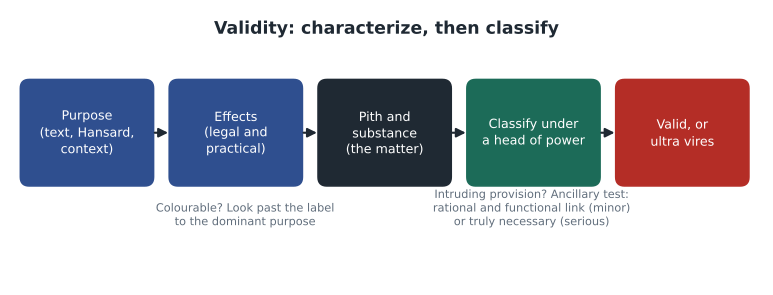
Two steps: characterization and classification
Every validity analysis has two steps. First, the court identifies the 'matter' of the law, its pith and substance or dominant characteristic. Second, it classifies that matter under one of the classes of subjects in sections 91 and 92 or another constitutional provision. If the matter falls within a head of power belonging to the enacting legislature, the law is valid, even if it has effects on matters within the other level's jurisdiction.
The Supreme Court restated the approach in Canadian Western Bank v. Alberta, 2007 SCC 22, and has applied it in every major federalism case since, including References re Greenhouse Gas Pollution Pricing Act, 2021 SCC 11, and Reference re Impact Assessment Act, 2023 SCC 23. Arjun's second box, 'What is the law about?', is the characterization step.
Identifying pith and substance
To characterize a law, courts look at its purpose and its effects.
- Purpose. What is the legislature trying to achieve? Courts consider intrinsic evidence, such as the law's title, preamble, purpose clauses and overall structure, and extrinsic evidence, such as Hansard debates, committee reports, government publications and the circumstances in which the law was enacted.
- Effects. What does the law actually do? Courts consider the legal effects, flowing from the law's terms, and the practical effects, the consequences of applying it.
The characterization should be as precise as possible. In the Reference re Genetic Non-Discrimination Act, 2020 SCC 17, Justice Karakatsanis warned against describing a law's matter in terms so broad (such as 'health' or 'the environment') that it fits any head of power, or so narrow that it simply restates the law's provisions. She also said the court must distinguish the law's matter from the means it uses to achieve its purpose. In Ward v. Canada (Attorney General), 2002 SCC 17, a federal ban on selling whitecoat and blueback seal pelts looked like a regulation of trade, a matter often provincial. But the Court found the ban's pith and substance was the management of the fishery by preventing a commercial hunt for seal pups, which falls under the federal fisheries power in section 91(12). The sales ban was the means, not the matter.
Courts also ignore the law's wisdom and its likely effectiveness. As the Court has said many times, the question is which legislature may enact a law, not whether the law is a good one.
Colourability
Sometimes a legislature dresses up a law to look like it falls under one head when its real purpose lies elsewhere. Courts call this a colourable law and will look past its form to its substance. R. v. Morgentaler, [1993] 3 SCR 463, is the leading example. After the Supreme Court struck down the Criminal Code's abortion provisions in 1988, Nova Scotia passed the Medical Services Act and regulations prohibiting abortions outside hospitals, presented as a measure to regulate health care delivery and prevent a two-tier system. The Court examined the legislative record, including statements by members of the legislature about preventing Dr. Henry Morgentaler from opening a clinic, and concluded that the law's dominant purpose was to suppress abortion clinics as a socially undesirable practice. That made it criminal law, within federal jurisdiction, and it was invalid.
Colourability does not mean a legislature may not have mixed motives. It means that the court characterizes the law by its true dominant purpose and effects, not by its label.
Incidental effects
A law whose pith and substance falls within the enacting legislature's jurisdiction is valid even if it has incidental effects on matters within the other level's jurisdiction. Canadian Western Bank put it simply: merely incidental effects will not disturb the constitutionality of an otherwise intra vires law. A provincial consumer protection law that affects how federally chartered banks sell insurance, or a federal criminal law that affects provincial property rights, is not invalid on that account.
This principle is essential in a modern state, where almost every significant law affects matters under the other level's authority. Without it, the division of powers would be unworkable. Incidental effects may still matter at a later stage, through interjurisdictional immunity or paramountcy, but they do not affect validity.
The ancillary powers doctrine
What if part of a valid scheme, looked at alone, would fall outside the enacting legislature's jurisdiction? The ancillary powers doctrine, sometimes called the necessarily incidental doctrine, can save it. General Motors of Canada Ltd. v. City National Leasing, [1989] 1 SCR 641, sets out the test. The court asks:
- Does the impugned provision, considered alone, intrude on the other level's jurisdiction, and if so, to what extent?
- Is the overall act, or the relevant part of it, valid?
- If so, is the provision sufficiently integrated with the valid scheme? The required degree of integration depends on the seriousness of the intrusion. A minor intrusion needs only a rational and functional connection to the scheme. A serious intrusion must be truly necessary or essential to it.
In General Motors, the federal Combines Investigation Act created a civil right of action for damages caused by anti-competitive conduct. Civil rights of action are normally provincial under property and civil rights. But the Court found the intrusion limited, the Act as a whole valid under the general trade and commerce power, and the civil remedy functionally integrated with the scheme. The provision was upheld. In Quebec (Attorney General) v. Lacombe, 2010 SCC 38, by contrast, a municipal by-law amendment banning aerodromes in most of a municipality could not be saved as ancillary to valid zoning powers, because it was not rationally connected to the zoning scheme's purpose and was in substance aimed at aeronautics.
The double aspect doctrine
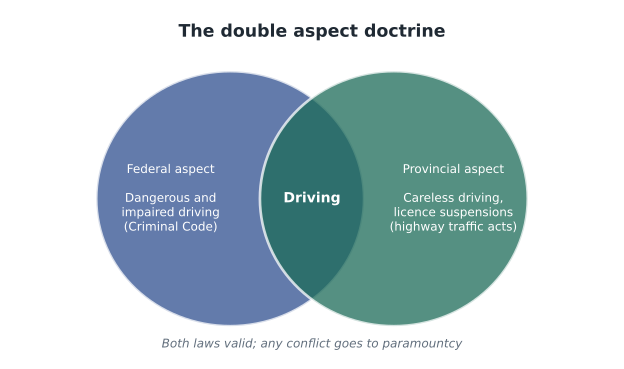
The most important tool for overlapping laws is the double aspect doctrine. Some subjects have both a federal and a provincial aspect, so that each level may legislate on them from its own perspective. The doctrine goes back to Hodge v. The Queen (1883), 9 App Cas 117, where the Privy Council said that 'subjects which in one aspect and for one purpose fall within sect. 92, may in another aspect and for another purpose fall within sect. 91'. Ontario could regulate taverns through liquor licensing, even though Parliament could address related conduct through criminal law.
Classic examples:
- Driving offences. Parliament may punish dangerous and impaired driving as crimes under the Criminal Code; provinces may regulate driving through highway traffic acts and licence suspensions. In O'Grady v. Sparling, [1960] SCR 804, a provincial offence of careless driving coexisted with the criminal offence of dangerous driving. In Ross v. Registrar of Motor Vehicles, [1975] 1 SCR 5, a provincial automatic licence suspension upon a criminal conviction operated alongside a federal court order permitting intermittent driving.
- Securities and insider trading. In Multiple Access Ltd. v. McCutcheon, [1982] 2 SCR 161, provisions on insider trading in both the Ontario Securities Act and the federal Canada Corporations Act were valid: the provincial ones as securities regulation and the federal ones as company law for federally incorporated companies.
- Maritime law and civil law. In Desgagnés Transport Inc. v. Wärtsilä Canada Inc., 2019 SCC 58, a dispute over the sale of marine engine parts engaged both federal maritime law and Quebec's Civil Code rules on sales. The majority held that the matter had both a federal maritime aspect and a provincial aspect. It declined to use interjurisdictional immunity to shield maritime law from the Civil Code, found no conflict that would engage paramountcy, and held that the Civil Code's warranty rules applied, defeating the seller's contractual limitation of liability.
The doctrine has limits. In Reference re Securities Act, 2011 SCC 66, the Court described double aspect as applying where the contrast between the relative importance of the two features is not so sharp. In Reference re Impact Assessment Act (2023), the majority stressed that the doctrine does not license one level to legislate on the other's aspect simply because a subject is diffuse; each law must still be confined to its own level's aspect. And double aspect has a consequence: where two valid laws apply to the same facts, conflicts are resolved by paramountcy, examined in lesson 10.
Characterization in the Genetic Non-Discrimination Act Reference
The 2020 reference shows how much depends on characterization. Parliament enacted the Genetic Non-Discrimination Act in 2017, making it an offence to require a person to undergo a genetic test or disclose genetic test results as a condition of providing goods or services or entering into a contract, with exceptions for health care providers and researchers. Quebec referred the Act's validity to its Court of Appeal, which found it ultra vires as a regulation of contracts and insurance, matters of property and civil rights.
The Supreme Court split five to four and upheld the Act as valid criminal law, but the majority itself split on characterization:
- Justice Karakatsanis, for three judges, characterized the Act's matter as protecting individuals' control over the detailed personal information disclosed by genetic tests, in the areas of contracting and the provision of goods and services, in order to address Canadians' fears that their genetic test results will be used against them and to prevent discrimination based on that information. That matter fell under criminal law because it targeted threats to autonomy, privacy, equality and public health.
- Justice Moldaver, for two judges, characterized the matter more narrowly as protecting health by prohibiting conduct that undermines individuals' control over the intimate information revealed by genetic testing, and agreed the Act was criminal law.
- Justice Kasirer, for four dissenting judges, characterized the Act's pith and substance as regulating contracts and the provision of goods and services, in particular insurance and employment contracts, in order to promote the uptake of genetic testing for health reasons. On that view, the law was a regulation of provincial matters and its purpose was not a valid criminal law purpose.
Theo notes that the three opinions read the same statute and reached different results largely because each described its purpose differently. 'Exactly,' Okafor-Lindqvist says. 'Characterization is where cases are won and lost. Write it carefully, support it with the law's text and its legislative history, and do not describe the matter in words that already assume the answer.'
A second example comes from Reference re Firearms Act (Can.), 2000 SCC 31. Alberta argued that requiring every gun owner to obtain a licence and register each firearm was, in substance, the regulation of property, a provincial matter, much like the registration of cars or land. The Supreme Court unanimously disagreed. Looking at the Act's purpose, shown by its history and the debates following the 1989 Montreal massacre, and at its effects, which tied licensing and registration to criminal prohibitions and penalties, the Court characterized the law as enhancing public safety by controlling access to firearms. That matter fell within criminal law. The regulatory form of the scheme, with its licences, certificates and administrative processes, did not change its character, and its effects on property were incidental. The lesson for characterization is that the same mechanism, registration, can serve a provincial property purpose or a federal public safety purpose; the court looks at which purpose dominates.
Putting the method together
For each law in a problem, Okafor-Lindqvist expects five moves:
- State the law's purpose, using its text and any legislative history the facts provide.
- State its legal and practical effects.
- Formulate the pith and substance precisely, distinguishing matter from means.
- Classify the matter under a head of power, explaining why it fits that head and not a competing one.
- If any provision intrudes on the other level's jurisdiction, apply the ancillary powers test; if the subject has two aspects, say so and flag the possibility of conflict for the paramountcy stage.
Common mistakes
MistakeA law is invalid if it has substantial effects on matters within the other level's jurisdiction.
InsteadIncidental effects, even significant ones, do not affect validity if the law's pith and substance is within jurisdiction.
MistakeThe pith and substance is the means the law uses, such as 'prohibiting sales'.
InsteadThe matter is distinct from the means (Ward). A sales ban can be fisheries management or criminal law depending on its purpose.
MistakeIf a subject has a double aspect, both laws apply and nothing more needs to be asked.
InsteadDouble aspect means both laws may be valid; any operational conflict or frustration of federal purpose is then resolved by paramountcy.
MistakeCourts ask whether the law is a good or effective way to achieve its goal.
InsteadWisdom and efficacy are irrelevant to characterization.
Practice problems
Work each problem on paper first, then reveal the answer to check.
A province bans the sale of a specific brand of energy drink, citing health, after Hansard shows members wanted to punish the manufacturer for a past scandal. How might a court characterize the law?
Show answer
It would look at purpose and effects, including Hansard. If the dominant purpose is to punish a company for perceived wrongdoing rather than to regulate product safety, the law may be colourable and, depending on its form, characterized as criminal law (Morgentaler), and so ultra vires the province.
Under the General Motors test, when must an intruding provision be 'truly necessary' to a valid scheme?
Show answer
When its intrusion into the other level's jurisdiction is serious. A minor intrusion needs only a rational and functional connection.
Give two examples of subjects with a double aspect.
Show answer
Driving offences (criminal law and provincial highway regulation); insider trading (provincial securities law and federal company law); also maritime and provincial civil law in Desgagnés.
Summary and key terms
- Validity analysis has two steps: characterize the law's pith and substance, then classify it under a head of power.
- Characterization looks at purpose and effects, using intrinsic and extrinsic evidence, and must be precise and distinguish matter from means.
- Colourable laws are characterized by their true dominant purpose (Morgentaler).
- Incidental effects on the other level's jurisdiction do not affect validity.
- The ancillary powers doctrine saves intruding provisions that are sufficiently integrated with a valid scheme (General Motors).
- The double aspect doctrine allows both levels to legislate on the same subject from different perspectives; conflicts go to paramountcy.
- Pith and substance
- The dominant purpose or true character of a law, identified by examining its purpose and effects.
- Characterization
- The first step of validity analysis: identifying the matter of the law.
- Classification
- The second step: assigning the law's matter to a head of power.
- Colourable law
- A law disguised to appear within one head of power when its true purpose falls within another.
- Ancillary powers doctrine
- The rule that a provision intruding on the other level's jurisdiction may be valid if sufficiently integrated with a valid scheme.
- Double aspect doctrine
- The principle that some subjects have both federal and provincial aspects, so laws enacted by both levels can be valid.
Lesson quiz · 5 questions
Score 60% or more to complete this lesson.
Create a free account to save your progress, take quizzes and earn a certificate.