
LAWC-101 · Lesson 2 of 12 · 18 min
Parliamentary sovereignty
▶ Video coming soon A video version of this lesson is on the way.
In the second week of term Okafor-Lindqvist writes a single sentence on the board: 'Parliament can make or unmake any law whatever, and no person or body may override or set aside its legislation.' She asks Section B whether the sentence is true in Canada. Theo Marchetti says yes, with exceptions. Sophie Tremblay-Hart says no, it was never true here. Arjun Mehta wants to know which Parliament the sentence means. By the end of the class, all three turn out to be partly right.
The sentence paraphrases the British constitutional theorist A. V. Dicey, whose Introduction to the Study of the Law of the Constitution (first published in 1885) described parliamentary sovereignty as the dominant characteristic of English political institutions. Because the preamble to the Constitution Act, 1867 promised Canada 'a Constitution similar in Principle to that of the United Kingdom', Dicey's idea was imported into Canada. But it arrived in a federal system and, after 1982, in a system of constitutional supremacy. This lesson traces how the doctrine survives, and where it stops.
The British starting point
In Dicey's account, parliamentary sovereignty has a positive and a negative side. Positively, Parliament may legislate on any subject. Negatively, no court or other body may declare an Act of Parliament invalid. Two corollaries follow. First, Parliament cannot bind its successors: a later Act prevails over an earlier inconsistent Act, expressly or by implication. Second, courts interpret statutes but do not review their validity; if the words are clear, they apply them.
British law has always had some nuance here. Courts presume that Parliament does not intend to override fundamental rights unless it says so clearly, and the debate over whether Parliament can bind itself as to the 'manner and form' of future legislation is old. For Canadian purposes, though, the core idea is that the legislature is the supreme law-maker and courts apply what it enacts.
Sovereignty divided: Hodge and Maritime Bank
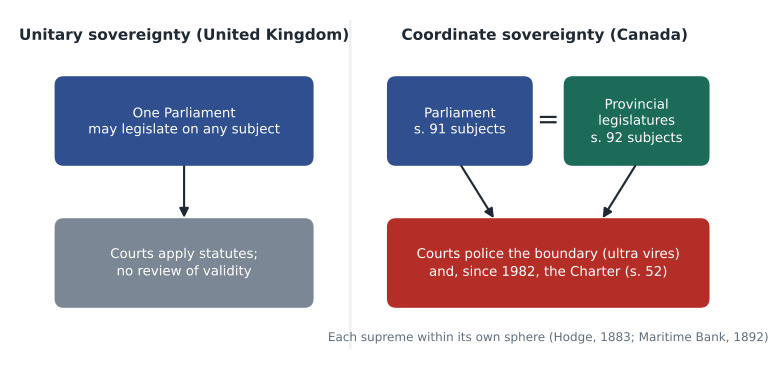
From the beginning, Canadian sovereignty was divided. In a unitary state like the United Kingdom, one Parliament holds all law-making power. The Constitution Act, 1867 instead assigned subjects to Parliament in section 91 and to the provincial legislatures in section 92. An Act that strays outside its assigned subjects is ultra vires, beyond the enacting body's powers, and courts have declared such Acts invalid since the 1870s. Judicial review on federalism grounds is as old as Confederation.
Within its own sphere, however, each legislature was held to be sovereign. In Hodge v. The Queen (1883), 9 App Cas 117, the Judicial Committee rejected the argument that the provincial legislatures were mere delegates of the Imperial Parliament who could not themselves delegate. It held that within the limits of section 92 a provincial legislature has 'authority as plenary and as ample' as the Imperial Parliament possessed, and may confer authority on bodies it creates, such as a board of licence commissioners. In Liquidators of the Maritime Bank of Canada v. Receiver-General of New Brunswick, [1892] AC 437, the Committee added that the provinces were not subordinated to the Dominion: the purpose of the 1867 Act was neither to weld the provinces into one nor to subordinate provincial governments to a central authority.
Okafor-Lindqvist sums up the result as 'coordinate sovereignty'. Parliament and each provincial legislature are sovereign, but only over the subjects the Constitution assigns to them. Sophie's point, that the British version was never fully true in Canada, is therefore right: courts have policed the boundaries of legislative power from the start.
From Imperial subordination to independence
Arjun's question, which Parliament, mattered for decades. Until 1931 Canadian legislatures were also subject to the Imperial Parliament at Westminster. Under the Colonial Laws Validity Act, 1865, a colonial law repugnant to an Imperial statute extending to the colony was void to the extent of the repugnancy.
The Statute of Westminster, 1931 removed that limit for the Dominions. It provided that no law made by the Parliament of a Dominion would be void for repugnancy to English law or to Imperial statutes, and that no future Imperial Act would extend to a Dominion unless the Dominion requested and consented to it. Section 7, however, preserved the British North America Acts from the Statute's effect, because Canadians had not agreed on a domestic amending formula. For another fifty years, most amendments to the Constitution Act, 1867 still had to be enacted at Westminster at Canada's request. That ended with patriation in 1982.
The Canadian Bill of Rights
In 1960 Parliament passed the Canadian Bill of Rights, an ordinary federal statute that applies to federal laws and declares rights such as equality before the law and the right not to be deprived of property except by due process of law. It directs courts to construe and apply federal laws so as not to abrogate those rights unless Parliament expressly declares that a law operates notwithstanding the Bill.
In R. v. Drybones, [1970] SCR 282, the Supreme Court used the Bill of Rights to render inoperative a provision of the Indian Act that made it an offence for an 'Indian' to be intoxicated off a reserve, because it denied equality before the law on the basis of race. Drybones showed that a statute could, in effect, constrain later legislation by setting interpretive conditions. Later cases were more cautious. In Authorson v. Canada (Attorney General), 2003 SCC 39, the Court held that the Bill of Rights' due process guarantee did not give disabled veterans a right to a hearing before Parliament extinguished, by clear words, their claims to interest on pension funds the Crown had managed. Parliament had spoken clearly, and the Bill does not protect against expropriation by valid legislation.
Constitutional supremacy after 1982
The Constitution Act, 1982 changed the frame. Section 52 makes the Constitution of Canada the supreme law, and the Charter subjects all legislation, federal and provincial, to guaranteed rights. Canada moved, in the Supreme Court's words in the Secession Reference, from a system of parliamentary supremacy to one of constitutional supremacy. Legislatures remain sovereign in the sense that they may enact any law within their jurisdiction that respects the Constitution, but the Constitution itself is beyond their reach except through the amending procedures.
The Charter preserved a piece of parliamentary sovereignty through section 33, the notwithstanding clause. Parliament or a provincial legislature may expressly declare that an Act operates notwithstanding section 2 or sections 7 to 15 of the Charter, for renewable periods of five years. Use of the clause has grown in recent years. Quebec invoked it for its laws on state secularism (Bill 21, 2019) and on the French language (Bill 96, 2022), Ontario invoked it in 2021 for election finance rules and in 2022 for a back-to-work law that it repealed within days, and Saskatchewan invoked it in 2023 for its law on pronouns and names in schools. The clause does not apply to the division of powers at all: no legislature can use it to escape the limits of sections 91 and 92.
Parliament cannot bind its successors
The rule that a legislature cannot bind its successors has survived in Canada. Reference re Canada Assistance Plan (B.C.), [1991] 2 SCR 525, is the leading case. Under the Canada Assistance Plan, Ottawa had agreed with the provinces to share the cost of social assistance programs. In 1990 Parliament limited the growth of its contributions to the three wealthiest provinces. British Columbia argued that the federal government could not unilaterally change the arrangement and that the provinces had a legitimate expectation of consultation.
The Supreme Court rejected both arguments. An agreement between governments could not stop Parliament from legislating, because a government cannot fetter the sovereignty of Parliament. The doctrine of legitimate expectations, a rule of procedural fairness in administrative law, does not apply to the legislative process. Sopinka J. noted that restrictions on the manner and form of legislation might bind a legislature in some circumstances, but the Plan's terms did not purport to do so.
Manner and form arguments have appeared occasionally. In R. v. Mercure, [1988] 1 SCR 234, the Court held that a requirement to publish Saskatchewan's statutes in English and French, inherited from territorial legislation, was not entrenched. The legislature could repeal it, but only by following the existing rule, so it could enact a bilingual statute declaring that future laws could be in English only. The broader question, whether an ordinary statute can require a special majority or a referendum for its own repeal, remains largely unsettled in Canada.
Legislation and the courts: what sovereignty still means
Several modern cases show how far parliamentary sovereignty protects legislation from judicial override:
- In Wells v. Newfoundland, [1999] 3 SCR 199, the province abolished a public utilities commissioner's position by statute. The Court held that the legislature could do so, but that abolishing the position did not extinguish the commissioner's contractual right to compensation, because the statute did not clearly say so.
- In Babcock v. Canada (Attorney General), 2002 SCC 57, a provision allowing the Clerk of the Privy Council to certify documents as cabinet confidences and so withhold them from courts was upheld against an argument based on the rule of law and judicial independence.
- In British Columbia v. Imperial Tobacco Canada Ltd., 2005 SCC 49, the Court upheld a statute creating a retroactive civil cause of action for the province to recover tobacco-related health care costs, rejecting arguments that the rule of law prohibits retroactive or targeted legislation.
- In Mikisew Cree First Nation v. Canada (Governor General in Council), 2018 SCC 40, the Court held that the Crown's duty to consult Indigenous peoples does not apply to the law-making process itself; courts will not supervise how Parliament drafts and passes legislation, though the resulting law may be challenged under section 35.
Parliamentary privilege also protects the internal workings of legislatures from court interference. In Canada (House of Commons) v. Vaid, 2005 SCC 30, the Court set out the test for privilege: it covers matters necessary to the legislative body's constitutional functions, such as its proceedings and the discipline of its members, but not every employment decision of its administration.
Delegation of legislative power
Coordinate sovereignty includes the power to delegate. Parliament and the provincial legislatures routinely give regulation-making powers to the cabinet, ministers, agencies and municipalities. In Re Gray (1918), 57 SCR 150, the Supreme Court upheld sweeping wartime delegations to the federal cabinet, and courts have since upheld broad framework statutes that leave most of the detail to regulations.
Some delegations allow the executive to amend the statute itself. These are called Henry VIII clauses, after the sixteenth-century king whose Statute of Proclamations let royal proclamations carry the force of law. In References re Greenhouse Gas Pollution Pricing Act, 2021 SCC 11, a majority upheld a provision that let the federal cabinet amend a schedule to the Act, holding that such clauses are constitutional where the delegation is set out in valid legislation that the legislature can revoke.
One delegation is not allowed. In Nova Scotia (Attorney General) v. Canada (Attorney General), [1951] SCR 31, the Nova Scotia Inter-delegation case, the Court held that Parliament and a provincial legislature cannot delegate law-making powers to each other. Doing so would let them rewrite the division of powers without a constitutional amendment. Administrative inter-delegation, however, is allowed. In P.E.I. Potato Marketing Board v. Willis, [1952] 2 SCR 392, Parliament validly delegated federal power over interprovincial marketing to a provincial marketing board, and in Coughlin v. Ontario Highway Transport Board, [1968] SCR 569, Parliament validly delegated licensing of interprovincial trucking to a provincial board applying provincial standards. Governments can also incorporate each other's laws by reference. These techniques let the two levels cooperate without rewriting the Constitution, a theme of lesson 9.
Bringing it together
Okafor-Lindqvist returns to Dicey's sentence on the board and corrects it for Canada: 'Within its jurisdiction, and subject to the Constitution of Canada, a legislature can make or unmake any law, and courts will not set aside its legislation except for a breach of the Constitution.' The corrections carry most of the weight. The division of powers has limited every Canadian legislature since 1867, the Charter has limited them since 1982, and the amending formula puts the Constitution beyond the reach of any single legislature. What remains of sovereignty is real, though: courts will not invalidate legislation because it is unwise, unfair, retroactive or in breach of an intergovernmental agreement, as long as it is within jurisdiction and consistent with the Constitution.
Theo asks what this means in practice for a federalism challenge. 'It means you never argue that a law is bad,' she says. 'You argue that the wrong legislature made it.'
Common mistakes
MistakeCanadian courts gained the power to strike down laws only in 1982.
InsteadCourts have struck down laws as ultra vires the division of powers since the nineteenth century. The Charter added rights-based review in 1982.
MistakeAn intergovernmental agreement binds Parliament.
InsteadReference re Canada Assistance Plan holds that the executive cannot fetter Parliament, and legitimate expectations do not apply to legislation.
MistakeThe notwithstanding clause lets a province legislate on federal subjects.
InsteadSection 33 applies only to section 2 and sections 7 to 15 of the Charter, not to the division of powers.
MistakeParliament may delegate law-making power to a provincial legislature.
InsteadLegislative inter-delegation is barred (Nova Scotia Inter-delegation, 1951), but delegation to a provincial board is allowed (Willis, Coughlin).
Practice problems
Work each problem on paper first, then reveal the answer to check.
A federal statute promises the provinces that federal transfers will not be reduced without two years' notice. A later federal Act cuts transfers immediately. Is the later Act invalid?
Show answer
No. Under Reference re Canada Assistance Plan, Parliament cannot bind its successors and the later Act prevails. Unless a valid manner and form requirement was imposed and ignored, the cut is effective.
Ontario's legislature passes an Act allowing the federal Minister of Transport to make regulations on provincial highway speed limits. What constitutional problem arises?
Show answer
The legislature cannot delegate law-making power to another level of government's legislature. The analysis is less settled for delegation to a federal minister, but the Nova Scotia Inter-delegation principle and the requirement that each level keep control of its own legislative power make the scheme vulnerable. Cooperative techniques such as incorporation by reference would be safer.
What did Hodge v. The Queen decide about provincial legislatures?
Show answer
Within section 92 they have authority as plenary and ample as the Imperial Parliament, so they are not mere delegates and may themselves delegate.
Summary and key terms
- Dicey's parliamentary sovereignty means a legislature may make any law and courts will not set it aside; Canada imported the idea through the 1867 preamble.
- From 1867, sovereignty in Canada was divided: each legislature is supreme only within its assigned subjects (Hodge; Maritime Bank).
- The Statute of Westminster, 1931 ended Imperial legislative supremacy, except for amendments to the British North America Acts, until patriation in 1982.
- Since 1982 Canada has constitutional supremacy; the notwithstanding clause preserves limited sovereignty over some Charter rights but not over the division of powers.
- A legislature cannot bind its successors (Canada Assistance Plan Reference) and cannot delegate law-making power to the other level's legislature, though administrative inter-delegation is permitted.
- Parliamentary sovereignty
- The principle that a legislature may make or unmake any law and that courts may not set aside its legislation.
- Ultra vires
- Beyond the powers of the enacting body; a law outside the legislature's jurisdiction is invalid.
- Coordinate sovereignty
- The idea that Parliament and the provincial legislatures are each supreme within their own spheres and neither is subordinate to the other.
- Manner and form
- Procedural requirements for enacting legislation, which may in some cases bind a legislature until repealed by the required procedure.
- Henry VIII clause
- A statutory provision allowing the executive to amend the statute itself by regulation.
- Administrative inter-delegation
- Delegation by one level of legislature to a body created by the other level, which courts allow.
Lesson quiz · 5 questions
Score 60% or more to complete this lesson.
Create a free account to save your progress, take quizzes and earn a certificate.