
LAWC-101 · Lesson 3 of 12 · 18 min
The courts, judicial review and references
▶ Video coming soon A video version of this lesson is on the way.
Noor Rahimi, the 3L teaching fellow who runs Section B's Thursday problem sessions, opens her first session with a question nobody expects: 'Who decides whether a law is constitutional?' Arjun Mehta says the Supreme Court. Theo Marchetti, who filed hundreds of documents in Hamilton's courthouse, says any judge with the case in front of them. Noor writes both answers down and spends the next two hours showing why Theo's is closer to the truth, and why Arjun's matters most in the end.
Federalism disputes are decided by courts, but which courts, how cases get there and what remedies follow are themselves constitutional questions. This lesson covers the structure of Canadian courts, the constitutional protection of superior courts, how division-of-powers challenges are brought, the remedies courts give, and the distinctively Canadian practice of reference cases.
The judicature provisions
Part VII of the Constitution Act, 1867 deals with the courts, and it splits responsibility between the two levels of government in an unusual way. Under section 92(14), the provinces have exclusive power over 'the Administration of Justice in the Province, including the Constitution, Maintenance, and Organization of Provincial Courts, both of Civil and of Criminal Jurisdiction'. Under section 96, however, the Governor General, meaning in practice the federal cabinet, appoints the judges of the superior, district and county courts in each province. Sections 99 and 100 give those judges tenure during good behaviour and require Parliament to fix and pay their salaries.
The result is a single, integrated court system rather than parallel federal and state courts as in the United States. Provincial superior courts, created and administered by the provinces but staffed by federally appointed judges, hear cases under both federal and provincial law, including all serious criminal trials, even though criminal law is a federal subject. Parliament can create courts under section 101, which authorizes 'a General Court of Appeal for Canada' and 'any additional Courts for the better Administration of the Laws of Canada'. The Supreme Court of Canada (1875), the Federal Court and the Federal Court of Appeal, and the Tax Court of Canada are section 101 courts.
Provinces also create their own courts with provincially appointed judges, such as the Ontario Court of Justice, which hears most criminal cases and family matters, and small claims and administrative tribunals of many kinds.
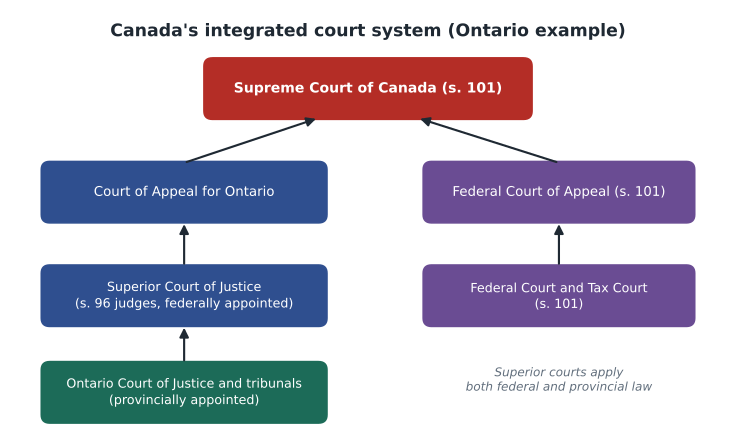
The road to the Supreme Court
Parliament created the Supreme Court of Canada in 1875 under section 101, but for decades it was not the final court. Litigants could appeal from it, or directly from provincial courts of appeal, to the Judicial Committee of the Privy Council in London. Parliament abolished criminal appeals to the Privy Council in 1933, a move upheld in British Coal Corporation v. The King, [1935] AC 500, after the Statute of Westminster removed the Imperial limits on Canadian legislation. The Privy Council itself upheld Parliament's power to abolish all appeals in Ontario (Attorney General) v. Canada (Attorney General), [1947] AC 127, and the abolition took effect in 1949. Cases begun before then could still proceed to London, and the last Canadian appeal was decided in 1959.
The Privy Council's long role matters for this course because many foundational federalism doctrines, including the narrow reading of trade and commerce and the broad reading of property and civil rights, were developed in London. When the Supreme Court became final, it inherited that body of law and has gradually reworked parts of it.
Today most cases reach the Supreme Court with leave, granted when a case raises an issue of public importance. Appeals as of right remain in a few situations, including references from provincial courts of appeal and certain criminal appeals where a judge of the court of appeal dissents on a point of law. The composition of the Court, nine judges of whom at least three must come from the bar or superior courts of Quebec, is constitutionally protected (Reference re Supreme Court Act, ss. 5 and 6, 2014 SCC 21).
The constitutional core of superior courts
Section 96 does more than allocate an appointment power. The Supreme Court has read it as protecting the core jurisdiction of provincial superior courts, so that neither level of government can strip them of their essential role or hand it to bodies whose members lack section 96 appointments and tenure. Otherwise, a province could avoid the federal appointment power simply by moving superior court work to provincially appointed tribunals.
In Re Residential Tenancies Act, 1979, [1981] 1 SCR 714, the Court set out a three-step test for whether a provincial tribunal unconstitutionally exercises section 96 powers. First, does the power broadly conform to a power exercised by superior, district or county courts at Confederation? Second, if so, is it a judicial power in its institutional setting? Third, if so, is it merely subsidiary or ancillary to a broader administrative scheme, or is it the tribunal's sole or central function? Ontario's attempt to give a residential tenancy commission the power to evict tenants failed this test in 1981, although later decisions, reflecting a different historical analysis, have allowed modern landlord and tenant boards to make eviction orders.
Two later cases protect a core that even Parliament cannot remove. In MacMillan Bloedel Ltd. v. Simpson, [1995] 4 SCR 725, the Court held that Parliament could not give youth courts exclusive jurisdiction over contempt of a superior court by young persons, because the power to punish contempt of its own orders is part of a superior court's inherent core. In Trial Lawyers Association of British Columbia v. British Columbia (Attorney General), 2014 SCC 59, the Court struck down British Columbia's hearing fees, which effectively barred people of modest means from trials, as an unconstitutional interference with the core jurisdiction of superior courts.
Most recently, in Reference re Code of Civil Procedure (Que.), art. 35, 2021 SCC 27, the Court held that giving the provincially appointed Court of Québec exclusive jurisdiction over civil claims below 70,000 dollars infringed section 96. Considering the amount, the share of civil litigation diverted and other factors, the Court found that the provision removed too much of the superior court's general private law jurisdiction. The reference shows that section 96 is not a historical curiosity; it can decide how a province organizes its courts today.
Bringing a division-of-powers challenge
Theo's answer to Noor's opening question is right because constitutional challenges can be raised in almost any proceeding. A person charged under a provincial offence can argue, as a defence, that the law is ultra vires. A business sued under a federal statute can argue the statute does not apply to it. Provincial courts and many tribunals can decide constitutional questions that arise in cases properly before them, though only superior courts can grant formal declarations of invalidity that bind beyond the parties.
Several procedural rules shape these cases:
- Notice. In Ontario, section 109 of the Courts of Justice Act requires a party challenging the validity or applicability of a statute to serve notice of a constitutional question on the Attorneys General of Canada and Ontario, who may then intervene. Other provinces have similar rules.
- Standing. A person directly affected by a law has standing to challenge it. Courts also grant public interest standing, considering whether there is a serious justiciable issue, whether the claimant has a genuine interest, and whether the suit is a reasonable and effective way to bring the issue before the court (Canada (Attorney General) v. Downtown Eastside Sex Workers United Against Violence Society, 2012 SCC 45; British Columbia (Attorney General) v. Council of Canadians with Disabilities, 2022 SCC 27).
- Evidence. Division-of-powers cases often turn on what a law really does, so courts admit extrinsic material: legislative history, Hansard debates, government reports and expert evidence about the law's effects. In Reference re Anti-Inflation Act, [1976] 2 SCR 373, the Court considered economic evidence about inflation, and in R. v. Morgentaler, [1993] 3 SCR 463, it relied on Hansard to conclude that Nova Scotia's ban on private abortion clinics was in pith and substance criminal law.
- The presumption of constitutionality. Courts start from the assumption that the legislature intended to act within its powers. Where a law can reasonably be read in a way that keeps it within jurisdiction, that reading is preferred (Nova Scotia Board of Censors v. McNeil, [1978] 2 SCR 662).
Remedies
When a court finds a law ultra vires, section 52 of the Constitution Act, 1982 makes it of no force or effect to the extent of the inconsistency. Courts tailor that remedy:
- Declaration of invalidity. The law, or the offending part of it, is struck down. In the Reference re Impact Assessment Act, 2023 SCC 23, for example, the Court found the scheme for designated projects ultra vires while upholding the Act's separate provisions governing projects on federal lands and abroad.
- Severance. Only the invalid provisions are struck, if the rest can stand on its own and the legislature would have enacted it anyway.
- Reading down. A broadly worded law is interpreted so that it does not reach matters outside jurisdiction. This is common in federalism cases.
- Declaration of inapplicability. Where interjurisdictional immunity applies, a valid law is declared inapplicable to the protected core of the other level's jurisdiction, as in Opsis Airport Services Inc. v. Quebec (Attorney General), 2025 SCC 17, examined in lesson 10.
- Suspended declarations. Courts sometimes delay a declaration of invalidity to give the legislature time to respond, though the Supreme Court has said this should be exceptional (Ontario (Attorney General) v. G, 2020 SCC 38). In Reference re Manitoba Language Rights, [1985] 1 SCR 721, the Court found almost all of Manitoba's unilingual statutes invalid but deemed them temporarily valid to avoid a legal vacuum, relying on the rule of law.
Reference cases
Sophie Tremblay-Hart asks the question Noor has been waiting for: how can a court give an opinion when nobody has been charged or sued? The answer is the reference procedure, which is unusual among common law countries. Under section 53 of the Supreme Court Act, the Governor in Council may refer important questions of law or fact to the Supreme Court for hearing and consideration, including questions on the interpretation of the Constitution and the validity of federal or provincial legislation. Each province has its own statute allowing its cabinet to refer questions to the provincial court of appeal. In Ontario it is section 8 of the Courts of Justice Act. A provincial reference opinion can be appealed to the Supreme Court as of right.
The Privy Council upheld the federal reference power in Ontario (Attorney General) v. Canada (Attorney General), [1912] AC 571, the Reference Appeal, rejecting the argument that it improperly turned courts into advisers of the executive. Formally, a reference opinion is advisory and binds no one. In practice, governments and courts treat it as authoritative, and the Supreme Court has said it does not regard its reference opinions as less weighty than its judgments.
References have produced many of the leading federalism decisions in this course: the Anti-Inflation Reference (1976), the Patriation Reference (1981), the Secession Reference (1998), the Securities Act Reference (2011), the Senate Reform Reference (2014), the Pan-Canadian Securities Regulation Reference (2018), the Genetic Non-Discrimination Act Reference (2020), the Greenhouse Gas Pollution Pricing Act References (2021), the Impact Assessment Act Reference (2023) and the reference on the federal Indigenous child and family services law (2024). Several began in provincial courts of appeal: the carbon pricing references came from Saskatchewan, Ontario and Alberta, the impact assessment reference from Alberta, and the genetic non-discrimination and child and family services references from Quebec.
The Court may decline to answer a reference question that is too vague, not ripe, or not legal in nature. In Reference re Same-Sex Marriage, 2004 SCC 79, it answered three questions, holding that the federal power over marriage in section 91(26) could extend to same-sex couples under the living tree approach, but declined to answer a fourth on whether the opposite-sex requirement was itself unconstitutional, because the government had already announced it would legislate and couples had relied on lower court rulings.
Interpreting the Constitution
Courts have developed several interpretive approaches that you will see throughout the course:
- Text. The words of the provision remain the anchor, read in their grammatical and ordinary sense.
- Historical context. The Senate Reform Reference relied heavily on the purpose of the Senate as designed in 1867 to conclude that consultative elections would change its fundamental nature.
- Progressive interpretation. The living tree principle allows provisions to apply to things the framers could not foresee, such as radio and aviation, which the Privy Council placed under federal jurisdiction in the 1930s, and same-sex marriage.
- Structure and purpose. Courts read heads of power in light of one another and of the federal principle. 'Property and civil rights' and 'trade and commerce' have each been read so as not to swallow the other.
- Precedent. The doctrines of pith and substance, double aspect, interjurisdictional immunity and paramountcy are judge-made and evolve case by case.
Okafor-Lindqvist adds a warning when Section B reassembles the following Tuesday. The Supreme Court has said repeatedly, in the Securities Act Reference (2011) and elsewhere, that its role is to decide whether a law is within jurisdiction, not whether it is good policy. 'Judges in federalism cases,' she says, 'are referees. They decide which team has the ball, not how well it plays.'
Common mistakes
MistakeCanada has separate federal and provincial court systems, like the United States.
InsteadCanada has an integrated system. Provincial superior courts, with federally appointed judges, apply both federal and provincial law.
MistakeReference opinions are not binding, so nobody follows them.
InsteadThey are formally advisory but treated as authoritative by governments and courts.
MistakeSection 96 only deals with who appoints superior court judges.
InsteadSection 96 also protects the core jurisdiction of superior courts from being removed by either level of government (MacMillan Bloedel; Trial Lawyers; the 2021 Quebec reference).
MistakeOnly the Supreme Court can decide that a statute is unconstitutional.
InsteadAny court or tribunal with jurisdiction over a case can decide constitutional questions that arise in it, though formal declarations come from superior courts.
Practice problems
Work each problem on paper first, then reveal the answer to check.
A province creates a housing tribunal with exclusive power to decide all contract disputes between builders and buyers, regardless of amount. Which test applies, and what is the likely concern?
Show answer
The Residential Tenancies three-step test, and since 2021 the core jurisdiction analysis in the Quebec Code of Civil Procedure reference. Removing a whole field of private law disputes from superior courts to a provincially appointed tribunal risks infringing section 96.
Saskatchewan's cabinet wants an opinion on whether a federal environmental law is valid. How does it get one?
Show answer
It refers the question to the Court of Appeal for Saskatchewan under the province's reference statute. The opinion may be appealed to the Supreme Court of Canada as of right.
Why does a party in Ontario challenging a statute's validity have to serve a notice of constitutional question?
Show answer
Section 109 of the Courts of Justice Act requires notice so the Attorneys General of Canada and Ontario can intervene to defend the law; without notice the court should not decide the issue.
Summary and key terms
- Provinces administer justice and create courts (s. 92(14)), but the federal government appoints and pays superior court judges (ss. 96 to 100), producing an integrated court system.
- Parliament created the Supreme Court and other courts under section 101; Privy Council appeals ended in 1949.
- Section 96 protects the core jurisdiction of superior courts against removal by either level of government.
- Constitutional challenges can arise in any proceeding, subject to notice, standing and evidence rules, and courts apply a presumption of constitutionality.
- Remedies include invalidity, severance, reading down, inapplicability and, exceptionally, suspended declarations.
- Governments can refer constitutional questions to the Supreme Court or a provincial court of appeal; reference opinions are advisory but authoritative in practice.
- Section 96 court
- A provincial superior court whose judges are appointed by the federal government and whose core jurisdiction is constitutionally protected.
- Section 101 court
- A court created by Parliament, such as the Supreme Court of Canada or the Federal Court.
- Reference
- A question referred by a government to a court for an advisory opinion.
- Notice of constitutional question
- Formal notice to Attorneys General that a party is challenging the validity or applicability of legislation.
- Public interest standing
- Standing granted to a claimant not directly affected, where the case raises a serious justiciable issue and the claim is a reasonable and effective way to bring it to court.
- Reading down
- Interpreting a broadly worded law narrowly so that it stays within the enacting legislature's jurisdiction.
Lesson quiz · 5 questions
Score 60% or more to complete this lesson.
Create a free account to save your progress, take quizzes and earn a certificate.