
LAWC-101 · Lesson 1 of 12 · 20 min
Sources of the Constitution
▶ Video coming soon A video version of this lesson is on the way.
Professor Miriam Okafor-Lindqvist begins the first class of Section B on Tuesday, September 8, 2026, by holding up two objects. One is a slim paperback consolidation of the Constitution Acts, 1867 to 1982, printed by the Department of Justice. The other is a thick red binder of photocopied judgments. 'Most of you think this is the Constitution,' she says, lifting the paperback. 'By December you will understand why this binder matters just as much, and why some of the most important rules of Canadian government are written in neither.'
Daniel Whitecloud, who spent four years as a band administration officer in northern Saskatchewan before coming to Brannock, asks whether the treaties his community signed belong in the binder or the paperback. Okafor-Lindqvist smiles. 'That question will follow us all term. Hold on to it.'
This course is about federalism: how the Constitution divides law-making power between Parliament and the provincial legislatures, how courts police that division, and how the rules can be changed. Before we can study the division of powers, we need to know what the Constitution of Canada is and where its rules come from. That is the work of this first lesson.
What a constitution does
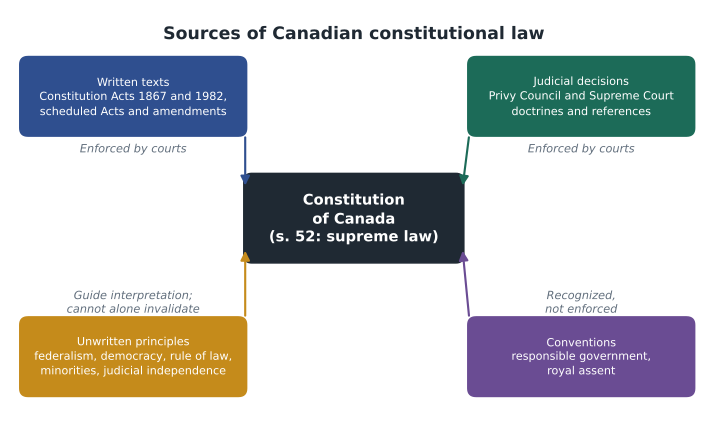
Every constitution answers a few basic questions. Who may make laws, and on what subjects? Who carries out the laws? Who decides disputes about them? What limits bind every government? How can the rules themselves be changed? A constitution creates public institutions, gives them their powers, and sets the limits of those powers. In Canada it does this through a mix of written texts, judicial decisions, unwritten principles and political conventions.
Canada is a federation. Law-making authority is divided between a central Parliament and ten provincial legislatures, each supreme within its own sphere, with neither subordinate to the other on the subjects assigned to it. The three territories are different: Yukon, the Northwest Territories and Nunavut exercise powers delegated to them by Parliament under federal statutes, so constitutionally they are not equal partners in the federation. Canada is also a constitutional monarchy, with the King as head of state, and a parliamentary democracy on the Westminster model, in which the government must keep the confidence of the elected House.
Section 52 and the Constitution of Canada
The starting point is section 52 of the Constitution Act, 1982. Subsection 52(1) declares that the Constitution of Canada is the supreme law of Canada, and that any law inconsistent with its provisions is, to the extent of the inconsistency, of no force or effect. Subsection 52(2) then says that the Constitution of Canada includes three things: the Canada Act 1982, including the Constitution Act, 1982; the Acts and orders listed in the schedule to that Act; and any amendment to them.
The schedule lists thirty items. They include the Constitution Act, 1867 (originally called the British North America Act, 1867), the Manitoba Act, 1870, the orders admitting British Columbia and Prince Edward Island, the Alberta Act and Saskatchewan Act of 1905, the Statute of Westminster, 1931, and the Newfoundland Act of 1949, among others. Together these are often called the written Constitution.
Notice the word 'includes' in subsection 52(2). The Supreme Court has read it as signalling that the list is not exhaustive. In New Brunswick Broadcasting Co. v. Nova Scotia (Speaker of the House of Assembly), [1993] 1 SCR 319, the Court held that the privileges of a provincial legislature, such as the power to exclude strangers from the chamber, have constitutional status even though no scheduled text mentions them. They come from the preamble to the Constitution Act, 1867, which says Canada is to have 'a Constitution similar in Principle to that of the United Kingdom'.
In Reference re Supreme Court Act, ss. 5 and 6, 2014 SCC 21, the Court went further and held that the essential features of the Supreme Court itself, including its composition, are part of the Constitution of Canada and protected by the amending formula, even though the Supreme Court Act is an ordinary federal statute. The Constitution of Canada, in other words, is a legal category the courts define, not simply a list.
The Constitution Act, 1867
The Constitution Act, 1867 united the Province of Canada (which it divided into Ontario and Quebec), Nova Scotia and New Brunswick into one Dominion on July 1, 1867. It is the document that creates the federation. For this course its most important parts are:
- Part III (sections 9 to 16), which vests executive government in the Queen, now the King, acting through the Governor General and the Privy Council for Canada.
- Part IV (sections 17 to 57), which creates Parliament, made up of the King, the Senate and the House of Commons.
- Part V (sections 58 to 90), which sets up provincial constitutions, with Lieutenant Governors and legislatures.
- Part VI (sections 91 to 95), the distribution of legislative powers, the heart of federalism.
- Part VII (sections 96 to 101), on the judicature, including the appointment of superior court judges by the Governor General and the power of Parliament to create a general court of appeal.
- Part VIII (sections 102 to 126), on revenues, debts, assets and taxation, including section 125, which bars one level of government from taxing the property of the other.
Section 91 lists federal heads of power, such as the regulation of trade and commerce, the postal service, navigation and shipping, banking, criminal law and 'Indians, and Lands reserved for the Indians'. Its opening words give Parliament power to make laws for the 'Peace, Order, and good Government of Canada' in relation to matters not assigned exclusively to the provinces. Section 92 lists provincial heads, such as direct taxation within the province, municipal institutions, property and civil rights in the province, the administration of justice, and 'Generally all Matters of a merely local or private Nature in the Province'. Section 92A, added in 1982, strengthened provincial jurisdiction over non-renewable natural resources, forestry and electricity. Section 93 gives provinces authority over education, subject to protections for denominational schools. Sections 94A and 95 deal with old age pensions, agriculture and immigration, the last two as concurrent powers with federal paramountcy.
Theo Marchetti, who spent a decade as a litigation clerk in Hamilton, asks why a 159-year-old statute still runs a modern country. Okafor-Lindqvist answers with a phrase students will hear all term. In Edwards v. Canada (Attorney General), [1930] AC 124, the Persons case, Lord Sankey for the Judicial Committee of the Privy Council described the British North America Act as 'a living tree capable of growth and expansion within its natural limits'. The Committee held that women were 'persons' eligible for appointment to the Senate, rejecting a reading frozen in the assumptions of 1867. Canadian courts have read the Constitution progressively ever since, though always within the 'natural limits' of its text and structure.
The Constitution Act, 1982
The Constitution Act, 1982 was enacted by the United Kingdom Parliament as Schedule B to the Canada Act 1982 and proclaimed in force by the Queen in Ottawa on April 17, 1982. It ended the need for Westminster to legislate for Canada, a process known as patriation. Its main parts are:
- Part I, the Canadian Charter of Rights and Freedoms (sections 1 to 34), which you will study in Constitutional Law II.
- Part II, section 35, which recognizes and affirms the existing aboriginal and treaty rights of the aboriginal peoples of Canada, defined to include the Indian, Inuit and Métis peoples.
- Part III, section 36, which commits governments to equal opportunities and to the principle of equalization payments.
- Part V (sections 38 to 49), the procedures for amending the Constitution of Canada, studied in lesson 11.
- Part VII, including section 52 on supremacy.
Daniel's earlier question returns here. Treaties themselves are not listed in the schedule, but treaty rights are recognized and affirmed by section 35, which places them beyond the reach of ordinary legislation unless an infringement can be justified. Land claims agreements are expressly included as treaties by subsection 35(3). Treaties therefore live partly in the paperback, through section 35, and partly in the binder, through the cases that interpret them.
Judicial decisions
The red binder holds the second great source: the decisions of courts interpreting the written texts. The words of sections 91 and 92 are short and general. What 'the Regulation of Trade and Commerce' or 'Property and Civil Rights in the Province' actually covers has been settled case by case, first by the Judicial Committee of the Privy Council in London, which was Canada's final court of appeal until appeals were abolished in 1949 (criminal appeals had ended in 1933), and since then by the Supreme Court of Canada.
This judicial gloss is so thick that a constitutional lawyer working on a division-of-powers question spends most of the time with cases, not text. Doctrines such as pith and substance, double aspect, national concern, interjurisdictional immunity and paramountcy are found nowhere in the 1867 Act. They are judge-made tools for applying it. Courts also decide reference questions, giving advisory opinions on constitutional issues at the request of governments, which lesson 3 examines.
Unwritten principles
The third source is the set of unwritten constitutional principles that the Supreme Court has identified as lying beneath the text. In Reference re Secession of Quebec, [1998] 2 SCR 217, the Court named four: federalism, democracy, constitutionalism and the rule of law, and respect for minorities. Others include judicial independence, recognized in Reference re Remuneration of Judges of the Provincial Court of Prince Edward Island, [1997] 3 SCR 3, and parliamentary privilege.
These principles help courts interpret the text and fill gaps in it. In Toronto (City) v. Ontario (Attorney General), 2021 SCC 34, however, a majority held that unwritten principles cannot on their own be used to strike down legislation. They are interpretive aids and can support structural doctrines, but invalidity must be grounded in the text. Lesson 4 returns to these principles in detail.
Constitutional conventions
The fourth source is not law at all in the strict sense. Constitutional conventions are rules of political practice that the actors in the system treat as binding, though courts will not enforce them. Responsible government is the classic example. The text of the 1867 Act gives the Governor General sweeping powers, including the power to refuse assent to bills. By convention, the Governor General acts on the advice of ministers who have the confidence of the House of Commons, and royal assent is never refused to a bill that has passed both Houses. The office of Prime Minister and the cabinet's dominance are almost entirely conventional.
In Reference re Resolution to Amend the Constitution, [1981] 1 SCR 753, the Patriation Reference, the Supreme Court confirmed that courts may recognize a convention but cannot enforce it. It adopted a three-part test drawn from the British scholar Sir Ivor Jennings: are there precedents; did the actors in the precedents believe they were bound by a rule; and is there a reason for the rule? Applying that test, a majority found that a convention required a substantial degree of provincial consent before Parliament asked Westminster to amend the Constitution in a way affecting provincial powers. Legally, however, Ottawa could proceed alone.
Hannah Kowalczyk, an economics graduate from Calgary, asks what the point is of a rule a court will not enforce. 'Political cost,' Okafor-Lindqvist says. 'After the Patriation Reference, Prime Minister Trudeau went back to the table, and nine provinces agreed in November 1981. The court's statement that a convention existed changed the politics, even though it changed nothing legally.' Quebec did not agree, and in Re: Objection by Quebec to a Resolution to Amend the Constitution, [1982] 2 SCR 793, the Court held that there was no convention giving Quebec a veto.
Other sources: statutes, prerogative and Indigenous law
Some ordinary statutes are constitutional in a functional sense even though they are not part of the Constitution of Canada under section 52. The Canada Elections Act, the Parliament of Canada Act, the Supreme Court Act and the Constitutional Amendments Act (1996) all organize core institutions. Most can be changed by ordinary legislation, though, as Reference re Supreme Court Act, ss. 5 and 6 shows, some features of such statutes have been constitutionalized.
The royal prerogative, the residue of powers historically held by the Crown, also remains a source of executive authority over matters such as foreign affairs, treaty-making, the conferral of honours and the summoning and dissolution of Parliament, to the extent statute has not displaced it.
Finally, Indigenous legal orders predate the Crown and continue to govern many communities. Courts and governments increasingly acknowledge them. Federal legislation such as An Act respecting First Nations, Inuit and Métis children, youth and families recognizes that the inherent right of self-government in section 35 includes jurisdiction over child and family services, and the Supreme Court upheld that Act as within Parliament's authority in Reference re An Act respecting First Nations, Inuit and Métis children, youth and families, 2024 SCC 5. The relationship between Indigenous law and Canadian constitutional law is examined more fully in LAWC-114, Indigenous Peoples and Canadian Law.
Reading a constitutional provision
Arjun Mehta, a civil engineer before law school, asks how he should actually read section 91. Okafor-Lindqvist suggests four habits that will serve the whole course:
- Read the provision in full, including the opening words and closing paragraphs. Section 91's closing words provide that matters within its listed classes are not to be deemed to come within the local or private matters of section 92(16).
- Read it in context with the provisions around it. The meaning of 'trade and commerce' in section 91(2) was narrowed by the presence of 'property and civil rights' in section 92(13).
- Read the leading cases that interpret it, in chronological order where possible, so you can see how the doctrine developed.
- Ask what purpose the provision serves in a federal system. The Supreme Court has repeatedly said that federalism exists to reconcile diversity with unity, allowing regional communities to pursue their own goals while the country acts together on shared concerns.
Why this matters for the rest of the course
Every problem in this course follows the same basic order. First, characterize the law: what is it really about? Second, classify that subject under a head of power. Third, if the law is valid but touches the other level's core, ask whether interjurisdictional immunity applies. Fourth, if a valid federal law and a valid provincial law both apply, ask whether they conflict so that paramountcy is engaged. Okafor-Lindqvist calls these the four boxes. The sources you met today supply the material for each box: text for the heads of power, cases for the tests, unwritten principles for the background values, and conventions for the political reality in which courts work.
| Source | Example | Enforced by courts? |
|---|---|---|
| Written Constitution (s. 52 and schedule) | Constitution Acts, 1867 and 1982; Manitoba Act, 1870 | Yes; inconsistent laws are of no force or effect |
| Judicial decisions | Edwards (Persons case); Canadian Western Bank | Yes; binding as precedent |
| Unwritten principles | Federalism, democracy, rule of law, minorities | Used to interpret; cannot alone invalidate laws (Toronto v. Ontario) |
| Conventions | Responsible government; royal assent | Recognized but not enforced (Patriation Reference) |
| Royal prerogative | Treaty-making, foreign affairs | Reviewable in some respects; displaced by statute |
| Indigenous legal orders | Laws of First Nations, Inuit and Métis communities | Increasingly recognized, often through section 35 and legislation |
Common mistakes
MistakeThe Constitution of Canada is exactly the list in the schedule to the Constitution Act, 1982.
InsteadSection 52(2) says the Constitution 'includes' those texts. Courts have added parliamentary privilege and the essential features of the Supreme Court.
MistakeConventions are just habits with no constitutional significance.
InsteadConventions are binding political rules. Courts can recognize them, as in the Patriation Reference, but will not enforce them.
MistakeUnwritten principles let courts strike down any law that offends democracy or the rule of law.
InsteadToronto v. Ontario (2021) holds that unwritten principles cannot by themselves invalidate legislation.
MistakeThe territories have the same constitutional status as provinces.
InsteadTerritorial governments exercise powers delegated by Parliament under federal statutes.
Practice problems
Work each problem on paper first, then reveal the answer to check.
A provincial government argues that its legislature's power to expel a member is constitutionally protected, even though no written text mentions it. What case supports that argument, and why?
Show answer
New Brunswick Broadcasting (1993): legislative privileges are part of the Constitution of Canada through the preamble's reference to a constitution 'similar in Principle to that of the United Kingdom', because section 52(2) is not exhaustive.
Why did the Patriation Reference matter politically if it held that Parliament could legally proceed without provincial consent?
Show answer
The Court also found a convention requiring substantial provincial consent. Breaching a recognized convention carried a political cost, which pushed the federal government back to negotiations that produced the November 1981 agreement with nine provinces.
Name the four habits for reading a constitutional provision suggested in this lesson.
Show answer
Read it in full; read it in context with surrounding provisions; read the leading cases interpreting it; and ask what purpose it serves in a federal system.
Summary and key terms
- Section 52 of the Constitution Act, 1982 makes the Constitution of Canada the supreme law and lists the texts it includes, but the list is not exhaustive.
- The Constitution Act, 1867 creates the federation and divides legislative power, mainly in sections 91 and 92.
- The Constitution Act, 1982 patriated the Constitution and added the Charter, section 35 and the amending formulas.
- Judicial decisions supply the doctrines used to apply the text; unwritten principles guide interpretation; conventions bind politically but are not enforced by courts.
- Every federalism problem follows four boxes: characterize, classify, consider immunity, consider conflict.
- Constitution of Canada
- The supreme law of Canada under section 52, including the texts listed in the schedule to the Constitution Act, 1982 and features the courts have recognized as constitutional.
- Federation
- A state in which law-making power is divided between a central government and regional governments, each supreme in its own sphere.
- Patriation
- The 1982 transfer of full amending authority over the Constitution from the United Kingdom Parliament to Canada.
- Constitutional convention
- A binding rule of political practice that courts may recognize but will not enforce.
- Living tree
- The principle from Edwards v. Canada that the Constitution is to be read progressively within its natural limits.
- Royal prerogative
- The residue of legal powers historically held by the Crown, such as foreign affairs and treaty-making, to the extent not displaced by statute.
Lesson quiz · 5 questions
Score 60% or more to complete this lesson.
Create a free account to save your progress, take quizzes and earn a certificate.