
LAWC-101 · Lesson 12 of 12 · 20 min
Capstone: solving a federalism problem
▶ Video coming soon A video version of this lesson is on the way.
On Thursday, November 12, 2026, Noor Rahimi hands Section B a two-page hypothetical and gives them ninety minutes, the same time they will have for the main question on the December exam. 'Professor Okafor-Lindqvist wrote this one,' she says. 'It covers almost everything we have done. Use the four boxes, write in IRAC form, and argue both sides where the law is unsettled.' This lesson works through that hypothetical and a model answer, then offers advice for writing federalism answers under exam conditions.
Everything in the hypothetical is fictional, including the statutes. Only the cases and constitutional provisions are real.
The hypothetical
Corwin, Ontario sits in a farming region that depends on groundwater. In 2026 two projects are proposed nearby.
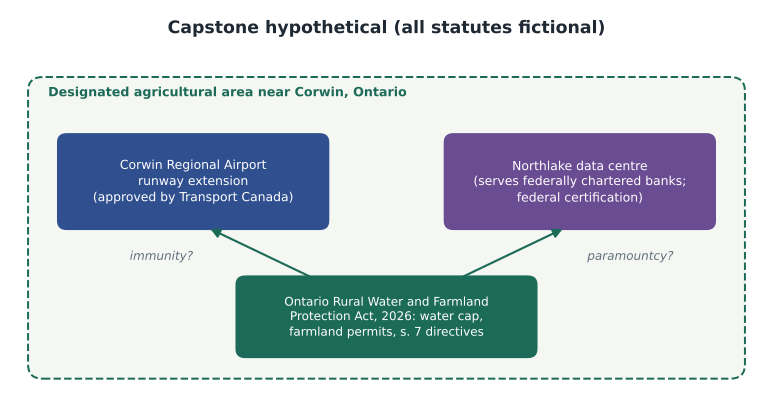
- Northlake Data Inc., a private company, plans a large data centre on farmland outside Corwin. Its main customers will be three federally chartered banks, which will store backup copies of critical transaction data there. The centre will need large volumes of groundwater for cooling.
- Corwin Regional Airport, a certified aerodrome, plans to extend its runway onto adjacent farmland so that larger aircraft can land. Transport Canada has approved the extension under the federal Aeronautics Act and its regulations.
In response, the Ontario legislature enacts the (fictional) Rural Water and Farmland Protection Act, 2026. Its key provisions are:
- Section 3: No person may construct a facility that withdraws more than 400,000 litres of groundwater per day in a designated agricultural area without a provincial water permit, and no permit may be issued for a facility on prime farmland.
- Section 4: No person may convert prime farmland in a designated agricultural area to a non-agricultural use without a provincial land use permit.
- Section 7: The Minister may issue binding directives to any facility in a designated area to protect 'community standards of rural life', and may suspend the facility's operations for non-compliance.
- Section 10: Any person who 'hoards water for the purpose of resale at an unconscionable price during a declared drought' commits an offence punishable by a fine of up to 50,000 dollars or imprisonment for up to two years.
The legislative debates show that members were concerned about groundwater levels, the loss of prime farmland, and reports that some suppliers had resold bottled water at very high prices during a 2025 drought. One member said the Act would 'stop the airport expansion before it starts'.
Meanwhile, Parliament enacts the (fictional) Financial Data Resilience Act. It requires federally regulated banks to keep backup copies of critical data in Canada at facilities certified by the federal Superintendent of Financial Institutions, and requires certified facilities to maintain 'redundant and uninterrupted cooling capacity'. Northlake applies for and receives federal certification.
Corwin Regional Airport, Northlake and one of the banks seek declarations about whether and how the Ontario Act applies to them. A supplier charged under section 10 argues that the section is invalid. Daniel Whitecloud, reading the facts, notes that the area is within treaty territory and asks whether that matters; Noor tells him it is beyond the scope of this question but worth flagging in a real memo.
Step 1: Identify the issues
Noor starts by listing the issues on the whiteboard before anyone writes a word of analysis:
- Is the Ontario Act valid as a whole, and in particular are sections 7 and 10 valid?
- Is the federal Financial Data Resilience Act valid?
- Does the Ontario Act apply to the runway extension, or is it inapplicable by interjurisdictional immunity?
- Does it apply to Northlake and the banks, or is it inapplicable?
- If it applies to Northlake, is it inoperative because of federal paramountcy?
Arjun points out that this list follows the four boxes exactly: validity (characterization and classification), then applicability, then operability.
Step 2: Validity of the Ontario Act
Issue. Is the Ontario Act within provincial jurisdiction?
Rule. A law is valid if its pith and substance, determined by its purpose and effects, falls within a head of power of the enacting legislature (Canadian Western Bank v. Alberta, 2007 SCC 22). Incidental effects on federal matters do not affect validity. A colourable law is characterized by its true purpose (R. v. Morgentaler, [1993] 3 SCR 463).
Application. The Act's purpose, from its title, structure and the debates, is to conserve groundwater and protect prime farmland. Its legal effects regulate water withdrawal and land use in designated areas. Its pith and substance is the conservation of provincial groundwater and the regulation of land use in agricultural areas. That falls within property and civil rights (s. 92(13)), the management of public lands (s. 92(5)) to the extent water is provincial property, and matters of a local nature (s. 92(16)). Provinces have long regulated water use and zoning.
The member's statement about stopping the airport expansion raises colourability. Hannah argues that it shows the Act was aimed at aeronautics. Theo replies that one member's statement does not establish the legislature's dominant purpose, especially when the Act applies to every facility and land conversion in designated areas, not just aerodromes. Compare Quebec (Attorney General) v. Lacombe, 2010 SCC 38, where a by-law amendment was struck down because, in substance, it singled out aerodromes. Here, the general application of the Act and the extensive evidence of genuine water and farmland concerns support validity. The better view is that the Act as a whole is valid; the airport problem is better addressed at the applicability stage.
Section 7, the directive and suspension power, is tied to the protection of 'community standards of rural life', a vague phrase. Its pith and substance is administering the land and water scheme, and it is valid as part of that scheme, though its breadth will matter later.
Section 10 needs separate attention. It prohibits hoarding water for resale at unconscionable prices during a declared drought, with imprisonment. Is it really criminal law, aimed at morally blameworthy profiteering? Recall Re Board of Commerce Act, 1919, [1922] AC 191, where federal anti-profiteering legislation failed, and the Margarine Reference's requirement of a typically criminal purpose for federal criminal law. Provinces can, however, create offences to enforce valid provincial laws under section 92(15), and can regulate prices and contracts within the province under section 92(13), including consumer protection against unconscionable pricing. Section 10 is closely tied to drought management and the supply of water in the province, and it targets a specific commercial practice rather than general moral wrongdoing. The better view is that it is valid as consumer protection and resource management, with the penalty supported by section 92(15). A counterargument would stress the imprisonment term and the moral language of 'hoarding', citing Westendorp v. The Queen, [1983] 1 SCR 43, but the provincial purpose is stronger here.
Conclusion. The Ontario Act, including sections 7 and 10, is likely valid.
Step 3: Validity of the federal Act
Issue. Is the Financial Data Resilience Act within federal jurisdiction?
Rule and application. Its purpose is to ensure that federally regulated banks can recover critical data after disruptions, protecting the stability of the banking system. Its effects impose requirements on banks and on the facilities they use. Its pith and substance is the operational resilience of federally regulated banks, which falls within banking (s. 91(15)). The requirements imposed on certified facilities, which are not themselves banks, intrude modestly on provincial jurisdiction over businesses and property, but they are rationally and functionally connected to the valid banking scheme, which is enough for a minor intrusion under General Motors of Canada Ltd. v. City National Leasing, [1989] 1 SCR 641. A national systemic risk argument under the general branch of trade and commerce (Reference re Pan-Canadian Securities Regulation, 2018 SCC 48) could provide additional support.
Conclusion. The federal Act is likely valid.
Step 4: Applicability to the runway extension
Issue. Does the Ontario Act apply to the airport's runway extension, which Transport Canada approved?
Rule. Interjurisdictional immunity makes a valid provincial law inapplicable to the extent that it impairs the core of a federal head of power (Canadian Western Bank). The location of aerodromes is at the core of the federal aeronautics power (Quebec (Attorney General) v. Canadian Owners and Pilots Association, 2010 SCC 39). Under Opsis Airport Services Inc. v. Quebec (Attorney General), 2025 SCC 17, impairment means adverse consequences for the core, which may be potential, and the provincial scheme may be assessed as a whole.
Application. Section 4 would require a provincial permit to convert the farmland for the runway, and the Act does not allow such permits on prime farmland. Applied to the runway extension, it would effectively prohibit the expansion of a federally approved aerodrome at that location. That is very close to COPA, where a provincial agricultural zoning law could not stop the construction of an aerodrome. Section 7's power to suspend operations for 'community standards' would give a provincial minister control over the operation of a certified aerodrome, much like the provincial powers found to impair federal jurisdiction in Opsis. The province would argue that only the runway extension, not the airport's operation, is affected, and that farmland protection is a general law. But COPA treats the location of aerodromes as core, and the effect here is not incidental: it decides whether the runway can be built at all.
Conclusion. Sections 4 and 7 are likely inapplicable to the runway extension and the airport's operations. The airport may still be subject to provincial laws that do not impair the core, such as ordinary employment standards for non-federal contractors or building code rules for terminal buildings, depending on the facts.
Step 5: Applicability to Northlake and the banks
Issue. Does the Ontario Act apply to Northlake's data centre?
Rule. Interjurisdictional immunity protects the core of federal heads and federal undertakings. It does not protect every business that deals with a federal undertaking (Canadian Western Bank, where banks promoting insurance were subject to Alberta's insurance law; Bank of Montreal v. Marcotte, 2014 SCC 55).
Application. Northlake is a private company, not a bank or a federal undertaking. Its data centre serves banks, but it also could serve anyone. Could the banks argue that the location of their backup data is at the core of banking? That would be a novel core. Opsis allows courts to recognize a core without precedent, but the banking core has traditionally been identified with matters such as deposit-taking, lending and the bank's relationship with customers, not with where a contractor stores backup files. The Act also leaves banks free to use certified facilities elsewhere. The better view is that the Act applies to Northlake. Section 7's broad directive and suspension power might raise a stronger argument if the minister used it to dictate how banks' data must be stored, but that has not happened on these facts.
Conclusion. The Ontario Act likely applies to Northlake.
Step 6: Paramountcy
Issue. Even if the Ontario Act applies to Northlake, is it inoperative because it conflicts with the federal Act?
Rule. A provincial law is inoperative to the extent that it operationally conflicts with a valid federal law, so that compliance with one is defiance of the other (Multiple Access Ltd. v. McCutcheon, [1982] 2 SCR 161; Alberta (Attorney General) v. Moloney, 2015 SCC 51), or frustrates its purpose (Bank of Montreal v. Hall, [1990] 1 SCR 121). Courts read federal purposes narrowly, and a federal permission is not a positive right unless Parliament clearly intended it (Rothmans, Benson & Hedges Inc. v. Saskatchewan, 2005 SCC 13; Saskatchewan (Attorney General) v. Lemare Lake Logging Ltd., 2015 SCC 53).
Application. Operational conflict: the federal Act requires certified facilities to maintain redundant cooling capacity; the Ontario Act limits groundwater withdrawal in designated areas and bars new facilities on prime farmland. Northlake can comply with both by building outside the designated area or using cooling methods that do not require more groundwater than the limit, so dual compliance is possible. Frustration of purpose: the federal purpose is bank data resilience. A provincial rule limiting where large water users may locate does not prevent banks from storing data in certified Canadian facilities; it only affects one site. Northlake would argue that federal certification of this site gave it a right to operate there, but certification under the federal Act is a regulatory approval of the facility's capabilities, not a positive right to operate anywhere in disregard of provincial land and water laws. Unless the federal Act expressly authorizes certified facilities to override local laws, the Rothmans and Lemare Lake line suggests no frustration.
Conclusion. There is likely no conflict, and the Ontario Act operates with respect to Northlake. If the minister used section 7 to order a certified facility to shut down in a way that left banks unable to meet their federal obligations, a frustration argument would become much stronger.
Step 7: Remedies and overall conclusion
The Ontario Act is valid. It is inapplicable, by interjurisdictional immunity, to the extent that it would prevent the federally approved runway extension or allow a minister to direct or suspend the airport's operations. It applies to Northlake and is not inoperative under paramountcy on the present facts. Section 10 is valid. A court would issue a declaration of inapplicability for the airport and dismiss the challenges by Northlake, the bank and the charged supplier. A full memo would also flag issues outside the question, such as the Crown's duty to consult First Nations on land use decisions in treaty territory, and Charter arguments, which belong to Constitutional Law II.
Writing federalism answers under time pressure
After the session, Noor shares the advice she gives every year:
- Spend the first ten minutes outlining. List every law, every party and every issue before writing. Most lost marks come from missed issues, not wrong conclusions.
- Follow the four boxes in order for each law: validity, applicability, operability. Keep the remedies distinct: invalid, inapplicable, inoperative.
- Characterize carefully. State purpose and effects, then a precise pith and substance. Avoid characterizations that assume the answer.
- Cite the leading case for each rule, briefly. A case name and one sentence on what it decided are enough; do not retell the facts at length.
- Argue both sides where the law is unsettled, then say which view is stronger and why. Markers reward judgment, not certainty.
- Use the facts. Every sentence in a hypothetical is there for a reason, like the member's statement about the airport and the 'community standards' language in section 7.
- Finish with clear conclusions and the remedy each party would obtain.
Okafor-Lindqvist drops by at the end of the session. 'If you can do what you did today,' she tells the group, 'you can handle the exam and most of what practice will throw at you. Federalism problems in the real world look exactly like this: messy facts, several laws and two governments each convinced the Constitution is on its side.'
Common mistakes
MistakeTreating one legislator's statement as proof of the law's purpose.
InsteadHansard is evidence, but the dominant purpose is drawn from the whole legislative record, the text and the law's effects.
MistakeConcluding that a provincial law is invalid because it cannot apply to a federal undertaking.
InsteadInapplicability by interjurisdictional immunity leaves the law valid and applicable to everyone else.
MistakeFinding a paramountcy conflict whenever a federal approval exists.
InsteadA federal approval is not a positive right unless Parliament clearly intended one; dual compliance is usually possible (Rothmans; Lemare Lake).
MistakeSkipping the validity of the federal law because it is federal.
InsteadBoth laws must be valid before applicability and operability questions arise.
Practice problems
Work each problem on paper first, then reveal the answer to check.
Change the facts: the federal Financial Data Resilience Act expressly provides that certified facilities 'may be constructed and operated at the location approved by the Superintendent notwithstanding any provincial law respecting land use'. How does the paramountcy analysis change?
Show answer
The provision suggests Parliament intended a positive right to operate at the approved site. Applying the Ontario Act to block that site would then frustrate the federal purpose, and possibly create an operational conflict, so the provincial provisions would likely be inoperative as applied to Northlake. A challenge to the federal clause's validity would also arise: does overriding provincial land use law remain rationally and functionally connected, or truly necessary, to the banking scheme?
Change the facts: the Ontario Act's only operative provision prohibits runway extensions at any aerodrome in the province. What happens at the validity stage?
Show answer
The Act would likely be characterized as a law in relation to aeronautics, not land use, because it singles out aerodromes (Lacombe). It would be invalid, not merely inapplicable.
List the three distinct outcomes a federalism analysis can produce for a law, and which doctrine produces each.
Show answer
Invalid (outside the enacting legislature's jurisdiction, from pith and substance analysis); inapplicable (to the extent it impairs the core of the other level's power, from interjurisdictional immunity); inoperative (to the extent it conflicts with a federal law, from paramountcy).
Summary and key terms
- Start every federalism problem by listing laws, parties and issues; then apply the four boxes to each law.
- Validity depends on pith and substance and classification; colourability and the ancillary doctrine are tested at this stage.
- Applicability depends on whether a valid law impairs the core of the other level's head of power (COPA; Opsis).
- Operability depends on operational conflict or frustration of federal purpose, with federal purposes read narrowly (Rothmans; Lemare Lake).
- Keep remedies distinct: invalid, inapplicable and inoperative.
- Use every fact, cite leading cases briefly, argue both sides where the law is unsettled and finish with clear conclusions.
- IRAC
- Issue, rule, application, conclusion: a standard structure for legal analysis.
- Hypothetical
- A fictional fact pattern used to test the application of legal rules.
- Declaration of inapplicability
- A court order that a valid law does not apply to a particular person or activity because of interjurisdictional immunity.
- Counterargument
- The strongest argument for the other side, which a good answer addresses before reaching a conclusion.
- Novel core
- A core of a head of power not previously recognized in the case law, which Opsis allows courts to identify with evidence.
- Operability
- Whether a valid and applicable provincial law can operate alongside a federal law without conflict.
Lesson quiz · 5 questions
Score 60% or more to complete this lesson.
Create a free account to save your progress, take quizzes and earn a certificate.