
LAWC-101 · Lesson 11 of 12 · 17 min
Amending the Constitution
▶ Video coming soon A video version of this lesson is on the way.
Okafor-Lindqvist opens the eleventh class by reading a list of failures: the Fulton-Favreau formula of 1964, the Victoria Charter of 1971, the Meech Lake Accord of 1987 and the Charlottetown Accord of 1992. 'Canadians spent more than fifty years failing to agree on how to change their Constitution,' she says, 'then agreed on a formula in 1982 that makes major change almost impossible. Today we learn the rules, and why so many people think they work too well.'
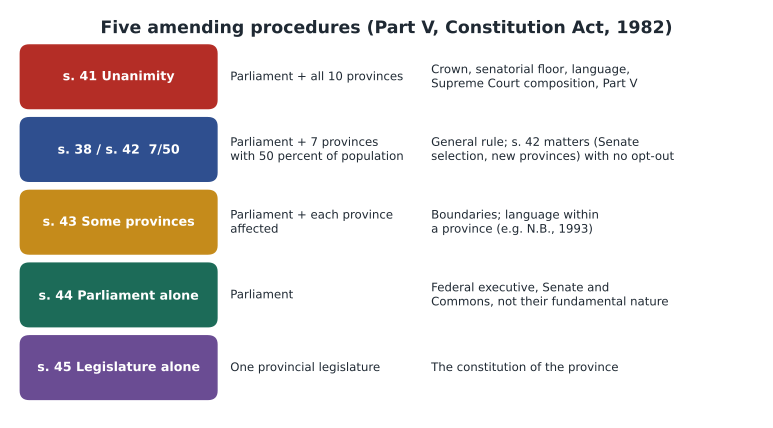
Part V of the Constitution Act, 1982 (sections 38 to 49) sets out five procedures for amending the Constitution of Canada. Each applies to different subjects and requires a different combination of consents. Choosing the right procedure is itself often the legal question, as the Senate Reform Reference showed.
Before 1982
The British North America Act, 1867 contained no general amending formula, because it was an Imperial statute and Westminster could amend it. In practice, Canada asked and Westminster acted. Some limited powers existed domestically: section 92(1) let provinces amend their own constitutions except as regards the office of Lieutenant Governor, and a 1949 amendment, section 91(1), gave Parliament a similar power over the federal constitution, subject to exceptions. After the Statute of Westminster, 1931, section 7 left the BNA Acts subject to Imperial amendment because Ottawa and the provinces could not agree on a domestic formula.
Attempts to agree failed repeatedly, mainly over how much protection Quebec and the other provinces should have. Patriation finally came after the Patriation Reference (1981), when nine provinces and Ottawa reached agreement in November 1981, leaving out Quebec. The formula adopted was largely the provinces' 'Vancouver formula', which relied on a right to opt out rather than the regional vetoes of the 1971 Victoria Charter.
The general procedure: section 38 (the 7/50 formula)
Section 38(1) is the default procedure. An amendment may be made by proclamation issued by the Governor General when authorized by resolutions of the Senate and House of Commons and of the legislative assemblies of at least two-thirds of the provinces (seven of ten) that have, in the aggregate, at least fifty percent of the population of all the provinces, according to the latest census. This is called the 7/50 formula.
Three further rules attach to it:
- Opting out. Under section 38(2) and (3), an amendment that derogates from the legislative powers, proprietary rights or other rights or privileges of a province's legislature or government requires a majority of the members of each House and of each legislative assembly, and it does not apply in a province whose assembly has expressed its dissent by resolution before the proclamation.
- Compensation. Under section 40, where a province opts out of an amendment transferring provincial legislative powers relating to education or other cultural matters to Parliament, Canada must provide reasonable compensation.
- Time limits. Under section 39, a proclamation under section 38 cannot be issued until one year after the resolution initiating the amendment, unless every province has already approved or dissented, and cannot be issued more than three years after the initiating resolution.
Section 42 lists matters that must be amended under the 7/50 procedure without the right to opt out: the principle of proportionate representation of the provinces in the House of Commons; the powers of the Senate and the method of selecting senators; the number of senators by which a province is represented and their residence qualifications; the Supreme Court of Canada (except its composition); the extension of existing provinces into the territories; and the establishment of new provinces.
Unanimity: section 41
Section 41 requires resolutions of the Senate, the House of Commons and every provincial legislative assembly for amendments in relation to:
- the office of the King, the Governor General and the Lieutenant Governor of a province;
- the right of a province to a number of members in the House of Commons not less than the number of senators by which it is entitled to be represented (the 'senatorial floor');
- subject to section 43, the use of the English or the French language;
- the composition of the Supreme Court of Canada;
- an amendment to Part V itself.
Unanimity effectively gives every province, and Parliament, a veto. The Meech Lake Accord, which would have recognized Quebec as a distinct society and changed several unanimity matters, died in June 1990 when the legislatures of Manitoba and Newfoundland did not approve it within the three-year window. Elijah Harper, a Cree member of the Manitoba legislature, used procedural rules to prevent a vote, objecting that the accord ignored Indigenous peoples. The broader Charlottetown Accord was rejected in a national referendum in October 1992.
Some but not all provinces: section 43
Section 43 applies to provisions that apply to one or more, but not all, provinces. An amendment may be made with resolutions of the Senate, the House of Commons and the legislative assembly of each province to which it applies. It covers any alteration to boundaries between provinces and any amendment to provisions relating to the use of English or French within a province. It has been used several times:
- 1993: section 16.1 was added to the Charter, recognizing the equality of the English and French linguistic communities in New Brunswick.
- 1997: Quebec and Parliament added section 93A to the Constitution Act, 1867, removing the denominational school protections of section 93 in Quebec, allowing linguistic school boards.
- 1998: Term 17 of the Terms of Union of Newfoundland was replaced, ending the constitutional protection of denominational schools in that province.
- 2001: the name of the province was changed to Newfoundland and Labrador.
Parliament or a legislature alone: sections 44 and 45
Under section 44, Parliament may exclusively make laws amending the Constitution of Canada in relation to the executive government of Canada or the Senate and House of Commons, subject to sections 41 and 42. Parliament has used this power to readjust the number of seats in the House of Commons, for example through the Fair Representation Act, 2011, and the Preserving Provincial Representation in the House of Commons Act, 2022, and to provide for Nunavut's representation in Parliament (Constitution Act, 1999 (Nunavut)).
Under section 45, a provincial legislature may exclusively make laws amending the constitution of the province, subject to section 41. Provincial constitutions include the provisions of the 1867 Act on provincial legislatures and executives, as well as statutes on elections and the legislature. In 2022, Quebec used section 45, through Bill 96, to add sections 90Q.1 and 90Q.2 to the Constitution Act, 1867, declaring that Quebecers form a nation and that French is the only official language of Quebec and the common language of the Quebec nation. Whether section 45 can be used to insert such provisions into the 1867 Act, and what legal effect they have, remains contested; challenges to parts of Bill 96 were still before the courts in 2026. Quebec's government also introduced a bill to adopt a written Quebec constitution in 2025, but abandoned it in June 2026.
Supporting rules
- Section 46: amendments under sections 38, 41, 42 and 43 may be initiated by the Senate, the House of Commons or a provincial legislative assembly.
- Section 47: the Senate has only a suspensive veto. If it has not adopted a resolution within 180 days after the House of Commons adopts it, and the House adopts it again, the amendment may proceed without the Senate.
- Section 52(3): amendments to the Constitution of Canada may be made only in accordance with the authority contained in the Constitution.
Statutory vetoes and referendum laws
After Quebec's 1995 referendum, Parliament passed An Act respecting constitutional amendments, S.C. 1996, c. 1, often called the Regional Veto Act. It prohibits a minister of the Crown from proposing a constitutional amendment under section 38 (other than one where a province may opt out) unless it has first been consented to by Ontario, Quebec, British Columbia, at least two Atlantic provinces with at least fifty percent of the Atlantic population, and at least two Prairie provinces with at least fifty percent of the Prairie population. Because Alberta alone has more than half the Prairie population, Alberta's consent is effectively required too. The Act binds only federal ministers; it is not part of the Constitution and does not formally change Part V, but it adds a practical layer of consent.
Some provinces require a referendum before their legislature approves an amendment. Alberta's Constitutional Referendum Act and British Columbia's Constitutional Amendment Approval Act are examples. Combined with the 1992 precedent of a national referendum on Charlottetown, many observers believe a convention may now be emerging that major constitutional changes require popular approval.
The Senate Reform Reference
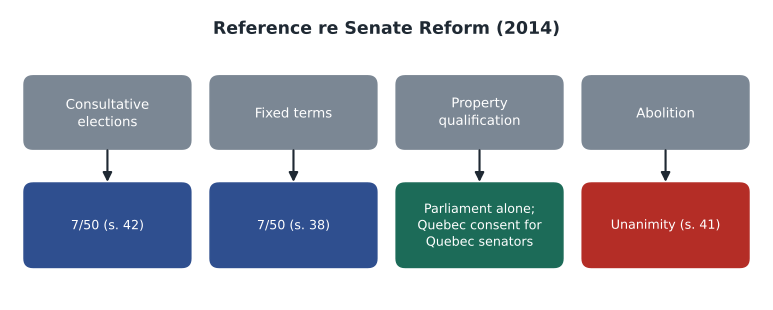
Reference re Senate Reform, 2014 SCC 32, is the essential guide to choosing a procedure. The federal government asked whether Parliament could act alone under section 44 to introduce consultative elections for senators, impose fixed terms, and remove the property qualification, and what procedure would be needed to abolish the Senate. A unanimous Court answered:
- Consultative elections would change the Senate's fundamental nature as a complementary body of independent sober second thought, giving senators a popular mandate. They relate to 'the method of selecting senators' under section 42 and require the 7/50 procedure.
- Fixed terms of eight or nine years would also change the Senate's fundamental nature by reducing senators' independence; they require the 7/50 procedure. (Term limits were distinguished from the existing mandatory retirement age of 75, introduced in 1965 by Parliament alone.)
- The net worth requirement could be removed by Parliament alone, except that for Quebec senators, whose property qualification is tied to the electoral divisions in section 23(6), the consent of Quebec's National Assembly under section 43 is required.
- Abolishing the Senate would require unanimity under section 41, because it would change Part V itself, which gives the Senate a role in the amending process.
The Court explained that Part V must be read in light of the Constitution's architecture: Parliament's unilateral power under section 44 covers only changes that do not affect the Senate's fundamental nature and role. In 2016 the federal government created the Independent Advisory Board for Senate Appointments, which recommends candidates to the Prime Minister. Because the board is advisory and the Prime Minister keeps full discretion, no constitutional amendment was needed.
The Supreme Court Act Reference
In Reference re Supreme Court Act, ss. 5 and 6, 2014 SCC 21, the Court considered the appointment of Justice Marc Nadon, a supernumerary judge of the Federal Court of Appeal, to one of the three Quebec seats. The majority held that section 6 of the Supreme Court Act requires Quebec appointees to be current members of the Quebec bar or current judges of Quebec's Court of Appeal or Superior Court, so Justice Nadon was ineligible. It also held that Parliament could not unilaterally change the eligibility rules for the Quebec seats, because the Court's composition, including the guarantee of three Quebec judges trained in the civil law, is protected by section 41(d), and its other essential features by section 42(1)(d).
Sophie notes that this decision constitutionalized parts of an ordinary statute. 'Exactly,' says Okafor-Lindqvist. 'Part V protects not just text but institutions. Before you advise a government that it can change something alone, ask whether the change affects an institution's fundamental nature.'
Choosing the procedure: a method
- Identify what the proposed change actually alters: text, an institution's nature, a province's powers, a language rule.
- Check section 41 first: does it touch the Crown, the senatorial floor, language (beyond one province), the Supreme Court's composition or Part V? If so, unanimity.
- Check section 42: does it touch proportionate representation, Senate powers or selection, Senate seats, other Supreme Court features, or new or extended provinces? If so, 7/50 without opting out.
- Check section 43: does it apply only to some provinces, such as a boundary or provincial language rule? If so, those provinces plus Parliament.
- Check sections 44 and 45: is it a change to federal or provincial institutions that does not affect their fundamental nature? If so, Parliament or the legislature alone.
- Otherwise, the general 7/50 procedure in section 38 applies, with opting out for derogations from provincial powers.
Common mistakes
MistakeParliament can reform the Senate alone because section 44 covers the Senate.
InsteadSection 44 is subject to sections 41 and 42; changes to the method of selecting senators or the Senate's fundamental nature need 7/50, and abolition needs unanimity (Senate Reform Reference).
MistakeThe Regional Veto Act amended Part V.
InsteadIt is an ordinary statute binding only federal ministers; it adds a practical layer of consent without changing the formal procedures.
MistakeA provincial referendum can amend the Constitution.
InsteadAmendments require resolutions under Part V; referendums have political, not direct legal, effect.
MistakeAll amendments under section 38 apply in every province.
InsteadA province may opt out of an amendment derogating from its powers or rights, with compensation for education and cultural matters.
Practice problems
Work each problem on paper first, then reveal the answer to check.
Parliament wants to require that all senators be elected in provincial elections. Which procedure applies?
Show answer
Section 42(1)(b), the method of selecting senators: the 7/50 formula in section 38 without opting out (Senate Reform Reference).
New Brunswick and Nova Scotia want to move their shared boundary by a few kilometres. Which procedure applies?
Show answer
Section 43: resolutions of the Senate, the House of Commons and the two affected legislatures.
Parliament wants to reduce the number of Supreme Court judges from nine to seven. Which procedure applies?
Show answer
Composition of the Supreme Court is in section 41(d), so unanimity is required (Supreme Court Act Reference).
Summary and key terms
- Part V of the Constitution Act, 1982 sets out five amending procedures for different subjects.
- The general procedure (s. 38) requires Parliament plus seven provinces with fifty percent of the population, with opting out and compensation rules and time limits.
- Unanimity (s. 41) covers the Crown, the senatorial floor, language, Supreme Court composition and Part V itself.
- Section 42 matters use 7/50 without opting out; section 43 covers some-but-not-all provinces; sections 44 and 45 let Parliament or a legislature act alone on their own institutions.
- The Senate Reform and Supreme Court Act References show that Part V protects the fundamental nature of institutions, not just text.
- The Regional Veto Act and provincial referendum laws add political layers of consent without changing Part V.
- 7/50 formula
- The general amending procedure in section 38: Parliament plus at least seven provinces with at least fifty percent of the provincial population.
- Unanimity procedure
- Section 41, requiring Parliament and every provincial legislature to approve certain amendments.
- Opting out
- A province's right under section 38(3) to dissent from an amendment that derogates from its powers or rights.
- Senatorial floor
- The rule that a province has at least as many House of Commons seats as Senate seats, protected by section 41(b).
- Regional Veto Act
- The 1996 federal statute requiring regional consent before a federal minister proposes certain amendments.
- Suspensive veto
- The Senate's power under section 47 to delay, but not block, certain amendments for 180 days.
Lesson quiz · 5 questions
Score 60% or more to complete this lesson.
Create a free account to save your progress, take quizzes and earn a certificate.