
LAWC-101 · Lesson 10 of 12 · 18 min
Paramountcy and interjurisdictional immunity
▶ Video coming soon A video version of this lesson is on the way.
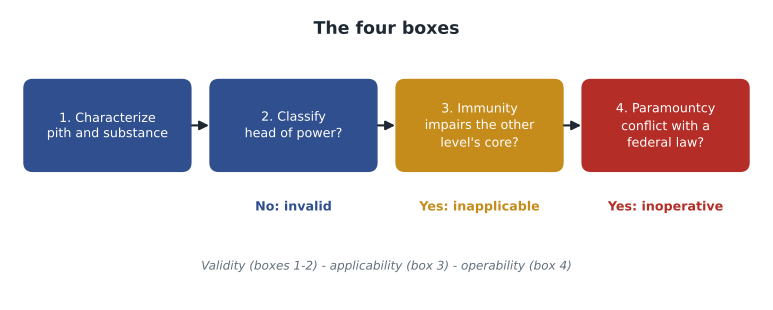
By the tenth class, Section B can characterize and classify a law with confidence. Okafor-Lindqvist now adds the last two of her four boxes. 'Suppose a federal law and a provincial law are both valid,' she says. 'A bank, a federally regulated business, is subject to both. Two questions remain. Does the provincial law even apply to the bank? And if it applies, what happens when it points one way and the federal law points another?' The first question is interjurisdictional immunity. The second is paramountcy.
Both doctrines deal with valid laws. Neither asks whether a law was within its enacting legislature's power; that question has already been answered. Instead, they decide whether a valid law applies in a particular situation and, if two valid laws apply, which one governs.
Interjurisdictional immunity
Interjurisdictional immunity protects the core of a head of power from intrusion by the other level of government. A valid law of general application is read down so that it does not apply to matters at the core of the other level's exclusive jurisdiction. In theory the doctrine is reciprocal, but in practice it has almost always protected federal heads, and federal undertakings, from provincial laws.
The rise: Bell Canada (1988)
In Bell Canada v. Quebec (Commission de la santé et de la sécurité du travail), [1988] 1 SCR 749, a pregnant Bell Canada employee sought protective reassignment under Quebec's occupational health and safety law. The Supreme Court held that the law did not apply to Bell, a federal undertaking, because working conditions, labour relations and management are a vital part of a federal undertaking. The Court said a provincial law need not 'impair' or 'paralyze' the federal undertaking to be inapplicable; it was enough that the law 'affected' a vital or essential part of it. This broad version of the doctrine threatened to shield federal undertakings from a wide range of provincial laws.
The retreat: Canadian Western Bank (2007)
In Canadian Western Bank v. Alberta, 2007 SCC 22, banks argued that Alberta's Insurance Act, which required them to be licensed and to follow consumer protection rules when promoting insurance products, could not apply to them because banking is a federal head. The Supreme Court rejected the argument and narrowed the doctrine in three ways:
- The threshold is impairment, not mere effect. A provincial law must impair the core of the federal power, which is less than sterilizing or paralyzing it but more than simply affecting it.
- The doctrine should generally be reserved for situations already covered by precedent, such as federal things, persons and undertakings, where it had already been applied.
- Courts should usually consider paramountcy before interjurisdictional immunity, because paramountcy respects the concurrent operation of laws and avoids creating legal vacuums.
The Court explained its concerns: a broad immunity creates gaps where neither level's laws apply, gives an unfair advantage to federal businesses, and is inconsistent with the 'dominant tide' of cooperative federalism. Promoting insurance was not at the core of banking, so Alberta's law applied.
Applications since 2007
The doctrine survived, in narrower form:
- In Quebec (Attorney General) v. Canadian Owners and Pilots Association, 2010 SCC 39 (COPA), a provincial agricultural zoning law could not apply to prohibit a private aerodrome, because the location of aerodromes is at the core of the federal aeronautics power, and the law impaired it by forcing the federal Parliament to legislate specifically to override the restriction.
- In Marine Services International Ltd. v. Ryan Estate, 2013 SCC 44, Newfoundland and Labrador's workers' compensation law, which barred lawsuits against employers, applied to a fishing vessel accident even though navigation and shipping is federal; it did not impair the core of federal maritime negligence law.
- In Bank of Montreal v. Marcotte, 2014 SCC 55, Quebec's consumer protection law requiring disclosure of conversion charges on credit cards applied to federally chartered banks: disclosure rules did not impair the core of banking.
- In Rogers Communications Inc. v. Châteauguay (City), 2016 SCC 23, a municipal notice that would have forced Rogers to put a cellular antenna on a different site than the one approved by Industry Canada was inapplicable, because the choice of location for radiocommunication antenna systems is at the core of federal jurisdiction over radiocommunication.
Opsis (2025)
The Supreme Court's latest word on the doctrine came in Opsis Airport Services Inc. v. Quebec (Attorney General), 2025 SCC 17, decided on May 30, 2025. Opsis, a federally regulated company providing pre-board screening at Quebec airports, was charged under Quebec's Private Security Act for operating without a provincial licence. A port loading company and its employee raised the same argument for navigation and shipping. A unanimous Court allowed the appeals and clarified the doctrine:
- Identifying the core does not require a prior precedent, although precedent and evidence help. Canadian Western Bank's suggestion that the doctrine should be reserved for situations covered by precedent does not prevent courts from recognizing a core that has not been litigated before.
- Impairment means adverse consequences for the core. It need not have materialized; a serious potential for impairment can suffice, and the scheme may be assessed as a whole rather than provision by provision.
- Applying those principles, the licensing requirement alone did not impair federal jurisdiction, but the provincial bureau's powers to set standards of conduct, give binding directives, and suspend or revoke licences did, because they let a provincial body control who carried out federally regulated airport and port security. Since those provisions could not be severed from the scheme, the Act as a whole was inapplicable to the appellants.
Commentators have described Opsis as a revival of the doctrine after years of narrowing. For exam purposes, follow its framework: identify the core of the head of power, ask whether the provincial law, considered as a scheme, has adverse consequences on it, and if so read it down or declare it inapplicable.
Interjurisdictional immunity and section 91(24)
Daniel Whitecloud asks whether provincial laws apply to First Nations. The answer has changed. Section 88 of the Indian Act incorporates provincial laws of general application by reference, so they apply to 'Indians' as federal law, subject to treaties and federal laws. In Tsilhqot'in Nation v. British Columbia, 2014 SCC 44, the Court held that interjurisdictional immunity does not shield Aboriginal title land from provincial laws of general application such as forestry legislation; instead, section 35 governs, and provincial laws that unjustifiably infringe Aboriginal rights or title are inapplicable to that extent. In Grassy Narrows First Nation v. Ontario (Natural Resources), 2014 SCC 48, the Court held that Ontario could 'take up' Treaty 3 lands for forestry, subject to the duty to consult and the treaty promises. In NIL/TU,O Child and Family Services Society v. B.C. Government and Service Employees' Union, 2010 SCC 45, an Indigenous child welfare agency's labour relations were held provincial, because the agency's function was child welfare, a provincial matter, despite its Indigenous character.
Federal paramountcy
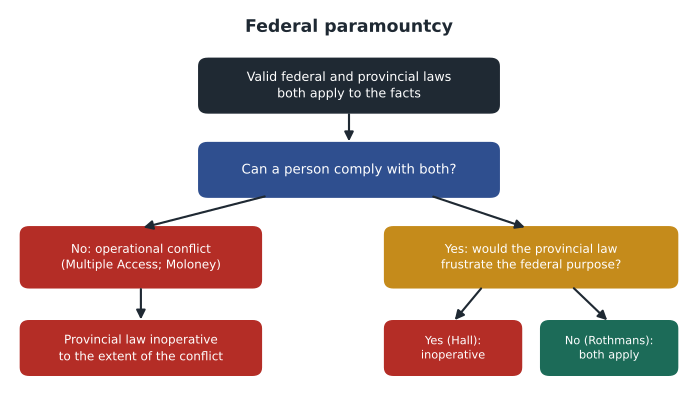
Paramountcy resolves conflicts between valid federal and provincial laws that both apply. Where they conflict, the federal law prevails and the provincial law is inoperative to the extent of the conflict. The provincial law is not invalid: it remains on the books and revives if the federal law is repealed or amended to remove the conflict. Paramountcy is a judge-made doctrine except for the express rules in section 95 (federal paramountcy over agriculture and immigration) and section 94A (provincial paramountcy over old age pensions).
There are two kinds of conflict.
Operational conflict
The first is operational conflict, or impossibility of dual compliance. In Multiple Access Ltd. v. McCutcheon, [1982] 2 SCR 161, Justice Dickson said there is a conflict where 'compliance with one is defiance of the other': one law says yes and the other says no, so that a person cannot obey both. Duplication is not a conflict; where both laws say the same thing, both apply. Nor is it a conflict when a provincial law is stricter than a federal one, provided a person can comply with both by meeting the stricter standard.
In Alberta (Attorney General) v. Moloney, 2015 SCC 51, a driver whose debt for an uninsured accident had been discharged in bankruptcy under the federal Bankruptcy and Insolvency Act found his licence suspended under Alberta's Traffic Safety Act until he paid the debt. The Court held there was an operational conflict: the federal law said the debt was released and the province could not enforce it; the provincial law said the province could enforce it by suspending the licence. Both could not be obeyed at once, so the provincial provision was inoperative.
Frustration of federal purpose
The second kind is frustration of federal purpose. Even where dual compliance is possible, a provincial law is inoperative if it frustrates the purpose of a federal law. In Bank of Montreal v. Hall, [1990] 1 SCR 121, Saskatchewan's law required a creditor to give notice and wait before seizing farm equipment, while the federal Bank Act gave banks a security interest that could be realized directly. The bank could technically comply with both by following the provincial procedure, but doing so would frustrate Parliament's purpose of creating a uniform, nationwide security regime for banks. The provincial law was inoperative. Similarly, in Law Society of British Columbia v. Mangat, 2001 SCC 67, provincial rules barring non-lawyers from practising law for a fee conflicted with federal immigration legislation allowing paid non-lawyer consultants to represent people before immigration tribunals, because applying the provincial rules would defeat Parliament's purpose of making that representation available.
Courts have warned against finding frustration too readily. The party relying on paramountcy must prove the federal purpose, and courts read federal purposes narrowly, rejecting attempts to infer a broad intention to cover a whole field. In Rothmans, Benson & Hedges Inc. v. Saskatchewan, 2005 SCC 13, Saskatchewan's ban on displaying tobacco products where minors were present was stricter than the federal Tobacco Act, which permitted some displays. The Court held that the federal Act did not grant a positive right to display tobacco, so the provincial ban did not frustrate it. In Saskatchewan (Attorney General) v. Lemare Lake Logging Ltd., 2015 SCC 53, a provincial farm security law requiring notice and mediation before a creditor could apply for a receiver did not frustrate the federal bankruptcy law's purpose. And in Orphan Well Association v. Grant Thornton Ltd., 2019 SCC 5, the Redwater case, Alberta's requirement that a bankrupt oil company's trustee meet environmental obligations to clean up abandoned wells, before paying creditors, did not conflict with the federal bankruptcy priority scheme, because the obligations were not claims provable in bankruptcy.
Putting the four boxes together
Okafor-Lindqvist sets out the full sequence one more time:
- Box 1, characterization: identify each law's pith and substance.
- Box 2, classification: decide whether each law falls within its enacting legislature's jurisdiction; apply the ancillary powers test to intruding provisions; note double aspects. Invalid laws are struck down here.
- Box 3, applicability: if a valid law of one level applies to a matter at the core of the other level's exclusive power, ask whether it impairs that core (Opsis). If so, it is inapplicable to that extent.
- Box 4, operability: if valid and applicable federal and provincial laws both govern the facts, ask whether there is an operational conflict or a frustration of federal purpose. If so, the provincial law is inoperative to the extent of the conflict.
Canadian Western Bank suggests considering paramountcy before interjurisdictional immunity in most cases, and many courts proceed that way. In an exam, Okafor-Lindqvist accepts either order, as long as students explain why each doctrine does or does not apply and remember that paramountcy only operates in favour of federal law.
Theo asks the practical question: which doctrine helps a client more? 'Immunity is a bigger prize,' she says. 'The whole provincial scheme may not apply to your client at all, as in Opsis. Paramountcy is narrower: only the conflicting part of the provincial law stops operating, and only while the federal law stays as it is. But paramountcy is easier to win, because courts have been reluctant to expand immunity, even after Opsis.'
Common mistakes
MistakeWhen paramountcy applies, the provincial law is struck down.
InsteadIt becomes inoperative to the extent of the conflict and revives if the federal law changes.
MistakeA stricter provincial law always conflicts with a more permissive federal law.
InsteadOnly if the federal law grants a positive right or its purpose would be frustrated; otherwise one can comply with both (Rothmans).
MistakeInterjurisdictional immunity applies whenever a provincial law affects a federal undertaking.
InsteadThe provincial law must impair the core, meaning adverse consequences (Canadian Western Bank; Opsis); mere effects are not enough.
MistakeFederal undertakings are immune from all provincial laws.
InsteadThey are subject to provincial laws of general application unless those laws impair the core of the federal power (Marcotte; Ryan Estate).
Practice problems
Work each problem on paper first, then reveal the answer to check.
A federal statute allows a pesticide to be sold nationwide. A municipal by-law bans cosmetic use of all pesticides within city limits. Is the by-law inoperative under paramountcy?
Show answer
Likely not. A person can comply with both by not using the pesticide in the city, and a federal approval for sale is generally not a positive right to use the product everywhere. The Supreme Court upheld a similar municipal by-law in 114957 Canada Ltée (Spraytech) v. Hudson (Town), 2001 SCC 40.
A provincial law requires every security guard in the province, including those screening passengers at airports under federal contracts, to obtain a provincial licence that a provincial board can suspend for misconduct. What does Opsis suggest?
Show answer
The licence alone may not impair the federal aeronautics core, but the board's power to set conduct standards and suspend licences gives a provincial body control over who performs federally regulated security, which Opsis found to be impairment. If those powers cannot be severed, the scheme is inapplicable to the federal screeners.
What are the two branches of conflict for federal paramountcy?
Show answer
Operational conflict (impossibility of dual compliance: Multiple Access; Moloney) and frustration of federal purpose (Bank of Montreal v. Hall; Mangat).
Summary and key terms
- Interjurisdictional immunity protects the core of a head of power: a valid law that impairs the other level's core is inapplicable to that extent.
- Bell Canada (1988) applied a broad 'affects' test; Canadian Western Bank (2007) narrowed it to impairment and urged restraint.
- Opsis (2025) held that a precedent is not required to identify a core and that impairment means adverse consequences, which may be potential; the Quebec Private Security Act was inapplicable to federally regulated airport and port security.
- Section 35, not interjurisdictional immunity, governs provincial laws on Aboriginal title land (Tsilhqot'in).
- Federal paramountcy makes a conflicting provincial law inoperative where there is operational conflict or frustration of federal purpose.
- Courts read federal purposes narrowly; duplication and stricter provincial standards are not conflicts (Rothmans; Lemare Lake; Redwater).
- Interjurisdictional immunity
- The doctrine that a valid law of one level does not apply to matters at the core of the other level's exclusive jurisdiction if it would impair that core.
- Core
- The basic, minimum and unassailable content of a head of power.
- Impairment
- Adverse consequences for the core of a head of power, the threshold for interjurisdictional immunity.
- Federal paramountcy
- The rule that where valid federal and provincial laws conflict, the federal law prevails and the provincial law is inoperative to the extent of the conflict.
- Operational conflict
- A conflict in which compliance with one law means defiance of the other.
- Frustration of federal purpose
- A conflict in which applying the provincial law would defeat the purpose of the federal law even though dual compliance is possible.
Lesson quiz · 5 questions
Score 60% or more to complete this lesson.
Create a free account to save your progress, take quizzes and earn a certificate.