
LAWC-101 · Lesson 8 of 12 · 17 min
Trade and commerce and the criminal law power
▶ Video coming soon A video version of this lesson is on the way.
Theo Marchetti brings a bag of groceries to the eighth class: a carton of eggs from an Ontario farm, a bottle of New Brunswick beer, a jar of Quebec maple syrup and a pack of cigarettes he confiscated, he says, from his brother. 'Every one of these,' Okafor-Lindqvist says, 'has been the subject of a Supreme Court decision about who gets to regulate it. Today we find out why the answers differ.'
This lesson covers two of Parliament's most important enumerated powers: the regulation of trade and commerce in section 91(2), and criminal law in section 91(27). Each is broad on its face. Each has been limited by the courts to protect provincial power over property and civil rights. And each comes up again and again in modern regulation of the economy, health, the environment and public safety.
Trade and commerce: the Parsons framework
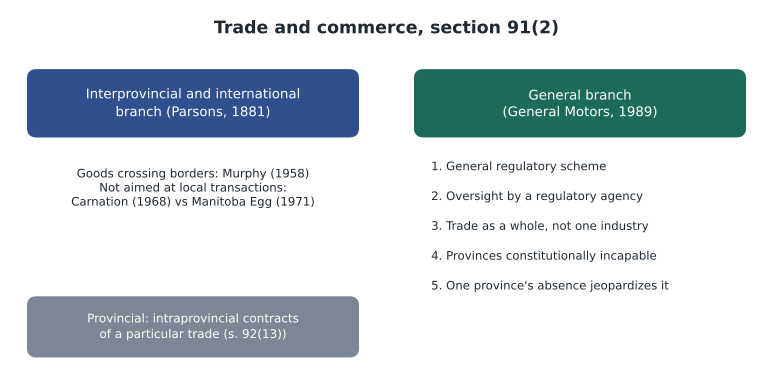
Read literally, 'the Regulation of Trade and Commerce' could cover almost all economic activity, leaving little for the provinces' power over property and civil rights. In Citizens Insurance Co. v. Parsons (1881), 7 App Cas 96, the Privy Council read the two heads together and limited the federal power to two branches:
- The interprovincial and international branch: the regulation of trade in matters of interprovincial concern and international trade.
- The general branch: perhaps, the general regulation of trade affecting the whole Dominion.
The Committee held that the federal power did not extend to regulating the contracts of a particular business or trade, such as fire insurance, within a single province. That remains the core limit: intraprovincial transactions in a particular trade are provincial.
For much of the twentieth century the Privy Council read even these branches narrowly. In Re Board of Commerce Act, 1919, [1922] AC 191, it struck down federal anti-profiteering legislation, and in Canada (Attorney General) v. Ontario (Attorney General), [1937] AC 377, the Natural Products Marketing Reference, it struck down a federal marketing scheme because it regulated transactions completed within a province.
The interprovincial and international branch
Federal power clearly extends to goods crossing provincial and national borders. In Murphy v. Canadian Pacific Railway, [1958] SCR 626, the Supreme Court upheld the Canadian Wheat Board's control of interprovincial and export grain. The difficult cases arise where the two levels' marketing schemes meet.
Provinces may regulate local transactions even if they affect interprovincial trade. In Carnation Co. v. Quebec Agricultural Marketing Board, [1968] SCR 238, a Quebec scheme fixing the price Carnation paid local farmers for milk was valid even though most of the processed product was exported, because the scheme regulated purchases completed within the province. But a province may not aim at interprovincial trade. In Reference re Manitoba Egg and Poultry, [1971] SCR 689, a Manitoba plan that would have controlled eggs produced in other provinces and sold in Manitoba was invalid because it was directed at extra-provincial goods.
Because neither level alone could run an effective national marketing scheme for products like eggs, poultry and dairy, the two levels cooperate. In Reference re Agricultural Products Marketing Act, [1978] 2 SCR 1198, the Court upheld a joint scheme in which federal and provincial laws together created supply management for eggs. That model, built on administrative inter-delegation, still underlies Canada's supply management system.
The general branch
The general branch revived in the 1970s and 1980s. In MacDonald v. Vapor Canada Ltd., [1977] 2 SCR 134, the Court struck down a federal civil cause of action for conduct 'contrary to honest industrial or commercial usage', but Chief Justice Laskin suggested the general branch could support regulation of trade generally, enforced by a regulatory agency.
In General Motors of Canada Ltd. v. City National Leasing, [1989] 1 SCR 641, the Court upheld the federal Combines Investigation Act (now the Competition Act) under the general branch and set out five indicia:
- The impugned legislation must be part of a general regulatory scheme.
- The scheme must be monitored by the continuing oversight of a regulatory agency.
- The legislation must be concerned with trade as a whole rather than with a particular industry.
- The legislation should be of a nature that the provinces jointly or severally would be constitutionally incapable of enacting.
- The failure to include one or more provinces or localities in the scheme would jeopardize its successful operation in other parts of the country.
The indicia are not exhaustive and need not all be present. Competition law met them easily: anti-competitive conduct flows across provincial lines, and a province could not protect its markets alone. Kirkbi AG v. Ritvik Holdings Inc., 2005 SCC 65, the LEGO case, applied the same reasoning to uphold the federal Trade-marks Act provision on passing off.
Securities regulation
Securities regulation shows where the general branch stops. Canada has thirteen provincial and territorial securities regulators, and Ottawa has long argued for a national regulator. In Reference re Securities Act, 2011 SCC 66, a unanimous Court held that the proposed federal Securities Act, which would have regulated the entire securities industry, was not valid under the general branch. Its main thrust was the day-to-day regulation of all aspects of contracts for securities, a matter of property and civil rights that the provinces had long regulated. The Court acknowledged that some aspects, such as managing systemic risk and national data collection, might have a genuine national dimension, and it encouraged a cooperative approach.
Governments took up the invitation. In Reference re Pan-Canadian Securities Regulation, 2018 SCC 48, the Court upheld a cooperative scheme in which participating provinces would enact uniform legislation and the federal government would enact a Capital Markets Stability Act limited to systemic risk and criminal matters. The Court held that the draft federal act fell within the general branch because it targeted systemic risk to the national economy, which no province could address alone. The cooperative regulator has not been fully implemented, but the reference marks the line: national systemic risk is federal; ordinary market regulation is provincial.
Section 121 and internal trade
Section 121 of the 1867 Act provides that articles of the growth, produce or manufacture of any province shall be 'admitted free' into each of the other provinces. In R. v. Comeau, 2018 SCC 15, a New Brunswick man was fined for bringing beer and liquor across from Quebec in excess of the province's personal limits. The Court held that section 121 prohibits laws whose essence and purpose is to impede the movement of goods across provincial borders, but not laws with other primary purposes that only incidentally burden interprovincial trade. New Brunswick's limit was part of a scheme to manage the supply of liquor in the province, so it was valid.
Governments have since moved to reduce internal barriers by legislation and agreement. Bill C-5, the One Canadian Economy Act, received royal assent in June 2025. Its Free Trade and Labour Mobility in Canada Act removes federal barriers to goods, services and workers that meet comparable provincial requirements, and provinces have made parallel commitments under the Canadian Free Trade Agreement.
The criminal law power
Section 91(27) gives Parliament exclusive power over 'The Criminal Law, except the Constitution of Courts of Criminal Jurisdiction, but including the Procedure in Criminal Matters'. Unlike in the United States, where criminal law is mainly a state matter, Canada has a single national Criminal Code. Provinces administer criminal justice under section 92(14), and prosecute most Criminal Code offences, but the substantive law is federal.
Early cases read the power expansively. In Proprietary Articles Trade Association v. Canada (Attorney General), [1931] AC 310, Lord Atkin defined criminal law by its form: an act prohibited with penal consequences. That definition would have let Parliament take over any subject by attaching a penalty.
The modern definition comes from the Margarine Reference, Reference re Validity of Section 5(a) of the Dairy Industry Act, [1949] SCR 1, affirmed [1951] AC 179. Parliament had banned the manufacture and sale of margarine to protect the dairy industry. Justice Rand held that a valid criminal law needs three elements: a prohibition, a penalty, and a typically criminal public purpose, such as 'public peace, order, security, health, morality'. Protecting one industry from competition was an economic purpose, not a criminal one, so the ban was invalid, except as it applied to imports, which fell under trade and commerce.
Modern criminal purposes
The Supreme Court has accepted many criminal purposes:
- Health. In RJR-MacDonald Inc. v. Canada (Attorney General), [1995] 3 SCR 199, a federal ban on tobacco advertising was valid criminal law protecting public health, even though the product itself remained legal. (The Act failed under the Charter's freedom of expression guarantee, and Parliament re-enacted a narrower law that was upheld in 2007.)
- The environment. In R. v. Hydro-Québec, [1997] 3 SCR 213, a five-to-four majority upheld federal controls on toxic substances under the Canadian Environmental Protection Act as criminal law, holding that protection of the environment is a legitimate criminal purpose. Justice La Forest stressed that criminal law can use regulatory techniques such as exemptions and permits.
- Public safety. In Reference re Firearms Act (Can.), 2000 SCC 31, the Court unanimously upheld the federal firearms licensing and registration scheme as criminal law aimed at public safety, despite its regulatory form.
- Morality and harm to self. In R. v. Malmo-Levine; R. v. Caine, 2003 SCC 74, the Court upheld the criminal prohibition on possessing marijuana, holding that Parliament may criminalize conduct to protect vulnerable groups and users themselves.
- Genetic privacy and discrimination. In the Reference re Genetic Non-Discrimination Act, 2020 SCC 17, examined in lesson 6, a majority held that protecting autonomy, privacy, equality and public health from the misuse of genetic test results was a valid criminal purpose.
The power has limits. In Reference re Assisted Human Reproduction Act, 2010 SCC 61, the Court split. Four judges upheld the whole Act as criminal law. Four would have struck down the regulatory provisions as provincial health regulation. Justice Cromwell held that the prohibitions on clearly reprehensible practices, such as human cloning, were valid criminal law, but that provisions regulating the practice of assisted reproduction in clinics, including consent, licensing and inspection, were in pith and substance regulation of medical practice and research, within provincial jurisdiction. His middle position determined the result.
Provincial penal laws and the line with criminal law
Provinces can create offences to enforce valid provincial laws under section 92(15). A provincial law is not invalid simply because it prohibits conduct and imposes penalties. The question is whether its pith and substance falls within provincial jurisdiction, or whether it is really aimed at suppressing conduct as morally wrong.
- In Westendorp v. The Queen, [1983] 1 SCR 43, a Calgary by-law prohibiting being on a street for the purpose of prostitution was struck down: despite its presentation as street regulation, it was an attempt to control prostitution itself, a criminal law matter.
- In Rio Hotel Ltd. v. New Brunswick (Liquor Licensing Board), [1987] 2 SCR 59, provincial liquor licence conditions restricting nude entertainment were valid as regulation of licensed premises.
- In Chatterjee v. Ontario (Attorney General), 2009 SCC 19, Ontario's civil forfeiture law, allowing courts to forfeit property shown to be proceeds of unlawful activity, was valid as property and civil rights, even though it overlapped with criminal law.
- In Murray-Hall v. Quebec (Attorney General), 2023 SCC 10, Quebec's ban on growing cannabis at home, which the federal Cannabis Act permitted in limited amounts, was upheld as a valid provincial law protecting health and safety and regulating the cannabis trade in the province. The Court held that the federal decision to decriminalize home cultivation did not create a positive right that the province had to respect, so there was no conflict and paramountcy did not apply.
Theo tallies his groceries at the end of class. The eggs belong to a joint federal-provincial marketing scheme. The beer was at the centre of Comeau. The maple syrup is sold through Quebec's provincial marketing system, which regulates intraprovincial production and sales. The cigarettes are subject to federal criminal law on advertising and provincial laws on retail sales and smoking places. 'Four products,' Okafor-Lindqvist says, 'and both levels of government touch every one of them. That is what modern federalism looks like.'
Common mistakes
MistakeTrade and commerce lets Parliament regulate any business that operates across Canada.
InsteadThe general branch requires a general regulatory scheme concerned with trade as a whole, meeting the General Motors indicia; ordinary regulation of a particular trade is provincial (Parsons; Securities Act Reference).
MistakeAny prohibition backed by a penalty is valid criminal law.
InsteadThe Margarine Reference requires a typically criminal public purpose in addition to prohibition and penalty.
MistakeIf Parliament decriminalizes conduct, provinces cannot prohibit it.
InsteadMurray-Hall: decriminalization is not a positive federal right; a provincial prohibition with a valid provincial purpose can coexist.
MistakeSection 121 bans every law that burdens interprovincial trade.
InsteadComeau: it bans laws whose primary purpose is to impede interprovincial trade, not laws with other purposes and incidental effects.
Practice problems
Work each problem on paper first, then reveal the answer to check.
Parliament creates a national regulator to license all real estate agents and set rules for every home sale in Canada. Is the scheme valid under the general branch of trade and commerce?
Show answer
Unlikely. It regulates a particular trade and the day-to-day contracts of that trade, a matter of property and civil rights (Parsons; Securities Act Reference). Provinces are capable of regulating real estate, and a province's absence would not jeopardize the scheme elsewhere.
What three elements did Rand J. require for a valid criminal law in the Margarine Reference?
Show answer
A prohibition, a penalty and a typically criminal public purpose such as public peace, order, security, health or morality.
Why did Justice Cromwell's opinion decide the Assisted Human Reproduction Act Reference?
Show answer
The Court split four to four between upholding and striking down the regulatory provisions. Cromwell J. upheld the prohibitions on reprehensible practices but struck down the provisions regulating medical practice and research, so his middle view set the result.
Summary and key terms
- Parsons limited trade and commerce to interprovincial and international trade and the general regulation of trade affecting the whole country.
- Provinces may regulate local transactions affecting interprovincial trade (Carnation) but not schemes aimed at extra-provincial goods (Manitoba Egg).
- The General Motors indicia govern the general branch; competition and trademark law qualify, ordinary securities regulation does not, but national systemic risk does.
- Section 121 bans laws whose primary purpose is to impede interprovincial trade (Comeau).
- A valid criminal law needs a prohibition, a penalty and a typically criminal purpose (Margarine Reference); health, environment, safety and morality all qualify.
- Provincial penal laws are valid if their pith and substance is provincial, but not if they are disguised attempts to suppress conduct as criminal.
- General branch
- The branch of trade and commerce covering the general regulation of trade affecting the whole country, assessed by the General Motors indicia.
- Interprovincial and international branch
- The branch of trade and commerce covering trade that crosses provincial or national borders.
- Supply management
- Joint federal-provincial marketing schemes controlling production and prices of products such as eggs, poultry and dairy.
- Systemic risk
- Risk that threatens the stability of the national financial system, held in 2018 to fall within the general branch.
- Criminal purpose
- A public purpose such as peace, order, security, health or morality, required for a valid criminal law.
- Section 92(15)
- The provincial power to impose penalties to enforce valid provincial laws.
Lesson quiz · 5 questions
Score 60% or more to complete this lesson.
Create a free account to save your progress, take quizzes and earn a certificate.