
ACCT-480 · Lesson 9 of 12 · 26 min
Strategy and governance cases
Strategy and governance is the competency area that ties a case together. Strategic issues ask where a business should go and how: whether to expand, acquire, diversify, exit a market, change its business model or respond to a competitor. Governance issues ask how the business is directed and controlled: the board's role, risk management, ethics, conflicts of interest and reporting to stakeholders, including sustainability reporting. In cases, strategic and governance issues often sit above the technical ones and give them meaning: an acquisition raises valuation, financing, accounting and tax questions, but the first question is whether the acquisition fits the strategy at all. This lesson introduces Copperline Outdoor Gear Ltd., an invented company that the remaining lessons use, and shows how to analyse strategic and governance issues. BUS-310 and BUS-450 taught the frameworks.
Meet Copperline Outdoor Gear
Copperline Outdoor Gear Ltd. is a private company based in Sudbury, Ontario, that designs and makes tents, packs and camping furniture and sells them through outdoor retailers and its own website. It was founded in 2009 by Nadia Bertrand and Joel Kowalczyk, who each own 40 per cent of the shares; the remaining 20 per cent is held by a regional investment fund that bought in three years ago and has a seat on the four-member board. Revenue for 2026 is about 31 million dollars and EBITDA about 4.2 million. Copperline reports under ASPE, has its statements audited for its bank and the fund, and has a term loan and an operating line with a leverage covenant of 3.25 times net debt to EBITDA. The founders want to grow; the fund wants an exit within four years. Every person, company and figure is invented.
The board is considering three strategic options. Option A is to open a direct e-commerce channel to US customers, with a small warehouse near the border. Option B is to acquire a smaller rival tent maker in Quebec. Option C is to expand into gear rentals through its own two stores and partner outfitters. The CFO, a CPA, has asked you, as a senior analyst, to evaluate the options and recommend one. That request is a strategy case, and it shows the method this lesson teaches.
Analysing a strategic decision
Start with the organization's mission, vision and objectives, which the case usually states or implies. Copperline's founders want to build a durable Canadian brand; the fund wants growth and an exit. Those objectives are the criteria against which options are judged, and a recommendation that ignores them, however profitable, will not persuade the board. Then analyse the environment: the industry, competitors, customers, suppliers, regulation and trends, using a framework only if it helps. A SWOT summary or a few lines on the five forces can be useful, but markers reward analysis of this company's situation, not a generic list.
When time is short, three questions do most of the work of a strategic analysis. What does each option do for the objectives the stakeholders care about? What does it require that the company may not have: money, people, skills, management attention? What could go wrong, and how bad would it be? Answering those three for each option, in a few lines each, is usually worth more than a full framework analysis, because it forces you to use the case facts. For Copperline, the acquisition's requirement for new debt and integration capacity, and the risk that the target's key designers leave after the sale, are the facts that lower its score, and saying so explicitly is what earns the marks.
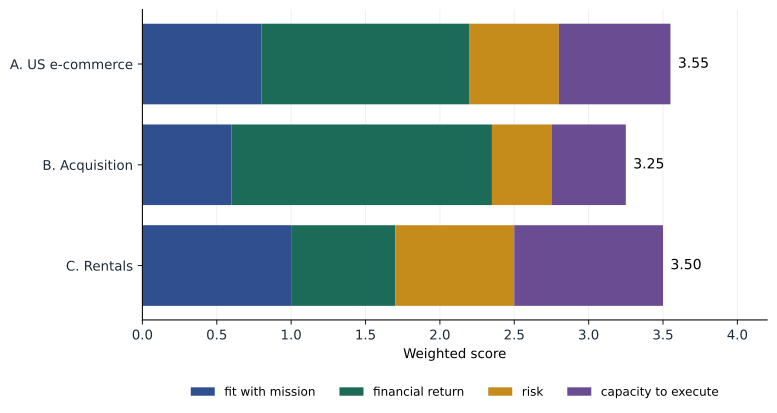
Next, set out the options and evaluate each against the criteria with both quantitative and qualitative evidence. A weighted scoring matrix is a simple, transparent tool: list the criteria with weights that reflect the objectives, score each option, and compute a weighted total. Its value in a case is less the arithmetic than the discipline of making criteria and judgments explicit. The program below scores Copperline's three options and checks the break-even volume for the preferred one.
# Strategy case: weighted scoring of three options for Copperline Outdoor Gear,
# then a break-even check on the preferred one (all figures invented).
criteria = {"fit with mission": 0.20, "financial return": 0.35, "risk": 0.20, "capacity to execute": 0.25}
options = {
    "A. Open a US e-commerce channel": {"fit with mission": 4, "financial return": 4, "risk": 3, "capacity to execute": 3},
    "B. Acquire a rival tent maker":   {"fit with mission": 3, "financial return": 5, "risk": 2, "capacity to execute": 2},
    "C. Expand rentals in-store":      {"fit with mission": 5, "financial return": 2, "risk": 4, "capacity to execute": 4},
}
for name, sc in options.items():
    total = sum(criteria[c] * s for c, s in sc.items())
    print(f"{name:34}{total:5.2f}")
fixed, price, var = 640000, 185, 111
be_units = fixed / (price - var)
print(f"\nOption A break-even: {be_units:,.0f} units a year at a {price - var} contribution per unit")
print("Sensitivity: if price drops 10%,", f"{fixed / (price * 0.9 - var):,.0f} units")A. Open a US e-commerce channel 3.55 B. Acquire a rival tent maker 3.25 C. Expand rentals in-store 3.50 Option A break-even: 8,649 units a year at a 74 contribution per unit Sensitivity: if price drops 10%, 11,532 units
The scores are close: e-commerce leads narrowly, rentals second and the acquisition third, because the acquisition scores high on return but low on risk and capacity to execute. Close scores are a signal that the recommendation depends on judgment, and the response should say what would change it. Option A needs about 8,650 units a year to cover its 640,000 dollars of fixed costs; a 10 per cent price cut would raise that to about 11,500 units. Whether Copperline can sell that many units to US customers is the key question, and the response should recommend testing it before committing, for example with a pilot through a US marketplace.
Recommending and implementing
A strategic recommendation should be clear, justified and implementable. State which option you recommend, why it best meets the objectives, what its main risks are and how to manage them, and what the first steps are. For Copperline, a strong recommendation might be: proceed with Option A as a twelve-month pilot through an existing US marketplace before investing in a warehouse; set targets for unit sales, margin and returns; and review at the end of the pilot. That recommendation respects the founders' brand goal, gives the fund a growth story, limits the downside and tests the critical assumption. Implementation points, such as the need for US sales tax registration under the state economic nexus rules, cross-border duties and a US-dollar revenue stream that naturally hedges Copperline's US-dollar fabric purchases, show integration with tax and finance.
Worked problem
Writing a strategic conclusion for Copperline
Write the conclusion paragraph of the strategy section.
Show solution
- Restate the objectives: durable brand growth for the founders, a growth path to exit for the fund.
- Recommendation: pursue US e-commerce, starting with a marketplace pilot.
- Why: highest weighted score, scalable, builds brand reach, creates a natural currency hedge; the acquisition scored higher on return but carries integration and financing risk the company cannot easily absorb.
- Risks and mitigation: weak US demand (pilot first), returns and logistics costs (set a returns target), tax and duties (obtain advice before launch).
- Next steps: approve a pilot budget, define success measures, report to the board in twelve months.
Answer: Recommend a staged US e-commerce strategy, beginning with a measured pilot, because it best balances the shareholders' objectives with Copperline's capacity and risk.
Governance issues
Governance issues in cases include the composition and independence of the board, conflicts of interest, the oversight of risk, executive compensation, ethics programs and reporting to stakeholders. They often appear as tensions. At Copperline, the fund's director wants an exit within four years, which may favour short-term profit over brand investment; the founders, as both owners and managers, may resist outside oversight; and the CFO reports to a chief executive who is also a 40 per cent shareholder. A case might ask whether the board needs an independent director, whether the audit committee should meet the auditor without management present, or how to handle a director's interest in a supplier. Identify the conflict, explain why it matters to the company and its stakeholders, and recommend a practical safeguard, such as disclosure and abstention from voting, an independent director or a formal related-party policy.
Enterprise risk management is a governance topic that links to every other area. A board should know the principal risks, the company's appetite for them and how they are managed. ACCT-421 covered the COSO and ISO 31000 frameworks; in a case, a short risk register with the top five risks, their likelihood and impact, and the response for each, is often more valuable than a description of a framework.
| Governance issue | Why it matters | Typical recommendation |
|---|---|---|
| Founder-CEO dominates the board | Weak challenge of management decisions | Add an independent director; separate chair and CEO roles |
| Director has an interest in a supplier | Conflict of interest; possible non-arm's-length pricing | Disclosure, abstention, related-party policy |
| No audit committee | Weak oversight of reporting and the auditor | Form a committee with at least one financially literate independent member |
| Investor wants a quick exit | Short-term focus versus long-term value | Agree on a strategy and exit timeline in a shareholder agreement |
| No risk register | Board unaware of principal risks | Create a register and review it quarterly |
Sustainability and stakeholder reporting
Sustainability is now a regular part of strategy and governance cases. Canadian companies face growing expectations from investors, lenders and customers for information on climate risk and other sustainability matters. The Canadian Sustainability Standards Board issued its first two standards, CSDS 1 and CSDS 2, based on the ISSB's IFRS S1 and S2, in December 2024; they are voluntary unless a regulator mandates them, and the Canadian Securities Administrators paused their climate disclosure rule in April 2025. A private company like Copperline faces no mandatory requirement, but its US retail customers, its lenders and its fund investor may ask for emissions data, and California's laws on climate disclosure by large companies doing business there may reach its larger customers. In a case, recommend proportionate steps: identify the information users are asking for, measure the most material items, such as scope 1 and 2 emissions, and consider whether assurance would add credibility. Avoid greenwashing claims that the company cannot support, which may contravene the 2024 amendments to the Competition Act on environmental claims.
Integrating strategy with the rest of the case
Strategy is where the integrated case comes together. The strategic recommendation must be consistent with the financial reporting conclusions (do the adjusted numbers still support the plan?), the finance analysis (can the company afford it, and what happens to the covenant?), the tax analysis (what structure is most efficient?) and the assurance considerations (does the plan change the risks the auditor will face?). At Copperline, lesson 12 will show that a revenue cut-off error pushes the leverage ratio above the covenant limit, which constrains every strategic option that requires new debt. A recommendation that ignores that finding would be impractical.
Common mistakes
MistakeRecommending the option with the highest number without discussing the objectives.
InsteadJudge options against the stated mission and stakeholder objectives.
MistakeUsing frameworks as lists.
InsteadApply a framework only where it helps analyse this company's situation.
MistakeIgnoring close scores.
InsteadWhen scores are close, identify the key assumption and recommend how to test it.
MistakeMaking recommendations without implementation steps.
InsteadGive first steps, measures and a review point.
MistakeTreating governance as a checklist.
InsteadIdentify the specific conflict or weakness, why it matters and a practical safeguard.
MistakeMaking unsupported sustainability claims.
InsteadMeasure first, claim only what can be supported and consider assurance.
Summary and key terms
- Strategic issues frame the technical ones; start from the organization's mission and stakeholders' objectives.
- Analyse the environment for this company, evaluate options against weighted criteria and make judgments explicit.
- Close scores call for identifying and testing the key assumption.
- Recommendations should be clear, justified and implementable, with risks, mitigation and next steps.
- Governance issues include board composition, conflicts, risk oversight and stakeholder reporting; recommend practical safeguards.
- Sustainability reporting in Canada is largely voluntary for now, but users increasingly ask for it; avoid unsupported claims.
- Strategic recommendations must be consistent with the reporting, finance, tax and assurance findings.
- Mission
- The organization's purpose, which guides strategic choices.
- Weighted scoring matrix
- A tool that scores options against weighted criteria to make judgments explicit.
- Break-even volume
- The number of units at which contribution covers fixed costs.
- Independent director
- A director with no material relationship with the company or its management.
- Related-party policy
- Rules for identifying, approving and disclosing transactions with insiders.
- Risk register
- A list of principal risks with likelihood, impact, owner and response.
- Greenwashing
- Making environmental claims that are misleading or cannot be substantiated.
Practice problems
Work each problem on paper first, then reveal the answer to check.
What should be the criteria for evaluating strategic options?
Show answer
The organization's mission and the objectives of its key stakeholders, translated into weighted criteria.
Rerun the scoring program with the risk weight raised to 0.30 and financial return lowered to 0.25. Which option leads?
Show answer
Option C, rentals: 0.20×5 + 0.25×2 + 0.30×4 + 0.25×4 = 3.70, ahead of A at 3.45 and B at 2.95.
Why recommend a pilot for Option A?
Show answer
Because the scores are close and the US demand assumption is critical; a pilot tests it with limited investment.
Name two tax or finance implementation points for Option A.
Show answer
US state sales tax registration under economic nexus rules; a natural hedge for US-dollar fabric purchases (also duties).
The fund's director owns part of a logistics company bidding for Copperline's US shipping. What do you recommend?
Show answer
Disclosure of the interest, abstention from the decision and a competitive, documented selection process.
What did the CSSB issue in December 2024?
Show answer
CSDS 1 and CSDS 2, Canadian sustainability disclosure standards based on IFRS S1 and S2.
Why might Copperline measure scope 1 and 2 emissions even though it is not required to?
Show answer
Customers, lenders and its investor may ask for them, and measurement supports credible claims.
What is the weakness of a founder-CEO who is also the board chair?
Show answer
The board may not effectively challenge management decisions.
Explain how a covenant breach affects the strategic options.
Show answer
Options requiring new debt become hard to finance until the breach is resolved, favouring lower-capital options or equity.
Write a one-sentence risk register entry for Option A.
Show answer
Risk: US demand below break-even; likelihood medium; impact high; response: twelve-month pilot with a stop-loss review.
Lesson quiz · 5 questions
Score 60% or more to complete this lesson.
Create a free account to save your progress, take quizzes and earn a certificate.