
ACCT-480 · Lesson 9 of 12 · 25 min
The discipline sections: BAR, ISC and TCP
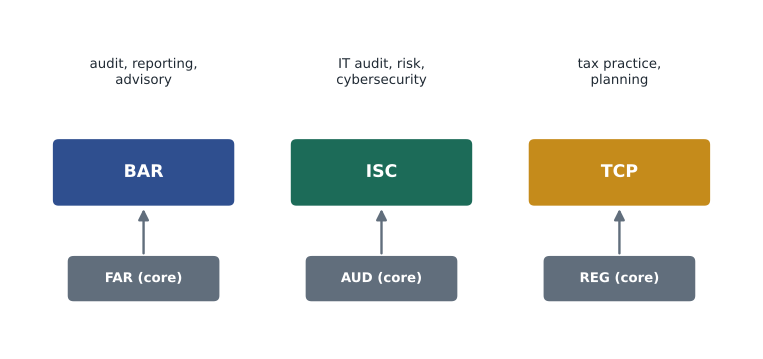
Every candidate chooses one discipline section, and the choice deserves more thought than many candidates give it. Each discipline builds on the core: Business Analysis and Reporting (BAR) deepens financial reporting and adds analytics and managerial topics; Information Systems and Controls (ISC) deepens information technology audit and controls; Tax Compliance and Planning (TCP) deepens individual and entity taxation. All three lead to the same license, so the choice is about your interests, your strengths and your schedule, not about limiting your career. This lesson describes each discipline, how it relates to the core and to this program's courses, and how to choose.
Business Analysis and Reporting (BAR)
BAR has three areas under the 2024 blueprint: business analysis, technical accounting and reporting, and state and local governments. Business analysis covers financial statement analysis, ratio analysis and comparisons, forecasting and projections, data analytics and visualization, cost accounting, variance analysis, capital budgeting, valuation techniques and economic concepts. Technical accounting covers more complex financial reporting topics than FAR, including intangible assets, revenue recognition for complex arrangements, stock compensation, research and development, software costs, business combinations and consolidation in more depth, derivatives and hedge accounting, leases from the lessor's side, and public company reporting topics. The state and local government area extends FAR's coverage of governmental reporting.
BAR suits candidates who plan careers in audit, financial reporting or advisory, and who enjoy technical accounting. It overlaps heavily with FAR, so taking it soon after FAR saves study time; that overlap is also why many candidates find it challenging, because its technical accounting goes beyond FAR. This program's ACCT-311, ACCT-341, ACCT-412, ACCT-421 and ACCT-470 cover most of its content.
Information Systems and Controls (ISC)
ISC has three areas: information systems and data management; security, confidentiality and privacy; and considerations for System and Organization Controls (SOC) engagements. The first area covers IT infrastructure, enterprise systems, business resilience, change management and data management, including data integrity and the life cycle of data. The second covers regulations and frameworks for security and privacy, such as the NIST Cybersecurity Framework and relevant laws, cyber risks and threats, and the controls that address them. The third covers the planning, performance and reporting of SOC 1, SOC 2 and related engagements from the service auditor's perspective. ISC has a different format from the other sections: under the 2024 blueprint it contains 82 MCQs and 6 TBSs, with MCQs weighted 60 percent.
ISC suits candidates interested in IT audit, risk advisory and cybersecurity, and those with technology backgrounds. It overlaps with AUD on internal control and SOC reports. This program's ACCT-240, ACCT-341 and the CISSP and computing courses are useful preparation; ACCT-431 covered SOC reports from the user auditor's side.
Tax Compliance and Planning (TCP)
TCP has four areas: tax compliance and planning for individuals and personal financial planning; entity tax compliance; entity tax planning; and property transactions, including the disposition of assets. It extends REG with more complex individual topics, such as gift taxation, passive activity and at-risk limits, and personal financial planning; with entity topics such as C corporation compliance, consolidated returns, S corporation and partnership details, and trusts; and with planning topics such as entity choice, distributions, liquidations and the tax consequences of business transactions. Because tax law changes, TCP's testable provisions follow the same schedule as REG; the 2025 tax act's provisions became testable from July 1, 2026.
TCP suits candidates heading for tax practice, and many find it the most predictable discipline because its content is close to REG. Taking it soon after REG makes sense. ACCT-351 and ACCT-352 cover much of it.
| Discipline | Builds on | Best for | Format under the 2024 blueprint |
|---|---|---|---|
| BAR | FAR | Audit, financial reporting, advisory | 50 MCQs, 7 TBSs; equal weights |
| ISC | AUD | IT audit, risk advisory, cybersecurity | 82 MCQs, 6 TBSs; MCQs 60 percent |
| TCP | REG | Tax practice, personal financial planning | 68 MCQs, 7 TBSs; equal weights |
How to choose
The choice should rest on three considerations. First, interest and career plan: a discipline that matches the work you want to do will be easier to study and more useful afterward. Second, overlap with your core review: taking BAR after FAR, ISC after AUD or TCP after REG lets you build on recent study. Third, current exposure at work: daily work in a discipline's subject makes the material concrete. Pass rates are published by the AICPA and differ across disciplines, but they reflect who chooses each section as much as its difficulty; they should not drive your choice on their own.
The program below scores the three disciplines for one candidate using her own ratings, then shows a practice performance tracker for REG by blueprint area, weighted by the midpoints of the 2024 blueprint ranges. Both are tools for making a judgment explicit, not formulas that make it for you.
# Choosing a discipline section: weighted fit for one candidate (scores 1-5 are
# the candidate's own). The three disciplines carry equal licensing weight.
weights = {"interest and career plan": 0.40, "overlap with core review": 0.30, "current job exposure": 0.30}
cand = {
    "BAR (business analysis and reporting)": {"interest and career plan": 3, "overlap with core review": 5, "current job exposure": 3},
    "ISC (information systems and controls)": {"interest and career plan": 4, "overlap with core review": 3, "current job exposure": 4},
    "TCP (tax compliance and planning)":      {"interest and career plan": 5, "overlap with core review": 4, "current job exposure": 2},
}
for d, s in cand.items():
    print(f"{d:42}{sum(weights[k] * v for k, v in s.items()):5.2f}")
# Performance tracker by blueprint area for practice MCQs (REG, 2024 blueprint ranges)
areas = {"Ethics, responsibilities, procedures": (0.15, 41, 60), "Business law": (0.20, 30, 52),
         "Property transactions": (0.10, 19, 30), "Individuals": (0.27, 70, 95), "Entities": (0.28, 48, 80)}
print()
weighted = 0
for a, (w, right, tried) in areas.items():
    pct = right / tried
    weighted += w * pct
    print(f"{a:38}{pct:6.0%}{'  <- focus' if pct < 0.65 else ''}")
print(f"Blueprint-weighted accuracy {weighted:.0%} (not a scaled score)")BAR (business analysis and reporting) 3.60 ISC (information systems and controls) 3.70 TCP (tax compliance and planning) 3.80 Ethics, responsibilities, procedures 68% Business law 58% <- focus Property transactions 63% <- focus Individuals 74% Entities 60% <- focus Blueprint-weighted accuracy 65% (not a scaled score)
For this candidate the scores are close, with TCP ahead because of her interest in tax and the overlap with REG, which she is studying now. Her practice tracker shows weaker results in business law, property transactions and entities; those are the REG areas to focus on, and two of them also matter for TCP. A blueprint-weighted accuracy of 65 percent on practice questions is not a scaled score and cannot be converted into one, but a rising trend across practice sets is a good sign.
Scheduling the discipline
Because disciplines are offered only in January, April, July and October, scheduling is part of the decision. A candidate who wants to take TCP right after REG needs to plan REG to finish a few weeks before a discipline window opens. Missing a window means waiting three months, which may matter if the credit window is tight. Score release for disciplines is later than for core sections, about six to seven weeks after the window closes, so a candidate cannot learn the result and retake in the same quarter. Lesson 1's credit window tracker can be extended to include the discipline window in the plan.
Worked problem
Planning a discipline around the core
Sam Whitaker passed FAR in February 2027 and plans to take AUD in May and REG in August. He works in tax and is leaning toward TCP.
Show solution
- TCP builds on REG, so it should follow REG closely.
- REG in August means TCP in October, the next discipline window; that leaves about six weeks to study TCP after REG.
- Discipline scores for October arrive in mid-December, so if Sam fails TCP his next attempt would be January or April 2028.
- Check his credit window: FAR passed in February 2027 under a 30-month rule expires in August 2029, leaving room for one retake.
Answer: Take TCP in the October window right after REG, and keep the January and April 2028 windows as fallbacks.
What the discipline means after licensure
The discipline you pass is reported to your state board, but it does not appear as a specialty on your license, and no state restricts a CPA's work to the area of the discipline passed. In practice the choice matters in two softer ways. Employers sometimes ask about it, because it signals interest; a firm hiring into its tax group may be pleased to see TCP, and a risk advisory practice may value ISC. And the knowledge is useful immediately: BAR's analytics and complex accounting, ISC's controls and SOC knowledge or TCP's planning knowledge are all directly applicable in the first years of practice. If you are unsure of your career direction, choose the discipline that best fits your study schedule and current strengths; you can build expertise in any area later through experience and continuing education.
A study plan for a discipline
Plan a discipline like a core section, but with the window in mind. Count back from the window: if you want to sit in the first week of October, finish content review by late September and begin about eight to ten weeks earlier, depending on your hours. Review the related core section's material in the first week, because the discipline assumes it. Use full practice exams in the format of your discipline, especially for ISC, whose higher MCQ count and weighting change the time budget: with 82 MCQs at about a minute and a quarter each, roughly 100 minutes go to MCQs and the rest to six simulations. Book the appointment early, because testing centers fill in the first weeks of each window.
Can you change your mind? Yes. A candidate who fails a discipline may take a different one next time; the credit for core sections is unaffected, because what matters is passing any one discipline within the credit window. Switching makes sense if the first attempt showed that the discipline is a poor fit, for example a candidate who chose BAR for its overlap with FAR but found its technical accounting much harder than expected and now works in tax. It rarely makes sense after a near miss, when another attempt at the same section, with targeted review, is usually the faster route.
Studying for a discipline
Each discipline goes deeper than the core in its area, so expect more analysis and evaluation tasks. For BAR, practice ratio analysis, forecasting and the complex accounting topics with full simulations. For ISC, learn the frameworks and controls well enough to apply them to scenarios, and practice SOC engagement planning and reporting questions. For TCP, practice multi-step computations and planning comparisons, such as the effect of different entity choices or distribution strategies. In all three, the blueprint's representative tasks are the best guide to what will be asked.
Common mistakes
MistakeChoosing a discipline only by pass rates.
InsteadChoose by interest, overlap with your core study and work exposure; pass rates reflect who takes each section.
MistakeThinking the discipline limits your career.
InsteadAll three lead to the same license.
MistakeScheduling the discipline without checking windows.
InsteadDisciplines are offered only in the first month of each quarter.
MistakeExpecting quick discipline results.
InsteadDiscipline scores arrive about six to seven weeks after the window closes.
MistakeAssuming ISC has the same format as the others.
InsteadISC has more MCQs and fewer TBSs, with MCQs weighted 60 percent.
MistakeStudying a discipline far from its related core section.
InsteadTake BAR after FAR, ISC after AUD or TCP after REG to build on recent study.
Summary and key terms
- BAR deepens financial reporting and adds business analysis and governmental reporting.
- ISC covers information systems and data, security and privacy, and SOC engagements, with a different format.
- TCP deepens individual and entity tax compliance and planning and follows tax law testable dates.
- Choose by interest and career plan, overlap with core study and work exposure; the license is the same.
- Disciplines are offered quarterly with later score release, so schedule them around the core and the credit window.
- Use weighted tools to make the choice explicit and practice data to target weak areas.
- BAR
- Business Analysis and Reporting, the discipline that deepens financial reporting and analysis.
- ISC
- Information Systems and Controls, the discipline covering IT, security, privacy and SOC engagements.
- TCP
- Tax Compliance and Planning, the discipline that deepens individual and entity tax.
- Discipline window
- The first month of each calendar quarter, when discipline sections are offered.
- SOC engagement
- An attestation engagement on a service organization's controls.
- Representative task
- A blueprint statement of a task a newly licensed CPA performs, with its skill level.
Practice problems
Work each problem on paper first, then reveal the answer to check.
Which core section does each discipline build on?
Show answer
BAR on FAR, ISC on AUD, TCP on REG.
Rerun the scoring program for a candidate who rates ISC 5 on interest and 5 on work exposure. Which discipline leads?
Show answer
ISC: 0.40×5 + 0.30×3 + 0.30×5 = 4.40, ahead of TCP at 3.80.
Why should pass rates not decide the choice?
Show answer
They reflect the candidates who choose each section as well as its difficulty.
When are discipline scores released relative to the window?
Show answer
About six to seven weeks after the window closes.
What is distinctive about the ISC format?
Show answer
More MCQs (82) and fewer TBSs (6), with MCQs weighted 60 percent.
Name three BAR technical accounting topics beyond FAR.
Show answer
Stock compensation, derivatives and hedge accounting, lessor accounting (also software costs and research and development).
A candidate passes REG in November. When is the next TCP window?
Show answer
January.
What does the REG tracker suggest for the candidate's study?
Show answer
Focus on business law, property transactions and entities, where accuracy is below 65 percent.
Can a practice accuracy of 65 percent be converted to a scaled score?
Show answer
No; the scaled score depends on item difficulty and other factors.
Which discipline suits a candidate who plans a career in IT audit?
Show answer
ISC.
Lesson quiz · 5 questions
Score 60% or more to complete this lesson.
Create a free account to save your progress, take quizzes and earn a certificate.