
ACCT-480 · Lesson 4 of 12 · 26 min
Management accounting and performance management cases
Management accounting is the other area in which Canadian candidates can show the depth that is required to pass, and it is the core of the Performance Management role. Management accounting issues in cases are about decisions: whether to accept an order, make or buy a component, price a product, invest in equipment, close a line or change how managers are measured. They are often the most quantitative part of a case, and they are where candidates most often produce a correct number but a weak answer, because they do not explain what the number means for the decision or which qualitative factors could change it. This lesson works through those decisions using Northgate Equipment, the invented manufacturer of agricultural equipment from ACCT-421, based in Winnipeg.
The decision frame
Every management accounting issue in a case starts with a decision someone must make. State it clearly: 'whether Northgate should accept the dealer's order for 400 seeders at 2,050 dollars each'. Then identify what is relevant to that decision. Relevant costs and revenues are future amounts that differ between the alternatives. Sunk costs, such as money already spent on a design, are irrelevant. Allocated fixed costs that will be incurred whatever the decision are irrelevant. Opportunity costs, such as the contribution lost when capacity is used for one order instead of another, are relevant even though they never appear in the accounting records. Getting this frame right is more important than any formula, and markers look for it explicitly.
Then consider capacity and constraints. With idle capacity, a special order needs to cover only its incremental costs to add profit. At full capacity, it must also cover the contribution of the work it displaces. When there is one scarce resource, such as machine hours in the paint shop, products should be ranked by contribution per unit of that resource, as ACCT-421 showed with throughput accounting. When there are several constraints, linear programming finds the best mix. In a case you will rarely have time to solve a full linear program, but you should recognize when constraints exist and say how they affect the recommendation.
A combined case: special order and make-or-buy
Northgate's CFO asks for advice on two decisions. A new dealer has offered to buy 400 seeders at 2,050 dollars each, below the usual price. Northgate has idle capacity this season. Variable costs are 1,180 dollars for materials, 310 for direct labour and 140 for variable overhead per unit, and the order would require 38,000 dollars of special tooling. Separately, Northgate could buy its hydraulic control modules from a supplier at 248 dollars each instead of making 5,000 a year at a variable cost of 212 dollars, with 260,000 dollars of fixed costs that would be avoided if it bought. Capital employed is 62.0 million and operating profit 7.69 million, a return on capital employed of 12.4 per cent against the board's 15 per cent target. The program below runs the numbers.
# Northgate Equipment (from ACCT-421): a special order and a make-or-buy in one case.
# Special order: 400 units at 2,050 dollars from a new dealer, idle capacity available.
units, price = 400, 2050
var_cost = {"materials": 1180, "direct labour": 310, "variable overhead": 140}
extra_fixed = 38000            # tooling for the order
vc = sum(var_cost.values())
contribution = units * (price - vc) - extra_fixed
print(f"Variable cost per unit {vc}; contribution from the order {contribution:,}")
# Make or buy the control module: 5,000 modules a year.
make_var, avoidable_fixed, buy_price = 212, 260000, 248
make = 5000 * make_var + avoidable_fixed
buy = 5000 * buy_price
print(f"Make {make:,} vs buy {buy:,}: {'make' if make < buy else 'buy'} saves {abs(make - buy):,}")
# Qualitative points the response must also raise
for p in ["dealer channel conflict", "supplier quality and lead time", "use of freed capacity"]:
    print("-", p)
# ROCE effect of the order (capital employed 62.0 million, operating profit 7.69 million)
op, ce = 7.69e6, 62.0e6
print(f"ROCE before {op / ce:.1%}; after the order {(op + contribution) / ce:.1%}")Variable cost per unit 1630; contribution from the order 130,000 Make 1,320,000 vs buy 1,240,000: buy saves 80,000 - dealer channel conflict - supplier quality and lead time - use of freed capacity ROCE before 12.4%; after the order 12.6%
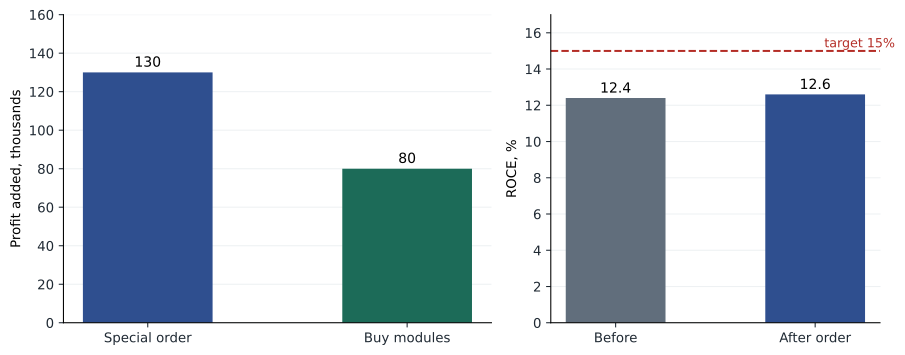
The special order adds 130,000 dollars of contribution after the tooling, so on the numbers alone it should be accepted. Buying the modules saves 80,000 dollars a year, because the avoidable fixed costs make in-house production more expensive than the supplier's price. Together the decisions add 210,000 dollars to operating profit, but the effect on return on capital employed is small: the order alone moves it from 12.4 to 12.6 per cent. That is a useful finding for the board message. These decisions are worth making, but they will not close the gap to 15 per cent on their own, and the CFO should not present them as if they would.
The qualitative factors matter as much as the arithmetic. Selling to a new dealer below the usual price may provoke existing dealers, who could demand the same terms; the response should ask whether the dealer is in a separate territory and whether the price can be kept confidential under competition law and dealer agreements. Buying modules depends on the supplier's quality, reliability and lead time, and it makes Northgate dependent on a single source for a critical component. The capacity freed by buying could be used for something more valuable, which would increase the benefit of buying. And two engineers resigned last month, which may limit the ability to deliver the special order on time. A good response lists these factors and says which ones the CFO should resolve before deciding.
Worked problem
Writing the special order paragraph
Write a paragraph for the CFO on the dealer's special order.
Show solution
- Decision: whether to accept 400 seeders at 2,050 dollars each from a new dealer.
- Relevant amounts: price 2,050; variable cost 1,630; tooling 38,000; with idle capacity, fixed overhead is irrelevant.
- Result: contribution of 420 per unit, 168,000 in total, less 38,000 of tooling, adds 130,000 to operating profit.
- Qualitative: dealer channel conflict, confidentiality of the price, staffing after the resignations, whether the dealer could become a regular customer at normal prices.
- Recommendation: accept, provided the dealer is outside existing dealers' territories and engineering can support delivery; otherwise negotiate a higher price or a later delivery date.
Answer: Accept the order for its 130,000 dollar contribution, subject to resolving the channel and staffing risks.
Pricing and costing issues
Pricing decisions appear in cases about new products, tenders and competitive pressure. Cost-plus pricing is common in practice but can mislead, because a cost that includes allocated fixed overhead rises when volume falls, which leads to higher prices and lower volume, a spiral ACCT-421 called the cost-plus trap. Value-based pricing starts from what the customer would pay, and target costing works backward from a market price to the cost the product must achieve. In a case, compute the price implied by the client's method, compare it with the market or the customer's alternatives, and recommend a price or a range with reasons. If the case gives price elasticity data, use it to find the price that maximizes contribution, not revenue.
Costing issues often concern overhead allocation. A company that allocates all overhead on direct labour hours when its costs are driven by setups and engineering changes will overcost simple, high-volume products and undercost complex, low-volume ones. Activity-based costing, taught in ACCT-321, can reveal which products and customers are actually profitable. In a case, you do not need to build a full activity-based system; you need to recognize when the current allocation distorts decisions and to show the direction and rough size of the distortion with the data given.
Performance measurement and incentives
Performance management cases ask whether a company measures the right things and rewards the right behaviour. A division manager evaluated on return on investment may reject a project that earns more than the company's cost of capital but less than the division's current return, because it would lower the division's average. Residual income or economic value added avoids that problem but favours large divisions. A balanced scorecard links financial measures to customer, process and learning measures, but only if the measures are tied to the strategy and the targets are realistic. Bonuses tied to a single measure invite gaming: managers paid on revenue will offer discounts; managers paid on profit may defer maintenance.
When a case describes a measurement system, test it against three questions. Does it align the manager's interests with the company's? Can the manager control what is measured? Does it encourage short-term behaviour that harms the long term? Then recommend specific changes, such as adding a measure, changing a target, adjusting for items outside the manager's control or lengthening the bonus period. Avoid vague recommendations like 'use a balanced scorecard'; say which measures and why.
| Measure | Strength | Weakness | Fix often suggested |
|---|---|---|---|
| Return on investment | Comparable across divisions of different size | Can reject value-adding projects | Use residual income alongside it |
| Residual income or EVA | Encourages any project above the cost of capital | Favours larger divisions | Compare with targets set per division |
| Revenue growth | Simple, tracks market share | Ignores margin and cost | Pair with contribution margin |
| Operating profit | Broad, understood | Open to short-term cuts and accounting choices | Add quality, maintenance and customer measures |
| Balanced scorecard | Links operations to strategy | Can become a long list of unrelated measures | Limit to measures on the strategy map |
Budgets, variances and forecasting
Variance analysis appears when a case gives budget and actual results and asks why profit differs from plan. Separate the flexible budget variance, which reflects spending and efficiency, from the sales volume variance, which reflects selling more or fewer units than planned. Then look for the explanation in the case facts: a materials price variance caused by a supplier change, a labour efficiency variance caused by new staff, a volume variance caused by a lost customer. The point of a variance in a case is the explanation and the action, not the arithmetic. A two-line calculation followed by a paragraph on what management should do is worth more than a page of variances without interpretation.
Forecasting issues appear when a client needs cash flow projections for a lender or a buyer. Check the assumptions: is the growth rate consistent with history and the market, are working capital needs included, are capital expenditures realistic, does the forecast reflect seasonality? Driver-based forecasts, which link revenue and costs to a few operating drivers, are easier to test and update than line-by-line projections. ACCT-421 showed how a Monte Carlo simulation can turn a forecast into a probability of breaching a covenant; in a case you may only have time for a simple best, base and worst scenario, but the logic is the same.
Integrating management accounting with other areas
Management accounting decisions connect to finance (an investment needs funding and creates risk), to tax (capital cost allowance and investment incentives change the cash flows), to financial reporting (a decision to close a line may trigger an impairment or a restructuring provision) and to strategy (a pricing decision says something about how the company wants to compete). The strongest responses make at least one of these links explicit. For Northgate, the link is the board's return target: the special order and make-or-buy add profit, but the capital investment in the paint line, discussed in lesson 8, will decide whether the target is reachable, and the board should see all three together.
Common mistakes
MistakeIncluding allocated fixed costs in a special order decision with idle capacity.
InsteadUse only incremental costs and revenues; unavoidable fixed costs are irrelevant.
MistakeIgnoring opportunity costs at full capacity.
InsteadInclude the contribution of displaced work as a relevant cost.
MistakeStopping at the number.
InsteadExplain what it means for the decision and list the qualitative factors that could change it.
MistakeRecommending a balanced scorecard without specifics.
InsteadName the measures, link them to strategy and explain the behaviour they will encourage.
MistakeComputing variances without explanation.
InsteadUse the case facts to explain each significant variance and recommend action.
MistakeOverstating the effect of a small decision on a key target.
InsteadQuantify the effect on the target metric honestly.
Summary and key terms
- Management accounting issues are decisions; start by stating the decision and the alternatives.
- Relevant amounts are future and differ between alternatives; sunk and unavoidable allocated costs are irrelevant; opportunity costs are relevant.
- Capacity and constraints determine whether displaced contribution matters and how to rank products.
- Qualitative factors, such as channel conflict, supplier risk and staffing, can outweigh a small quantitative advantage.
- Pricing should consider market value and avoid the cost-plus trap; costing should reflect cost drivers.
- Performance measures should align interests, be controllable and avoid short-termism; recommend specific changes.
- Explain variances and forecasts in terms of causes and actions, and link decisions to finance, tax, reporting and strategy.
- Relevant cost
- A future cost that differs between alternatives.
- Sunk cost
- A cost already incurred that cannot be changed by the decision.
- Opportunity cost
- The benefit given up by choosing one alternative over another.
- Contribution margin
- Revenue less variable costs.
- Return on capital employed (ROCE)
- Operating profit divided by capital employed.
- Residual income
- Operating profit less a charge for the capital employed at the required rate of return.
- Flexible budget
- A budget adjusted to the actual level of activity.
Practice problems
Work each problem on paper first, then reveal the answer to check.
What makes a cost relevant to a decision?
Show answer
It is a future amount that differs between the alternatives.
Rerun the special order with a price of 1,700 dollars. Should Northgate accept?
Show answer
Contribution falls to 70 per unit, 28,000 in total, less 38,000 tooling: a loss of 10,000, so reject unless there are strategic reasons.
At full capacity, what additional cost must a special order cover?
Show answer
The contribution lost on the work it displaces.
Why does buying the modules save money in this case?
Show answer
Because 260,000 of fixed costs would be avoided; total make cost 1,320,000 exceeds buy cost 1,240,000.
Name three qualitative factors for a make-or-buy decision.
Show answer
Supplier quality, reliability and lead time; dependence on a single source; use of freed capacity.
A division manager rejects a project earning 14 per cent when the cost of capital is 10 per cent and the division's ROI is 18 per cent. Why, and what would fix it?
Show answer
The project would lower the division's ROI; evaluating on residual income would make it attractive.
Write one sentence for the board on the effect of the two decisions on ROCE.
Show answer
The special order and outsourcing together add about 210,000 dollars of operating profit, moving ROCE only a few tenths of a point, so the 15 per cent target depends mainly on the paint line investment.
What is the cost-plus trap?
Show answer
Falling volume raises unit cost including fixed overhead, which raises the price and reduces volume further.
How should a variance be presented in a case?
Show answer
A brief calculation followed by the cause from the case facts and a recommended action.
Give an example of a management accounting decision with a financial reporting implication.
Show answer
Closing a product line may require an impairment test and a restructuring provision.
Lesson quiz · 5 questions
Score 60% or more to complete this lesson.
Create a free account to save your progress, take quizzes and earn a certificate.