
ACCT-480 · Lesson 6 of 12 · 25 min
Assurance cases II: procedures, controls and reporting
Once risks are assessed, a case usually asks what the auditor should do about them, what the client should do about weaknesses in its controls, or what the report should say. These are the parts of assurance analysis where candidates most often lose marks for being generic. A list of procedures copied from memory, 'vouch, confirm, recalculate', earns little; a procedure designed for the specific risk and the specific facts earns a lot. This lesson shows how to write procedures, how to analyse internal control weaknesses and how to reach reporting conclusions, continuing with Tamarack Foods Group and its auditor Hollis Ward LLP, and drawing on ACCT-331 and ACCT-431.
Writing procedures that earn marks
A well-written procedure has four parts: what the auditor will do, to what population or source, for which assertion, and why it addresses the risk. 'Obtain the distributor's confirmation of the December shipments, including any side agreements on returns, to test the occurrence and cut-off of revenue, because the volume spike and the sales bonuses create a risk of overstatement' contains all four. Compare it with 'confirm receivables'. The difference is not length but specificity: the first procedure could only have been written for this case.
Choose procedures by the assertion and the evidence they produce. External confirmations provide strong evidence of existence and rights. Inspecting documents provides evidence of occurrence and, for documents created outside the entity, of accuracy. Observation, such as attending an inventory count, provides evidence of existence at a point in time. Recalculation and reperformance test accuracy. Analytical procedures can be substantive if the expectation is precise enough, but in a case they work best as a supporting procedure unless you can build a precise expectation from the data. Inquiry alone is never sufficient. For estimates, CAS 540 asks the auditor to test how management made the estimate, test subsequent events, or develop an independent point estimate or range; say which approach you would use and why.
| Assertion at risk | Strong procedure | Why it works |
|---|---|---|
| Occurrence of revenue | Confirm terms with customers; vouch sales to shipping documents | External evidence that the sale happened on stated terms |
| Cut-off | Examine shipments and invoices a few days either side of year end | Tests recording in the correct period |
| Existence of inventory | Attend the count; test counts to and from records | Direct observation and two-way testing |
| Valuation of inventory | Compare cost with subsequent selling prices; test the aging report | Evidence of net realizable value and of the data used |
| Completeness of liabilities | Search for unrecorded liabilities in payments after year end | Finds obligations not recorded at year end |
| Valuation of estimates | Develop an independent range; test assumptions against evidence | Assesses reasonableness and bias |
Sampling in a case
Cases occasionally ask how many items to test or how to evaluate the results of a test. You will not be expected to use statistical tables from memory, but you should know how sample size responds to the inputs: higher confidence, lower tolerable deviation and more expected deviations all increase sample size. The program below calculates attribute sample sizes for a test of a control at 95 per cent confidence with a tolerable deviation rate of 5 per cent, and evaluates the upper deviation limit for different numbers of deviations found.
# Attribute sampling for a test of controls, and evaluating the result.
import math
def sample_size(tolerable, expected_errors=0, confidence=0.95):
    # smallest n such that P(at most e deviations | rate = tolerable) <= 1 - confidence
    n = 1
    while True:
        p = sum(math.comb(n, k) * tolerable**k * (1 - tolerable)**(n - k) for k in range(expected_errors + 1))
        if p <= 1 - confidence: return n
        n += 1
def upper_limit(n, found, confidence=0.95):
    lo, hi = 0.0, 1.0
    for _ in range(60):
        mid = (lo + hi) / 2
        p = sum(math.comb(n, k) * mid**k * (1 - mid)**(n - k) for k in range(found + 1))
        lo, hi = (mid, hi) if p > 1 - confidence else (lo, mid)
    return hi
for e in (0, 1, 2):
    print(f"Tolerable 5%, expecting {e} deviations: n = {sample_size(0.05, e)}")
n = sample_size(0.05, 1)
for found in (0, 1, 2):
    ul = upper_limit(n, found)
print(f"n={n}, found {found}: upper deviation limit {ul:.1%} -> {'rely' if ul <= 0.05 else 'do not rely'}")Tolerable 5%, expecting 0 deviations: n = 59 Tolerable 5%, expecting 1 deviations: n = 93 Tolerable 5%, expecting 2 deviations: n = 124 n=93, found 0: upper deviation limit 3.2% -> rely n=93, found 1: upper deviation limit 5.0% -> rely n=93, found 2: upper deviation limit 6.6% -> do not rely
Expecting no deviations requires 59 items; expecting one requires 93; expecting two, 124. With a sample of 93, finding no deviations gives an upper limit of 3.2 per cent and finding one gives exactly the tolerable 5.0 per cent, so the auditor can just rely on the control; finding two pushes the upper limit to 6.6 per cent, above tolerable, and the auditor cannot rely on it as planned. In a case response the useful point is the consequence: if the control cannot be relied on, the auditor must increase substantive testing of the related balances and should communicate the deficiency to management.
Internal control weaknesses
Many cases include a description of a process, such as purchasing, payroll or revenue, with weaknesses planted in it. A strong response presents each weakness in a structured way: the weakness, its implication, and a recommendation. The implication should say what could go wrong and why it matters: 'Because the same clerk sets up new suppliers and approves payments, a fictitious supplier could be created and paid without detection, which is a risk of fraud and misstatement of expenses.' The recommendation should be practical for the client's size: in a small company that cannot separate duties, a monthly review of new suppliers and payments by the owner may be the best compensating control.
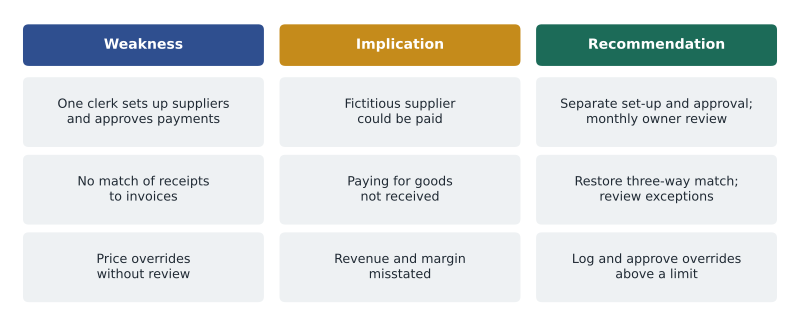
Ranking matters here too. A case may describe eight weaknesses; the marker expects you to identify the most important ones, usually those that could lead to material misstatement or fraud, and to address them well. Weaknesses that are inefficient but low-risk, such as a manual process that takes too long, deserve a brief mention unless the client asked about efficiency. If the client is a reporting issuer, remember that management must certify the design and operating effectiveness of disclosure controls and internal control over financial reporting under NI 52-109, and that a material weakness must be disclosed in MD&A, so control findings have reporting implications too.
Worked problem
Analysing a control weakness at Tamarack
At Tamarack's distribution component, receiving staff record goods into the ERP system, and the system matches the receipt to the purchase order and the supplier's invoice. After the July ERP conversion, the three-way match was switched off for two months to clear a backlog, and invoices were approved manually by the accounts payable supervisor.
Show solution
- Weakness: for two months, invoices were paid without automated matching to receipts and orders.
- Implication: payments for goods not received, duplicate payments or incorrect prices could have occurred; expenses and payables may be misstated; there is a fraud risk because one person approved.
- Assurance response: test a sample of invoices paid in those months against receiving records and purchase orders, and run a duplicate payment analysis on the full population, as ACCT-341 showed.
- Recommendation to management: restore the match, review all exceptions from the period, and require IT change approval before disabling a key control in future.
- Communication: report the deficiency in writing to management and, if significant, to the audit committee under CAS 265.
Answer: A significant deficiency for two months; extend substantive testing and recommend restoring and governing the automated control.
Reaching reporting conclusions
Reporting questions ask what kind of report the auditor should issue. Start with the evaluation of misstatements: compare uncorrected misstatements, individually and in total, with materiality, and consider qualitative factors. If management refuses to correct a material misstatement, the opinion is qualified if the effect is material but not pervasive, and adverse if it is material and pervasive. If the auditor cannot obtain sufficient appropriate evidence, the opinion is qualified or, if the possible effects are pervasive, a disclaimer of opinion. If there is a material uncertainty related to going concern that is adequately disclosed, the report includes a separate section on it under CAS 570; if the disclosure is inadequate, the opinion is modified. For listed entities, key audit matters are communicated under CAS 701.
In a case, show the reasoning: the misstatement, its size relative to materiality, whether it is pervasive, management's response and the resulting report. 'The inventory provision is understated by an estimated 492 thousand to 1,516 thousand. The lower end is below overall materiality of 1,400 thousand, but the upper end exceeds it. If management does not adjust toward our point estimate and the misstatement is material, a qualified opinion would be required, because the effect is confined to inventory and cost of sales.' This kind of paragraph shows the marker that you understand both the standards and their application.
| Situation | Material, not pervasive | Material and pervasive |
|---|---|---|
| Misstatement not corrected | Qualified opinion | Adverse opinion |
| Unable to obtain sufficient appropriate evidence | Qualified opinion | Disclaimer of opinion |
Reviews and compilations in a case
When the engagement is a review, the procedures are mainly inquiry and analytical procedures, and the practitioner must design them to address areas where material misstatements are likely. If the practitioner becomes aware of a matter suggesting a material misstatement, additional procedures are required. A review report expresses a conclusion that nothing has come to the practitioner's attention that causes them to believe the statements are not prepared, in all material respects, in accordance with the framework. A compilation under CSRS 4200 provides no assurance; the practitioner must still not be associated with information they know is false or misleading. In a case, the most common error is recommending audit procedures, such as confirmations, for a review engagement. They are not required, and recommending them suggests the candidate does not understand the engagement.
Integrating assurance with the rest of the case
Procedures and reporting conclusions should flow from the earlier analysis. If your reporting section concluded that revenue should be deferred, your assurance section should include procedures to test the deferral and should evaluate the misstatement if management disagrees. If the finance section shows that a covenant is breached after adjustments, the assurance section should address going concern. If the tax section identifies an uncertain position, the assurance section should consider the related provision. Tie these together with a sentence or two, and the marker will see an integrated response rather than separate essays.
Common mistakes
MistakeListing generic procedures.
InsteadSpecify what, to which source, for which assertion, and why it addresses the case risk.
MistakeRelying on inquiry alone.
InsteadCorroborate inquiry with documents, external evidence or analysis.
MistakeRecommending audit procedures in a review engagement.
InsteadA review relies mainly on inquiry and analytical procedures.
MistakePresenting control weaknesses without implications.
InsteadState what could go wrong and why it matters, then recommend a practical control.
MistakeChoosing a modified opinion without discussing pervasiveness.
InsteadAssess materiality and pervasiveness explicitly before deciding.
MistakeRecommending controls the client cannot afford.
InsteadFit recommendations to the client's size, using compensating controls where needed.
Summary and key terms
- Good procedures are specific: the action, the source, the assertion and the link to the case risk.
- Choose procedures by the evidence they produce; inquiry alone is never enough.
- Sample size rises with confidence, lower tolerable deviation and more expected deviations; failing a controls test increases substantive work.
- Present control weaknesses as weakness, implication and recommendation, ranked by risk, with practical recommendations.
- Reporting conclusions follow from materiality and pervasiveness; know the modified opinions and going concern reporting.
- Reviews rely on inquiry and analysis; compilations provide no assurance.
- Link procedures and reporting conclusions to the reporting, finance and tax analysis.
- Substantive procedure
- A procedure designed to detect material misstatements at the assertion level.
- Test of controls
- A procedure to evaluate the operating effectiveness of a control.
- Upper deviation limit
- The maximum deviation rate in the population at a given confidence level, based on sample results.
- Compensating control
- A control that reduces the risk left by a weakness elsewhere, often a review by an owner or manager.
- Pervasive
- Affecting many elements of the statements, or fundamental to users' understanding.
- Key audit matter
- A matter of most significance in the audit of a listed entity, communicated in the report under CAS 701.
- Significant deficiency
- A deficiency in internal control important enough to merit the attention of those charged with governance.
Practice problems
Work each problem on paper first, then reveal the answer to check.
Rewrite 'confirm receivables' as a case-specific procedure.
Show answer
For example: confirm the December balances and terms of the three largest distributor accounts, including any rights of return, to test existence and cut-off, because shipments to them rose sharply before year end.
Rerun the sampling program with a tolerable rate of 8 per cent and one expected deviation. What sample size results?
Show answer
About 58 items.
A sample of 93 finds two deviations. What should the auditor do?
Show answer
Not rely on the control as planned, increase substantive testing and communicate the deficiency.
Write a weakness-implication-recommendation for a payroll clerk who adds employees and processes pay.
Show answer
Weakness: one clerk adds employees and runs payroll. Implication: a fictitious employee could be paid. Recommendation: require HR approval of new employees and a monthly review of the payroll register by a manager.
What opinion results from a material but not pervasive uncorrected misstatement?
Show answer
A qualified opinion.
What report section is required when a material uncertainty about going concern is adequately disclosed?
Show answer
A separate section on material uncertainty related to going concern.
Why are confirmations not required in a review?
Show answer
A review provides limited assurance through inquiry and analytical procedures.
Under CAS 540, name three ways to test an estimate.
Show answer
Test management's process, use events after year end, develop an independent estimate or range.
What reporting obligation does a material weakness create for a reporting issuer?
Show answer
Disclosure in MD&A and consideration in the NI 52-109 certifications.
Link an assurance procedure to a finance finding in one sentence.
Show answer
Because the cut-off adjustment puts the leverage ratio above the covenant limit, we should evaluate management's going concern assessment and the adequacy of its disclosures.
Lesson quiz · 5 questions
Score 60% or more to complete this lesson.
Create a free account to save your progress, take quizzes and earn a certificate.