
ACCT-480 · Lesson 3 of 12 · 26 min
Financial reporting issues in cases
Financial reporting is the competency area that appears in almost every Canadian case, and it carries special weight: candidates must show depth in financial reporting or management accounting to pass, and depth in financial reporting is required for a public accounting licence. This lesson shows how financial reporting issues appear in cases, what a competent analysis looks like and how to connect accounting conclusions to the rest of the case. The technical rules were taught in ACCT-211, ACCT-212, ACCT-311 and ACCT-470; here the focus is on applying them under time pressure to a client's facts.
How financial reporting issues appear
Case writers rarely ask 'what is the accounting for a lease?'. They describe a transaction or an event and let you discover that it raises a reporting question. A company signs a ten-year agreement for warehouse space; a customer pays in advance for equipment and installation; a division's orders fall sharply; the owners want to convert a shareholder loan into shares; a supplier offers a rebate if purchases exceed a threshold. Each is an accounting issue, and the clue is often in the narrative, not the financial statements. Train yourself to ask, for every transaction or change in the case: has it been recorded, has it been recorded correctly, and does it change any other number someone relies on?
The framework matters before anything else. A publicly accountable enterprise in Canada applies IFRS Accounting Standards under Part I of the CPA Canada Handbook. Most private enterprises may choose ASPE in Part II, and many do because it is simpler; some choose IFRS because of a planned listing, a foreign parent or lender preference. Not-for-profit organizations use Part III or Part I, and public sector entities use the Public Sector Accounting Handbook, as ACCT-412 showed. If the case is ambiguous about the framework, say which one you are applying and why. If the company is changing status, for example planning an initial public offering, the move from ASPE to IFRS may itself be an issue.
The structure of a competent analysis
Markers look for a recognizable structure in each financial reporting issue. Identify the issue in terms of the case: not 'leases' but 'whether the warehouse agreement contains a lease and how it should be recorded'. Refer to the relevant guidance precisely enough to show that you know it, using the criteria or principle in the standard. Apply the criteria to the case facts one by one, using the numbers. Consider alternatives where the facts are ambiguous, and explain which you prefer. Conclude: state the accounting treatment and quantify its effect where you can. Then explain the implications: what the adjustment does to profit, equity, ratios, covenants, tax or the user's decision.
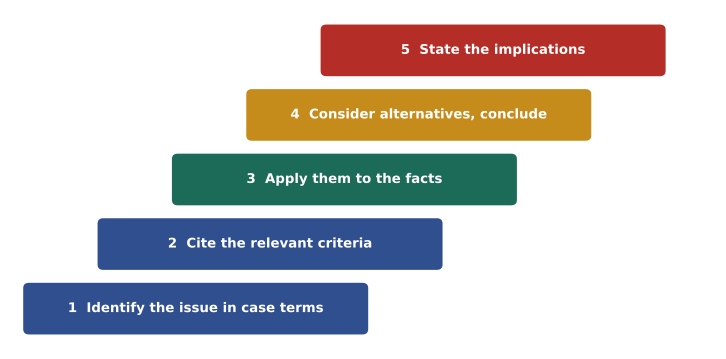
Many candidates stop after the conclusion. The implications step is where integration happens, and where the strongest responses separate themselves. An impairment is not just an expense; it may reduce equity below a covenant threshold, change the chief executive's bonus, signal to a buyer that a segment is struggling and affect the deferred tax position. A revenue cut-off error changes not only revenue but also the receivables a lender uses to calculate the borrowing base. Ask 'so what?' after every accounting conclusion.
A worked case: Tamarind Bay at year end
Recall Tamarind Bay Foods Inc., the invented packaged-foods company from ACCT-470, listed on the Toronto Stock Exchange and reporting under IFRS Accounting Standards. Suppose you are a senior at its audit firm, and the partner asks for a memo on the year-end issues in the Frozen segment, where orders fell after a major retailer delisted two product lines. The relevant facts: the Frozen cash-generating unit's carrying amount, including 138 million of goodwill, is 690 million; management's value in use is 644 million; an external estimate of fair value less costs of disposal is 630 million; profit before tax before any impairment is 144.2 million. The program below performs the calculations you would put in the memo.
# Tamarind Bay (from ACCT-470): the numbers a financial reporting case response needs.
pbt_before_imp = 144.2
materiality = round(0.05 * pbt_before_imp, 1)
carrying, viu, fvlcd = 690.0, 644.0, 630.0     # Frozen CGU, millions
recoverable = max(viu, fvlcd)
impairment = max(0.0, carrying - recoverable)
goodwill = 138.0
print(f"Overall materiality (5% of PBT before impairment): {materiality}")
print(f"Recoverable amount = max(VIU {viu}, FVLCD {fvlcd}) = {recoverable}")
print(f"Impairment = {carrying} - {recoverable} = {impairment}  (charged to goodwill {goodwill})")
print(f"Impairment / materiality = {impairment / materiality:.1f} times")
# Sensitivity a case marker expects: discount rate +0.5 point lowers VIU by about 4.6%
viu_up = round(viu * (1 - 0.046), 1)
print(f"If VIU falls to {viu_up}, impairment rises to {carrying - max(viu_up, fvlcd):.1f}")Overall materiality (5% of PBT before impairment): 7.2 Recoverable amount = max(VIU 644.0, FVLCD 630.0) = 644.0 Impairment = 690.0 - 644.0 = 46.0 (charged to goodwill 138.0) Impairment / materiality = 6.4 times If VIU falls to 614.4, impairment rises to 60.0
Recoverable amount under IAS 36 is the higher of value in use and fair value less costs of disposal, so it is 644 million and the impairment is 46 million, allocated first to goodwill. That is more than six times overall materiality, so it is clearly material. But the more important finding for the partner is the sensitivity: a half-point increase in the discount rate, which is well within the range a reasonable valuer might use, lowers value in use to about 614 million, below fair value less costs of disposal, and the impairment rises to 60 million. The impairment is therefore highly sensitive to management's assumptions, which makes it a significant risk for the audit and an area where IAS 36 requires disclosure of key assumptions and sensitivity.
Worked problem
Writing the Tamarind Bay paragraph
Write the memo paragraph on the Frozen impairment for the audit partner.
Show solution
- Issue: the delisting is an indicator of impairment for the Frozen CGU, which contains goodwill and must be tested at least annually in any case.
- Guidance: IAS 36 compares carrying amount with recoverable amount, the higher of value in use and fair value less costs of disposal; impairment is allocated to goodwill first.
- Application: carrying amount 690 million, value in use 644 million, fair value less costs of disposal 630 million; recoverable amount 644 million; impairment 46 million.
- Alternatives: if the discount rate is half a point higher, value in use falls to about 614 million and the impairment would be 60 million.
- Implications: the impairment reduces profit and equity; we should test management's discount rate and cash flow forecasts, consider a valuation specialist and ensure the key assumptions and sensitivity are disclosed.
Answer: An impairment of 46 million is required, with a range of 46 to 60 million depending on a reasonable discount rate; it is a significant risk for the audit and a key disclosure.
Issues that recur in cases
Some reporting issues appear in cases far more often than others, because they arise naturally from business events and require judgment. Revenue from contracts with customers (IFRS 15 or ASPE 3400) appears when a business bundles goods and services, offers rebates or rights of return, or changes its business model. Leases (IFRS 16, or ASPE 3065 with its operating and capital lease distinction) appear with property, equipment and vehicle agreements. Impairment appears when a segment struggles. Provisions and contingencies appear with warranties, lawsuits and environmental obligations. Financial instruments appear with complex financing, such as convertible debt, redeemable shares or derivatives. Business combinations and consolidation appear when the client buys or sells a business. Each of these has a few criteria that do most of the work; know them well enough to apply without notes.
| Issue | Typical case trigger | Key criteria to apply | Common implication |
|---|---|---|---|
| Revenue | Bundled sale, rebates, returns, bill-and-hold | Performance obligations, transaction price, timing of control | Revenue timing, covenants, bonuses |
| Leases | New property or equipment agreement | Identified asset, right to direct use; under ASPE, capital lease tests | Debt ratios, EBITDA |
| Impairment | Falling orders, closures, market decline | Indicators, CGU, recoverable amount | Profit, equity, disclosure |
| Provisions | Warranties, lawsuits, restoration | Present obligation, probable outflow, reliable estimate | Liabilities, disclosure |
| Financial instruments | Convertible debt, preferred shares, hedges | Liability or equity, classification, measurement | Leverage, EPS |
| Consolidation | Acquisition, investment, joint arrangement | Control, joint control, significant influence | Group results, goodwill |
| Going concern | Losses, breaches, refinancing | Material uncertainty, management plans | Basis of preparation, disclosure |
ASPE in a private company case
Private company cases often test whether you know the ASPE answer and whether you can explain the effect of the choices ASPE offers. Under ASPE an entity may use the taxes payable method for income taxes, may account for subsidiaries by consolidation, the equity method or the cost method in its own statements, may expense development costs in some situations, and classifies leases as capital or operating under criteria that differ from IFRS 16. A frequent case question is whether a private company should change from ASPE to IFRS because a buyer, a bank or a planned listing requires it, and what would change. A good answer lists the major differences that matter for this company, estimates their size where the case allows and recommends a course of action with a timeline.
Connecting reporting to other areas
Financial reporting conclusions feed every other area. In assurance, an aggressive accounting choice is a risk of material misstatement and may indicate management bias. In finance, adjustments change valuation multiples and debt capacity. In tax, the accounting treatment may or may not follow the tax treatment, which creates temporary differences and sometimes planning opportunities. In management accounting, the measures used for performance evaluation and bonuses may be distorted by accounting choices. In governance, the board and audit committee need to understand significant judgments. When you finish a reporting issue, look for at least one link to another area and state it explicitly.
A useful habit is to keep a running list of 'adjusted' figures as you work through the case. Start with the client's draft profit, equity and key ratios. Each time you conclude that an adjustment is needed, update the list. By the end you have an adjusted set of numbers to use in your finance, tax and governance analysis, and you can show the cumulative effect, which is often more striking than any single adjustment.
Disclosure is part of the answer
Many reporting issues are not fully resolved by a journal entry. A material uncertainty about going concern must be disclosed even if the statements are prepared on a going concern basis. A significant judgment, such as concluding that a contract is not a lease, must be explained. Key assumptions behind an impairment test, with sensitivity, must be described. A subsequent event, such as a lawsuit filed after year end, may require disclosure rather than adjustment. In a case, a complete answer to a reporting issue therefore often has two parts: the measurement conclusion and the disclosure the users need. Markers frequently reward a sentence such as 'the notes should disclose the discount rate and growth rate used, and the reasonably possible change that would eliminate the headroom', because it shows that you understand why the standard requires the disclosure and what a reader would do with it.
Common mistakes
MistakeExplaining a standard in general without applying it.
InsteadApply each criterion to the case facts and quantify the result.
MistakeStopping at the accounting conclusion.
InsteadState the implications for ratios, covenants, users and other areas.
MistakeAssuming IFRS applies to every company.
InsteadIdentify the framework; private enterprises often use ASPE.
MistakeIgnoring sensitivity in estimates.
InsteadShow how the conclusion changes under reasonable alternative assumptions.
MistakeAnalysing each adjustment in isolation.
InsteadKeep a running list of adjusted figures and show the cumulative effect.
MistakeWriting long paragraphs on immaterial items.
InsteadCompare each item with materiality and give minor items a sentence.
Summary and key terms
- Financial reporting appears in almost every case and depth in it is central to passing.
- Issues are signalled by transactions and events in the narrative; ask whether each has been recorded correctly and what it changes.
- Identify the reporting framework first: IFRS for publicly accountable enterprises, ASPE or IFRS for private ones.
- A competent analysis identifies the issue, cites the criteria, applies them, considers alternatives, concludes and states implications.
- Sensitivity analysis shows whether a judgment is robust and often reveals the real risk.
- Recurring issues include revenue, leases, impairment, provisions, financial instruments, consolidation and going concern.
- Keep a running list of adjusted figures and link reporting conclusions to assurance, finance, tax and governance.
- Cash-generating unit (CGU)
- The smallest group of assets that generates largely independent cash inflows, used for impairment testing under IFRS.
- Recoverable amount
- The higher of value in use and fair value less costs of disposal.
- ASPE
- Accounting Standards for Private Enterprises, Part II of the CPA Canada Handbook.
- Publicly accountable enterprise
- An entity with debt or equity traded in a public market, or that holds assets in a fiduciary capacity for a broad group of outsiders, which must apply IFRS.
- Sensitivity analysis
- Showing how a result changes when key assumptions change.
- Implications
- The consequences of an accounting conclusion for users, ratios, decisions and other competency areas.
Practice problems
Work each problem on paper first, then reveal the answer to check.
What three questions should you ask about every transaction in a case?
Show answer
Has it been recorded, has it been recorded correctly, and does it change any other number someone relies on?
List the six steps of a competent reporting analysis.
Show answer
Identify, cite criteria, apply to facts, consider alternatives, conclude, state implications.
Rerun the impairment program with value in use of 700 million. What is the result?
Show answer
Recoverable amount 700 exceeds carrying amount 690, so there is no impairment; the sensitivity case gives an impairment of 22.2 million (690 less 667.8).
Why is the Frozen impairment a significant audit risk?
Show answer
It is large, depends on judgmental assumptions and is highly sensitive to the discount rate.
Name three ASPE choices that differ from IFRS.
Show answer
Taxes payable method, cost or equity method for subsidiaries in separate statements, different lease classification criteria.
A private client plans an IPO in two years. What reporting issue does that raise?
Show answer
Conversion from ASPE to IFRS, with comparative figures, likely changes to leases, income taxes and financial instruments, and the need for audited IFRS statements.
Give an example of a reporting conclusion with a finance implication.
Show answer
Recognizing lease liabilities under IFRS 16 increases debt and may affect leverage covenants.
Write the implications sentence for a revenue cut-off error of 620 thousand.
Show answer
Correcting the error reduces revenue and receivables by 620 thousand, lowers EBITDA and the borrowing base, and must be assessed against the covenant before the statements go to the bank.
How do you decide how much to write about an accounting issue?
Show answer
Compare its size and judgment with materiality and its importance to the user's decision.
What is the benefit of a running list of adjusted figures?
Show answer
It lets you use corrected numbers in later analysis and show the cumulative effect of adjustments.
Lesson quiz · 5 questions
Score 60% or more to complete this lesson.
Create a free account to save your progress, take quizzes and earn a certificate.