
ACCT-480 · Lesson 12 of 12 · 25 min
Capstone: a full practice case with model response
This lesson is a complete practice case. Read it as you would in an examination, plan your response, and write it in the time suggested before reading the model response that follows. Then assess your response with the rubric from lesson 10. The case is original and invented; it is written in the style of a multi-competency case but is not an official case, and the model response is one competent approach, not an official solution. Allow about 90 minutes for the case if you want to treat it as a Day 3-style simulation, or use it untimed as a study exercise.
The case: Copperline Outdoor Gear Ltd.
You are a CPA employed as a senior analyst at Copperline Outdoor Gear Ltd., the Sudbury company introduced in lesson 9. It is November 2026. The CFO, Priya Raman, CPA, has asked you to prepare a memo for the board meeting in three weeks. She writes: 'Our draft 2026 results show EBITDA of 4.18 million dollars against net debt of 13.3 million, so leverage is 3.18 times, inside the bank's 3.25 limit. The board will decide on one of the three strategic options we discussed. Please also look at the December shipment to Northern Trails, our largest distributor, which Joel arranged; I'm not sure about the accounting. And the fund has asked whether we should get assurance on our first emissions report, which a big US customer has requested. Finally, Nadia wants to know the tax effect of paying herself a bonus of 150,000 dollars before year end.'
Additional information from the files: Northern Trails ordered 620,000 dollars of tents in mid-December, three times its usual December order, after Joel offered extended payment terms and the right to return unsold tents until March 31. Northern Trails has returned about 35 per cent of similar seasonal orders in the past. The tents cost Copperline 58 per cent of the selling price. The draft results record the full 620,000 as revenue. The bank tests the covenant on the annual audited statements. Copperline reports under ASPE and is audited by an external firm. Joel's sales bonus depends on annual revenue exceeding 31 million dollars; draft revenue is 31.2 million. Copperline is a CCPC taxed at the combined small business rate on its first 500,000 dollars of active business income; its taxable income exceeds that limit. The US customer's request is for scope 1 and 2 emissions for 2026, and its supplier code says data should be 'independently verified where possible'.
Requirements
Prepare a memo to the board that addresses: (1) the accounting for the Northern Trails shipment and its effect on the covenant; (2) the implications for the year-end audit; (3) your recommendation on the strategic options in light of your findings; (4) the emissions assurance question; and (5) the tax implications of Nadia's bonus. Address any other issues you consider important. Write as the company's own analyst, not as its auditor.
Planning the response
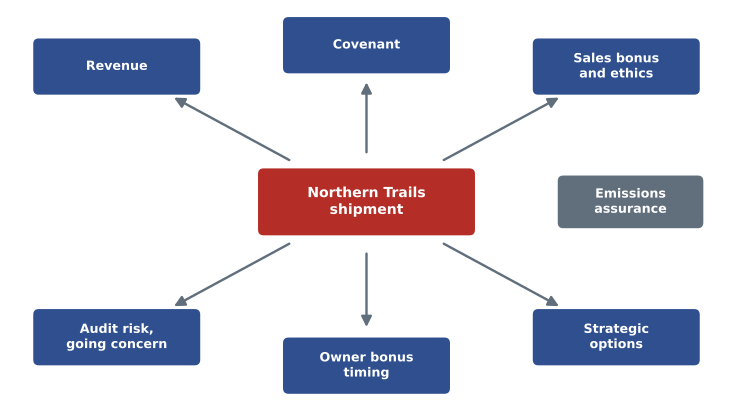
Before reading the model response, list the issues and rank them. A strong plan would identify the shipment as the most important issue, because it affects revenue, the covenant, Joel's bonus and the audit; it would see an ethical issue in Joel's arrangement of a sale that triggers his own bonus; it would recognize that the strategic recommendation depends on whether the covenant is breached; and it would treat the emissions and bonus questions as smaller but directed. The program below does the quantitative core: the covenant test before and after correcting the revenue recognition.
# Practice case quantitative: Copperline Outdoor Gear's covenant test and
# the effect of correcting a revenue cut-off error (all figures invented, in thousands of dollars).
ebitda, net_debt, limit = 4180, 13300, 3.25
cutoff_error_revenue, margin = 620, 0.42
adj_ebitda = ebitda - cutoff_error_revenue * margin
for label, e in (("As drafted", ebitda), ("After cut-off correction", adj_ebitda)):
    r = net_debt / e
    print(f"{label:26} EBITDA {e:7,.0f}  leverage {r:4.2f}x  {'breach' if r > limit else 'within limit'}")
print(f"Headroom needed to stay within {limit}x: EBITDA of at least {net_debt / limit:,.0f}")As drafted EBITDA 4,180 leverage 3.18x within limit After cut-off correction EBITDA 3,920 leverage 3.39x breach Headroom needed to stay within 3.25x: EBITDA of at least 4,092
The program uses a simplified adjustment: it removes the gross margin on the shipment, 42 per cent of 620,000, from EBITDA, which gives 3,920 thousand and leverage of 3.39 times, above the limit. A more refined analysis under ASPE 3400 would recognize revenue for the portion not expected to be returned if the amount can be reasonably estimated; using the 35 per cent historical return rate, revenue of about 403,000 dollars might be recognized and 217,000 deferred, reducing EBITDA by about 91,000 dollars to about 4,089 thousand and leverage to about 3.25 times, at or marginally above the limit. Either way, the covenant headroom has disappeared. Copperline needs EBITDA of at least about 4,092 thousand to stay within 3.25 times, and the shipment as recorded is what kept it there.
Model response
To: Board of Directors, Copperline Outdoor Gear Ltd. From: Senior Analyst. Re: 2026 year-end issues and strategic options. This memo addresses, in order of priority, the December shipment to Northern Trails and its effect on our bank covenant, the related audit implications, the strategic options, assurance on our emissions report and the tax effect of a year-end bonus.
1. The Northern Trails shipment. Under ASPE 3400, revenue from the sale of goods is recognized when the significant risks and rewards of ownership have transferred, the amount can be measured reliably and collection is reasonably assured. Northern Trails can return unsold tents until March 31 and has historically returned about 35 per cent of similar orders; the order was three times normal and was induced by extended payment terms. These facts suggest that the risks and rewards of a substantial part of the shipment have not transferred. If returns can be reasonably estimated from history, revenue should be reduced by the expected returns, about 217,000 dollars, with a corresponding provision; if they cannot, given the unusual size of the order, revenue on the whole shipment should be deferred until the return period ends. I recommend deferring at least the expected returns and discussing with the auditors whether the unusual size of the order makes the historical rate unreliable.
Effect on the covenant. Deferring the expected returns reduces EBITDA to about 4.09 million and leverage to about 3.25 times, at or marginally above the limit; deferring the whole shipment reduces EBITDA to about 3.92 million and leverage to 3.39 times, a breach. Because the bank tests the covenant on the audited statements, we should not assume the draft figure will stand. I recommend that we approach the bank now, explain the situation and request a waiver or an amendment for 2026, before the audit is complete.
Ethics and governance. The shipment was arranged by Joel, whose bonus depends on revenue exceeding 31 million dollars; without the shipment, revenue would be below the threshold. This creates a conflict of interest and a risk that the transaction was structured to meet the target. The board should review the terms of the arrangement, ensure the accounting reflects its substance regardless of the bonus effect, and consider whether sales bonuses should be based on revenue net of returns or on margin. As a CPA, I am required to ensure that the accounting is not biased; I have raised the matter with the CFO.
2. Audit implications. The auditors will treat revenue recognition as a presumed fraud risk, and the size and timing of this order, together with the bonus incentive and the covenant pressure, make it a significant risk. We should expect them to confirm the terms with Northern Trails, including any side agreements, to examine returns after year end and to evaluate our returns estimate. If the covenant is breached without a waiver, the loan may become payable on demand, which would require classification as a current liability and could raise a going concern question that the auditors must evaluate. Obtaining a waiver before the statements are finalized avoids both.
3. Strategic options. In lesson 9 the e-commerce pilot (Option A) scored highest, closely followed by rentals (Option C), with the acquisition (Option B) last. The covenant finding strengthens that ranking. The acquisition would require new debt, which the bank is unlikely to provide while we are at or above the leverage limit. The e-commerce pilot through an existing marketplace requires little capital and can be funded from operations. I recommend proceeding with the pilot, deferring any decision on the acquisition until the covenant position is resolved, and reviewing the rental option in twelve months.
4. Emissions assurance. Our customer asks for scope 1 and 2 emissions and prefers independent verification. Limited assurance on a first-year emissions report is a proportionate step: it adds credibility, it is less costly than reasonable assurance and it will reveal weaknesses in our data collection. A practitioner could provide it under CSAE 3410 or the new Canadian sustainability assurance standard; we should confirm which the customer accepts. If we engage our auditors, the fund and the board should consider independence and cost; another firm may be appropriate. Before assurance, we need a reliable inventory of fuel use at the plant and vehicles (scope 1) and purchased electricity (scope 2), and we should avoid any public claims about emissions until the data are verified.
5. Nadia's bonus. A bonus is deductible to Copperline in 2026 if it is a reasonable expense and is paid within 180 days after year end. Because Copperline's taxable income exceeds the 500,000 dollar small business limit, the bonus reduces income taxed at the general corporate rate, which is higher than the small business rate, so the deduction is more valuable than if it reduced income eligible for the small business deduction. Nadia will pay personal tax on the bonus at her marginal rate and it will create RRSP room for 2027; CPP contributions apply only up to the annual maximum, which her salary has probably already reached. Note that a bonus paid before year end reduces 2026 EBITDA by 150,000 dollars, which makes the covenant position worse; a bonus accrued but paid after year end has the same effect on EBITDA. The board should therefore consider deferring the bonus decision until the covenant waiver is resolved.
Integrated conclusion. The Northern Trails shipment, properly accounted for, removes our covenant headroom and may cause a breach. That finding affects every other decision: we should seek a waiver now; we should choose the low-capital e-commerce pilot rather than the acquisition; we should expect the audit to focus on revenue and returns; and we should defer the bonus until the covenant is settled. Separately, we should obtain limited assurance on our first emissions report and change the sales bonus plan so that it rewards net sales rather than gross shipments.
| Assessment opportunity | What a competent response does | Common weakness |
|---|---|---|
| Revenue recognition | Applies ASPE 3400 criteria to the return right and order size; quantifies the adjustment | States the rule without applying it, or ignores the return right |
| Covenant | Recalculates leverage after adjustment and recommends approaching the bank | Uses the draft figure |
| Ethics | Identifies Joel's conflict and recommends governance action | Misses it entirely |
| Audit | Identifies the significant risk and the going concern link | Lists generic procedures |
| Strategy | Updates the recommendation for the covenant finding | Repeats lesson 9 without integration |
| Emissions assurance | Recommends proportionate limited assurance and data readiness | Recommends an audit of emissions without considering cost or readiness |
| Tax | Explains deductibility, timing, rate effect and personal tax, and the EBITDA link | Computes tax but misses the covenant effect |
Assessing your response
Rate your response on each line of the rubric using the levels from lesson 10: not addressed, nominal, reaching, competent, strong. Be honest. Most candidates find that their response is stronger on the issues they identified first and weaker on integration and ethics. If you missed the conflict of interest, re-read the case and look for the sentence that should have alerted you: 'Joel's sales bonus depends on annual revenue exceeding 31 million dollars; draft revenue is 31.2 million.' A competent professional reads that sentence and immediately sees the question it raises. Practise noticing such sentences, and write down, after each practice case, the clues you missed.
Where to go from here
This course ends the accounting program, but case skills improve only with practice. Work through more cases under timed conditions, mix competency areas, and debrief each one. Revisit earlier courses when a case exposes a technical gap: ACCT-470 for reporting judgments, ACCT-431 for assurance, ACCT-352 for corporate tax, ACCT-421 for performance management. Confirm the current structure and dates of the certification program with your regional CPA body, especially during the transition to the new CPA Professional Program, and plan your path so that you complete the examinations you need while they are offered.
Common mistakes
MistakeUsing the draft covenant figure after finding an adjustment.
InsteadRecalculate key ratios with the adjusted numbers.
MistakeMissing a conflict of interest hidden in the facts.
InsteadLook for incentives, such as bonuses tied to targets, near the transactions you analyse.
MistakeTreating each requirement as a separate essay.
InsteadConnect the findings in an integrated conclusion.
MistakeRecommending reasonable assurance by default.
InsteadMatch the level of assurance to the user's need, cost and readiness.
MistakeAnalysing a tax question without its business effects.
InsteadNote effects on EBITDA, covenants and cash, not just tax.
MistakeReading a model response before writing your own.
InsteadWrite first, then compare and assess.
Summary and key terms
- A full practice case tests issue identification, prioritization, analysis, ethics and integration together.
- The Northern Trails shipment illustrates how one reporting conclusion changes the covenant, the audit, the strategy and the tax advice.
- Recalculate key ratios after adjustments and recommend action before the user's deadline.
- Incentives near a transaction signal ethical and fraud risks; name them and recommend governance action.
- Match assurance to the user's need and the entity's readiness.
- Write first, assess honestly with a rubric, record the clues you missed and practise again.
- Practice case
- An original case used to rehearse the examination format and assess one's own response.
- Model response
- One competent approach to a case, used for comparison, not an official answer.
- Covenant waiver
- A lender's agreement not to enforce a breached covenant for a period.
- Scope 1 and 2 emissions
- Direct emissions from owned sources and indirect emissions from purchased energy.
- Limited assurance
- A lower level of assurance than an audit, often appropriate for first-year sustainability information.
- Conflict of interest
- A situation in which a person's private interest could influence their professional judgment.
Practice problems
Work each problem on paper first, then reveal the answer to check.
Why is the Northern Trails shipment the top-priority issue?
Show answer
It affects revenue, the covenant, a bonus, ethics, the audit and the strategic options.
Rerun the covenant program with a 20 per cent margin instead of 42. Is the covenant breached after the correction?
Show answer
EBITDA becomes 4,056; leverage 3.28 times, a narrow breach.
What ASPE 3400 conditions are in doubt for the shipment?
Show answer
Transfer of significant risks and rewards, given the return right and unusual order size.
Why should Copperline approach the bank before the audit is complete?
Show answer
To obtain a waiver or amendment that avoids current classification of the loan and a going concern question.
What governance change would reduce the risk shown by Joel's arrangement?
Show answer
Basing sales bonuses on net sales after returns or on margin, and board review of unusual transactions.
Why might limited assurance be preferable for the emissions report?
Show answer
It meets the customer's request at lower cost and suits first-year data.
Why does Nadia's bonus worsen the covenant?
Show answer
It reduces 2026 EBITDA by 150,000 dollars.
How does the covenant finding change the strategic recommendation?
Show answer
It makes the debt-funded acquisition impractical and favours the low-capital pilot.
What clue should alert you to a conflict of interest?
Show answer
The sales bonus threshold of 31 million and draft revenue of 31.2 million, combined with Joel arranging the shipment.
What should you record after each practice case?
Show answer
Your rubric ratings and the clues you missed.
Lesson quiz · 5 questions
Score 60% or more to complete this lesson.
Create a free account to save your progress, take quizzes and earn a certificate.