
ACCT-480 · Lesson 5 of 12 · 26 min
Assurance cases I: engagement acceptance, planning and risk
Assurance appears in almost every Canadian case, and candidates who want a public accounting licence must show depth in the Assurance role. Assurance issues in cases range from whether a firm should accept a new client, through which kind of engagement a user needs, to planning, risk assessment, procedures, internal control and reporting. This lesson covers the first half: acceptance, the choice of engagement, materiality and risk assessment. Lesson 6 covers procedures, controls and reporting. The technical material was taught in ACCT-331 and ACCT-431; here the question is how to apply it to the facts of a case, using Tamarack Foods Group, the invented food company from ACCT-431, and its auditor Hollis Ward LLP.
Which engagement does the user need?
Many cases begin with a user who needs some kind of assurance and does not know which kind. A bank lending to a small private company may accept a review engagement under CSRE 2400, which provides limited assurance through inquiry and analytical procedures. A larger loan, a buyer, or a regulator may require an audit under the Canadian Auditing Standards, which provides reasonable assurance. A compilation under CSRS 4200 provides no assurance and is suitable when the user only wants financial information prepared by an accountant. Specific elements, such as a sales figure used in a rent calculation, may be audited under CAS 805, and compliance with a contract, such as a covenant, may be reported on under CSAE 3001 or with an agreed-upon procedures engagement under CSRS 4400. Sustainability information may be assured under the new Canadian standard based on ISSA 5000, adopted in 2026.
In a case, identify the user, what the user will do with the report and the level of confidence the user needs, then recommend the engagement and explain the trade-offs: cost, time, the level of assurance and what the report will say. If the client wants an audit but cannot afford one, or wants a review when the bank needs an audit, say so and recommend a path, such as asking the bank whether a review with specified procedures would be acceptable. Markers reward a clear recommendation tied to the user's needs.
| Engagement | Assurance | Typical user need | Main procedures |
|---|---|---|---|
| Audit (CAS) | Reasonable | Investors, larger lenders, regulators, buyers | Risk assessment, controls testing, substantive procedures |
| Review (CSRE 2400) | Limited | Smaller lenders, owners, some suppliers | Inquiry and analytical procedures |
| Compilation (CSRS 4200) | None | Owners, tax filing, some small lenders | Preparation from records, no verification |
| Specific element (CAS 805) | Reasonable on the element | Landlord, royalty holder | Audit procedures focused on the element |
| Agreed-upon procedures (CSRS 4400) | None; findings only | A party that defines its own procedures | Procedures agreed with the user, factual findings |
| Other assurance (CSAE 3000, 3001) | Reasonable or limited | Compliance, controls, non-financial information | Depends on subject matter and criteria |
Acceptance and independence
Before planning, a firm must decide whether to accept or continue an engagement. Under CSQM 1 the firm must have policies on client acceptance and continuance that consider the integrity of the client's management, whether the firm has the competence and resources, and whether it can comply with ethical requirements including independence. Cases plant acceptance issues: a prospective client whose previous auditor resigned after a disagreement, a partner who owns shares in the client, a fee that would make up a large share of the firm's revenue, a request to prepare the statements and also audit them for a listed entity. A competent response identifies the threat (self-interest, self-review, advocacy, familiarity or intimidation), evaluates its significance and recommends safeguards or declining the engagement.
Independence is assessed in the Assurance role but also matters in other roles. A candidate in the Finance role who is asked to value a company that the firm audits must notice the self-review threat. Write the principle, the threat and the response in a few sentences: 'Because Hollis Ward audits Tamarack, preparing the valuation that Tamarack will use in its financial statements would create a self-review threat; for a listed entity, this service is generally prohibited, so the firm should decline or refer it to another firm.'
Materiality in a case
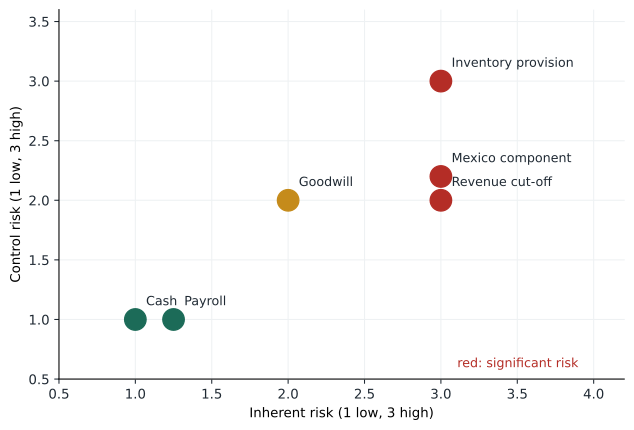
Planning a case audit requires a materiality figure, and markers expect you to calculate one and justify it. Choose a benchmark that reflects what users focus on: profit before tax for a stable profitable company, revenue or total assets for a company near break-even or a not-for-profit, equity for some investment entities. Apply a percentage within the usual ranges, explain any adjustments for unusual items, and then set performance materiality, typically 50 to 75 per cent of overall materiality depending on the risk of misstatement and the history of errors, and a clearly trivial threshold, often about 5 per cent of overall materiality. The program below shows the Tamarack figures used in ACCT-431 and ranks the significant areas.
# Assurance planning for Tamarack Foods Group (from ACCT-431), in thousands.
benchmarks = {"pre-tax income x 5%": 28000 * 0.05, "revenue x 0.5%": 412000 * 0.005}
overall = 1400                       # chosen: pre-tax income basis, rounded
performance = round(overall * 0.75)  # 75% for a recurring audit with few past errors
trivial = round(overall * 0.05)
for k, v in benchmarks.items(): print(f"{k:22}{v:>10,.0f}")
print(f"Overall {overall:,}, performance {performance:,}, clearly trivial {trivial:,}")
# Rank account-level risks: inherent risk x control risk on a 1-3 scale
areas = {"Revenue cut-off": (3, 2), "Inventory provision": (3, 3), "Goodwill": (2, 2),
         "Payroll": (1, 1), "Mexico component": (3, 2), "Cash": (1, 1)}
print()
for a, (ir, cr) in sorted(areas.items(), key=lambda kv: -kv[1][0] * kv[1][1]):
    level = ir * cr
    resp = "significant risk: tailored substantive work" if level >= 6 else "standard procedures" if level >= 3 else "minimal"
print(f"{a:20}{level:>3} {resp}")pre-tax income x 5% 1,400 revenue x 0.5% 2,060 Overall 1,400, performance 1,050, clearly trivial 70 Inventory provision 9 significant risk: tailored substantive work Revenue cut-off 6 significant risk: tailored substantive work Mexico component 6 significant risk: tailored substantive work Goodwill 4 standard procedures Payroll 1 minimal Cash 1 minimal
Tamarack's pre-tax income of 28 million gives 1,400 thousand at 5 per cent, which Hollis Ward chose over the revenue benchmark because Tamarack is a stable, profitable listed company and investors focus on earnings. Performance materiality of 1,050 thousand, 75 per cent of overall materiality, is appropriate for a recurring audit with few past misstatements; a first-year audit or one with known control weaknesses would use a lower percentage. Clearly trivial is 70 thousand. In a case, also mention when a lower materiality applies to particular items, such as related-party transactions or executive pay.
Assessing the risks of material misstatement
Risk assessment is where cases test judgment most directly. CAS 315 (Revised) requires the auditor to understand the entity, its environment, the applicable financial reporting framework and its system of internal control, and to identify and assess risks of material misstatement at the financial statement and assertion levels, considering inherent risk factors such as complexity, subjectivity, change, uncertainty and susceptibility to misstatement due to management bias or fraud. Risks at the high end of the spectrum are significant risks that require a specific response. Revenue recognition is presumed to be a fraud risk unless rebutted, and management override of controls is always a significant risk.
In a case, link each risk to the facts and to an assertion. 'There is a risk that revenue is overstated (occurrence and cut-off) because the sales team's bonuses depend on December shipments and shipments to one distributor doubled in the last week of the year' is a competent risk statement. 'Revenue is risky' is not. Then explain the response: what kind of procedures, at what timing and extent, focused on which assertion. The ranking in the program is a simplification of that process. It scores inherent and control risk and labels the high scores as significant; in practice the assessment is a judgment informed by such scores, not the product of them.
Worked problem
Writing a risk paragraph for Tamarack's inventory provision
Tamarack carries a provision for slow-moving and expired inventory. The provision fell from 3.1 million to 1.85 million this year although sales of two product lines declined and a new ERP system was installed in July.
Show solution
- Risk: the provision may be understated (valuation assertion), increasing profit.
- Facts that raise inherent risk: subjectivity in estimating net realizable value, declining sales in two lines, a large reduction in the provision without an obvious explanation.
- Facts that raise control risk: the new ERP system may have disrupted the aging reports on which the provision is based.
- Assessment: significant risk, with a possible indicator of management bias.
- Response: test the aging report's accuracy after the ERP conversion, compare sales after year end with recorded values, develop an independent estimate of the provision, and evaluate whether management's estimate falls within a reasonable range.
Answer: A significant risk at the valuation assertion; respond with tests of the data, subsequent sales testing and an independent estimate.
Group and component considerations
Group audits appear in cases with subsidiaries, especially foreign ones. Under CAS 600 (Revised), effective for periods beginning on or after December 15, 2023, the group engagement team determines which components need work, the nature and extent of that work, and how to direct and review the work of component auditors. Tamarack's Mexican subsidiary is audited by another firm, so Hollis Ward must evaluate that firm's competence and independence, communicate its requirements and component performance materiality, and review the work. In a case, note that the group engagement partner remains responsible for the group opinion; in Canada the report does not divide responsibility with the component auditor.
Professional scepticism in the response
Markers look for evidence that you approached management's explanations with a questioning mind. When a case gives management's reason for an unusual result, such as 'the provision fell because we cleared old stock', a sceptical response asks what evidence would confirm it: sales records for the cleared stock, the prices obtained, whether the stock was sold to a related party. Scepticism does not mean assuming dishonesty; it means not accepting a convenient explanation without corroboration, especially when it supports a result management wants. Write it into the response explicitly: 'Management attributes the decrease to clearance sales; we should obtain the sales records and confirm that the items were sold at or above their carrying amount before accepting the lower provision.' One such sentence per significant risk shows the marker that you are thinking as an auditor, not repeating the client's view.
Integrating assurance with other areas
Assurance analysis builds on the financial reporting analysis. If you have concluded in the reporting section that revenue on bundled contracts is recognized too early, that conclusion becomes an assurance risk and probably a proposed adjustment. If a covenant is close to its limit, management has an incentive to bias estimates, which raises fraud risk. If a tax planning scheme is aggressive, the tax provision becomes a significant estimate. The best responses make these links and avoid analysing assurance in isolation. They also stay in role: as auditor you recommend procedures and evaluate management's accounting; you do not make management's decisions.
Common mistakes
MistakeRecommending an audit without considering the user's needs.
InsteadMatch the engagement and level of assurance to what the user will do with the report.
MistakeStating a risk without linking it to facts and an assertion.
InsteadWrite: the risk, the assertion, the facts that create it and the response.
MistakeChoosing a materiality benchmark without justification.
InsteadExplain why the benchmark reflects what users focus on and adjust for unusual items.
MistakeIgnoring independence threats in non-assurance roles.
InsteadIdentify the threat whenever the firm provides another service to an audit client.
MistakeListing generic procedures.
InsteadDesign procedures that address the specific assertion and facts.
MistakeMaking management decisions as the auditor.
InsteadRecommend and evaluate; leave decisions to management.
Summary and key terms
- Identify the user and recommend the engagement that meets their need: audit, review, compilation, specific element, AUP or other assurance.
- Acceptance requires management integrity, firm competence and compliance with ethics, including independence threats and safeguards.
- Materiality uses a justified benchmark and percentage, with performance materiality and a clearly trivial threshold.
- Risk assessment under CAS 315 (Revised) links risks to facts and assertions and identifies significant risks.
- Revenue recognition fraud risk is presumed and management override is always a significant risk.
- Group audits under CAS 600 (Revised) keep sole responsibility with the group engagement partner.
- Assurance analysis builds on reporting conclusions and must stay within the auditor's role.
- Reasonable assurance
- A high, but not absolute, level of assurance obtained in an audit.
- Limited assurance
- A lower level of assurance, obtained in a review mainly through inquiry and analysis.
- Performance materiality
- An amount below overall materiality used to reduce the risk that uncorrected misstatements exceed materiality.
- Significant risk
- An identified risk of material misstatement close to the upper end of the spectrum of inherent risk.
- Assertion
- A representation by management about recognition, measurement, presentation or disclosure, such as occurrence or valuation.
- Self-review threat
- The threat that a firm will not appropriately evaluate work it performed itself.
- Component auditor
- An auditor who performs work on a component's financial information for the group audit.
Practice problems
Work each problem on paper first, then reveal the answer to check.
A small client's bank wants 'some comfort' on the annual statements for a modest loan. What engagement would you suggest?
Show answer
A review engagement under CSRE 2400, confirming with the bank that limited assurance is acceptable.
Name the five threats to independence.
Show answer
Self-interest, self-review, advocacy, familiarity, intimidation.
Rerun the materiality program with pre-tax income of 9 million. What benchmark might you use?
Show answer
5 per cent of income gives 450; with low or volatile profit, revenue at 0.5 per cent (2,060) may be more appropriate, adjusted for judgment.
When would you use 50 per cent rather than 75 per cent for performance materiality?
Show answer
For a first-year audit, known control weaknesses or a history of misstatements.
Write a risk statement for a company whose largest customer has gone bankrupt.
Show answer
There is a risk that receivables are overstated (valuation) because the largest customer's balance may not be collectible; we will examine subsequent receipts and the bankruptcy filings and evaluate the allowance.
Why is management override always a significant risk?
Show answer
Management is in a position to override controls, so the risk is present in every entity.
What must the group engagement team do about a component auditor?
Show answer
Evaluate competence and independence, communicate requirements and component materiality, and review the work.
Explain how a covenant near its limit affects the assurance analysis.
Show answer
It creates an incentive to bias estimates and accounting choices, raising fraud risk and the need for scepticism.
Your firm is asked to value an audit client's acquisition for its financial statements. What do you write?
Show answer
This would create a self-review threat; for a listed client the service is generally prohibited, so decline or refer it.
What is the difference between an AUP report and a review report?
Show answer
An AUP report gives factual findings without assurance; a review gives limited assurance in the form of a conclusion.
Lesson quiz · 5 questions
Score 60% or more to complete this lesson.
Create a free account to save your progress, take quizzes and earn a certificate.