
ACCT-480 · Lesson 10 of 12 · 25 min
Writing a case response
Analysis that the reader cannot follow earns nothing. This lesson is about turning a ranked issues list into a response that a marker, and a client, can read quickly and act on: how to organize it, how to write each issue, how to present calculations, how to reach and state recommendations, and how to review your own work against a rubric. The earlier lessons showed what to analyse; this one shows how to put it on the page. The examples come from the Copperline Outdoor Gear case introduced in lesson 9.
Organize for the reader
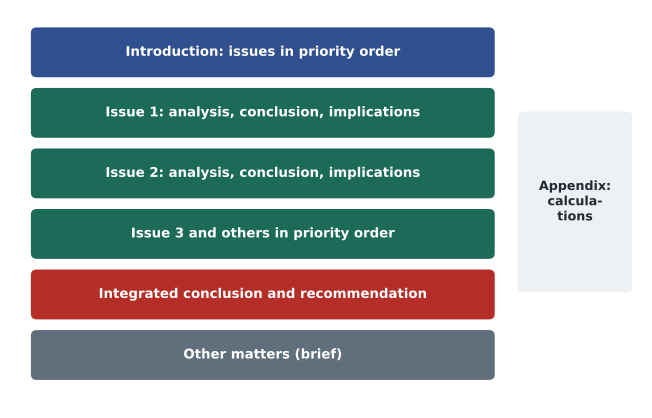
Start with a short introduction that tells the reader what the response covers and in what order. One or two sentences are enough: 'This memo addresses the accounting for the December distributor shipments, the effect on the bank covenant, the evaluation of the three strategic options and the audit implications, followed by other matters.' Then address the issues in order of priority, each under a clear heading that names the issue in the client's terms. End with an integrated conclusion that pulls the main findings together into a recommendation. A response organized this way lets the marker find each assessment opportunity and lets the client see what matters most first.
Use headings and short paragraphs. Markers read many responses quickly, and a response that buries a conclusion in the middle of a long paragraph risks having it missed. Numbered points work well for lists of procedures, weaknesses or implementation steps. Tables work well for comparisons of options or for calculations. Avoid repeating the case facts at length; refer to them only to support your analysis. And write in complete, professional sentences: notes and fragments save little time and make the response harder to follow.
Writing each issue
Each issue should follow a consistent pattern adapted to its competency area: what the issue is, the relevant guidance or framework, the application to the facts, alternatives where they exist, a conclusion and the implications. The pattern is not a formula to be applied mechanically; it is a check that nothing important is missing. The most common gap is the conclusion. Candidates often analyse an issue thoroughly and then move on without saying what the client should do. A single sentence beginning 'Therefore' or 'I recommend' closes the issue and earns the marks for concluding.
Use the case facts in every paragraph. A sentence like 'Revenue should be recognized when control transfers' shows knowledge; a sentence like 'Because the distributor can return unsold tents until March and has done so in the past, control of the 620 thousand dollars of December shipments has not transferred, and revenue should be reduced' shows competence. Markers look for the second kind. Practise rewriting general sentences into case-specific ones until it becomes a habit.
| Weak sentence | Strong sentence |
|---|---|
| Inventory should be valued at the lower of cost and net realizable value. | The 2023 tent models are selling at 40 per cent below cost after the new line launched, so they should be written down by about 180 thousand dollars. |
| Controls should be improved. | The warehouse manager both records returns and approves credit notes; the controller should approve credit notes above 5,000 dollars. |
| The company should consider its options. | I recommend the US e-commerce pilot, because it best meets the founders' brand goal at a cost the company can fund within its covenant. |
| There are tax implications. | Selling directly to US consumers will require sales tax registration in states where Copperline exceeds economic nexus thresholds. |
Presenting calculations
Calculations should support a point, be easy to follow and be right. Put the result and its meaning in the body of the response, and the detailed working in a table or an appendix if it is long. Label every number, state your assumptions and round sensibly. If the case gives incomplete information, make a reasonable assumption, say what it is and, where it matters, show how the result would change. Markers give credit for a sensible approach with a minor arithmetic error, but they give little for a correct number with no explanation, and none for a calculation they cannot follow.
Do the calculations that matter to the decision. A full set of ratios is rarely necessary; the one or two that bear on the issue are. If the issue is whether the covenant is breached, compute the covenant ratio before and after your adjustments. If the issue is whether to accept an order, compute its contribution. Then say what the number means: 'After the cut-off adjustment, leverage is 3.39 times, above the 3.25 limit, so Copperline would be in breach and should approach the bank before the statements are issued.' That sentence is worth more than a page of ratios.
Recommendations that work
A recommendation should be specific, justified and practical. Specific: say what to do, who should do it and by when. Justified: link it to the analysis and the client's objectives. Practical: make sure the client can implement it, given its size, resources and constraints. 'Improve controls' fails all three; 'Before the year-end close, the controller should require approval of all credit notes above 5,000 dollars and review a monthly list of returns, because the current process lets one person record and approve returns' passes. Where alternatives are close, say what would change your recommendation; that shows judgment.
The integrated conclusion is where the strongest responses distinguish themselves. It should not simply list the conclusions of each section; it should show how they connect and what they mean together. For Copperline: the cut-off adjustment reduces EBITDA and causes a covenant breach; the breach constrains financing; therefore the strategic option that requires the least new capital, the e-commerce pilot, is the most realistic; and the audit will need to address going concern unless the bank grants a waiver. Four sentences that connect the analysis are worth more than a page that repeats it.
Writing in role
The same issue is written differently depending on the role the case gives you. As the client's controller you write to the chief executive in plain language, explain the accounting and its effect on the business, and recommend what management should do. As an external auditor you write to the engagement partner, explain the risk, the procedures and the effect on the report, and you do not make management's decisions. As an advisor to a buyer you write to the buyer's board, sceptical of the target's figures, and focus on value and risk. On Day 2 of the CFE, the role you pre-selected shapes the depth requirements of the case; in Day 3 simulations and in practice cases, the role is stated in the case and may differ from simulation to simulation. Before writing each section, ask who is reading and what they will do with it; then choose the vocabulary, the level of technical detail and the form of the recommendation to suit. A technically correct answer written for the wrong reader loses marks for communication and sometimes for the substance as well, because the recommendation is not one the role can properly make.
Self-assessment with a rubric
The fastest way to improve is to write a response under time pressure and then assess it honestly. Use a rubric that lists the main assessment opportunities you expected and the level you reached on each. The Board of Examiners uses five performance categories, from not addressed to competent with distinction, and the program below uses similar levels in an illustrative rubric for a Copperline practice response. It is not an official marking guide; it is a tool for your own review.
# Self-assessing a case response against an illustrative rubric (not an official
# marking guide). Levels: 0 not addressed, 1 nominal, 2 reaching, 3 competent, 4 strong.
rubric = {
    "Identifies the users and their needs": 3,
    "Financial reporting issue: analysis and conclusion": 2,
    "Quantitative analysis: correct and relevant": 3,
    "Assurance issue: procedures specific to the risk": 1,
    "Tax issue: identifies and explains implications": 2,
    "Integrates findings into a recommendation": 2,
    "Communication: clear, organized, professional": 3,
}
levels = ["not addressed", "nominal", "reaching", "competent", "strong"]
for k, v in rubric.items(): print(f"{k:52}{levels[v]}")
competent = sum(1 for v in rubric.values() if v >= 3)
print(f"\nCompetent or better on {competent} of {len(rubric)}; weakest:",
min(rubric, key=rubric.get))Identifies the users and their needs competent Financial reporting issue: analysis and conclusion reaching Quantitative analysis: correct and relevant competent Assurance issue: procedures specific to the risk nominal Tax issue: identifies and explains implications reaching Integrates findings into a recommendation reaching Communication: clear, organized, professional competent Competent or better on 3 of 7; weakest: Assurance issue: procedures specific to the risk
This candidate was competent on three of seven items, reaching on three and nominal on the assurance issue. The weakest point is clear: the assurance procedures were generic. The candidate's next practice case should focus on writing procedures tied to specific risks, as lesson 6 showed, and the review should check that each procedure names the assertion and the case fact it addresses. Repeating this cycle, write, assess, target the weakest area, write again, is how case-writing skill grows.
Worked problem
Improving a weak paragraph
A candidate wrote: "There is a risk with revenue. The auditor should test revenue and confirm receivables. This is important because revenue is material."
Show solution
- Identify the specific risk: overstatement of December revenue (occurrence and cut-off) because the distributor can return unsold tents until March.
- Link to facts: shipments to the distributor were 620 thousand dollars in December, three times normal; management bonuses depend on annual revenue.
- Specify procedures: confirm the distributor's terms, including return rights and any side agreements; examine returns and credit notes issued in January to March; compare December shipments with the distributor's sell-through data.
- Conclude: if returns rights are confirmed, propose an adjustment to defer revenue, and evaluate its effect on the covenant and the report.
Answer: A specific risk, linked to facts and an incentive, with targeted procedures and a conclusion.
Editing in the last minutes
Reserve a few minutes at the end to review. Check that every directed requirement has been addressed, that each issue ends with a conclusion, that the integrated conclusion is there, and that headings make the structure visible. Do not start a new issue in the last five minutes unless it is a directed requirement you have missed; a short paragraph identifying it and recommending a next step is better than nothing. Fix obvious errors in key numbers. Then stop: the response does not need to be perfect, but it does need to be complete.
Common mistakes
MistakeWriting without an introduction or structure.
InsteadState the issues in priority order at the start and use headings for each.
MistakeLeaving issues without a conclusion.
InsteadEnd each issue with a clear conclusion or recommendation.
MistakeRepeating case facts at length.
InsteadUse facts to support analysis, not as a summary.
MistakePresenting calculations without explanation.
InsteadState the result, its meaning and the assumptions in the body.
MistakeGiving vague recommendations.
InsteadSay what, who, when and why, and make it practical for the client.
MistakeListing conclusions instead of integrating them.
InsteadShow how findings connect and what they mean together.
Summary and key terms
- Organize for the reader: an introduction, issues in priority order under clear headings, an integrated conclusion and other matters.
- Write each issue with the issue, guidance, application, alternatives, conclusion and implications; never omit the conclusion.
- Use case facts in every paragraph; turn general statements into case-specific analysis.
- Present calculations that matter to the decision, explain them and state assumptions.
- Recommendations should be specific, justified and practical; say what would change them when alternatives are close.
- The integrated conclusion connects the findings into one recommendation.
- Self-assess against a rubric, target the weakest area and practise again.
- Integrated conclusion
- A closing section that connects findings across areas into a single recommendation.
- Case-specific analysis
- Analysis that applies guidance to the facts of the case rather than describing it in general.
- Assumption
- A stated premise used where case information is incomplete.
- Rubric
- A list of expected assessment opportunities with performance levels, used for marking or self-assessment.
- Other matters
- A short section for minor issues that are noted but not analysed in depth.
- Implementation step
- A specific action, owner and timing that puts a recommendation into effect.
Practice problems
Work each problem on paper first, then reveal the answer to check.
What should a case response introduction contain?
Show answer
A one- or two-sentence statement of the issues to be addressed, in priority order.
Rewrite 'Prices should be reviewed' as a case-specific recommendation.
Show answer
For example: The marketing director should raise the price of the rental kits from 45 to 52 dollars a weekend for 2027, because utilization is above 90 per cent in summer and competitors charge 55.
Rerun the rubric program after raising the assurance score to 3. What changes?
Show answer
Competent on four of seven, and the weakest item becomes one of the reaching items.
Why is a covenant ratio more useful than a full ratio analysis in most cases?
Show answer
It bears directly on a decision and on going concern; other ratios may not.
What should you do if the case lacks a figure you need?
Show answer
Make a reasonable assumption, state it and show how the result would change if it matters.
Name the three qualities of a good recommendation.
Show answer
Specific, justified and practical.
Write a two-sentence integrated conclusion for Copperline.
Show answer
The cut-off adjustment puts Copperline in breach of its leverage covenant, which limits new borrowing, so the low-capital e-commerce pilot is the most realistic strategy. Management should seek a covenant waiver now, because without it the auditor will need to consider a going concern uncertainty.
What should you do in the last five minutes?
Show answer
Check directed requirements, conclusions and the integrated conclusion; fix key numbers; do not start new minor issues.
Why are general sentences about standards worth little?
Show answer
They show knowledge but not application, which is what is assessed.
How should you use a rubric after a practice case?
Show answer
Rate each opportunity honestly, identify the weakest area and target it in the next practice case.
Lesson quiz · 5 questions
Score 60% or more to complete this lesson.
Create a free account to save your progress, take quizzes and earn a certificate.