
ACCT-480 · Lesson 2 of 12 · 27 min
Reading a case: roles, requirements and the client's needs
Most weak case responses go wrong in the first thirty minutes, before a word of analysis is written. The candidate reads the case once, starts writing about the first issue that looks familiar, and discovers two hours later that the client's real concern was somewhere else. This lesson is about those first thirty minutes: how to read a case, how to identify your role and the user, how to distinguish what you are asked from what you should notice, and how to rank the issues so that your time goes where the marks are. Lesson 10 covers writing the response; this lesson covers deciding what to write.
Who are you, and who is reading?
Every case puts you in a role. You may be a CPA employed by the company, a staff accountant at a firm, a senior manager, an advisor engaged for a specific project or a member of a board committee. The role determines what you can do and how you should write. An external auditor cannot design the client's controls or take management decisions, because that would impair independence; an internal controller can. An advisor to a buyer looks at a target sceptically; the target's own CFO presents it favourably but honestly. If you misread your role you will give advice that someone in that role could not properly give.
The user is the person your response is addressed to, and usually there is more than one. The chief executive wants to know what to do; the board wants to understand risks; the bank wants assurance; a partner wants a memo that can go to the client with light editing. Identify the primary user and their decision. Then list the secondary users and what they need from the same information. A financial reporting issue looks different to a lender who tests covenants than to a buyer who is setting a price. Writing for the user is the single best way to keep your analysis relevant.
Cases also tell you about the entity's constraints: its size, its stage of growth, its ownership, its financing and any deadlines. A private company owned by a family that plans to sell in two years has different priorities from a listed company with a new chief executive. Those details shape which accounting framework applies (IFRS Accounting Standards for publicly accountable enterprises, ASPE for many private ones), whether an audit or a review is enough, which tax planning is appropriate and how much risk the owners will accept. Note them as you read; they are the context in which every recommendation must make sense.
Directed and undirected requirements
The case requirements tell you some of what to do. A directed requirement is stated explicitly, often in a memo from a partner or the client: 'Please analyse the accounting for the new contracts and calculate the impact on our covenant ratios.' An undirected requirement is not stated but is clearly signalled by the facts, and the marker expects a competent professional to notice it. If the case mentions in passing that a supplier has stopped shipping because invoices are unpaid, a competent professional would see a liquidity and going concern issue even if nobody asked. Undirected opportunities are part of why cases are realistic: clients do not always know what they should be asking.
Two rules follow. First, always answer the directed requirements; they are where most of the marks are and markers notice when one is missing. Second, look for undirected issues, but give them proportionate time: a short, sharp paragraph that identifies the issue, explains why it matters and recommends a next step is usually enough. Candidates who turn an undirected issue into a long essay often do so at the expense of a directed one.
| Clue in the case | Issue it may signal | Likely depth |
|---|---|---|
| The bank now wants audited statements | Assurance engagement, independence, planning | Directed or high priority |
| Sales to a new distributor jumped in December | Revenue recognition, cut-off, possible channel stuffing | Often undirected, potentially high |
| The founder pays her son a salary for occasional work | Tax: reasonableness, TOSI; governance | Undirected, moderate |
| A key machine is idle for three months | Impairment indicator, capacity cost, decision about use | Undirected, depends on size |
| The board asks about climate disclosures | Strategy and governance, sustainability reporting | Directed if asked, usually brief |
| A covenant is close to its limit | Finance, going concern, financial reporting judgments | High; links many issues |
A reading method
There is no single correct way to read a case, but a disciplined method beats reading from the first page to the last. Many experienced writers start with the requirements, then skim the whole case to understand the business and the role, then read the exhibits closely with the requirements in mind. As they read they make a running list of issues, each with a note of the relevant facts and the exhibit or page where they appear. By the end of the reading they have an issues list, a sense of which issues are directed and which are not, and the numbers they will need. Some writers prefer to read the background first so that the requirements make sense; either approach works if you finish with a complete list.
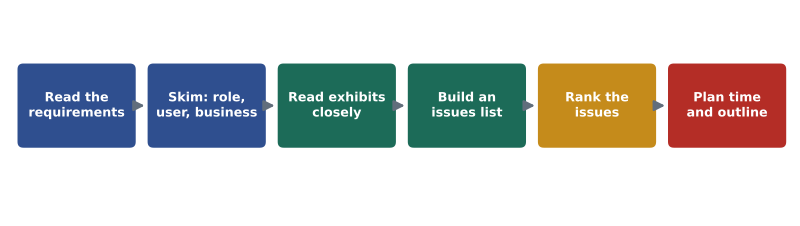
Write your issues list in a form you can work from. A simple table with columns for the issue, the area, the key facts, the user's concern and a priority score will serve you well. It prevents you from forgetting an issue you noticed early, and it gives you something to check against at the end: every directed requirement should be on the list, and every issue on the list should have been addressed or consciously set aside.
Ranking issues
Not every issue deserves the same time. Rank them using a few questions. How important is it to the user's decision? How large is it, in dollars and in risk? Is it directed? Is it urgent, for example because a deadline or a covenant test is near? Does it affect other issues, so that resolving it changes the analysis elsewhere? A practical scoring system multiplies importance by urgency, each on a scale of one to five, and then adjusts for whether the issue is directed. The program below applies that idea to a case with eight issues and a four-hour time budget, after setting aside 25 minutes for reading and 15 for planning.
# Ranking the issues in a case by importance and urgency, then budgeting time.
issues = [
    # (issue, importance 1-5, urgency 1-5, quantitative?)
    ("Revenue recognition on bundled contracts", 5, 4, True),
    ("Going concern doubt from covenant breach", 5, 5, True),
    ("Capital budgeting for the new line", 4, 3, True),
    ("Control weakness in purchasing", 3, 3, False),
    ("Tax on the planned share sale", 4, 2, True),
    ("Lease or buy the warehouse", 3, 2, True),
    ("Board asks about ESG reporting", 2, 2, False),
    ("Inventory count procedures", 2, 3, False),
]
minutes = 240 - 25 - 15          # total, reading, planning
ranked = sorted(issues, key=lambda r: (r[1] * r[2], r[1]), reverse=True)
score_total = sum(r[1] * r[2] for r in ranked[:6])
print(f"{'Issue':44}{'Score':>6}{'Minutes':>9}")
for name, imp, urg, q in ranked:
    s = imp * urg
    m = round(minutes * s / score_total) if ranked.index((name, imp, urg, q)) < 6 else 0
    print(f"{name:44}{s:>6}{m:>9}")
print()
print("Covered in depth:", sum(1 for r in ranked[:6]), "issues;", "left for a one-line mention:", len(ranked) - 6)Issue Score Minutes Going concern doubt from covenant breach 25 62 Revenue recognition on bundled contracts 20 50 Capital budgeting for the new line 12 30 Control weakness in purchasing 9 22 Tax on the planned share sale 8 20 Lease or buy the warehouse 6 15 Inventory count procedures 6 0 Board asks about ESG reporting 4 0 Covered in depth: 6 issues; left for a one-line mention: 2
The scoring gives the going concern and revenue recognition issues almost half the writing time between them, and it leaves two minor issues with no dedicated time. That does not mean ignoring them: a sentence each in an 'other matters' section shows the marker that you noticed them and judged them minor. The numbers in the program are a guide, not a rule. If the revenue issue drives the covenant calculation that drives the going concern assessment, you will analyse them together, and the time will flow between them naturally.
Be careful with issues that look technical and interesting but are small. A complex consolidation question about a subsidiary that represents two per cent of the group, or a clever tax structure for an amount that would save a few hundred dollars, can consume time out of proportion to its value. The best writers ask, before they begin each issue, how much the answer could change the user's decision. If the answer is 'not much', they write a short paragraph and move on.
Worked problem
Ranking the issues for Northgate Equipment
Northgate's CFO asks for a memo on four matters: whether to accept a large special order from a new dealer, whether to buy rather than make the hydraulic control modules, how the bank's move to reviewed statements affects the year-end timetable, and what the company should say to the board about its ROCE target of 15 per cent. The case also mentions that a dealer has been paid a volume rebate in advance and that two engineers resigned last month.
Show solution
- Directed: special order, make-or-buy, review engagement, ROCE communication.
- Undirected: the prepaid rebate (financial reporting: is it an asset or a reduction of revenue?), the resignations (risk to capacity for the special order).
- Importance: the special order and make-or-buy affect profit and capacity; the ROCE message depends on them; the review is a process issue with a deadline.
- Ranking: special order and make-or-buy first and together, ROCE second because it uses their results, review third, the rebate and resignations as short paragraphs linked to the special order.
Answer: Two connected decisions get depth, the board message integrates them, and the undirected issues are noted briefly where they affect the main analysis.
Reading the numbers
Cases contain financial statements, budgets, quotes, tax data and schedules. Do not treat them as background. Before writing, look for the numbers that matter: totals that look wrong, ratios that are close to covenant limits, trends that change direction, figures in the narrative that do not match the exhibits. A quick ratio calculation, such as current ratio, debt to EBITDA, gross margin and days receivable, often reveals the issue that the case writer planted. Markers reward candidates who use the case numbers to support their points, and they especially reward candidates who notice that an accounting adjustment changes a key number.
Make your quantitative analysis purposeful. Before you calculate, decide what question the calculation answers and how the answer will affect your recommendation. A contribution margin analysis for a special order answers 'does it add profit?'; a net present value answers 'does it create value?'; a covenant recalculation answers 'is the company in breach after the adjustment?'. Then show the calculation clearly, state your assumptions and explain the result in words. Lesson 10 returns to how to present calculations.
The ethics lens
Read every case with an eye on professional ethics. Cases often include a pressure point: a manager who wants a favourable estimate, a client who wants to delay recording a loss until after a financing, a relative who asks for confidential information, a fee arrangement that could threaten independence. Under the CPA Code of Professional Conduct you must act with integrity and objectivity, maintain confidentiality, avoid conflicts of interest and, in assurance roles, remain independent. A competent response identifies the ethical issue, explains which principle is at stake and recommends what to do, such as discussing it with the engagement partner or declining a request. Ethics is an enabling competency, and it is assessed in context rather than in a separate section.
Common mistakes
MistakeStarting to write before finishing an issues list.
InsteadRead the whole case, list and rank the issues, then plan your time before writing.
MistakeMisreading your role.
InsteadCheck whether you are an auditor, an employee or an advisor; it determines what you can recommend.
MistakeAnswering only the directed requirements.
InsteadIdentify undirected issues signalled by the facts and address them in proportion to their importance.
MistakeSpending long periods on small, interesting issues.
InsteadAsk how much each issue could change the user's decision before deciding how much time to give it.
MistakeIgnoring the exhibits.
InsteadUse the numbers to find issues and to support every point you make.
MistakeOverlooking an ethical pressure point.
InsteadName the principle at stake and recommend a professional response.
Summary and key terms
- Your role determines what you can properly recommend; the user determines what your response must deliver.
- Directed requirements are stated; undirected issues are signalled by the facts and expected of a competent professional.
- A disciplined reading method ends with a written, ranked issues list linked to the facts and exhibits.
- Rank issues by importance, size, urgency, whether they are directed and their links to other issues.
- Small, interesting issues deserve a short paragraph, not a long essay.
- Use the case numbers to find issues and support conclusions; decide what each calculation is for before doing it.
- Look for ethical pressure points and respond with the relevant principle and a recommendation.
- Role
- The position the case assigns to you, such as auditor, controller or advisor.
- User
- The person or group for whom the response is written and whose decision it supports.
- Directed requirement
- A task stated explicitly in the case.
- Undirected issue
- An issue not stated in the requirements but signalled by the facts.
- Issues list
- A working table of identified issues with facts, references and priority.
- Priority score
- A ranking of an issue based on importance, urgency and other factors, used to allocate time.
- Pressure point
- A fact in a case that creates an ethical risk, such as a request to bias an estimate.
Practice problems
Work each problem on paper first, then reveal the answer to check.
Why does your role matter when you recommend changes to controls?
Show answer
An external auditor cannot design controls or make management decisions without impairing independence; an employee or consultant can.
Give an example of an undirected issue and how much time you would give it.
Show answer
A supplier stopping shipments for unpaid invoices signals liquidity risk; a short paragraph identifying it, explaining why it matters and recommending a cash flow forecast.
Rerun the ranking program with the ESG issue's importance raised to 5 and urgency to 4. Where does it rank?
Show answer
Its score becomes 20, tying revenue recognition for second, and it receives writing time.
What columns would you put in an issues list?
Show answer
Issue, competency area, key facts and references, user's concern, priority.
Name four quick ratios that often reveal planted issues.
Show answer
Current ratio, debt to EBITDA, gross margin, days receivable.
A manager asks you to estimate warranty costs at the low end of the range 'because we need to hit our target'. What do you write?
Show answer
That the estimate must be unbiased under the CPA Code's integrity and objectivity principles and the accounting standards, and that you will use the best estimate and raise the matter with the CFO.
Why might two issues be analysed together?
Show answer
Because one affects the other, for example an accounting adjustment that changes a covenant ratio.
Write a one-sentence 'other matters' note about the two engineers who resigned.
Show answer
The resignation of two engineers may limit capacity for the special order; management should confirm staffing before accepting it.
What does the ownership of a company tell you?
Show answer
It influences the accounting framework, the assurance needed, the tax planning and the risk appetite.
When is a long analysis of an undirected issue justified?
Show answer
When the issue is material and central to the user's decision, for example a going concern doubt.
Lesson quiz · 5 questions
Score 60% or more to complete this lesson.
Create a free account to save your progress, take quizzes and earn a certificate.