
ACCT-480 · Lesson 11 of 12 · 25 min
The capstone group case and time management
Capstone 1 and Day 1 of the CFE are different from other cases. Capstone 1 is a group case: a team works for several weeks on a large business situation, writes a report and presents it to a panel. Day 1 is a four-hour individual examination linked to that case, assessed pass or fail on a holistic basis. Both reward the same skills: understanding a complex organization, analysing its strategic situation across competency areas, and giving integrated advice. This lesson covers working in a group case, preparing for Day 1, and managing time in long cases generally. As in lesson 1, the description of the program is drawn from published sources checked in October 2026 and is not official guidance.
What a large case asks of you
A capstone-style case is long, often dozens of pages with many exhibits, and describes an organization facing several interrelated issues. Unlike shorter cases, it rarely has a list of discrete requirements; instead it asks you, as an advisor, to help the organization decide what to do. The marks go to responses that understand the organization's situation as a whole, identify the issues that matter most to its mission and stakeholders, analyse them with appropriate depth, and pull the analysis together into a coherent recommendation. Day 1's holistic assessment reflects this: markers judge whether the response, taken as a whole, shows that the candidate can apply the CPA way to a complex situation.
The skills from earlier lessons apply, but the emphasis shifts. Situational analysis becomes central: who are the stakeholders, what do they want, what are the organization's strengths, weaknesses and constraints, and what are the major issues it faces? Strategy and governance often frame the response, with financial reporting, management accounting, finance, tax and assurance issues serving the strategic analysis. Integration is not an extra; it is the main thing being assessed.
Working in a group
Group work in Capstone 1 is practice for professional teamwork, and the enabling competencies of working with others and leading are assessed through it. Effective teams agree early on roles and deadlines, divide the analysis sensibly, and integrate it before writing the report. A common failure is to divide the case by competency area, with each member writing a section, and then to staple the sections together; the result reads like four separate essays and lacks the integration the case requires. A better approach is to analyse individually, meet to discuss findings and agree on the main recommendation, then write sections that support that recommendation, with one person responsible for the integrated introduction and conclusion.
Teams also need to handle disagreement. Members may reach different conclusions on an accounting issue or a strategic option. Treat this as useful: the debate tests the analysis, and the report can acknowledge alternatives and explain why the team chose one. When a member does not contribute, raise it early and directly, and document what was agreed. The presentation to the panel requires the same integration; each presenter should know how their part connects to the recommendation and be ready for questions on any part.
| Team practice | Why it helps |
|---|---|
| Agree on roles, deadlines and a meeting schedule in the first days | Avoids last-minute crises and uneven workloads |
| Everyone reads the whole case before dividing the analysis | Each member understands the situation and can see connections |
| Agree on the main recommendation before writing | Sections support one integrated message |
| Assign one editor for the introduction and conclusion | Gives the report a single voice |
| Rehearse the presentation with questions | Prepares every member to defend the recommendation |
Use the capstone period to practise the individual skills that Day 1 will test. After each team meeting, write a short memo of your own on one of the case's issues, as if the new information on Day 1 had made it urgent, and time yourself. Compare your memo with the team's eventual analysis. This habit keeps you from relying on teammates for areas you find difficult, which is a risk in group work, because on Day 1 you write alone.
Preparing for Day 1
Day 1 is linked to the Capstone 1 case, so candidates know the organization in advance. Preparation means knowing the case thoroughly: its history, stakeholders, mission, financial position and major issues, and the team's analysis of them. On the day, the examination adds new information, a development or a new set of facts, and asks candidates to respond to the situation as it now stands. The candidates who do best are those who understand the organization well enough to see quickly how the new information changes things, rather than those who try to reproduce their team's report. Expect the new facts to test whether your earlier recommendation still holds.
Because Day 1 is assessed holistically, a strong response is one that reads as the work of a professional advisor: it starts from the organization's situation, identifies the key issues raised by the new information, analyses them using the right tools, and reaches clear, integrated recommendations. A response that lists every possible issue without priority, or that analyses technical points without connecting them to the organization's decisions, will struggle even if each point is correct.
The capstone presentation
The presentation to the panel is a test of communication under questioning. Plan it as a story: the organization's situation, the key issues, the team's recommendation and why it is better than the alternatives, and how it should be implemented. Keep slides simple, with one message each and numbers only where they support that message. Practise the transitions between presenters so that the presentation sounds like one argument, not four. The questions are where the panel tests understanding: why the team rejected an option, what would change the recommendation, how a particular number was derived, what the board should do first. Answer directly, admit uncertainty where it exists and connect the answer back to the recommendation. Every member should be able to answer questions on any part, because the panel may direct a finance question to the member who presented governance. Treat the presentation as rehearsal for a real client meeting; the habits it builds, listening to the question, answering it briefly and checking that the listener is satisfied, are the habits clients value most in their advisors.
Time management
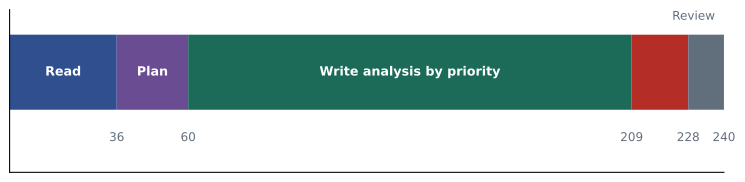
Time is the binding constraint in every case. The program below shows a plan for a four-hour response: about 15 per cent of the time for reading, 10 per cent for planning, most of the time for writing the analysis by priority, a protected block for the integrated recommendation and a few minutes for review. The percentages are a starting point; experienced writers adjust them to the case. The important point is that reading and planning, about an hour together, are not wasted time. They are what makes the writing time productive.
# Day 1 style time plan: a four-hour response to a large case, by stage.
total = 240
plan = [("Read the case and requirements", 0.15), ("Plan: list issues, rank, outline", 0.10),
        ("Write: analysis by priority", 0.62), ("Write: integrated recommendation", 0.08),
        ("Review and tidy", 0.05)]
t = 0
for stage, share in plan:
    m = round(total * share)
    print(f"{stage:38}{m:>4} min  ends at {t + m:>3}")
    t += m
print(f"Total {t} min")Read the case and requirements 36 min ends at 36 Plan: list issues, rank, outline 24 min ends at 60 Write: analysis by priority 149 min ends at 209 Write: integrated recommendation 19 min ends at 228 Review and tidy 12 min ends at 240 Total 240 min
Within the writing block, allocate time by issue priority, as lesson 2 showed, and watch the clock. If an issue takes much longer than planned, finish its conclusion and move on; returning later with fresh eyes is often faster than pushing through. Protect the time for the integrated recommendation. Candidates who run out of time usually lose it at the end, where the integration is, and the integration is what distinguishes a strong response in a large case.
For Day 2's five hours, the same principles apply with more time and a single large case answered from your role. The Board of Examiners has noted that the Day 2 case is designed so that an average candidate needs about three and a half hours, leaving time to find the relevant information in the case. Use the extra time for careful reading and planning, not for writing more on low-priority issues. For Day 3's three simulations of 45 to 90 minutes each, time management is stricter: budget each simulation by its suggested time and move on when the time is up, because a simulation left unattempted cannot be recovered by extra work elsewhere.
Worked problem
Adjusting the plan during the exam
Ninety minutes into the writing block of a four-hour case, a candidate has finished two of five priority issues and is halfway through the third. The plan allowed 149 minutes for all five.
Show solution
- Remaining writing time: about 59 minutes for three issues, one of them half done.
- Finish the third issue's conclusion in about 10 minutes.
- Give the fourth issue about 25 minutes and the fifth about 15, focusing on analysis and conclusion rather than background.
- Keep the 19 minutes for the integrated recommendation; do not borrow from it.
Answer: Finish the current issue quickly, shorten the remaining ones and protect the integrated recommendation.
Practising for long cases
Practise under the conditions you will face: timed, with the same tools and without notes. Long cases are tiring, so build stamina by writing full-length cases, not just parts of them. After each practice case, debrief: compare your response with a model answer or the guidance you have, rate each major area with a rubric as lesson 10 showed, and write down the two or three things you will do differently next time. Over several cases, look for patterns: do you consistently run out of time, miss undirected issues or omit conclusions? Fixing a pattern raises your performance on every case.
Look after yourself too. Long cases require concentration for hours, and fatigue causes errors in reading and judgment. Sleep, regular breaks during preparation and familiarity with the exam centre's procedures all help. On the day, use the scheduled breaks, eat and drink sensibly, and do not spend break time discussing the case with other candidates, which tends to increase anxiety rather than performance.
Common mistakes
MistakeDividing a group case by competency area and stapling the parts together.
InsteadAnalyse individually, agree on the main recommendation, then write sections that support it.
MistakeTrying to reproduce the team report on Day 1.
InsteadRespond to the situation as the new information changes it.
MistakeSkipping planning to start writing sooner.
InsteadReading and planning make the writing time productive.
MistakeRunning out of time before the integrated recommendation.
InsteadProtect that block and adjust issue times instead.
MistakeWriting more on low-priority issues because time remains on Day 2.
InsteadUse extra time for reading, planning and depth on key issues.
MistakePractising only short cases.
InsteadBuild stamina and timing with full-length timed cases.
Summary and key terms
- Large cases ask you to understand an organization as a whole and give integrated advice; integration is the main thing assessed.
- Group cases work when the team agrees on the recommendation before writing and one editor gives the report a single voice.
- Day 1 adds new information to the known capstone case; respond to how it changes the situation.
- Day 1 is assessed holistically; prioritized, connected analysis matters more than a list of points.
- A typical four-hour plan spends about an hour reading and planning, most of the time writing by priority, and protects time for the integrated recommendation.
- Day 2 has extra time for finding information; Day 3 needs strict budgeting for each simulation.
- Practise full-length timed cases, debrief with a rubric and fix recurring patterns.
- Capstone 1
- The group case module of CPA PEP, ending in a written report and a presentation.
- Holistic assessment
- Judging a response as a whole against the profession's expectations, rather than by summing marks.
- Situational analysis
- Understanding the organization, its stakeholders, objectives, strengths, weaknesses and constraints.
- Time budget
- The planned allocation of time to reading, planning, writing and review.
- Debrief
- A structured review of a practice response to identify improvements.
- Stamina
- The capacity to sustain concentration and quality over a long examination.
Practice problems
Work each problem on paper first, then reveal the answer to check.
Why does dividing a group case by competency area often fail?
Show answer
It produces separate essays that lack the integration the case requires.
What should a team agree on before writing?
Show answer
The main recommendation that the sections will support.
Rerun the time plan with reading at 0.12 and planning at 0.13. When does planning end?
Show answer
At 60 minutes (29 minutes reading plus 31 planning, rounded).
What does the new information on Day 1 test?
Show answer
Whether the candidate can see how it changes the organization's situation and whether earlier recommendations still hold.
A candidate is 30 minutes behind plan. What should they not cut?
Show answer
The integrated recommendation.
How should extra time on Day 2 be used?
Show answer
For careful reading, planning and depth on key issues, not for writing more on minor issues.
What is the risk of exceeding the time for one Day 3 simulation?
Show answer
Another simulation may be left unattempted, and its opportunities cannot be recovered.
Name two patterns a debrief might reveal.
Show answer
Running out of time; missing undirected issues; omitting conclusions.
How should a team handle disagreement on a strategic option?
Show answer
Debate it on the evidence, choose one and acknowledge the alternative and why it was rejected.
Why is reading and planning time not wasted?
Show answer
It identifies and ranks the issues so that writing goes to what matters.
Lesson quiz · 5 questions
Score 60% or more to complete this lesson.
Create a free account to save your progress, take quizzes and earn a certificate.