
ACCT-480 · Lesson 8 of 12 · 25 min
Finance cases: capital budgeting, valuation and financing
Finance issues appear in Canadian cases as breadth opportunities for every candidate and as depth for those in the Finance role. They concern how a business creates value and pays for it: whether to invest in a project, what a business is worth, how to finance a purchase, how much working capital it needs and how to manage financial risk. Finance analysis in cases is quantitative, but the marks go to the candidate who uses the numbers to support a recommendation and who checks the assumptions behind them. This lesson works through a capital budgeting decision for Northgate Equipment's paint line, a valuation for a proposed acquisition and the financing choices that follow. FIN-201 and FIN-301 taught the techniques; ACCT-421 applied them to performance management.
Capital budgeting in a case
The standard method is net present value: estimate the incremental after-tax cash flows, discount them at a rate that reflects the project's risk, and accept projects with a positive NPV. In a case, the main work is identifying the right cash flows. Include incremental operating cash flows after tax, the initial investment, changes in working capital and their recovery, the tax shield from capital cost allowance, and salvage value with the related tax effect. Exclude sunk costs, allocated overhead that does not change and financing costs, which are reflected in the discount rate. A common error is to discount accounting profit rather than cash flow, or to include depreciation as a cash outflow.
In Canada the tax shield from capital cost allowance has a closed-form present value, because CCA is calculated on a declining balance. With the accelerated investment incentive, which provides one and a half times the normal first-year CCA, the present value of the tax shield on a cost C, at CCA rate d, tax rate t and discount rate k, is C·d·t divided by (d + k), multiplied by (1 + 1.5k)/(1 + k). The program below uses that formula for Northgate's 900,000 dollar paint line in CCA class 43 at 30 per cent, with a 27 per cent tax rate and a 9 per cent cost of capital, operating savings of 235,000 dollars a year for six years and salvage of 120,000 dollars. Certain manufacturing and processing equipment available for use before 2030 may qualify for immediate expensing under the 2025 federal budget measures, as ACCT-421 discussed; the case would need to say whether it does, and the program assumes it does not.
# Capital budgeting with a CCA tax shield (declining-balance class, half-year rule
# replaced by the accelerated investment incentive factor of 1.5 in year 1).
cost, d, t, k, n = 900000, 0.30, 0.27, 0.09, 6
cash_in, salvage = 235000, 120000
pv_ops = sum(cash_in * (1 - t) / (1 + k)**i for i in range(1, n + 1))
# PV of CCA tax shield (perpetual declining balance), with the 1.5 first-year factor
shield = (cost * d * t / (d + k)) * ((1 + 1.5 * k) / (1 + k))
lost_shield = (salvage * d * t / (d + k)) / (1 + k)**n
npv = -cost + pv_ops + shield + salvage / (1 + k)**n - lost_shield
print(f"PV after-tax operating cash flows {pv_ops:,.0f}")
print(f"PV of CCA tax shield {shield:,.0f} less lost shield on salvage {lost_shield:,.0f}")
print(f"NPV {npv:,.0f}")
# Valuation cross-check: EBITDA multiple range for the target business
ebitda = 2.6e6
for m in (5.5, 6.0, 6.5):
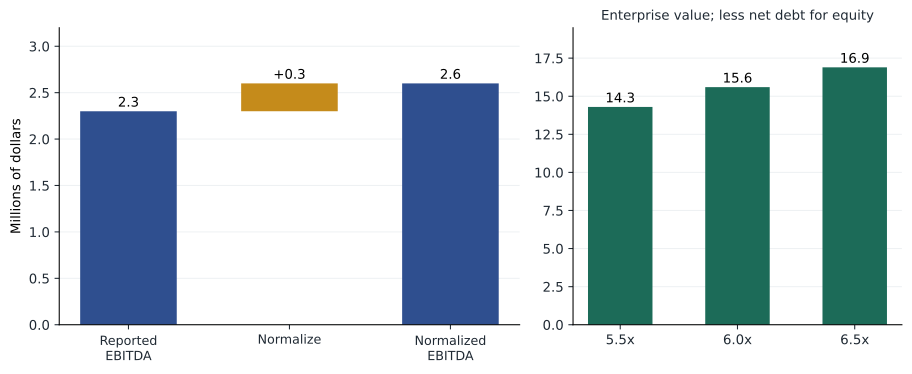
print(f"EV at {m}x EBITDA: {ebitda * m / 1e6:.1f} million")PV after-tax operating cash flows 769,559 PV of CCA tax shield 194,640 less lost shield on salvage 14,861 NPV 120,891 EV at 5.5x EBITDA: 14.3 million EV at 6.0x EBITDA: 15.6 million EV at 6.5x EBITDA: 16.9 million
The project has an NPV of about 121,000 dollars, so on these assumptions it adds value. The tax shield is worth almost 195,000 dollars, more than the NPV itself, which shows how much the tax treatment matters: if the paint line qualified for immediate expensing, the shield's present value would be higher still. A good case response does not stop at the NPV. It identifies the key assumptions, the savings estimate, the life and the discount rate, and shows how sensitive the result is to each. If a 15 per cent shortfall in savings would make the NPV negative, the board needs to know that before approving.
Worked problem
Sensitivity of the paint line NPV
How much can the annual savings fall before the paint line's NPV becomes zero?
Show solution
- After-tax savings of 1 dollar a year for six years at 9 per cent have a present value of 0.73 times the six-year annuity factor of 4.486, about 3.27 dollars.
- The NPV of 120,891 dollars therefore equals about 37,000 dollars of annual pre-tax savings (120,891 divided by 3.27).
- Savings can fall from 235,000 to about 198,000 dollars, a 16 per cent shortfall, before the NPV is zero.
- Recommend testing the savings estimate, for example with a pilot or supplier guarantees, before committing.
Answer: The project tolerates a shortfall of about 16 per cent in annual savings; the savings estimate is the critical assumption.
Valuation
Valuation questions appear when a client plans to buy or sell a business, bring in a new shareholder, settle a dispute or set a price for a share transfer. The main approaches are the income approach, which discounts expected cash flows or capitalizes maintainable earnings or cash flow; the market approach, which applies multiples from comparable transactions or public companies; and the asset approach, which values the net assets and is used for holding companies or businesses that are worth more liquidated than as going concerns. In a case, choose an approach that fits the business and the data, explain why, compute a value or a range, and identify the factors that would move it.
Normalization is often the key step. Earnings in a private company are distorted by owner salaries above or below market, personal expenses run through the business, non-recurring items, related-party rents and redundant assets. A buyer will pay for normalized, maintainable earnings, not for the reported figure. The case facts usually contain several normalization adjustments; finding them and quantifying their effect on value is where the marks are. Redundant assets, such as excess cash or investment property, are valued separately and added to the operating value.
| Approach | When to use it | Key inputs | Typical case pitfall |
|---|---|---|---|
| Discounted cash flow | Growing business with forecasts | Cash flow forecast, discount rate, terminal value | Unrealistic growth; ignoring working capital and capital spending |
| Capitalized earnings or cash flow | Stable business | Maintainable earnings, capitalization rate | Failing to normalize earnings |
| Market multiples | Comparable transactions available | EBITDA or earnings multiple, comparables | Using public multiples for a small private company without a discount |
| Asset approach | Holding company or liquidation | Fair values of assets and liabilities, disposal costs | Using book values; forgetting tax on disposal |
The program's second output shows a cross-check by multiples for a target business with 2.6 million dollars of normalized EBITDA. A range of 5.5 to 6.5 times gives an enterprise value of 14.3 to 16.9 million dollars, before subtracting debt to reach equity value. A buyer would also consider synergies, the cost of integration and whether it could finance the purchase, and a seller would consider the tax structure of the sale, as lesson 7 discussed.
Financing
Once a client decides to invest or buy, it must finance the decision. Debt is cheaper than equity because interest is deductible and lenders take less risk, but it adds fixed obligations and covenants, and too much of it raises the risk of distress. Equity is more expensive and dilutes existing owners, but it adds flexibility. Leasing is an alternative to borrowing for equipment and property. In a case, compare the options on cost, risk, control and flexibility, and test the effect on the client's covenants and cash flow. A financing recommendation that ignores the covenant calculation is incomplete.
Working capital is a frequent and underestimated finance issue. A growing business needs more receivables and inventory, which absorbs cash before profit arrives. A case that shows rising sales, longer collection periods and a stretched supplier is signalling a working capital problem even if nobody asks about it. Calculate the cash conversion cycle, days receivable plus days inventory less days payable, and recommend specific actions: tighter credit terms, inventory reduction, supplier financing or a larger operating line.
Financial risk management
Cases may ask about foreign exchange risk, interest rate risk or commodity price risk. Identify the exposure, quantify it where you can, and compare the responses: natural hedges, such as matching foreign currency costs and revenues, forward contracts, options and swaps. Explain the trade-offs: a forward contract removes uncertainty but also the upside; an option keeps the upside at a cost. If the client hedges, note the financial reporting consequence: hedge accounting under IFRS 9 or ASPE 3856 can avoid volatility in profit but requires documentation. Treasury policy, such as limits on speculation and approval requirements, is also a governance point.
Lease or buy
A lease-or-buy question compares the present value of the after-tax costs of leasing with those of borrowing to buy. The discount rate is the after-tax cost of borrowing, because the lease is a substitute for debt and its payments are about as certain as loan payments. Buying gives the CCA tax shield and the salvage value; leasing gives deductible lease payments and leaves the residual value with the lessor. The option with the lower present value of after-tax cost is cheaper. Qualitative factors often matter more than a small difference in cost: a lease may include maintenance and the option to upgrade, which is valuable for equipment that becomes obsolete quickly; buying gives control and avoids restrictions on use. Note the reporting effect too. Under IFRS 16 almost all leases are on the balance sheet as a right-of-use asset and a lease liability, so leasing no longer keeps debt off the balance sheet for a client reporting under IFRS, but under ASPE an operating lease remains off the balance sheet, which may matter for a private client's covenant ratios. Lesson 3 discussed how a lease conclusion changes covenant calculations.
Integrating finance with other areas
Finance analysis depends on the reporting analysis for its numbers. If the reporting section concluded that revenue was overstated, the EBITDA used in valuation and covenant tests must be adjusted. It depends on the tax analysis for after-tax cash flows and the effect of the transaction structure. It informs the assurance analysis through going concern and the risk of bias. And it feeds the strategic recommendation, which weighs value against risk and fit. A finance section that uses the client's unadjusted numbers when the rest of the response has found errors in them is a missed integration opportunity that markers notice.
Common mistakes
MistakeDiscounting accounting profit.
InsteadUse incremental after-tax cash flows, including the CCA tax shield and working capital.
MistakeIncluding financing costs in project cash flows.
InsteadReflect financing in the discount rate, not as a cash outflow.
MistakeReporting a single NPV without sensitivity.
InsteadIdentify the critical assumptions and show the break-even or a range.
MistakeValuing a private company on reported earnings.
InsteadNormalize earnings for owner compensation, personal expenses and one-time items.
MistakeApplying public multiples without adjustment.
InsteadAdjust for size, marketability and risk, and cross-check with another method.
MistakeRecommending debt without checking covenants.
InsteadRecalculate the covenant ratios with the new debt and the adjusted numbers.
Summary and key terms
- Capital budgeting uses incremental after-tax cash flows discounted at a risk-appropriate rate.
- In Canada the CCA tax shield has a closed-form present value; the accelerated investment incentive increases it.
- Sensitivity analysis identifies the critical assumptions and the break-even point.
- Valuation uses income, market or asset approaches; normalization of earnings and redundant assets are often the key steps.
- Financing choices balance cost, risk, control and flexibility, and must be tested against covenants and cash flow.
- Working capital and financial risk are frequent finance issues; hedging has reporting consequences.
- Use adjusted figures from the reporting analysis and after-tax figures from the tax analysis.
- Net present value (NPV)
- The present value of a project's cash inflows less the present value of its outflows.
- CCA tax shield
- The tax saved by claiming capital cost allowance on depreciable property.
- Normalized earnings
- Earnings adjusted for non-recurring, non-arm's-length and discretionary items to show sustainable profit.
- Redundant asset
- An asset not needed in operations, valued separately from the business.
- Enterprise value
- The value of a business's operations to all capital providers, before subtracting net debt.
- Cash conversion cycle
- Days receivable plus days inventory less days payable.
- Natural hedge
- Reducing exposure by matching revenues and costs in the same currency or commodity.
Practice problems
Work each problem on paper first, then reveal the answer to check.
Which cash flows belong in an NPV analysis?
Show answer
Incremental after-tax operating cash flows, initial investment, working capital changes and recovery, the CCA tax shield and after-tax salvage.
Rerun the NPV program with a 12 per cent discount rate. Is the project still acceptable?
Show answer
The NPV falls to about 37,000 dollars; still positive but much thinner.
Why is the CCA shield worth more with the accelerated investment incentive?
Show answer
More CCA is claimed in the first year, so tax savings arrive sooner and have a higher present value.
Name three normalization adjustments common in private company valuations.
Show answer
Owner salary to market level, personal expenses, non-recurring gains or losses (also related-party rent).
A target has 1.2 million dollars of excess cash. How is it treated in valuation?
Show answer
As a redundant asset added to the operating value.
Compute the cash conversion cycle with 52 days receivable, 74 days inventory and 38 days payable.
Show answer
52 plus 74 less 38 equals 88 days.
What is the trade-off between a forward contract and an option?
Show answer
A forward fixes the rate and removes upside; an option protects against loss and keeps upside at the cost of a premium.
Why must a financing recommendation consider covenants?
Show answer
New debt changes leverage and coverage ratios, which may breach existing covenants.
Write a sentence linking a reporting adjustment to a valuation.
Show answer
Because December revenue of 620 thousand should be deferred, normalized EBITDA falls by about 260 thousand, reducing the enterprise value range by about 1.4 to 1.7 million dollars at the multiples used.
When is the asset approach appropriate?
Show answer
For holding companies, asset-heavy businesses with weak earnings, or when liquidation value exceeds going concern value.
Lesson quiz · 5 questions
Score 60% or more to complete this lesson.
Create a free account to save your progress, take quizzes and earn a certificate.