
ACCT-480 · Lesson 1 of 12 · 29 min
The case approach and the CPA competency map
This is the last course in the accounting program, and it is different from the others. Earlier courses taught one area at a time: financial reporting in ACCT-211, ACCT-212, ACCT-311 and ACCT-470, management accounting in ACCT-222, ACCT-321 and ACCT-421, audit in ACCT-331 and ACCT-431, tax in ACCT-351 and ACCT-352, and so on. Professional work does not arrive sorted by course. A client calls with a problem, and the problem usually touches several areas at once: a proposed acquisition raises valuation, financing, accounting, tax and assurance questions in the same conversation. This course teaches you to work that way, using the integrated case, the format the Canadian profession uses to decide whether a candidate is ready to practise.
The course does not reteach the technical material. Each lesson revisits an area through a case and asks you to apply what you already know: to recognize which issues matter, to analyse them using the right standards and numbers, and to give advice the client can act on. Where a lesson needs a technical point, it points back to the course that taught it. The cases reuse the invented companies from earlier courses, so the facts will feel familiar: Tamarind Bay Foods from ACCT-470, Northgate Equipment from ACCT-421, Tamarack Foods Group from ACCT-431 and the Brandt family from ACCT-351 and ACCT-352. A new company, Copperline Outdoor Gear Ltd., based in Sudbury, Ontario, is introduced later for the full practice cases. Every company, person and figure in this course is invented.
A note on independence. This is an independent course. It does not reproduce official cases, marking guides or examination questions; every case here is original. It describes the certification program as published by the profession and checked in October 2026, and it tells you where details are changing. Always confirm current requirements with your regional CPA body before you rely on them.
Why the profession assesses with cases
A multiple-choice test can tell whether you know that goodwill is tested for impairment annually. It cannot tell whether you would notice, in a 30-page client file, that a drop in a segment's orders is an impairment indicator, whether you would see that the same drop threatens a loan covenant, and whether you would explain both to a chief financial officer in plain language with a recommendation. That combination of skills is what clients and employers pay for. The case method assesses it directly by giving you a realistic situation with more information than you need, asking you to play a defined role, and judging what you do with it.
Cases reward three abilities that technical exams do not. The first is issue identification: the requirements rarely list every issue, so you must find the ones that matter from clues in the facts. The second is prioritization: there is never enough time to address everything, so you must decide what deserves depth and what deserves a sentence. The third is integration: the best responses connect findings across areas, for example by showing that an accounting error changes a ratio that a lender tests, which changes the financing advice. You will practise all three throughout this course.
The CPA certification program as it stands in late 2026
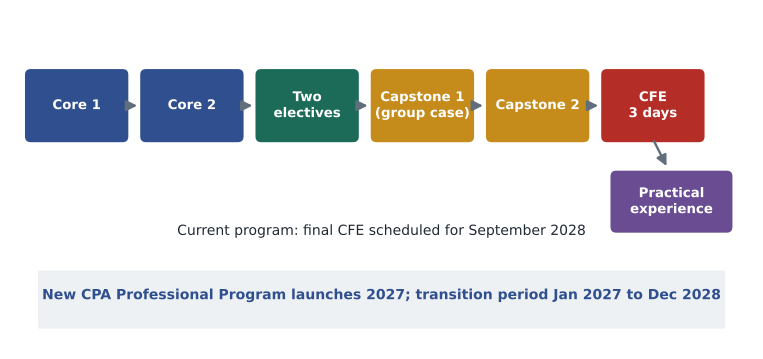
Candidates in Canada currently qualify through the CPA Professional Education Program (CPA PEP), the Common Final Examination (CFE) and a period of practical experience. CPA PEP consists of two core modules, two elective modules chosen from Assurance, Finance, Performance Management and Taxation, and two capstone modules. Capstone 1 is a group case in which teams analyse a large business situation and present to a panel. Capstone 2 prepares candidates for the CFE. Candidates who completed an accredited university program may enter later in the sequence. The details of entry, exemptions and timing are set regionally by the CPA Western School of Business, CPA Ontario, CPA Atlantic School of Business and the Ordre des CPA du Québec.
The CFE is a three-day examination written at CPA exam centres. According to the Board of Examiners' report on the May 2025 examination, Day 1 is a single four-hour simulation linked to the Capstone 1 group case and is assessed pass or fail on a holistic basis. Day 2 is a five-hour case with four roles, Assurance, Finance, Performance Management and Taxation; each candidate pre-selects one role and answers from that role's perspective. Day 3 is a four-hour paper with three shorter multi-competency simulations. First-time candidates must write all three days in the same offering, and they must pass all three to qualify.
| Paper | Length | Content | How it is assessed |
|---|---|---|---|
| Day 1 | 4 hours | One simulation linked to the Capstone 1 group case | Pass or fail, holistic |
| Day 2 | 5 hours | One large case; the candidate answers from a pre-selected role | Assessment opportunities, combined with Day 3 |
| Day 3 | 4 hours | Three multi-competency simulations of 45 to 90 minutes each | Assessment opportunities, combined with Day 2 |
Days 2 and 3 are evaluated together in four levels. A response must be sufficient overall, which means reaching competence on enough of the assessment opportunities. It must show depth in financial reporting or management accounting, depth in the candidate's chosen role, and breadth across all the competency areas of the map at a core level. Candidates who want a licence for public accounting must also show depth in financial reporting and in the Assurance role. Each assessment opportunity is marked in one of five categories, from not addressed through nominal competence, reaching competence and competent to competent with distinction. These terms will appear in the self-assessment rubrics later in this course, used in the same spirit but never with official marking guides.
A program in transition
The profession is replacing the current program. The regional schools have published a transition policy for a new CPA Professional Program aligned with the second version of the CPA Competency Map, often called Competency Map 2.0. According to the CPA Atlantic School of Business policy, effective January 27, 2026 and last updated in August 2026, the new program launches in 2027, the transition period runs from January 1, 2027 to December 31, 2028, and the final CFE under the current program is scheduled for September 2028. The new program's structure includes foundational and core modules, electives, capstones, two professional final exams and a readiness component. Candidates who do not transition by the end of 2028 may have to enter the new program without credit for prior studies. The details differ by region and are subject to change, so a candidate partway through must plan carefully.
The short program below counts the months to the key dates for a candidate who is reading this in November 2026. It is a planning aid, not advice; the dates come from one region's published policy and should be checked against your own.
# Timeline for a candidate finishing the current CPA program (dates from the
# published transition policy, checked October 2026; confirm with your region).
from datetime import date
milestones = [
    ("Transition period opens", date(2027, 1, 1)),
    ("Final Core 2 exam", date(2027, 9, 15)),
    ("Final elective exams", date(2028, 3, 15)),
    ("Final Capstone 1 presentation", date(2028, 7, 15)),
    ("Final Common Final Examination", date(2028, 9, 15)),
    ("Transition period closes", date(2028, 12, 31)),
]
today = date(2026, 11, 1)
print(f"{'Milestone':34}{'Approx. date':>14}{'Months away':>13}")
for name, d in milestones:
    months = (d.year - today.year) * 12 + (d.month - today.month)
    print(f"{name:34}{d.isoformat():>14}{months:>13}")
# A candidate who starts Core 1 now and takes one module per offering:
plan = ["Core 1", "Core 2", "Elective 1", "Elective 2", "Capstone 1", "Capstone 2", "CFE"]
print()
print("Modules still to complete:", len(plan))
print("Last CFE leaves", (2028 - 2026) * 12 + (9 - 11), "months from today")Milestone Approx. date Months away Transition period opens 2027-01-01 2 Final Core 2 exam 2027-09-15 10 Final elective exams 2028-03-15 16 Final Capstone 1 presentation 2028-07-15 20 Final Common Final Examination 2028-09-15 22 Transition period closes 2028-12-31 25 Modules still to complete: 7 Last CFE leaves 22 months from today
Twenty-two months to the last CFE sounds generous until you count the modules that remain. A candidate who still has Core 1 ahead of them, and who takes one module per offering, has little slack for a failed attempt. That is a planning problem of exactly the kind a case asks you to solve: identify the constraint, quantify it and recommend a course of action. The rest of this course is about solving those problems for clients, but it is worth noticing that the method works for your own career too.
The competency map
Whatever the program structure, the profession defines what a newly certified CPA must be able to do in a competency map. The map has two parts. The technical competencies are grouped into areas: financial reporting, strategy and governance, management accounting, audit and assurance, finance, and taxation, with data and information technology competencies now running through them. The enabling competencies describe how a professional works: acting ethically and with professional values, solving problems and adding value, communicating, managing self and leading, and working with others. Competency Map 2.0 places more emphasis on data, technology and sustainability than the original map, and it is the basis for the new program. Your regional body publishes the version that applies to your examination.
The map matters for cases because it is the blueprint from which cases are built and assessed. Each case is designed to give candidates opportunities to show particular competencies at a particular level. If you know the map, you can read a case the way its author designed it: a client who mentions that its bank wants audited statements for the first time is creating an assurance opportunity; a founder who wants to sell shares to an employee is creating a tax opportunity. Learning to see these signals is the first skill of case writing, and lesson 2 practises it in detail.
| Competency area | Typical case signal | Course that taught it |
|---|---|---|
| Financial reporting | A new transaction, a change in the business, a user who relies on the statements | ACCT-211, 212, 311, 470 |
| Management accounting | A decision about pricing, capacity, a new product or performance measures | ACCT-222, 321, 421 |
| Audit and assurance | A request for an audit, review or other report; a control failure; a fraud risk | ACCT-331, 431, 460 |
| Taxation | Owner remuneration, a sale of shares or assets, a reorganization, GST/HST | ACCT-351, 352 |
| Finance | Valuation, financing, capital budgeting, working capital, treasury risk | FIN-201, FIN-301 |
| Strategy and governance | A strategic choice, a board question, risk management, ESG reporting | BUS-310, BUS-450, ACCT-421 |
The CPA way: a disciplined approach to a case
The profession teaches a problem-solving approach that it calls the CPA way. In plain terms, it asks you to assess the situation, analyse the major issues, conclude and advise, and communicate. Assessing the situation means understanding who the client is, what they want, who will use your work, and what constraints apply. Analysing the issues means identifying them, ranking them and working through the important ones with the relevant standards, numbers and alternatives. Concluding and advising means saying what you think, and what the client should do, rather than leaving the analysis hanging. Communicating means presenting all of this in a form the reader can use. The Board of Examiners' reports repeatedly note that candidates lose marks less often for technical errors than for failing to conclude, failing to tailor their analysis to the facts, or spending too long on low-priority issues.
Two habits distinguish strong case writers from weak ones. Strong writers use the case facts in every paragraph: they do not explain what a provision is in general, they explain whether this client's warranty claims require one and how much it should be. And they keep the user in mind: the response is addressed to someone, a chief executive, a partner, a board, and is written for that person's decision. You will see both habits modelled in every lesson.
Worked problem
Reading a short case paragraph
Northgate Equipment's controller writes: "Our bank has asked for reviewed statements this year instead of compiled ones, because we are increasing our credit line to fund the new paint line. The paint line will cost about 3.2 million. We are also thinking of buying, rather than making, the hydraulic control modules."
Show solution
- List the issues signalled: a change from compilation to review (assurance); the increased credit line (finance, possibly covenants); a capital investment decision (management accounting and finance); a make-or-buy decision (management accounting).
- Note the users: the bank, which will rely on the reviewed statements and probably set covenants; management, which must decide on the investment and sourcing.
- Note what is not yet known: the covenant terms, the capacity freed by buying modules, the paint line's cash flows.
- Rank: the review engagement and the investment decision are most important; the make-or-buy is smaller but connected, because freed capacity affects the paint line case.
Answer: Four issues in three sentences, two of them connected. A good response addresses all four, gives depth to the two that matter most and shows the connection.
How this course is organized
Lessons 2 to 9 each take one competency area, or a pair of them, and work through it in case form: how the issues appear, what the marker expects, how to structure the analysis and how to integrate it with other areas. Lesson 10 is about writing the response itself: organization, prioritization, quantitative analysis and recommendations. Lesson 11 deals with the capstone group case, the Day 1 format and time management. Lesson 12 is a full practice case with a model response and a self-assessment. Each lesson has a short program that performs the kind of quick calculation a case response needs, because in a case the numbers have to be right and they have to be done fast.
Expect to write. Reading model responses teaches less than you think; writing your own, timing it and comparing it against a rubric teaches a great deal. Each lesson's practice questions include at least one short writing task, and the quizzes test whether you can recognize good case technique. If you take one thing from this course, take the habit of writing under time pressure and then reviewing what you wrote with an honest eye.
Common mistakes
MistakeTreating the CFE as a test of memory.
InsteadIt tests whether you can apply what you know to unfamiliar facts, prioritize and advise; knowledge is necessary but not enough.
MistakeAnswering only the requirements that are stated explicitly.
InsteadLook for issues signalled by the facts; directed and undirected opportunities are both assessed.
MistakeWriting general explanations of standards.
InsteadApply the standard to the case facts and reach a conclusion for this client.
MistakeAssuming program details are the same as last year.
InsteadThe program is in transition through 2028; confirm dates and structure with your regional body.
MistakeLeaving analysis without a conclusion.
InsteadEvery issue you address should end with a conclusion or recommendation.
MistakeIgnoring the enabling competencies.
InsteadEthics, communication and professional judgment are assessed alongside the technical areas.
Summary and key terms
- Professional problems are multi-competency; the integrated case assesses whether you can handle them as a practising CPA would.
- Cases reward issue identification, prioritization and integration, not only technical knowledge.
- The CFE has three days: a four-hour Day 1 linked to Capstone 1, a five-hour role-based Day 2 and a four-hour Day 3 with three simulations.
- Days 2 and 3 are assessed together for sufficiency, depth in financial reporting or management accounting, depth in role and breadth.
- A new CPA Professional Program launches in 2027, with a transition period through 2028 and a final CFE scheduled for September 2028 under the current program.
- The competency map defines technical and enabling competencies, and cases are built to give opportunities to show them.
- The CPA way is assess, analyse, conclude and advise, and communicate; using the case facts and writing for the user are the habits that matter most.
- Integrated case
- A realistic business situation that requires analysis across several competency areas and a recommendation for a defined user.
- Common Final Examination (CFE)
- The three-day examination that concludes the current Canadian CPA certification program.
- Competency map
- The profession's statement of the technical and enabling competencies a newly certified CPA must have.
- Enabling competencies
- Professional skills such as ethics, problem solving, communication, self-management and teamwork.
- Assessment opportunity
- A point in a case designed to let a candidate demonstrate a specific competency.
- Depth and breadth
- The requirement to show strong competence in key areas and at least core competence across all areas.
- Role
- The perspective a candidate pre-selects for Day 2: Assurance, Finance, Performance Management or Taxation.
- CPA way
- The profession's problem-solving approach: assess the situation, analyse issues, conclude and advise, communicate.
Practice problems
Work each problem on paper first, then reveal the answer to check.
What three abilities does a case reward that a technical exam does not?
Show answer
Issue identification, prioritization and integration across areas.
Describe the three CFE papers.
Show answer
Day 1: four hours, one simulation linked to Capstone 1, pass or fail. Day 2: five hours, one case answered from a pre-selected role. Day 3: four hours, three multi-competency simulations.
What four levels are used to evaluate Days 2 and 3?
Show answer
Sufficiency, depth in financial reporting or management accounting, depth in the chosen role, and breadth across all competency areas.
A candidate wants a public accounting licence. Which depth requirements apply?
Show answer
Depth in financial reporting and in the Assurance role.
Rerun the timeline program with today set to March 1, 2027. How many months remain to the last CFE?
Show answer
Eighteen months (March 2027 to September 2028).
List four case signals and the competency area each points to.
Show answer
A bank wants reviewed statements (assurance); an owner wants to pay herself (tax); a new product launch (management accounting); a proposed acquisition (finance and financial reporting).
Why do markers penalize general explanations of standards?
Show answer
Because the case assesses application to the client's facts and a conclusion, not recall of the standard.
Write two sentences addressed to Northgate's controller about the review engagement.
Show answer
For example: Because the bank will rely on reviewed statements for the larger credit line, you will need to engage a practitioner who is independent of Northgate; we should confirm the bank's covenants now so that the review scope and timing meet its requirements.
What does the transition to the new program mean for a candidate who has not started Core 1?
Show answer
They should plan to complete the current program before the final offerings in 2027 and 2028 or move to the new program, confirming the rules with their regional body.
Name the five enabling competency groups in the original map.
Show answer
Professionalism and ethics, problem solving and decision making, communication, self-management, and teamwork and leadership.
Lesson quiz · 5 questions
Score 60% or more to complete this lesson.
Create a free account to save your progress, take quizzes and earn a certificate.