
ACCT-480 · Lesson 8 of 12 · 24 min
REG II: taxation of individuals, entities and property
The tax areas of REG, the taxation of property transactions, individuals and entities, carry about two thirds of the section's weight. They test computation more than any other part of the exam: gross income, adjustments, deductions, credits, basis, gains and losses, and the taxation of C corporations, S corporations, partnerships and trusts. This lesson reviews these topics through the Brandt family from ACCT-351 and ACCT-352: Leah Brandt, a quality engineer in Des Moines with a drone business, Brandt Aerial, which she later runs as an LLC electing S corporation status, and SkyGrid Data LLC, the partnership she formed with Dev Mehta. Figures for 2026 are those used in those courses, checked in October 2026.
Individual taxation: the structure of the return
Every individual question follows the same structure: gross income, less adjustments for adjusted gross income (AGI), less the standard deduction or itemized deductions and the qualified business income deduction, gives taxable income; tax at the applicable rates, less credits, plus other taxes such as self-employment tax and the net investment income tax, gives total tax, less payments and withholding. Know what is included in gross income (wages, interest, dividends, business and rental income, gains, alimony under pre-2019 agreements, prizes) and what is excluded (municipal bond interest, gifts and inheritances, certain employer-provided benefits, life insurance proceeds and the gain on a principal residence up to the section 121 limits).
Know the deductions and credits that the exam tests repeatedly. Adjustments include half of self-employment tax, contributions to traditional IRAs and health savings accounts, student loan interest and self-employed retirement contributions. Itemized deductions include medical expenses above 7.5 percent of AGI, state and local taxes up to the cap (40,400 dollars for 2026, phased down above 505,000 dollars of income under the 2025 tax act, as ACCT-351 verified), home mortgage interest and charitable contributions subject to AGI limits. Credits include the child tax credit, the earned income credit, education credits and the credit for child and dependent care. The 2025 act also introduced deductions for certain tips, overtime pay and seniors for 2025 through 2028; confirm their testable dates.
| Step | Leah's 2026 figures (from ACCT-351) | What the exam tests |
|---|---|---|
| Wages (box 1) | 94,320 after a 9,000 401(k) deferral | Pre-tax deferrals reduce wages |
| Schedule C | 12,910 after 12,200 of bonus depreciation | Business income and expensing |
| Rental | Loss of 2,073 suspended | Passive loss rules and the phase-out of the 25,000 allowance |
| Capital gains | Net capital gain 12,501.50 | Netting, holding periods, preferential rates |
| AGI | 159,459.44 | Adjustments including half of SE tax |
| Taxable income | 124,859.85 after deductions and QBI | Standard versus itemized, QBI deduction |
| Total tax | 15,502.18 with SE tax of 1,824.12 | Rates, credits and other taxes |
Property transactions
Property questions test basis, gain and loss, and character. Basis starts at cost, increases with improvements and decreases with depreciation. Property received by gift generally takes the donor's basis, with a special rule for losses when fair value is below the donor's basis; property inherited takes a basis equal to fair value at death. Gains and losses are capital or ordinary: capital assets held more than a year give long-term gains taxed at 0, 15 or 20 percent; depreciable business property held more than a year is section 1231 property, whose net gains are capital and net losses ordinary, subject to depreciation recapture under section 1245 for personal property and the unrecaptured section 1250 rules for real property. Like-kind exchanges under section 1031 are limited to real property and defer gain except to the extent of boot received. Wash sales disallow losses on securities repurchased within 30 days before or after the sale.
Worked problem
A section 1245 recapture question
Brandt Aerial sells a drone it bought in 2025 for 12,200 dollars, fully expensed with bonus depreciation, for 7,000 dollars in 2027.
Show solution
- Adjusted basis is zero because the full cost was expensed.
- Gain is 7,000 dollars.
- Section 1245 recaptures depreciation as ordinary income up to the gain: all 7,000 dollars is ordinary.
- None of the gain is section 1231 gain, because the gain does not exceed the depreciation taken.
Answer: A 7,000 dollar ordinary gain under section 1245; immediate expensing converts later gains into ordinary income.
Entity taxation: choosing a structure
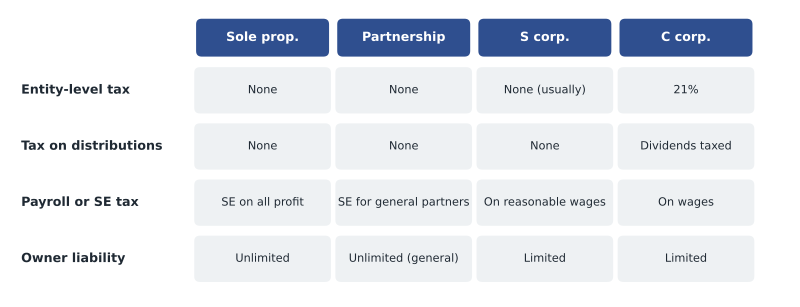
REG compares the taxation of C corporations, S corporations, partnerships and sole proprietorships. A C corporation pays tax at a flat 21 percent, and its shareholders pay tax again on dividends, so income is taxed twice. A sole proprietor pays income tax and self-employment tax on all business profit. An S corporation's income passes through to shareholders, avoiding the corporate tax, and only wages paid to shareholder-employees are subject to payroll taxes, provided the wages are reasonable. Partnerships also pass through income, and a general partner's distributive share of ordinary business income is generally subject to self-employment tax. The qualified business income deduction under section 199A, made permanent by the 2025 tax act, applies to pass-through income subject to limits for high earners and specified service businesses.
The program below compares the payroll tax burden of running Brandt Aerial as a sole proprietorship and as an S corporation with 120,000 dollars of net profit, using the 2026 Social Security wage base of 184,500 dollars, and computes Leah's outside basis in SkyGrid Data after a distribution. It is a simplified illustration; ACCT-352 computed the full entity comparison, which found total tax of about 40,385 dollars as a sole proprietorship, 31,301 as an S corporation and 44,799 as a C corporation for the case facts.
# REG II: Brandt Aerial (from ACCT-351/352) as a sole proprietorship or an S corporation.
# 2026 Social Security wage base of 184,500 dollars; illustrative figures, not a full return.
net = 120000
se_base = net * 0.9235
se_tax = min(se_base, 184500) * 0.124 + se_base * 0.029
print(f"Sole proprietorship: SE tax {se_tax:,.0f} on {net:,} of net earnings")
for wage in (60000, 80000):
    payroll = wage * 0.153
    print(f"S corporation, wage {wage:,}: payroll taxes {payroll:,.0f}; "
          f"distribution {net - wage - wage * 0.0765:,.0f} free of payroll tax")
print("Reasonable compensation is a facts-and-circumstances test (see Watson).")
# Partnership basis (SkyGrid Data LLC, from ACCT-352)
basis = 55000 + 23000 - 12000     # opening + share of income - distributions
print(f"Leah's outside basis after a 12,000 distribution: {basis:,}")Sole proprietorship: SE tax 16,955 on 120,000 of net earnings S corporation, wage 60,000: payroll taxes 9,180; distribution 55,410 free of payroll tax S corporation, wage 80,000: payroll taxes 12,240; distribution 33,880 free of payroll tax Reasonable compensation is a facts-and-circumstances test (see Watson). Leah's outside basis after a 12,000 distribution: 66,000
Self-employment tax on 120,000 dollars of net earnings is about 16,955 dollars. As an S corporation paying Leah a wage of 60,000 dollars, payroll taxes on the wage, counting both the employer and employee shares, are 9,180 dollars, and the rest of the profit is distributed free of payroll tax. A higher wage of 80,000 dollars costs more payroll tax but is easier to defend as reasonable compensation. The Watson case, in which the court reclassified distributions to an accountant as wages because his salary of 24,000 dollars was far below the roughly 91,000 dollars a comparable professional would earn, is the standard reminder that the wage must reflect the services provided.
S corporations and partnerships in detail
S corporation questions test eligibility (a domestic corporation with no more than 100 shareholders, only individuals, estates and certain trusts as shareholders, no nonresident aliens and one class of stock), the election on Form 2553, shareholder basis (stock basis increased by income and decreased by distributions and losses, plus debt basis for loans the shareholder makes), the order in which distributions are treated, the accumulated adjustments account, and the built-in gains tax on corporations that converted from C status. Partnership questions test contributions under section 721 (generally tax-free), the partner's outside basis (contributions plus share of income and liabilities, less distributions and share of losses), guaranteed payments, special allocations with substantial economic effect, the treatment of distributions and the disposition of an interest, including hot assets under section 751. SkyGrid's 23,000 dollar share of income increases Leah's outside basis from 55,000 to 78,000 dollars, and a 12,000 dollar distribution reduces it to 66,000.
C corporations and other entities
C corporation questions test the computation of taxable income and the reconciliation from book income on Schedule M-1 or M-3: book-tax differences such as federal income tax expense, nondeductible fines and penalties, 50 percent of business meals, tax-exempt interest, depreciation differences and the dividends received deduction of 50, 65 or 100 percent depending on ownership. Net operating losses arising after 2017 carry forward indefinitely and offset up to 80 percent of taxable income. Earnings and profits determine whether distributions are dividends. Corporate formation under section 351 is tax-free when transferors of property control at least 80 percent after the exchange. Trusts and estates, exempt organizations and the federal gift and estate taxes also appear, mostly at the understanding level; know the 2026 annual gift exclusion of 19,000 dollars and that the 2025 act set the estate and gift exclusion at 15 million dollars, as ACCT-351 recorded.
Other taxes and credits on the exam
Several taxes beyond the regular income tax appear regularly in REG questions. The net investment income tax is 3.8 percent of the lesser of net investment income and the excess of modified AGI over 200,000 dollars for single filers or 250,000 dollars for married couples filing jointly; these thresholds are not indexed for inflation. The additional Medicare tax of 0.9 percent applies to wages and self-employment income above the same thresholds. The alternative minimum tax applies when tentative minimum tax, computed on a broader base with an exemption, exceeds regular tax; the 2025 act made the higher exemption amounts permanent but changed the phase-out, so check the testable figures. The kiddie tax taxes a child's unearned income above a threshold at the parents' rate. On the credit side, distinguish refundable credits, such as the earned income credit and part of the child tax credit, from nonrefundable credits, which can reduce tax only to zero, and know which credits phase out with income. A question that gives you a high-income taxpayer with investment income is usually testing the net investment income tax; one with large incentive stock option exercises is usually testing the alternative minimum tax.
Common mistakes
MistakeTaxing all S corporation profit at the corporate rate.
InsteadS corporation income passes through; only reasonable wages bear payroll tax.
MistakeForgetting the passive loss rules for rentals.
InsteadRental losses are passive; the 25,000 dollar allowance phases out between 100,000 and 150,000 dollars of modified AGI.
MistakeTreating gain on fully depreciated equipment as capital.
InsteadSection 1245 recaptures depreciation as ordinary income.
MistakeGiving a gift recipient a fair value basis.
InsteadGifts generally carry over the donor's basis; inheritances get fair value at death.
MistakeIgnoring liabilities in partnership basis.
InsteadA partner's share of partnership liabilities increases outside basis.
MistakeUsing an old year's figures.
InsteadCheck which tax year and which recent provisions are testable.
Summary and key terms
- Individual returns follow a fixed structure from gross income through AGI and taxable income to total tax.
- Know the major exclusions, adjustments, itemized deductions and credits, and the 2025 act's changes for 2026.
- Property questions test basis rules, capital versus ordinary character, section 1231 and recapture, like-kind exchanges and wash sales.
- C corporations face double taxation; pass-through entities avoid it, with payroll tax limited to reasonable wages in S corporations.
- S corporation eligibility, basis and distributions, and partnership contributions, basis, allocations and distributions are tested often.
- C corporation taxable income reconciles to book income through M-1 or M-3 adjustments, including the dividends received deduction.
- Adjusted gross income (AGI)
- Gross income less above-the-line adjustments.
- Section 1231 property
- Depreciable business property and real property held more than a year.
- Depreciation recapture
- Treating gain attributable to prior depreciation as ordinary income.
- Reasonable compensation
- The wage an S corporation must pay a shareholder-employee for services, based on facts and circumstances.
- Outside basis
- A partner's basis in the partnership interest.
- Qualified business income deduction
- The section 199A deduction for pass-through business income, made permanent in 2025.
- Dividends received deduction
- A corporate deduction of 50, 65 or 100 percent of dividends received from other domestic corporations.
Practice problems
Work each problem on paper first, then reveal the answer to check.
List the steps from gross income to total tax for an individual.
Show answer
Gross income, less adjustments for AGI, less deductions and QBI for taxable income, tax at rates, less credits, plus other taxes.
Rerun the payroll comparison with net profit of 150,000 dollars and a wage of 70,000. What are the SE tax and payroll taxes?
Show answer
SE tax about 21,194 dollars; S corporation payroll taxes 10,710 dollars.
What is the basis of property inherited from a parent?
Show answer
Fair value at the date of death.
A drone with adjusted basis zero is sold for 7,000 dollars. What is the character of the gain?
Show answer
Ordinary income under section 1245.
Name four S corporation eligibility requirements.
Show answer
Domestic corporation, no more than 100 shareholders, eligible shareholders only, one class of stock.
Leah's SkyGrid share of liabilities rises by 10,000 dollars. What happens to her outside basis?
Show answer
It increases by 10,000 dollars, to 76,000 after the distribution.
What limits apply to a post-2017 net operating loss?
Show answer
It carries forward indefinitely and offsets up to 80 percent of taxable income.
When is corporate formation tax-free under section 351?
Show answer
When transferors of property control at least 80 percent of the corporation immediately after the exchange.
Why did the court reclassify distributions in Watson?
Show answer
The shareholder's salary was unreasonably low for his services, so part of the distributions were wages.
What is the 2026 annual gift exclusion?
Show answer
19,000 dollars per donee.
Lesson quiz · 5 questions
Score 60% or more to complete this lesson.
Create a free account to save your progress, take quizzes and earn a certificate.