
ACCT-480 · Lesson 6 of 12 · 25 min
AUD II: procedures, internal control, reporting and attestation
The second half of the AUD blueprint covers what the auditor does after assessing risk: performing further procedures, obtaining sufficient appropriate evidence, evaluating the results, and forming conclusions and reports. It also covers engagements other than audits: reviews and compilations under SSARS, attestation engagements under the SSAEs, and the Single Audit. This lesson reviews these topics, continues the Tamarack Foods Group example and adds the small clients from ACCT-431, Kestrel Landscaping and Larch Street Bakery.
Evidence and procedures
Audit evidence must be sufficient (enough of it) and appropriate (relevant and reliable). Reliability increases when evidence comes from independent external sources, when it is obtained directly by the auditor, when it is documentary rather than oral, when it is an original rather than a copy, and when the related controls are effective. The exam often presents four procedures and asks which provides the most reliable evidence for a particular assertion; work from the assertion first, then pick the procedure that addresses it with the most reliable evidence. Confirmation addresses existence; vouching from records to documents addresses occurrence; tracing from documents to records addresses completeness; recalculation addresses accuracy; inspection of subsequent events addresses valuation.
Analytical procedures appear at three stages: in planning, to identify risks; as substantive procedures, when the expectation is precise enough to detect a material misstatement; and at the end, as an overall review. A substantive analytical procedure requires developing an independent expectation, defining a threshold for acceptable differences, comparing the recorded amount and investigating differences above the threshold. Questions test whether an analytical procedure is precise enough to be substantive and what the auditor must do with an unexplained difference.
Sampling
AUD tests audit sampling conceptually and with simple calculations. For tests of controls, attribute sampling estimates the deviation rate; sample size increases with the desired confidence, with a lower tolerable rate and with a higher expected rate. For substantive tests, variables sampling or monetary unit sampling estimates misstatement. The program below calculates attribute sample sizes at 95 percent confidence with a 5 percent tolerable deviation rate and evaluates the results.
# Attribute sampling for a test of controls, and evaluating the result.
import math
def sample_size(tolerable, expected_errors=0, confidence=0.95):
    # smallest n such that P(at most e deviations | rate = tolerable) <= 1 - confidence
    n = 1
    while True:
        p = sum(math.comb(n, k) * tolerable**k * (1 - tolerable)**(n - k) for k in range(expected_errors + 1))
        if p <= 1 - confidence: return n
        n += 1
def upper_limit(n, found, confidence=0.95):
    lo, hi = 0.0, 1.0
    for _ in range(60):
        mid = (lo + hi) / 2
        p = sum(math.comb(n, k) * mid**k * (1 - mid)**(n - k) for k in range(found + 1))
        lo, hi = (mid, hi) if p > 1 - confidence else (lo, mid)
    return hi
for e in (0, 1, 2):
    print(f"Tolerable 5%, expecting {e} deviations: n = {sample_size(0.05, e)}")
n = sample_size(0.05, 1)
for found in (0, 1, 2):
    ul = upper_limit(n, found)
print(f"n={n}, found {found}: upper deviation limit {ul:.1%} -> {'rely' if ul <= 0.05 else 'do not rely'}")Tolerable 5%, expecting 0 deviations: n = 59 Tolerable 5%, expecting 1 deviations: n = 93 Tolerable 5%, expecting 2 deviations: n = 124 n=93, found 0: upper deviation limit 3.2% -> rely n=93, found 1: upper deviation limit 5.0% -> rely n=93, found 2: upper deviation limit 6.6% -> do not rely
With a sample of 93, finding one deviation gives an upper deviation limit of 5.0 percent, exactly the tolerable rate, so the planned reliance is just supported; finding two gives 6.6 percent, so the auditor must reduce reliance on the control and increase substantive work. The exam asks about this relationship in several forms: which change would increase sample size, what the auditor should do when the upper limit exceeds the tolerable rate, and the risks involved. The risk of assessing control risk too low, also called the risk of overreliance, affects audit effectiveness; the risk of assessing it too high affects efficiency.
Internal control and the integrated audit
For nonissuers, the auditor obtains an understanding of internal control to assess risk, may test controls to support reliance, and must communicate significant deficiencies and material weaknesses in writing to management and those charged with governance under AU-C 265. For larger issuers, accelerated and large accelerated filers, the auditor performs an integrated audit under PCAOB AS 2201, expressing an opinion on the effectiveness of internal control over financial reporting as well as on the financial statements. AS 2201 uses a top-down approach: start at the financial statement level and entity-level controls, identify significant accounts and relevant assertions, and test the controls that address the risks. A material weakness, a deficiency or combination of deficiencies creating a reasonable possibility that a material misstatement will not be prevented or detected on a timely basis, results in an adverse opinion on internal control.
Tamarack is an accelerated filer, so Hollis Ward performed an integrated audit. ACCT-431 concluded that a deficiency in the review control over the goodwill impairment model was a material weakness, giving an adverse opinion on internal control and an unmodified opinion on the financial statements, because substantive testing supported the impairment amount. That combination surprises many candidates, and the exam tests it: an adverse ICFR opinion does not by itself require a modified opinion on the statements.
Forming conclusions and reporting
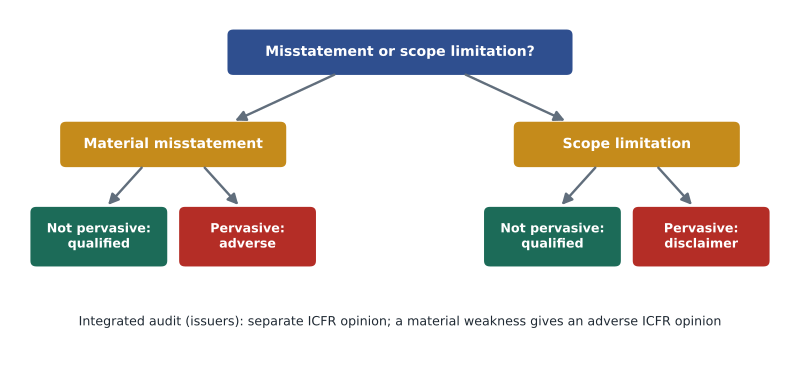
The auditor accumulates misstatements above the clearly trivial threshold, asks management to correct them and evaluates the uncorrected ones individually and in total. Modified opinions follow a simple matrix: a material misstatement that is not pervasive gives a qualified opinion and a pervasive one an adverse opinion; an inability to obtain sufficient appropriate evidence that is material but not pervasive gives a qualified opinion and a pervasive one a disclaimer. The report also includes, when appropriate, a going concern section, an emphasis-of-matter paragraph drawing attention to a matter already disclosed, or an other-matter paragraph about something not in the statements.
For issuers, AS 3101 requires the auditor to communicate critical audit matters, matters communicated to the audit committee that relate to material accounts or disclosures and involved especially challenging, subjective or complex judgment. For nonissuers, the auditor may be engaged to communicate key audit matters under AU-C 701. Know the order and content of the report sections, the auditor's responsibilities statement and the management responsibilities statement, which differ in small ways between AU-C 700 and AS 3101.
| Finding | Material, not pervasive | Material and pervasive |
|---|---|---|
| Material misstatement | Qualified (except for) | Adverse |
| Unable to obtain sufficient appropriate evidence | Qualified (except for) | Disclaimer of opinion |
| Substantial doubt about going concern, adequately disclosed | Unmodified with a going concern section | Unmodified with a going concern section |
Documentation and completion
Several completion procedures appear regularly on AUD. Audit documentation must be sufficient for an experienced auditor with no previous connection to the engagement to understand the work performed, the evidence obtained and the conclusions reached; for nonissuers the documentation must be assembled within 60 days after the report release date and retained for at least five years, and for issuers within 45 days and for seven years. Before the report is released, the auditor obtains written representations from management, dated as of the report date, reads other information included with the statements for material inconsistencies, performs subsequent events procedures up to the report date and, for issuers and some other engagements, obtains an engagement quality review. Questions often test dates: the report is dated no earlier than the date on which sufficient appropriate evidence was obtained, which includes management's acceptance of responsibility for the statements, and the representations carry the same date.
Reviews, compilations and preparation engagements
Under SSARS, a review engagement (AR-C 90) provides limited assurance through inquiry and analytical procedures and requires independence. A compilation (AR-C 80) provides no assurance; the accountant may compile statements without being independent but must disclose the lack of independence in the report. A preparation engagement (AR-C 70) provides no assurance and no report, but each page must state that no assurance is provided. Kestrel Landscaping's lender accepted a review; Larch Street Bakery's owner wanted only prepared statements for her tax return. Questions ask which engagement fits a client's need, which procedures are required and what the report says. The most common trap is applying audit procedures, such as confirmations or internal control testing, to a review; they are not required.
Attestation engagements and SOC reports
Attestation engagements under the SSAEs report on subject matter other than historical financial statements, or on assertions about it. An examination provides reasonable assurance and results in an opinion; a review provides limited assurance and a conclusion; an agreed-upon procedures engagement under AT-C 215 provides findings without assurance, and the engaging party must agree that the procedures are appropriate. System and Organization Controls reports are attestation engagements on a service organization's controls: SOC 1 reports address controls relevant to user entities' financial reporting and are used by user auditors; SOC 2 reports address security, availability, processing integrity, confidentiality or privacy. A Type 2 report includes tests of operating effectiveness over a period; a Type 1 report addresses design at a point in time. ISC tests SOC engagements in more depth; AUD tests the user auditor's perspective.
Government audits
Audits under Government Auditing Standards, the Yellow Book, add requirements on independence, continuing professional education and reporting on internal control and compliance. The 2024 revision of the Yellow Book took effect for periods beginning on or after December 15, 2025. A Single Audit under the Uniform Guidance is required for nonfederal entities that spend 1,000,000 dollars or more of federal awards in a fiscal year, for fiscal years beginning on or after October 1, 2024; the auditor identifies major programs using risk-based criteria and a Type A threshold, and reports on compliance with requirements for each major program. ACCT-412 worked through the City of Aspen Ridge's Single Audit; on the exam, know the threshold, the major program determination and the reports required.
Worked problem
Choosing the right report
Hollis Ward finds that Tamarack's inventory provision is understated by an amount the firm estimates at 492 thousand to 1,516 thousand; materiality is 1,400 thousand. Management agrees to increase the provision by 1,000 thousand. Separately, Tamarack has adequately disclosed a covenant waiver that removes going concern doubt.
Show solution
- After the adjustment, the remaining misstatement is at most 516 thousand and possibly zero, below materiality.
- No other uncorrected misstatements are significant, so the financial statements are not materially misstated.
- The covenant waiver resolves the going concern doubt; no going concern section is needed, though the auditor considers whether the matter is a critical audit matter.
- The internal control opinion depends on whether the provision process deficiency is a material weakness, evaluated separately.
Answer: An unmodified opinion on the financial statements, with critical audit matters as required; the ICFR opinion is evaluated separately.
Common mistakes
MistakeChoosing a procedure without identifying the assertion.
InsteadStart with the assertion at risk, then pick the most reliable procedure that addresses it.
MistakeTreating an adverse ICFR opinion as requiring a modified financial statement opinion.
InsteadThe two opinions are separate; substantive work may support an unmodified financial statement opinion.
MistakeModifying the opinion for adequately disclosed going concern doubt.
InsteadAdd a going concern section; the opinion remains unmodified if disclosure is adequate.
MistakeRequiring independence for a compilation.
InsteadA compilation may be performed without independence, but the lack must be disclosed.
MistakeConfusing SOC 1 and SOC 2.
InsteadSOC 1 concerns controls relevant to financial reporting; SOC 2 concerns the trust services criteria.
MistakeForgetting the Single Audit threshold.
InsteadOne million dollars of federal expenditures for fiscal years beginning on or after October 1, 2024.
Summary and key terms
- Evidence must be sufficient and appropriate; reliability depends on source, directness, form and controls.
- Analytical procedures support planning, substantive testing (if precise enough) and the final review.
- Attribute sample sizes rise with confidence, lower tolerable rates and higher expected rates; exceeding the tolerable rate reduces reliance.
- Integrated audits under AS 2201 give a separate ICFR opinion; a material weakness gives an adverse ICFR opinion.
- Modified opinions depend on whether the issue is a misstatement or a scope limitation, and whether it is pervasive.
- SSARS distinguishes reviews, compilations and preparation engagements; SSAEs cover examinations, reviews, AUPs and SOC reports.
- Yellow Book and Single Audit requirements add compliance reporting; know the 1,000,000 dollar threshold.
- Sufficient appropriate evidence
- Evidence adequate in quantity and relevant and reliable in quality.
- Integrated audit
- An audit of both the financial statements and internal control over financial reporting under PCAOB AS 2201.
- Material weakness
- A deficiency creating a reasonable possibility that a material misstatement will not be prevented or detected on a timely basis.
- Critical audit matter
- A matter communicated to the audit committee, relating to material items and involving especially challenging judgment, reported under AS 3101.
- Preparation engagement
- A SSARS engagement to prepare financial statements without assurance or a report.
- SOC 1 Type 2 report
- A service auditor's report on the design and operating effectiveness of controls relevant to user entities' financial reporting over a period.
- Single Audit
- An audit of a nonfederal entity's financial statements and federal awards compliance under the Uniform Guidance.
Practice problems
Work each problem on paper first, then reveal the answer to check.
Which procedure addresses completeness: vouching or tracing?
Show answer
Tracing from source documents to the records.
Rerun the sampling program with 99 percent confidence and zero expected deviations. What sample size results?
Show answer
About 90 items.
What is the effect of the risk of assessing control risk too low?
Show answer
It threatens audit effectiveness, because the auditor may rely on a control that is not working.
Tamarack has a material weakness but no material misstatement. What opinions result?
Show answer
Adverse on ICFR, unmodified on the financial statements.
A scope limitation is material and pervasive. What report results?
Show answer
A disclaimer of opinion.
Which SSARS engagement requires independence?
Show answer
A review engagement (AR-C 90).
What must each page of prepared statements include?
Show answer
A statement that no assurance is provided.
A user auditor relies on a SOC 1 Type 1 report. Why is that not enough for control reliance?
Show answer
A Type 1 report covers design at a point in time, not operating effectiveness over a period.
What is the Single Audit threshold for fiscal years beginning on or after October 1, 2024?
Show answer
1,000,000 dollars of federal expenditures.
When must an AUP engaging party agree to the procedures?
Show answer
Before the report is issued; the engaging party acknowledges that the procedures are appropriate for its purpose.
Lesson quiz · 5 questions
Score 60% or more to complete this lesson.
Create a free account to save your progress, take quizzes and earn a certificate.