
ACCT-480 · Lesson 4 of 12 · 25 min
FAR II: governmental, not-for-profit and complex transactions
Governmental and not-for-profit accounting is a distinct part of FAR that many candidates neglect because it seems narrow. It is not small on the exam: questions on state and local governments and on not-for-profit organizations appear in both MCQs and simulations, and the rules are different enough from business accounting that guessing rarely works. This lesson reviews both, using the City of Aspen Ridge, Nebraska, and Riverbend Community Pantry from ACCT-412, and then turns to the complex business transactions that FAR tests most often: business combinations, consolidation, foreign currency and derivatives. ACCT-412 and ACCT-311 taught the details; here the focus is on what the exam asks and how to answer quickly.
Two measurement focuses
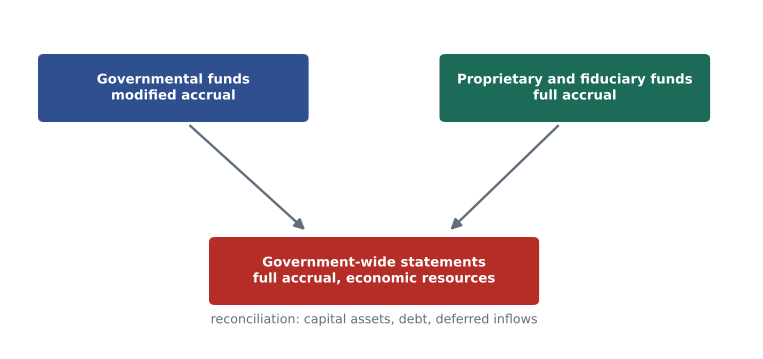
State and local governments report under standards issued by the Governmental Accounting Standards Board (GASB). The single most important idea is that governments use two measurement focuses and bases of accounting at once. Governmental funds, such as the general fund, special revenue funds, debt service funds and capital projects funds, use the current financial resources measurement focus and the modified accrual basis: revenues are recognized when measurable and available to pay current-period liabilities, and expenditures when the related liability is incurred, with exceptions such as debt service. The government-wide statements use the economic resources measurement focus and the full accrual basis, like a business. Proprietary funds, such as enterprise funds for a water utility, and fiduciary funds use full accrual in their own statements.
Because the fund statements and the government-wide statements use different bases, the financial report includes reconciliations between them. FAR questions frequently ask you to convert a governmental fund figure to its government-wide equivalent or to identify a reconciling item. The program below shows two common ones for Aspen Ridge: property tax revenue, where the fund recognizes only taxes collected within the availability period, and capital assets, where the fund records the full outlay as an expenditure while the government-wide statements capitalize and depreciate.
# FAR II: governmental funds use modified accrual; the government-wide statements use full accrual.
# Property taxes levied for FY2027 (fiscal year ends Sept 30, 2027), in thousands.
levy, collected_in_year, collected_within_60_days, later = 22000, 20400, 900, 500
fund_revenue = collected_in_year + collected_within_60_days     # measurable and available
gw_revenue = levy - 200                                          # less estimated uncollectible
print(f"General fund property tax revenue (modified accrual): {fund_revenue:,}")
print(f"Government-wide revenue (accrual, net of 200 allowance): {gw_revenue:,}")
print(f"Reconciling item, deferred inflows of resources: {gw_revenue - fund_revenue:,}")
# Capital outlay in the fund vs depreciation in the government-wide statements
outlay, depreciation = 6800, 4100
print(f"Capital outlay {outlay:,} less depreciation {depreciation:,} adds {outlay - depreciation:,} to the change in net position")
# Not-for-profit: release of donor restrictions (Riverbend Community Pantry, ACCT-412 style)
restricted_open, new_restricted, spent_for_purpose = 310, 145, 220
print(f"Net assets with donor restrictions: {restricted_open} + {new_restricted} - {spent_for_purpose} = "
f"{restricted_open + new_restricted - spent_for_purpose}")General fund property tax revenue (modified accrual): 21,300 Government-wide revenue (accrual, net of 200 allowance): 21,800 Reconciling item, deferred inflows of resources: 500 Capital outlay 6,800 less depreciation 4,100 adds 2,700 to the change in net position Net assets with donor restrictions: 310 + 145 - 220 = 235
In the general fund, Aspen Ridge recognizes the 20.4 million collected during the year and the 0.9 million collected within 60 days after year end, the availability period most governments use for property taxes, for revenue of 21.3 million. The government-wide statement of activities recognizes the whole levy, net of the 0.2 million allowance for uncollectible taxes, or 21.8 million. The 0.5 million difference is reported as a deferred inflow of resources in the fund and is a reconciling item. For capital assets, the fund records 6.8 million of capital outlay as an expenditure; the government-wide statements capitalize it and record 4.1 million of depreciation, so the reconciliation adds 2.7 million to the change in net position. Know the main reconciling items: capital outlay and depreciation, long-term debt proceeds and repayments, accrued interest, compensated absences, pension and OPEB amounts, and deferred revenue.
Fund types, statements and other GASB topics
Know the fund categories and the statements each uses. Governmental funds present a balance sheet and a statement of revenues, expenditures and changes in fund balances; fund balance is classified as nonspendable, restricted, committed, assigned or unassigned under GASB 54. Proprietary funds present a statement of net position, a statement of revenues, expenses and changes in net position, and a statement of cash flows that uses the direct method and four categories, including noncapital and capital and related financing. Fiduciary funds present a statement of fiduciary net position and changes. The government-wide statements are the statement of net position and the statement of activities, which presents net expense or revenue by function. GASB 103, effective for fiscal years beginning after June 15, 2025, changed parts of the reporting model, including the presentation of proprietary fund statements and the management's discussion and analysis; check which version your exam tests.
Other GASB topics that appear on FAR include the classification of nonexchange revenues under GASB 33 (derived tax revenues such as sales taxes, imposed revenues such as property taxes, government-mandated and voluntary nonexchange transactions), budgetary accounting and encumbrances, interfund transactions and transfers, the infrastructure modified approach, leases under GASB 87 and subscription-based IT arrangements under GASB 96. Do not try to learn every GASB statement; focus on the reporting model, the two bases, revenue recognition and the reconciliation.
Not-for-profit organizations
Private not-for-profit organizations follow FASB standards in ASC 958, not GASB. Their statements are a statement of financial position, a statement of activities, a statement of cash flows and, for all not-for-profits under ASU 2016-14, an analysis of expenses by both nature and function. Net assets are classified in two categories: with donor restrictions and without donor restrictions. When a restriction is satisfied, by spending for the specified purpose or by the passage of time, the amount is reclassified from net assets with donor restrictions to net assets without donor restrictions as a release, shown in the statement of activities. The program's final line shows Riverbend's restricted net assets after receiving 145 thousand of new restricted gifts and spending 220 thousand for restricted purposes.
Contributions are another heavily tested area. Unconditional promises to give are recognized as revenue when made, measured at the present value of expected cash flows if payable later. Conditional promises, which have both a barrier and a right of return or release, are not recognized until the condition is met, under ASU 2018-08. Contributed services are recognized only if they create or enhance a nonfinancial asset or require specialized skills that would otherwise be purchased. Gifts in kind are recognized at fair value and, under ASU 2020-07, presented separately with disclosure of how they are used. Exchange transactions, such as fees for services, are revenue under ASC 606 rather than contributions.
| Topic | Governments (GASB) | Not-for-profits (FASB ASC 958) |
|---|---|---|
| Statements | Government-wide plus fund statements | Financial position, activities, cash flows, functional expenses |
| Net position or net assets | Net investment in capital assets, restricted, unrestricted | With and without donor restrictions |
| Basis | Modified accrual for governmental funds; full accrual government-wide | Full accrual |
| Restricted resources | Restricted by external parties or enabling legislation | Restricted by donors |
| Revenue from gifts | Voluntary nonexchange transactions under GASB 33 | Contributions; conditional promises not recognized until met |
Worked problem
Classifying Riverbend's transactions
Riverbend Community Pantry receives: (a) a 50 thousand gift restricted to buying a refrigerated van; (b) a pledge of 30 thousand payable next year, unconditional; (c) a grant of 40 thousand that will be paid only if Riverbend serves 2,000 households and must be returned otherwise; (d) 10 thousand of donated food at fair value; (e) volunteer hours from people sorting food.
Show solution
- (a) Contribution revenue with donor restrictions of 50; released when the van is bought (or over its life if the policy so provides).
- (b) Contribution revenue with donor restrictions (time) at present value; released when received.
- (c) Conditional contribution: not recognized until 2,000 households are served.
- (d) Gift in kind: contribution revenue of 10 at fair value, presented separately.
- (e) Not recognized: general volunteer work does not require specialized skills and does not create a nonfinancial asset.
Answer: Recognize (a), (b) and (d); defer (c) until the condition is met; do not recognize (e).
Budgetary accounting and encumbrances
Governments adopt legally binding budgets, and FAR tests how they are recorded and reported. Many governments record the budget in the accounts: estimated revenues and appropriations are entered at the start of the year, so that actual revenues and expenditures can be compared with them throughout the year. When the government places a purchase order, it records an encumbrance to reserve part of the appropriation, so that it cannot be spent twice. When the goods arrive, the encumbrance is reversed and the actual expenditure is recorded, often at a slightly different amount. Encumbrances outstanding at year end are not expenditures or liabilities; they are reported as restricted, committed or assigned fund balance depending on the constraint. A budgetary comparison schedule, usually presented as required supplementary information for the general fund and major special revenue funds, shows the original budget, the final budget, actual amounts on the budgetary basis and the variance. Questions often ask which column a figure belongs in or whether an encumbrance affects fund balance classification, so learn the sequence of entries for a purchase order from appropriation to payment.
Complex business transactions
FAR's remaining heavy topics are business combinations and consolidation, foreign currency, and derivatives and hedging. For business combinations, know that the acquirer measures identifiable assets and liabilities at acquisition-date fair value, recognizes goodwill or a bargain purchase gain, measures noncontrolling interest at fair value, expenses acquisition costs and recognizes contingent consideration at fair value. Consolidation questions test intercompany eliminations: intercompany sales and unrealized profit in inventory, intercompany loans and interest, and the allocation of income to the noncontrolling interest. Variable interest entities appear occasionally; know that the primary beneficiary consolidates.
Foreign currency has two parts. Transactions denominated in a foreign currency, such as a purchase from a supplier in euros, are remeasured at each balance sheet date, with gains and losses in income. Financial statements of a foreign subsidiary are translated into the parent's reporting currency using the current rate method if the subsidiary's functional currency is its local currency, with translation adjustments in other comprehensive income, or remeasured using the temporal method if its functional currency is the parent's currency, with gains and losses in income. Derivatives are measured at fair value; hedge accounting under ASC 815 matches the timing of gains and losses on the derivative with the hedged item, through income for fair value hedges and through other comprehensive income for cash flow hedges. Expect conceptual MCQs and at least one calculation on these topics.
Common mistakes
MistakeRecognizing property tax revenue in a governmental fund when levied.
InsteadRecognize it when measurable and available, usually collected within 60 days after year end; the rest is a deferred inflow.
MistakeExpecting depreciation in a governmental fund.
InsteadGovernmental funds record capital outlay as an expenditure; depreciation appears only in the government-wide statements.
MistakeApplying GASB standards to a private not-for-profit.
InsteadPrivate not-for-profits follow FASB ASC 958.
MistakeRecognizing a conditional grant when promised.
InsteadRecognize conditional contributions only when the barrier is overcome.
MistakeRecording all volunteer time as revenue.
InsteadRecognize contributed services only if they create a nonfinancial asset or need specialized skills that would be purchased.
MistakePutting translation adjustments in net income.
InsteadUnder the current rate method, translation adjustments go to other comprehensive income.
Summary and key terms
- Governments use two measurement focuses: modified accrual and current financial resources in governmental funds; full accrual and economic resources government-wide.
- Reconciliations connect the fund statements to the government-wide statements; know the main reconciling items.
- Know the fund categories, their statements and GASB 54 fund balance classifications; GASB 103 updated the reporting model from 2025.
- Private not-for-profits follow ASC 958 with net assets with and without donor restrictions and releases when restrictions are met.
- Unconditional promises are recognized when made; conditional promises when conditions are met; contributed services only in limited cases.
- Business combinations, consolidation, foreign currency and hedging complete the heavily tested FAR transactions.
- Modified accrual
- The basis of governmental funds, recognizing revenues when measurable and available and expenditures when liabilities are incurred.
- Current financial resources measurement focus
- A focus on near-term inflows and outflows of spendable resources.
- Deferred inflow of resources
- An acquisition of net assets applicable to a future period, such as property taxes not yet available.
- Net assets with donor restrictions
- Not-for-profit net assets subject to donor-imposed purpose or time limits.
- Conditional promise to give
- A pledge with a barrier and a right of return or release, not recognized until the barrier is overcome.
- Functional currency
- The currency of the primary economic environment in which an entity operates.
Practice problems
Work each problem on paper first, then reveal the answer to check.
What are the measurement focus and basis of a governmental fund?
Show answer
Current financial resources measurement focus and modified accrual basis.
Rerun the program with 1.4 million collected within 60 days and 0 later. What is fund revenue and the deferred inflow?
Show answer
Fund revenue is 21.8 million (20.4 plus 1.4), and the deferred inflow is zero.
Name three items that reconcile governmental fund balances to governmental activities net position.
Show answer
Capital assets net of depreciation, long-term debt, accrued interest (also pensions, compensated absences, deferred revenue).
Which statement of a proprietary fund uses the direct method and four categories?
Show answer
The statement of cash flows.
How are restricted contributions released?
Show answer
By reclassifying from net assets with donor restrictions to without donor restrictions when the purpose or time restriction is met.
Is a grant payable only if a target is met, with return otherwise, recognized when promised?
Show answer
No, it is a conditional contribution recognized when the condition is met.
When are contributed services recognized?
Show answer
When they create or enhance a nonfinancial asset or require specialized skills that would otherwise be purchased.
Where do translation adjustments go under the current rate method?
Show answer
Other comprehensive income.
What fair value applies to noncontrolling interest in a business combination?
Show answer
Acquisition-date fair value.
Why should you check which GASB reporting model your exam tests?
Show answer
GASB 103 changed parts of the model for fiscal years beginning after June 15, 2025, and testable dates may lag.
Lesson quiz · 5 questions
Score 60% or more to complete this lesson.
Create a free account to save your progress, take quizzes and earn a certificate.