
ACCT-480 · Lesson 3 of 12 · 26 min
FAR I: the conceptual framework, financial statements and select transactions
Financial Accounting and Reporting is the broadest section of the exam and, for many candidates, the one with the lowest pass rate. It covers the conceptual framework, the form and content of financial statements for business entities, the accounting for most balance sheet accounts and many transactions, and the accounting for state and local governments and not-for-profit organizations. This lesson reviews the business-entity content through the lens of the exam, using Tamarind Bay Foods from ACCT-470. Lesson 4 covers governmental and not-for-profit accounting and complex transactions. The technical material was taught in ACCT-211, ACCT-212, ACCT-311 and ACCT-470; this lesson shows how FAR tests it and which points are most often missed.
What the FAR blueprint covers
Under the 2024 blueprint, FAR has three content areas. Area I, financial reporting, covers the conceptual framework and standard setting, general-purpose financial statements for for-profit entities, public company reporting topics such as earnings per share and segment reporting, special purpose frameworks, financial statement ratios, and governmental and not-for-profit reporting. Area II covers select balance sheet accounts: cash, receivables, inventory, property and equipment, intangibles, payables, debt, equity and investments. Area III covers select transactions: revenue, income taxes, leases, contingencies, subsequent events, fair value, changes and errors, business combinations and foreign currency. Check the current blueprint for weights and tasks, which the AICPA updated on January 1, 2026.
FAR is tested mostly at the application and analysis levels. You will compute amounts, prepare journal entries, complete schedules and identify errors in a client's accounting. Remembering a rule is not enough; you must use it quickly with numbers. Because there are only 50 MCQs, each carries considerable weight, and the simulations, which make up half the score, often combine two or three topics in one task.
| Blueprint area | Examples of tested tasks | Where this program taught it |
|---|---|---|
| I. Financial reporting | Statement of cash flows, EPS, segments, ratios, governmental and NFP statements | ACCT-211, 212, 412, 470 |
| II. Select balance sheet accounts | Receivables and credit losses, inventory, PP&E, intangibles, debt, equity, investments | ACCT-211, 212 |
| III. Select transactions | Revenue, income taxes, leases, contingencies, fair value, business combinations, foreign currency | ACCT-212, 311, 470 |
The conceptual framework and standard setting
Expect a few MCQs on the conceptual framework: the objective of general-purpose financial reporting, the qualitative characteristics (relevance and faithful representation as fundamental, comparability, verifiability, timeliness and understandability as enhancing), the elements of financial statements and the recognition and measurement concepts. The FASB's Concepts Statements are not authoritative, but they explain why the standards say what they say, and questions often ask which characteristic a requirement supports. Know the structure of the Accounting Standards Codification, the role of the FASB, the SEC, the Private Company Council and the GASB, and the fact that Accounting Standards Updates amend the Codification.
Financial statements and the statement of cash flows
The statement of cash flows is among the most frequently tested topics in FAR. Know the indirect method thoroughly: start with net income, add back non-cash expenses such as depreciation, amortization and impairment, remove gains and losses on investing and financing activities, and adjust for changes in operating working capital. Know which items are operating, investing and financing under US GAAP: interest paid and received and dividends received are operating, dividends paid are financing, and the purchase of equipment is investing. Know the required disclosures for non-cash investing and financing activities, such as acquiring an asset by issuing debt. A simulation may give you comparative balance sheets and an income statement and ask you to prepare the operating section; work methodically through each balance sheet change.
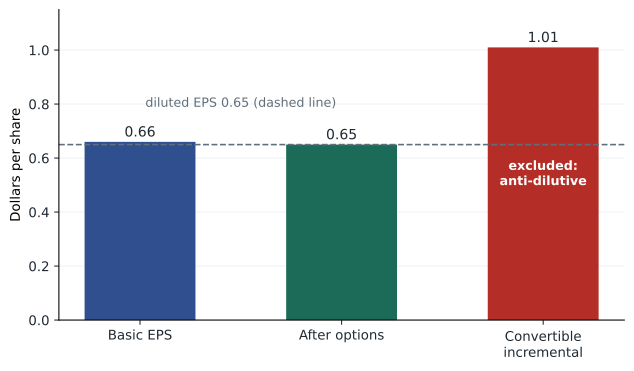
Earnings per share is the other financial statement topic that FAR tests repeatedly, and it rewards careful technique. The program below computes basic and diluted EPS for a simplified version of Tamarind Bay's 2026 results: net income of 80.7 million, 122 million weighted average shares, six million options with an exercise price of 15 dollars when the average share price is 24 dollars, and convertible notes that would add ten million shares and save 13.5 million of interest before tax at a 25 percent rate. It also shows the one-step goodwill impairment test under ASC 350.
# FAR review with Tamarind Bay (from ACCT-470): goodwill under ASC 350 and diluted EPS.
carrying_ru, fair_value_ru = 690.0, 659.0
impairment = max(0.0, carrying_ru - fair_value_ru)
print(f"Goodwill impairment (one step, capped at goodwill 138.0): {min(impairment, 138.0)}")
# Diluted EPS: options by the treasury stock method; convertible tested if-converted.
net_income, shares = 80.7, 122.0               # millions
options, strike, avg_price = 6.0, 15.0, 24.0
incremental = options - options * strike / avg_price
basic = net_income / shares
after_options = net_income / (shares + incremental)
conv_shares, conv_interest_after_tax = 10.0, 13.5 * (1 - 0.25)
per_incremental = conv_interest_after_tax / conv_shares
print(f"Basic EPS {basic:.2f}; incremental option shares {incremental:.2f}m")
print(f"EPS after options {after_options:.3f}; convertible adds {per_incremental:.3f} per share")
print("Convertible is", "anti-dilutive" if per_incremental > after_options else "dilutive")
print(f"Diluted EPS {after_options:.2f}")Goodwill impairment (one step, capped at goodwill 138.0): 31.0 Basic EPS 0.66; incremental option shares 2.25m EPS after options 0.649; convertible adds 1.012 per share Convertible is anti-dilutive Diluted EPS 0.65
The treasury stock method assumes the option proceeds are used to buy back shares at the average price, so six million options add only 2.25 million shares. The convertible's incremental earnings per share, about 1.01 dollars, exceed EPS after the options, so including it would increase EPS; it is anti-dilutive and excluded. Diluted EPS is 0.65 dollars against basic EPS of 0.66 dollars. On the exam, rank the potentially dilutive securities by their incremental EPS, include them one at a time starting with the most dilutive, and stop when the next one would increase EPS. The goodwill test under ASU 2017-04 is a single step: the impairment is the excess of the reporting unit's carrying amount over its fair value, limited to the goodwill, here 31 million.
Select balance sheet accounts
Several balance sheet topics are tested heavily. Receivables are measured using the current expected credit loss model of ASC 326, which requires an allowance for lifetime expected losses from the date the receivable is recognized; know the aging and loss-rate approaches. Inventory is measured at the lower of cost and net realizable value for FIFO and average cost, but at the lower of cost or market for LIFO and the retail method, where market is replacement cost bounded by a ceiling and a floor. Property and equipment questions test capitalization of interest during construction, depreciation methods, impairment under ASC 360 (the two-step recoverability and fair value test for assets held and used) and exchanges. Debt questions test the effective interest method for bonds issued at a discount or premium, debt issue costs presented as a reduction of the liability, and extinguishment gains and losses.
Worked problem
Bond interest by the effective interest method
On January 1, 2026, Tamarind Bay issues five-year bonds with a face amount of 100 million and a 5 percent coupon paid annually, when the market rate is 6 percent. The issue price is 95.79 million.
Show solution
- Interest expense for 2026 is 6 percent of the carrying amount: 0.06 times 95.79 million, which is 5.75 million.
- Cash paid is the coupon: 5 percent of 100 million, which is 5.0 million.
- The discount amortized is 5.75 million less 5.0 million, which is 0.75 million.
- The carrying amount at December 31, 2026 rises to 95.79 plus 0.75, which is 96.54 million.
Answer: Interest expense 5.75 million, cash 5.0 million, amortization 0.75 million, ending carrying amount 96.54 million.
Select transactions
Revenue under ASC 606 follows five steps: identify the contract, identify the performance obligations, determine the transaction price, allocate it on relative standalone selling prices and recognize revenue when or as control transfers. FAR simulations often give you a contract with several elements, a discount or variable consideration and ask for the revenue in each period. Income taxes under ASC 740 test temporary differences, deferred tax assets and liabilities at enacted rates, valuation allowances when realization is not more likely than not, and the separation of current and deferred expense. Leases under ASC 842 test classification as finance or operating for lessees, measurement of the lease liability and right-of-use asset, and the different expense patterns. Contingencies under ASC 450 are accrued when a loss is probable and reasonably estimable, with probable meaning likely to occur.
Business combinations appear in FAR mostly as acquisition-date measurement: identifiable assets and liabilities at fair value, goodwill as the excess of consideration plus noncontrolling interest over net assets, and the treatment of acquisition costs as expenses. Consolidation procedures, intercompany eliminations and foreign currency translation also appear. If your preparation time is short, prioritize revenue, leases, income taxes and the statement of cash flows; they appear in nearly every exam form.
How FAR simulations are built
A typical FAR simulation gives you several exhibits, such as a trial balance, a contract, a lease agreement and an email from a manager, and asks you to complete a schedule or a set of journal entries. Read the requirement first and note exactly what is asked: an amount at a date, an entry for a period, or a classification. Many candidates lose points by computing the right number for the wrong date. Use the spreadsheet tool for multi-step calculations so you can check them. If a simulation asks for several related amounts, solve the first one carefully, because later cells often depend on it.
Changes, errors and subsequent events
Three related topics appear in almost every FAR exam form and are easy points if you know the rules. Under ASC 250, a change in accounting principle is applied retrospectively unless impracticable, and the new principle must be preferable; a change in accounting estimate is applied prospectively; a change in the reporting entity is applied retrospectively; and an error correction is a restatement of prior periods. A change in depreciation method is treated as a change in estimate effected by a change in principle, so it is prospective. Under ASC 855, subsequent events are either recognized, when they provide evidence about conditions that existed at the balance sheet date, such as the settlement of a lawsuit that was pending at year end, or nonrecognized, when they reflect conditions that arose afterward, such as a fire in February, which may require disclosure. SEC filers evaluate subsequent events through the date the statements are issued; other entities through the date they are available to be issued, and disclose that date.
Questions on these topics often combine them. A simulation might ask you to correct an inventory error discovered in the current year that affected the prior year's ending inventory, show the effect on opening retained earnings and decide whether a lawsuit settled after year end is a recognized subsequent event. Work through them in order: identify the type of change or event, apply the required treatment, and then compute the effect on each statement. Remember that an inventory error reverses itself over two periods, so the cumulative effect on retained earnings after the second year is zero even though each year's income was misstated.
Common mistakes
MistakeIncluding anti-dilutive securities in diluted EPS.
InsteadRank potential shares by incremental EPS and include them only while they reduce EPS.
MistakeApplying lower of cost and net realizable value to LIFO inventory.
InsteadLIFO and retail method inventory use lower of cost or market with a ceiling and floor.
MistakeClassifying interest paid as financing on the US GAAP cash flow statement.
InsteadInterest paid is operating under US GAAP.
MistakeUsing the coupon rate for bond interest expense.
InsteadInterest expense uses the market rate at issue times the carrying amount.
MistakeTesting goodwill in two steps.
InsteadSince ASU 2017-04, the impairment is the excess of carrying amount over fair value, limited to goodwill.
MistakeAnswering for the wrong date in a simulation.
InsteadNote the date and the item asked for before computing.
Summary and key terms
- FAR has three areas: financial reporting, select balance sheet accounts and select transactions; it is tested mostly at application and analysis levels.
- Conceptual framework questions test the objective, qualitative characteristics, elements and the structure of standard setting.
- The statement of cash flows and EPS are tested repeatedly; know the indirect method and the ranking procedure for dilution.
- Know CECL for receivables, the inventory measurement rules, ASC 360 impairment and the effective interest method.
- Revenue, income taxes, leases and contingencies are the highest-yield transaction topics.
- Read simulation requirements for the exact item and date before computing, and use the spreadsheet tool.
- Treasury stock method
- The method of computing dilution from options by assuming the proceeds repurchase shares at the average market price.
- Anti-dilutive
- A potential share issue that would increase EPS or reduce a loss per share, and so is excluded from diluted EPS.
- CECL
- The current expected credit loss model of ASC 326, which recognizes lifetime expected losses from inception.
- Effective interest method
- Amortizing a discount or premium so that interest expense equals the market rate times the carrying amount.
- Reporting unit
- An operating segment or one level below, used for goodwill impairment testing under US GAAP.
- Indirect method
- Presenting operating cash flows by adjusting net income for non-cash items and working capital changes.
Practice problems
Work each problem on paper first, then reveal the answer to check.
Name FAR's three blueprint areas.
Show answer
Financial reporting, select balance sheet accounts, select transactions.
Rerun the EPS program with an average share price of 30. What happens to diluted EPS?
Show answer
Incremental option shares rise to 3.0 million; EPS after options is about 0.646, which still rounds to 0.65, and the convertible remains anti-dilutive.
Where are dividends paid and interest paid classified under US GAAP?
Show answer
Dividends paid are financing; interest paid is operating.
What is the measurement basis for FIFO inventory?
Show answer
Lower of cost and net realizable value.
Compute 2027 interest expense on the bond example.
Show answer
6 percent of 96.54 million, about 5.79 million.
When is a loss contingency accrued under ASC 450?
Show answer
When a loss is probable (likely to occur) and the amount can be reasonably estimated.
A lease simulation asks for the lessee's year-1 expense on an operating lease. What pattern applies?
Show answer
A single straight-line lease cost over the term.
Why must you check the date in a simulation requirement?
Show answer
Amounts such as carrying values and accruals differ by date, and later cells depend on earlier ones.
What did ASU 2017-04 change?
Show answer
It removed step 2 of the goodwill impairment test; impairment is carrying amount less fair value, limited to goodwill.
Which four transaction topics would you prioritize if short of time?
Show answer
Revenue, leases, income taxes and the statement of cash flows.
Lesson quiz · 5 questions
Score 60% or more to complete this lesson.
Create a free account to save your progress, take quizzes and earn a certificate.