
ACCT-480 · Lesson 2 of 12 · 25 min
Study planning and exam strategy
Most candidates who fail a CPA Exam section know enough to pass it. They run out of time on the simulations, misread what a task asks, or spend their study hours on topics they already know because those feel productive. This lesson is about the parts of passing that are not technical knowledge: building a study plan from the blueprint, practicing in a way that fixes weaknesses, managing time on exam day and handling MCQs and TBSs efficiently. Lessons 3 to 10 apply these techniques to the content of each section.
Start from the blueprint
The AICPA publishes a blueprint for each section. It lists content areas with weight ranges, then breaks each area into groups and representative tasks, each tagged with a skill level: remembering and understanding, application, analysis or evaluation. For example, the FAR blueprint's three areas under the 2024 version are financial reporting, select balance sheet accounts and select transactions, each with a weight range of roughly a quarter to two fifths of the section. The REG blueprint has five areas, from ethics and federal tax procedures through business law to the taxation of property transactions, individuals and entities. Use the current blueprint as your syllabus. Map your review course's chapters to it, so that every task is covered and you can see which areas carry the most weight.
The skill levels matter as much as the topics. Remembering and understanding tasks are mostly tested in MCQs. Application and analysis tasks appear in both formats, and evaluation, the highest level, appears mainly in AUD and BAR simulations. If your practice consists only of reading and flashcards, you are preparing for the lowest skill level. Most of your practice should be working problems: computing, analyzing exhibits and deciding.
| Skill level | What it asks | Where it appears | How to practice |
|---|---|---|---|
| Remembering and understanding | Recall and explain concepts and rules | Mostly MCQs | Flashcards, short quizzes, explaining a rule aloud |
| Application | Use a rule to compute or classify | MCQs and TBSs | Worked problems, journal entries, tax computations |
| Analysis | Examine information, find relationships and errors | Mostly TBSs | Exhibit-based simulations, reconciliations, document review |
| Evaluation | Judge, conclude and form an opinion | AUD and BAR TBSs | Audit reports, going concern, complex judgments |
A study plan that fits your life
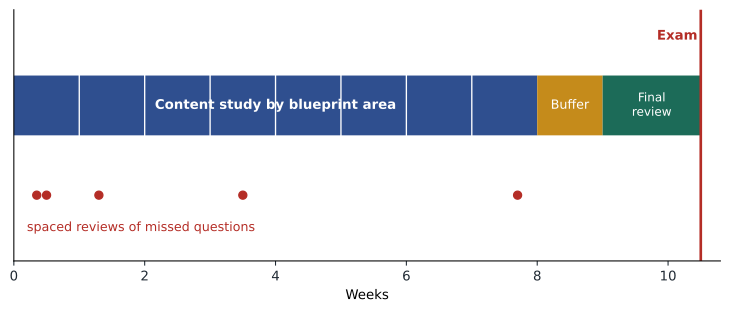
Most candidates study while working full time, and the plan has to fit that reality. A common estimate is 80 to 150 hours of study per section, with FAR at the high end and the discipline sections and AUD for experienced auditors at the lower end. At 15 hours a week, that is six to ten weeks per section. Build the plan backward from your exam date: the last ten days for final review and full practice exams, the weeks before that for working through the blueprint area by area, with regular cumulative review so that early material is not forgotten. Leave a buffer for busy season at work, illness and the possibility of a retake within your credit window.
Plan your section order with the credit window in mind. Passing FAR early helps with AUD and BAR, because so much of those sections assumes FAR knowledge. REG is largely independent, but tax law changes on a schedule, so taking REG soon after you study it avoids learning provisions twice. The discipline section must fit into a January, April, July or October window. Lesson 1 showed how to track credit expiry; your plan should keep at least one retake inside the window for every section.
Practicing so that it sticks
Two techniques have strong research support for long-term learning: retrieval practice and spacing. Retrieval practice means testing yourself instead of rereading; each attempt to recall an answer strengthens memory more than another pass through the notes. Spacing means returning to material at increasing intervals rather than cramming. Many review courses build both into their software. You can apply them yourself by keeping a log of questions you miss and reviewing each one on a schedule that lengthens as you get it right. The program below implements a simplified version of the SM-2 scheduling rule used in many flashcard applications.
# Budgeting time in a four-hour core section (counts per the 2024 blueprints;
# confirm on the current AICPA blueprint). Testlets 1-2 are multiple choice,
# 3-5 are task-based simulations (TBS).
sections = {"AUD": (78, 7), "FAR": (50, 7), "REG": (72, 8)}
total = 240
for sec, (mcq, tbs) in sections.items():
    usable = total - 15          # breaks, tutorial screens, final review
    mcq_min = round(mcq * 1.3)   # rule of thumb: about 1.3 minutes per MCQ
    tbs_min = usable - mcq_min
    print(f"{sec}: {mcq} MCQ in {mcq_min} min ({mcq_min * 60 / mcq:.0f} s each); "
          f"{tbs} TBS in {tbs_min} min ({tbs_min / tbs:.0f} min each)")
# A simple spaced-repetition scheduler (SM-2 style) for missed questions.
def sm2(reps, interval, ease, grade):
    if grade < 3: return 0, 1, ease
    reps += 1
    interval = 1 if reps == 1 else 6 if reps == 2 else round(interval * ease)
    ease = max(1.3, ease + 0.1 - (5 - grade) * (0.08 + (5 - grade) * 0.02))
    return reps, interval, ease
state, day = (0, 0, 2.5), 0
print()
for grade in [2, 4, 4, 5, 3, 5]:
    reps, interval, ease = sm2(*state, grade)
    day += interval
    print(f"grade {grade}: next review in {interval:>2} days (day {day:>3}), ease {ease:.2f}")
state = (reps, interval, ease)AUD: 78 MCQ in 101 min (78 s each); 7 TBS in 124 min (18 min each) FAR: 50 MCQ in 65 min (78 s each); 7 TBS in 160 min (23 min each) REG: 72 MCQ in 94 min (78 s each); 8 TBS in 131 min (16 min each) grade 2: next review in 1 days (day 1), ease 2.50 grade 4: next review in 1 days (day 2), ease 2.50 grade 4: next review in 6 days (day 8), ease 2.50 grade 5: next review in 15 days (day 23), ease 2.60 grade 3: next review in 39 days (day 62), ease 2.46 grade 5: next review in 96 days (day 158), ease 2.56
The first part of the output is a time budget, discussed below. The second shows the scheduler: a question you get wrong comes back the next day; one you answer well comes back after a day, then six days, then about two weeks, then a month or more. A shaky answer (grade 3) lengthens the interval less and lowers the ease factor slightly, so that the question returns sooner next time. The exact numbers are less important than the principle: spend your review time on what you are about to forget, not on what you already know.
Mix topics in your practice. Blocked practice, doing twenty lease questions in a row, feels efficient but trains you to apply a rule you already know is relevant. Interleaved practice, mixing leases with revenue, inventory and governmental questions, trains you to recognize which rule applies, which is what the exam actually tests. Use blocked practice when you first learn a topic and interleaved practice once you know it.
Managing time on exam day
Each section allows four hours, with an optional standardized break after the third testlet that does not count against your time. The time budget in the program assumes about 1.3 minutes per MCQ, a common rule of thumb, and divides the rest of the time among the simulations after leaving 15 minutes for screens and review. The result is roughly 18 minutes per simulation in AUD, 23 in FAR and 16 in REG. These are targets, not limits; some simulations are quick and some take longer. What matters is that you do not spend 40 minutes on the first simulation and leave the last one blank.
Use checkpoints. Before you start, write down the time at which you should finish each testlet. If you are behind at a checkpoint, speed up: make your best choice on difficult MCQs and move on, and in simulations complete the parts you can do quickly before returning to harder ones. Every simulation has several scoring points, so partial work earns partial credit. A blank simulation earns nothing.
Multiple-choice technique
Read the last sentence of the question first, so you know what is being asked, then read the facts with that in mind. Before looking at the options, try to answer in your own words or compute the answer; then look for it among the options. If you cannot compute it, eliminate options that are clearly wrong: those that misapply a rule, use the wrong period or answer a different question. Be alert to words like 'least', 'except' and 'not', which reverse the question. There is no penalty for guessing, so never leave an MCQ blank, and do not change an answer without a specific reason.
Task-based simulation technique
Start each simulation by reading the requirement and looking at the structure of the response area: how many cells, what kind of entries, which drop-down options. Then read the exhibits with the requirement in mind. Simulations often contain more information than you need, and some of it is a distraction. Work the parts you can do with confidence first. For calculations, use the exam's spreadsheet tool for anything with more than two steps. For research tasks, which ask you to find the relevant section of the authoritative literature, think about where the topic lives in the Codification or the standards before searching, then use precise search terms. Lesson 10 practices the simulation formats in detail.
Worked problem
A study plan for FAR
Daniel Reyes works in industry accounting and has 14 hours a week to study. He wants to sit for FAR on May 20, 2027 and has a review course with about 120 hours of content.
Show solution
- Count back: 10 days of final review means content study ends around May 10.
- Content: 120 hours at 14 hours a week is about 8.5 weeks, so start in mid-March; add a week of buffer and start March 8.
- Order: financial reporting and select balance sheet accounts first, governmental and not-for-profit in the middle, select transactions last with cumulative review every Sunday.
- Practice: two full practice exams in the final ten days, timed, with every missed question logged for spaced review.
Answer: Start March 8, finish content by May 10, take two timed practice exams, and sit on May 20 with a week of buffer.
Common reasons candidates fail
Score reports show performance by content area as stronger, comparable or weaker relative to passing candidates. Read yours carefully if you need to retake. The most common patterns are not knowing a heavily weighted area well enough, poor performance on simulations because practice focused on MCQs, and time trouble. Each has a different fix: targeted study of the weak area, more full simulations under time pressure, and practice with checkpoints. A candidate who simply rereads the whole course after a near miss often repeats the same result.
Common mistakes
MistakeUsing a study outline instead of the blueprint.
InsteadMap your study to the current blueprint's areas, groups and skill levels.
MistakeRereading notes as the main study method.
InsteadPractice retrieval: work questions and test yourself; reread only to fix what you missed.
MistakeDoing only blocked practice.
InsteadMix topics once you know them so you learn to recognize which rule applies.
MistakeSpending too long on the first simulation.
InsteadSet checkpoints and move on; partial credit is available on every simulation.
MistakeLeaving MCQs blank.
InsteadThere is no penalty for guessing; always choose an answer.
MistakeRetaking without diagnosis.
InsteadUse the score report and practice data to target weak areas before you schedule a retake.
Summary and key terms
- The blueprint is the syllabus: content areas with weights, representative tasks and skill levels.
- Most practice should be at the application and analysis levels, using problems and simulations.
- Plan backward from the exam date, with cumulative review, a buffer and room for a retake inside the credit window.
- Retrieval practice, spacing and interleaving make learning last; a spaced-repetition log targets what you are about to forget.
- Budget time per testlet and use checkpoints; partial credit makes every simulation worth attempting.
- Read the question before the facts, answer before looking at options, eliminate and never leave MCQs blank.
- Diagnose failure from the score report and fix the specific cause.
- Blueprint
- The AICPA document that defines each section's content areas, weights, tasks and skill levels.
- Skill level
- The cognitive level a task tests: remembering and understanding, application, analysis or evaluation.
- Retrieval practice
- Learning by recalling information, for example by answering questions, rather than rereading.
- Spacing
- Reviewing material at increasing intervals over time.
- Interleaving
- Mixing different topics in one practice session.
- Checkpoint
- A planned time by which a testlet should be finished.
- Score report
- The candidate's report showing performance by content area relative to passing candidates.
Practice problems
Work each problem on paper first, then reveal the answer to check.
What four skill levels does the blueprint use?
Show answer
Remembering and understanding, application, analysis, evaluation.
Why is rereading a weak study method?
Show answer
It creates familiarity without strengthening recall; retrieval practice builds memory more effectively.
Rerun the time budget with 1.0 minute per MCQ. How many minutes per FAR simulation result?
Show answer
50 minutes for MCQs leaves 175 minutes for 7 simulations, 25 minutes each.
In the scheduler, what happens to the interval after a grade of 2?
Show answer
It resets to one day and the repetition count restarts.
When should you use blocked practice?
Show answer
When first learning a topic; switch to interleaving once you know it.
You are 20 minutes behind at the start of testlet 4. What do you do?
Show answer
Complete the quick parts of each remaining simulation first, make reasonable choices without overchecking, and leave nothing blank.
Why might REG be scheduled soon after studying it?
Show answer
Tax law changes on testable dates, and recent study avoids relearning changed provisions.
A score report shows weaker performance in one AUD area. What is the plan?
Show answer
Target that area with study and simulations, retest with practice questions, then schedule the retake.
Name two traps in MCQ wording.
Show answer
Reversals such as 'except' or 'not', and options that answer a different question or use the wrong period.
How many study hours per section do many candidates plan, and why does FAR need more?
Show answer
About 80 to 150; FAR covers the broadest content.
Lesson quiz · 5 questions
Score 60% or more to complete this lesson.
Create a free account to save your progress, take quizzes and earn a certificate.