
ACCT-480 · Lesson 12 of 12 · 26 min
Capstone: a full practice set with explanations
This final lesson is a practice set: twelve original multiple-choice questions and two short simulations drawn from the three core sections, with explanations. Work them under timed conditions, about 1.3 minutes per MCQ and 20 minutes per simulation, before reading the explanations. Then use the self-assessment at the end to plan your remaining study. The questions are original and are not released or licensed exam items; they are written in the style of the exam to give practice with its formats. The scenarios reuse the companies from this course.
Part 1: multiple-choice questions
FAR 1. Tamarind Bay leases a warehouse for 10 years; the lease contains a purchase option that Tamarind Bay is reasonably certain to exercise. Under ASC 842 the lease is classified as: (a) operating; (b) finance; (c) short-term; (d) a service contract.
FAR 2. The City of Aspen Ridge levies property taxes of 22 million dollars for its fiscal year; it collects 20.4 million during the year and expects to collect 0.9 million within 60 days after year end. General fund property tax revenue is: (a) 22.0 million; (b) 21.3 million; (c) 20.4 million; (d) 21.8 million.
FAR 3. Riverbend Community Pantry receives a pledge of 40 thousand dollars payable only if it serves 2,000 households, otherwise returnable. At year end it has served 1,600. Riverbend should report: (a) contribution revenue of 40 thousand; (b) contribution revenue of 32 thousand; (c) no contribution revenue; (d) a liability of 40 thousand.
FAR 4. Six million options with an exercise price of 15 dollars are outstanding when the average market price is 24 dollars. Incremental shares under the treasury stock method are: (a) 6.0 million; (b) 3.75 million; (c) 2.25 million; (d) 0.
AUD 1. Which procedure provides the most reliable evidence of the existence of accounts receivable? (a) inquiry of the credit manager; (b) confirmation sent and received directly by the auditor; (c) analytical review of days receivable; (d) inspection of the aged trial balance.
AUD 2. An issuer has a material weakness in internal control, but the auditor's substantive testing finds no material misstatement. The auditor issues: (a) adverse opinions on both the financial statements and ICFR; (b) an unmodified opinion on the financial statements and an adverse opinion on ICFR; (c) a qualified opinion on the financial statements; (d) a disclaimer on ICFR.
AUD 3. A sample of 93 items in a test of controls with a 5 percent tolerable rate yields two deviations, and the upper deviation limit is 6.6 percent. The auditor should: (a) rely on the control as planned; (b) increase reliance; (c) reduce reliance and increase substantive procedures; (d) issue a qualified opinion.
AUD 4. Which service is prohibited for an issuer audit client? (a) tax return preparation with audit committee preapproval; (b) valuation of an acquired intangible asset recorded in the statements; (c) a comfort letter for a securities offering; (d) an audit of the employee benefit plan.
REG 1. A taxpayer omits gross income equal to 28 percent of the gross income reported. The general period for assessment is: (a) 2 years; (b) 3 years; (c) 6 years; (d) unlimited.
REG 2. Brandt Aerial sells a drone with an adjusted basis of zero, fully expensed under bonus depreciation, for 7,000 dollars after two years. The gain is: (a) 7,000 dollars long-term capital gain; (b) 7,000 dollars ordinary income; (c) 3,500 dollars ordinary and 3,500 capital; (d) not taxable.
REG 3. Which entity is eligible to be an S corporation shareholder? (a) a private equity partnership; (b) a C corporation; (c) a U.S. citizen individual; (d) a nonresident alien.
REG 4. A seller of equipment on credit retains a security interest under a signed agreement but does not file. A month later the buyer's bank files on all equipment. Priority goes to: (a) the seller; (b) the bank; (c) equally; (d) the first to sue.
Answers and explanations
| Question | Answer | Explanation |
|---|---|---|
| FAR 1 | (b) | A purchase option reasonably certain to be exercised is a finance lease criterion. |
| FAR 2 | (b) | Taxes collected during the year plus those available within 60 days: 20.4 plus 0.9. |
| FAR 3 | (c) | A conditional promise is recognized only when the barrier is overcome; 1,600 of 2,000 is not enough. |
| FAR 4 | (c) | Proceeds of 90 million buy back 3.75 million shares; 6.0 less 3.75 is 2.25 million. |
| AUD 1 | (b) | External evidence obtained directly by the auditor is most reliable for existence. |
| AUD 2 | (b) | The opinions are separate; substantive testing can support an unmodified financial statement opinion. |
| AUD 3 | (c) | The upper limit exceeds the tolerable rate, so the planned reliance is not supported. |
| AUD 4 | (b) | Valuation services whose results are audited are prohibited for issuer audit clients. |
| REG 1 | (c) | Omitting more than 25 percent of reported gross income extends the period to six years. |
| REG 2 | (b) | Section 1245 recaptures prior depreciation as ordinary income up to the gain. |
| REG 3 | (c) | Individuals who are U.S. citizens or residents are eligible; partnerships, corporations and nonresident aliens are not. |
| REG 4 | (b) | A perfected interest has priority over an unperfected one; the seller should have filed within 20 days. |
Use the explanations as well as the answers. For each question you missed, write down the rule in your own words and add the question to your spaced review log from lesson 2. For each question you answered correctly but with hesitation, do the same: a lucky guess is not knowledge, and the exam will test the same rule in a different form.
Note what each question tests and at what skill level. FAR 2, FAR 4 and REG 2 are application questions: a rule applied to numbers. FAR 1, FAR 3, AUD 4 and REG 3 test remembering and understanding of a specific rule, but the scenario forces you to recognize which rule applies. AUD 2 and AUD 3 test evaluation: you must judge what the results mean for the auditor's conclusion. REG 1 and REG 4 test rules that candidates often think of as minor, yet they appear on nearly every exam form. A real exam section draws on the blueprint in a similar way, mixing skill levels and topics in each testlet. If your errors cluster at one skill level, for example evaluation questions in AUD, the remedy is different from a cluster in one topic: practice more judgment-based questions and simulations, and explain your reasoning aloud before choosing an answer.
Part 2: two short simulations
Worked problem
Simulation A (FAR and REG): the cutting line
Copperline Outdoor Gear Inc. places a 1,200,000 dollar cutting line in service on July 1, 2026. For books it uses straight-line depreciation over 8 years with no salvage value, a half year in 2026. For tax it claims 100 percent bonus depreciation. The federal rate is 21 percent. Compute (1) 2026 book depreciation, (2) the temporary difference at December 31, 2026, and (3) the deferred tax liability.
Show solution
- Book depreciation for a half year: 1,200,000 divided by 8, times one half, equals 75,000.
- Tax basis is zero after bonus depreciation; book basis is 1,125,000; the temporary difference is 1,125,000.
- Deferred tax liability: 1,125,000 times 21 percent equals 236,250.
- Check: the lesson 11 program assumed a full year of book depreciation; the half-year convention here changes the answer, a typical exam variation.
Answer: Book depreciation 75,000; temporary difference 1,125,000; deferred tax liability 236,250.
Worked problem
Simulation B (AUD): document review of a draft report
A staff member drafted the opinion paragraph for Copperline, a nonissuer, after the auditor concluded that a material misstatement in inventory was not corrected but was not pervasive. The draft says: "In our opinion, the financial statements present fairly, in all material respects, the financial position of Copperline Outdoor Gear Inc. as of December 31, 2026." For each element, decide whether to keep or change it.
Show solution
- Heading: an opinion paragraph for a material, non-pervasive misstatement must be headed Qualified Opinion; change it.
- Wording: the opinion must include "except for the effects of the matter described in the Basis for Qualified Opinion section"; change it.
- Basis section: a Basis for Qualified Opinion section describing the misstatement and quantifying its effects, if practicable, is required; add it.
- Reference to the framework: keep "in accordance with accounting principles generally accepted in the United States of America".
Answer: Change the heading to Qualified Opinion, add the except-for wording and a Basis for Qualified Opinion section, and keep the framework reference.
Self-assessment
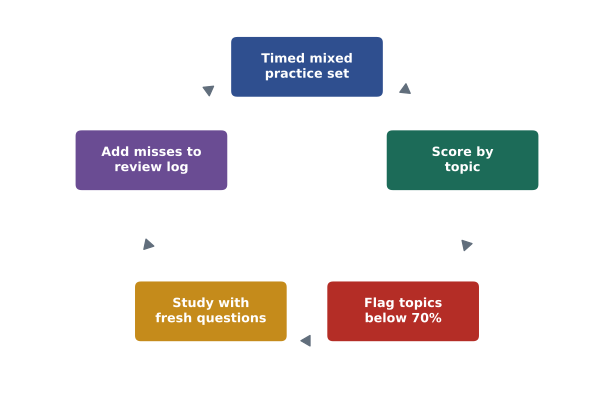
After scoring the practice set, record your results by section and topic. The program below shows one candidate's log from a larger practice set, with ten questions per topic, flagging topics where fewer than seven were correct. The output is the start of a study plan: this candidate should revisit ethics in AUD and business law and procedures in REG, which are among the areas candidates most often neglect, as lessons 5 and 7 noted.
# Practice set review: accuracy by section and topic, flagging what to revisit.
import random
random.seed(480)
topics = {"FAR": ["leases", "revenue", "governmental", "NFP", "EPS"],
          "AUD": ["risk", "sampling", "reports", "ethics"],
          "REG": ["individuals", "S corps", "partnerships", "law", "procedures"]}
for sec, ts in topics.items():
    print(sec)
    for t in ts:
        right = random.randint(5, 10)
        flag = "  revisit" if right < 7 else ""
print(f" {t:14}{right}/10{flag}")FAR leases 8/10 revenue 9/10 governmental 10/10 NFP 7/10 EPS 9/10 AUD risk 10/10 sampling 10/10 reports 8/10 ethics 6/10 revisit REG individuals 10/10 S corps 10/10 partnerships 7/10 law 5/10 revisit procedures 6/10 revisit
Turn the flags into a schedule. For each flagged topic, set aside a study block in the next two weeks: reread your notes or the review course chapter, work twenty fresh questions, then add every miss to your spaced review log. After two weeks, take another mixed practice set. If a topic is still weak, try a different resource or explain the topic aloud to someone else; teaching is one of the best tests of understanding. Repeat until no topic in the sections you are about to take is flagged.
Final advice
In the last week before a section, stop learning new material and consolidate: take one or two full timed practice exams, review your spaced review log and rest. On exam day, arrive early with the required identification and your notice to schedule, use the checkpoints you planned, take the standardized break and leave nothing blank. Afterward, whatever the result, record what went well and what did not while it is fresh. If you need to retake, your score report and your notes are the basis for a targeted plan. If you pass, move on to the next section while your momentum is high. And when you have passed all four sections within your credit window, complete your state's education, experience and ethics requirements, and apply for your license. Confirm each step with your state board, because the rules continue to change.
Common mistakes
MistakeReading the explanations before attempting the questions.
InsteadAnswer first under time, then review explanations.
MistakeRecording only wrong answers.
InsteadAlso log correct answers given with hesitation.
MistakeIgnoring a timing difference in a simulation.
InsteadCheck conventions such as half-year depreciation before computing.
MistakeKeeping the unmodified opinion wording for a qualified opinion.
InsteadUse the Qualified Opinion heading, except-for wording and a basis section.
MistakeStudying flagged topics with the same questions.
InsteadUse fresh questions to test real understanding.
MistakeLearning new material in the final week.
InsteadConsolidate, practice and rest.
Summary and key terms
- A mixed practice set across FAR, AUD and REG tests recall, application and judgment in exam formats.
- Explanations matter as much as answers; log misses and hesitant correct answers for spaced review.
- Simulations often vary a familiar fact, such as a depreciation convention; read carefully before computing.
- A qualified opinion needs its heading, except-for wording and a basis section.
- Score practice by topic, flag weak areas, fix them with fresh questions and repeat.
- In the final week, consolidate and rest; after the exam, record lessons while they are fresh.
- Practice set
- A group of original questions used to rehearse exam formats and identify weak areas.
- Half-year convention
- Taking half a year of depreciation in the year an asset is placed in service.
- Qualified opinion
- An auditor's opinion that the statements are fairly presented except for the effects of a material but not pervasive matter.
- Spaced review log
- A record of missed or uncertain questions scheduled for review at increasing intervals.
- Flagged topic
- A topic where practice accuracy falls below a chosen threshold.
- Consolidation
- Reviewing and reinforcing material already learned rather than adding new content.
Practice problems
Work each problem on paper first, then reveal the answer to check.
Why does FAR 3 give no revenue?
Show answer
The pledge is conditional and the barrier, serving 2,000 households, has not been overcome.
Rerun Simulation A with a full year of book depreciation. What is the DTL?
Show answer
Book depreciation 150,000, temporary difference 1,050,000, DTL 220,500.
What three changes turn the Simulation B draft into a qualified opinion?
Show answer
The Qualified Opinion heading, except-for wording and a Basis for Qualified Opinion section.
Rerun the self-assessment program with a different seed. What should you expect?
Show answer
Different simulated scores and flags; the method, not the numbers, is the point.
Why log correct answers given with hesitation?
Show answer
Because they may reflect guesses, and the rule may be tested differently.
Which REG areas are most often neglected?
Show answer
Business law and ethics and procedures.
What should you bring on exam day?
Show answer
Required identification and the notice to schedule.
What should the final week before a section focus on?
Show answer
Full timed practice exams, the spaced review log and rest.
What do you do after passing all four sections?
Show answer
Complete the state's education, experience and ethics requirements and apply for the license.
Explain REG 3 in one sentence.
Show answer
Only individuals who are U.S. citizens or residents, certain trusts and estates may be S corporation shareholders, so partnerships, corporations and nonresident aliens are excluded.
Lesson quiz · 5 questions
Score 60% or more to complete this lesson.
Create a free account to save your progress, take quizzes and earn a certificate.