
ACCT-480 · Lesson 11 of 12 · 25 min
Integrated case analysis for US practice
The CPA Exam tests sections separately, but practice does not. A new associate at a firm, or a staff accountant in industry, meets problems that cut across financial reporting, tax, audit and business law in the same afternoon. This lesson works through an integrated case that combines the sections, using Copperline Outdoor Gear Inc., an invented company based in Chattanooga, Tennessee. The aim is to practice moving between areas, to see how a conclusion in one changes the analysis in another, and to prepare for the exam's simulations, which increasingly combine topics within a section. Every company, person and figure is invented.
The Copperline case
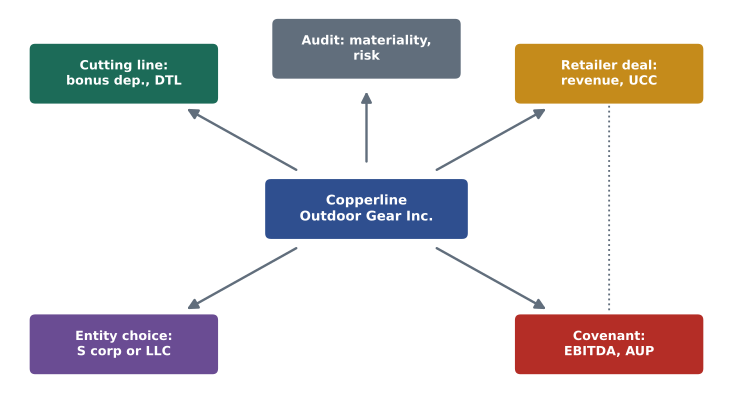
Copperline Outdoor Gear Inc. designs and makes tents, packs and camping furniture, and sells through outdoor retailers and its own website. It is a C corporation owned by its two founders, Nadia Bertrand and Joel Kowalczyk, with 40 percent each, and a regional private equity fund with 20 percent and a board seat. Revenue for 2026 is about 31 million dollars and pre-tax income about 3.1 million. Copperline's bank requires audited financial statements and a leverage covenant of 3.25 times net debt to EBITDA. In 2026 Copperline bought a new cutting line for 1.2 million dollars, is negotiating a distribution agreement with a large retailer, and is considering converting to an S corporation or forming an LLC for a new rental business. The CFO, a CPA, has asked you, a senior associate at the company's audit and tax firm, for a memo on the issues. Before answering, consider your role: your firm audits Copperline and prepares its tax returns, so independence limits what you may do.
Tax and financial reporting: the cutting line
The cutting line is placed in service in 2026. Under the 2025 tax act, 100 percent bonus depreciation is permanent for qualifying property acquired after January 19, 2025, so Copperline can deduct the full cost for tax. For financial reporting, it depreciates the line straight-line over eight years. The difference creates a temporary difference and a deferred tax liability under ASC 740. The program below computes the effect and checks whether the addition is material to the audit.
# Integrated US case: Copperline Outdoor Gear Inc. buys a 1.2 million dollar cutting line
# in 2026 (all figures invented). Tax: 100% bonus depreciation; books: 8-year straight line.
cost, rate, book_life = 1_200_000, 0.21, 8
tax_dep, book_dep = cost, cost / book_life
temp_diff = tax_dep - book_dep
dtl = temp_diff * rate
print(f"Tax depreciation {tax_dep:,.0f}; book depreciation {book_dep:,.0f}")
print(f"Temporary difference {temp_diff:,.0f}; deferred tax liability {dtl:,.0f} (ASC 740)")
print(f"Current federal tax saved in 2026: {(tax_dep - book_dep) * rate:,.0f}")
# Audit angle: is the asset addition material? Overall materiality 5% of pre-tax income.
pretax = 3_100_000
mat = 0.05 * pretax
print(f"Materiality {mat:,.0f}; the addition is {cost / mat:.1f} times materiality -> vouch it")
# Attest angle: the lender wants an agreed-upon procedures report on the covenant
print("Engagement for the lender: agreed-upon procedures (AT-C 215), not an audit opinion")Tax depreciation 1,200,000; book depreciation 150,000 Temporary difference 1,050,000; deferred tax liability 220,500 (ASC 740) Current federal tax saved in 2026: 220,500 Materiality 155,000; the addition is 7.7 times materiality -> vouch it Engagement for the lender: agreed-upon procedures (AT-C 215), not an audit opinion
Tax depreciation of 1.2 million dollars against book depreciation of 150,000 creates a temporary difference of 1.05 million and a deferred tax liability of 220,500 dollars at the 21 percent federal rate, ignoring state tax for simplicity. Current federal tax falls by the same amount in 2026, which helps cash flow. The addition is 7.7 times overall materiality of 155,000 dollars, so the audit team will vouch it to the invoice and contract, confirm the placed-in-service date that drives both the tax deduction and depreciation, and test the deferred tax calculation. One asset, three sections of the exam: REG for the deduction, FAR for the deferred tax and AUD for the testing.
Revenue and business law: the retailer agreement
The proposed agreement with the retailer includes a slotting fee that Copperline would pay to obtain shelf space, a right for the retailer to return unsold product within 90 days, and a clause that title passes when the goods are delivered to the retailer's distribution center. Under ASC 606, consideration payable to a customer, such as the slotting fee, reduces the transaction price unless it is payment for a distinct good or service; a right of return is variable consideration, so Copperline recognizes revenue only for the amount it expects not to be returned, with a refund liability and an asset for the expected returns. From a business law perspective, the agreement is a sale of goods governed by UCC Article 2; between merchants, additional terms in the retailer's acceptance may become part of the contract unless they materially alter it or Copperline objects. The CFO should have counsel review the terms, and the accounting team should prepare a revenue memo before the agreement is signed, so that the commercial terms are understood in accounting terms.
| Area | Issue | Conclusion | Link to other areas |
|---|---|---|---|
| REG | Bonus depreciation on the cutting line | Full deduction in 2026 | Creates a deferred tax liability; reduces cash taxes |
| FAR | Deferred taxes; revenue under the retailer agreement | DTL of 220,500; revenue net of slotting fee and expected returns | Affects EBITDA and the covenant |
| AUD | Material addition; new revenue terms | Vouch the asset; test returns estimate and cut-off | Covenant pressure raises fraud risk |
| REG business law | UCC terms of the agreement | Counsel review; watch additional terms | Terms drive the revenue conclusion |
| REG entities | S corporation election or LLC for rentals | Evaluate eligibility and built-in gains | Affects tax, payroll and the investor's position |
| Attestation | Bank wants a covenant report | Agreed-upon procedures or examination | Independence and engagement terms |
Entity choice: S corporation or LLC
The founders ask whether Copperline should elect S corporation status to avoid double taxation. The first question is eligibility: an S corporation may have no more than 100 shareholders, all of them individuals, certain trusts or estates, and only one class of stock. Copperline's private equity fund is almost certainly an ineligible shareholder, such as a partnership or corporation, so Copperline cannot elect unless the fund's interest is restructured or bought out. Even if it could, a C corporation that converts faces the built-in gains tax on appreciation that existed at conversion if assets are sold within five years. A better route for the new rental business may be a separate LLC taxed as a partnership, owned by the founders and possibly Copperline, which passes income through and allows flexible allocations. That structure raises its own questions: transfer pricing for equipment the LLC rents from Copperline, related-party disclosures in Copperline's statements and the self-employment tax position of the founders. This is advice the firm may give as tax adviser, but the audit team must ensure it does not take management responsibilities.
Attestation and independence
The bank wants a report on Copperline's covenant calculation each quarter. Because the bank defines what it wants checked, an agreed-upon procedures engagement under AT-C 215 is a natural fit: the firm performs procedures the bank and Copperline agree are appropriate, such as recomputing the ratio from the general ledger and comparing EBITDA with the audited statements, and reports its findings without an opinion. If the bank instead wants assurance on whether Copperline complied with the covenant, an examination or review under the attestation standards would be needed. Independence is required for both, and the firm already audits Copperline, which is consistent. What the firm must not do is prepare the covenant calculation and then report on it, which would create a self-review threat, or advise the bank on whether to lend.
Covenant pressure and audit risk
Copperline's draft EBITDA gives leverage of about 3.18 times, close to the 3.25 limit. If the slotting fee and expected returns under the new agreement reduce revenue more than management expects, or if a year-end cut-off error is found, the covenant could be breached. That pressure raises the risk of material misstatement due to fraud: management has an incentive to accelerate revenue or understate the returns estimate. The audit plan should treat revenue cut-off and the returns estimate as significant risks, test journal entries near year end and evaluate management's estimates for bias. If a breach is likely, the auditor must evaluate whether there is substantial doubt about Copperline's ability to continue as a going concern and whether management's plans, such as obtaining a waiver, alleviate it. Lesson 12's practice set returns to this.
Worked problem
Writing the integrated paragraph for the CFO
Write the paragraph that ties the Copperline issues together.
Show solution
- Start with what matters most: the covenant is close to its limit.
- Connect the issues: the retailer agreement reduces recognized revenue through the slotting fee and returns, which lowers EBITDA; the cutting line's bonus depreciation helps cash but not EBITDA.
- State the consequence: Copperline should model the agreement's effect on the covenant before signing and discuss headroom with the bank.
- Add the structural point: an S election is not available while the fund holds shares; an LLC for rentals is worth analyzing.
- Close with the audit and attestation points: expect focus on revenue and returns; the bank's covenant report can be an AUP engagement.
Answer: Model the retailer agreement's effect on the covenant before signing, use an LLC rather than an S election for the rental business, and expect audit focus on revenue and returns.
State and local tax points
Integrated cases often hide a state tax issue. Not every state follows federal bonus depreciation, so Copperline should check how Tennessee's franchise and excise taxes treat the cutting line, and a company with operations in several states must track separate depreciation schedules for states that decouple. Copperline's website sales create sales tax obligations in states where it exceeds economic nexus thresholds under the Wayfair decision, and its new retailer agreement may shift sales into states where it has not yet registered. A rental LLC operating in more than one state may need to file partnership returns and withhold or pay tax for nonresident members, and may be eligible for a state pass-through entity tax election. A memo that mentions these points briefly and recommends that the state tax team review them shows the breadth an employer expects.
Common mistakes
MistakeTreating each exam section's topic in isolation.
InsteadFollow the connections: a tax deduction creates a deferred tax; a revenue term affects a covenant.
MistakeRecommending an S election without checking eligibility.
InsteadCheck shareholder types, the number of shareholders and one class of stock.
MistakeRecognizing revenue gross of consideration payable to a customer.
InsteadA slotting fee reduces the transaction price unless it pays for a distinct good or service.
MistakePreparing a calculation and then reporting on it.
InsteadThat creates a self-review threat; the client prepares, the firm reports.
MistakeIgnoring the fraud risk created by covenant pressure.
InsteadTreat related estimates and cut-off as significant risks.
MistakeForgetting state taxes.
InsteadConsider state income tax, sales tax nexus and conformity to federal bonus depreciation.
Summary and key terms
- Practice problems cross sections; integrated cases train you to move between REG, FAR, AUD and business law.
- Bonus depreciation creates a temporary difference and a deferred tax liability; a large addition is a focus of audit testing.
- Revenue terms such as slotting fees and returns change the transaction price; UCC rules govern the agreement itself.
- S corporation eligibility rules often rule out an election when an entity investor holds shares; an LLC may suit a new business.
- A lender's covenant report can be an agreed-upon procedures engagement or an examination, both requiring independence.
- Covenant pressure raises fraud risk and may lead to going concern evaluation.
- Bonus depreciation
- An immediate deduction of qualifying property's cost, made permanent at 100 percent for property acquired after January 19, 2025.
- Deferred tax liability
- The future tax on a temporary difference that will reverse, such as accelerated tax depreciation.
- Consideration payable to a customer
- Amounts a seller pays a customer, which reduce the transaction price unless they buy a distinct good or service.
- Built-in gains tax
- A tax on an S corporation that was formerly a C corporation when it sells assets that had appreciated before conversion.
- Agreed-upon procedures
- An attestation engagement reporting findings from procedures the parties agree are appropriate, without assurance.
- Self-review threat
- The threat that a practitioner will not appropriately evaluate work it performed itself.
Practice problems
Work each problem on paper first, then reveal the answer to check.
Why does the cutting line create a deferred tax liability?
Show answer
Tax depreciation (1.2 million) exceeds book depreciation (150,000), creating a taxable temporary difference.
Rerun the program with a book life of 10 years. What is the DTL?
Show answer
Book depreciation 120,000; temporary difference 1,080,000; DTL 226,800.
Why can Copperline probably not elect S status?
Show answer
The private equity fund is likely an ineligible shareholder.
How does a right of return affect revenue under ASC 606?
Show answer
Revenue is recognized only for amounts not expected to be returned, with a refund liability and a returns asset.
When does a slotting fee not reduce revenue?
Show answer
When it pays for a distinct good or service at fair value.
What engagement suits a bank that specifies the procedures it wants on a covenant?
Show answer
An agreed-upon procedures engagement under AT-C 215.
Name two risks the audit team should treat as significant given covenant pressure.
Show answer
Revenue cut-off and the returns estimate.
What independence issue arises if the firm prepares the covenant calculation?
Show answer
A self-review threat, because it would report on its own work.
What should the CFO do before signing the retailer agreement?
Show answer
Model its effect on revenue, EBITDA and the covenant, and have counsel review the terms.
What tax issues would a rental LLC raise?
Show answer
Partnership taxation and allocations, transfer pricing for equipment rented from Copperline, and self-employment tax for the founders.
Lesson quiz · 5 questions
Score 60% or more to complete this lesson.
Create a free account to save your progress, take quizzes and earn a certificate.