
ACCT-480 · Lesson 10 of 12 · 25 min
Task-based simulations and research tasks
Task-based simulations make up half the score in each core section, and most candidates who fail a section score lower on simulations than on multiple-choice questions. Simulations are harder because they present realistic situations with several exhibits, ask for several related answers and give no options to choose from for some of them. They also take time, which is why lesson 2 budgeted 16 to 23 minutes for each. This lesson describes the common simulation formats, a method for working them and the research task that asks you to find guidance in the authoritative literature. The examples use Tamarind Bay Foods and Copperline Outdoor Gear Inc.
Simulation formats
Simulations come in several formats, and a single simulation may combine them. In a numeric entry task you compute and enter amounts, such as the components of a lease liability or the taxable income of a partnership. In an option list task you choose from drop-down lists for each row, such as classifying items as operating, investing or financing. A journal entry task asks you to select accounts and enter debits and credits. A document review simulation shows a draft document, such as a memo, a set of notes or an audit report, with highlighted phrases, and asks you to accept, replace or delete each one. A research task asks you to find and enter a citation from the authoritative literature. Each format has its own techniques, but the same method applies to all.
| Format | What you do | Typical sections | Technique |
|---|---|---|---|
| Numeric entry | Compute and enter amounts | FAR, REG, BAR, TCP | Use the spreadsheet tool; check signs and units |
| Option list | Choose from drop-downs | All | Read every option; eliminate before choosing |
| Journal entry | Select accounts and amounts | FAR, BAR | Balance the entry; check the date and the account names |
| Document review | Accept, change or delete phrases in a document | AUD, FAR, REG, ISC | Compare each phrase with the exhibits and the standards |
| Research | Find a citation in the literature | AUD, FAR, REG, BAR, TCP | Think about where the topic lives before searching |
A method for every simulation
First, read the requirement and look at the response area before reading the exhibits. Knowing what you must produce tells you which information matters. Second, scan the exhibits to see what they contain, then read the relevant ones closely. Third, work the parts you can do quickly, then return to the harder ones; scoring is by item, so each completed cell earns its own credit. Fourth, check your answers against the requirement: the right number for the wrong date, or a debit entered as a credit, earns nothing. Finally, if time is short, make your best attempt at every remaining cell rather than leaving any blank.
Be alert to irrelevant information. Simulations often include exhibits or facts that do not affect the answer, such as an email with an opinion from a manager, a list of balances that includes accounts outside the question, or a tax fact for a different year. The exam is testing whether you can distinguish relevant from irrelevant, which is a skill used every day in practice. When a fact seems to have no role, it may be a distractor; check that your answer does not depend on it, then move on.
Document review simulations
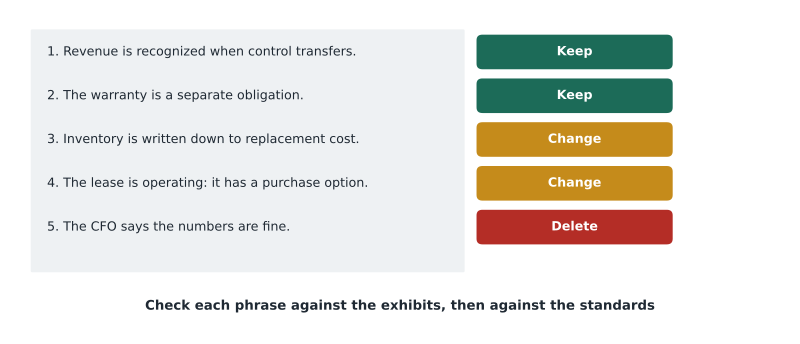
Document review simulations are common in AUD and increasingly in other sections. The document is a draft with several highlighted phrases, and for each you choose whether to keep the original text or replace it with one of several alternatives, or delete it. The key is to compare each phrase with the exhibits and the standards: is the statement true, complete and appropriate for this document? The program below scores one candidate's responses to a short document review of a revenue and lease memo for Tamarind Bay. Each of the five items is scored separately, which is why partial credit matters.
# A document-review TBS: flag each sentence of a draft memo as keep, change or delete.
memo = [
    ("Revenue is recognized when control transfers to the customer.", "keep"),
    ("The warranty is a separate performance obligation because customers can buy it separately.", "keep"),
    ("Inventory is written down to replacement cost.", "change"),
    ("The lease is classified as operating because the lessee has a purchase option.", "change"),
    ("The CFO says the numbers are fine.", "delete"),
]
answers = ["keep", "keep", "change", "keep", "delete"]     # one candidate's responses
score = sum(a == k for (_, k), a in zip(memo, answers))
for (s, k), a in zip(memo, answers):
    print(f"{'ok ' if a == k else 'XX '} {k:7} {s}")
print(f"\n{score} of {len(memo)} correct; each item is scored separately, so partial credit counts")ok keep Revenue is recognized when control transfers to the customer. ok keep The warranty is a separate performance obligation because customers can buy it separately. ok change Inventory is written down to replacement cost. XX change The lease is classified as operating because the lessee has a purchase option. ok delete The CFO says the numbers are fine. 4 of 5 correct; each item is scored separately, so partial credit counts
The candidate kept the lease sentence, but it should have been changed: a purchase option does not make a lease an operating lease; under ASC 842 a purchase option the lessee is reasonably certain to exercise is one of the criteria for a finance lease. The candidate also correctly changed the inventory sentence, because inventory measured at FIFO is written down to net realizable value, not replacement cost, and deleted the irrelevant sentence about the CFO's opinion. Four of five correct is a good result on a document review, and the miss is a typical one: a sentence that sounds plausible but reverses a rule. Read every highlighted phrase as if it might be wrong.
Research tasks
A research task asks you to find the paragraph in the authoritative literature that answers a question, and enter its citation. In FAR and BAR the literature is the FASB Accounting Standards Codification; in AUD it is the AICPA's professional standards and the PCAOB's standards; in REG and TCP it is the Internal Revenue Code. You do not need to memorize citations, but you need to know how each source is organized so that you can search efficiently. The Codification is organized by topic, subtopic, section and paragraph: topic 842 is leases, subtopic 20 is lessee, section 25 is recognition, and so on. The auditing standards are organized by AU-C section number, such as AU-C 705 for modified opinions. The Code is organized by section number, such as section 1031 for like-kind exchanges.
Search with precise terms. If the question asks when a lessee should classify a lease as a finance lease, search for 'finance lease' and 'classification' within topic 842 rather than for 'lease'. Read the paragraph you find to confirm that it answers the question, not a related one; research tasks often have a nearby paragraph that addresses a different point. Enter the citation in the format requested. A research task is usually worth the same as any other simulation, and a candidate who knows how the literature is organized can often finish one in five minutes, which saves time for harder simulations.
Worked problem
A research task in FAR
Copperline Outdoor Gear Inc. wants to know where US GAAP specifies the criteria for classifying a lease as a finance lease from the lessee's perspective.
Show solution
- The topic is leases, which is topic 842.
- The question concerns the lessee, so subtopic 20 is likely, but classification criteria may be in subtopic 10 (overall), which applies to both lessees and lessors.
- Search within 842 for "classification" and "finance lease"; read the paragraph listing the five criteria.
- Confirm that the paragraph gives the criteria, not the measurement, and enter its citation.
Answer: The criteria are found in the classification section of topic 842's overall subtopic; confirm the exact paragraph in the Codification during the exam.
Numeric and journal entry simulations
Numeric simulations reward organization. Set up a small schedule in the spreadsheet tool with labeled rows, compute step by step and transfer the results. Check signs: a decrease in a liability, a loss or a refund may need to be entered as a negative number depending on the instructions. Check units: if the response area says 'in thousands', enter 1,250 rather than 1,250,000. Journal entry simulations ask you to choose account titles from a list; read the titles carefully, because similar titles such as 'right-of-use asset' and 'lease liability' are easy to swap, and make sure debits equal credits.
Simulations often build on earlier cells. A lease simulation may ask for the initial liability, then the interest for the first year, then the carrying amount at year end; an error in the first cell carries through. Spend your care where it matters most: get the first number right, then the rest follows. If you are unsure of the first number, make your best estimate and continue: a completed cell has a chance of being correct, while a blank has none, and some later cells may not depend on the first one at all.
What simulations look like in each section
Each section has its typical simulations. In FAR, expect numeric and journal entry tasks on leases, revenue, income taxes, bonds, the statement of cash flows and governmental reconciliations, and at least one research task in the Codification. In AUD, expect document reviews of audit reports, engagement letters and audit programs, option lists that match procedures to assertions, sampling evaluations and research in the auditing standards; few AUD simulations require lengthy calculations. In REG, expect computations of taxable income, basis, gain and character for individuals and entities, option lists on business law and procedures, and research in the Code. In the disciplines, BAR adds financial analysis and complex accounting computations, ISC adds scenario-based tasks on controls, data and SOC reports, and TCP adds multi-step planning comparisons. Knowing what to expect helps you plan: a REG candidate should be fast with the spreadsheet tool, while an AUD candidate should be fast at reading documents critically.
Practicing simulations
Practice simulations in exam conditions: timed, using the exam's tools and without notes. After each, review not just whether you were right but how long you took and what slowed you down. Many candidates find that their main problem is not knowledge but process: reading exhibits before the requirement, recomputing numbers already given, or getting stuck on one cell. Keep a log of these process errors as well as content errors, and work on both. The AICPA releases sample tests that show the exam interface and formats; use them to become familiar with the tools before exam day.
Common mistakes
MistakeReading exhibits before the requirement.
InsteadRead the requirement and look at the response area first.
MistakeLeaving cells blank when short of time.
InsteadEach cell is scored separately; make a best attempt at every one.
MistakeAccepting plausible-sounding phrases in a document review.
InsteadCheck each phrase against the exhibits and the standards; look for reversed rules.
MistakeSearching the literature with broad terms.
InsteadIdentify the topic and use precise terms; confirm the paragraph answers the question.
MistakeEntering amounts in the wrong units or with the wrong sign.
InsteadCheck the instructions for units and signs before entering.
MistakeRecomputing amounts given in the exhibits.
InsteadUse given amounts; spend time on what the requirement asks.
Summary and key terms
- Simulations are half the score in core sections and use numeric, option list, journal entry, document review and research formats.
- Read the requirement and response area first, scan then read the exhibits, work quick parts first, check against the requirement and leave nothing blank.
- Distractors are common; confirm your answer does not depend on irrelevant facts.
- In document reviews, test every highlighted phrase against the exhibits and the standards.
- Research tasks reward knowing how the Codification, the auditing standards and the Code are organized.
- Numeric and journal entry tasks reward organized schedules and checks of signs, units and dates.
- Practice in exam conditions and log process errors as well as content errors.
- Task-based simulation
- An exam item presenting a realistic case with exhibits and several scored responses.
- Document review simulation
- A simulation in which the candidate evaluates highlighted phrases in a draft document.
- Research task
- A simulation requiring a citation from the authoritative literature.
- Accounting Standards Codification
- The FASB's single source of authoritative nongovernmental US GAAP, organized by topic, subtopic, section and paragraph.
- Distractor
- Information in a question that does not affect the answer.
- Exhibit
- A document provided in a simulation, such as a contract, memo or trial balance.
Practice problems
Work each problem on paper first, then reveal the answer to check.
What should you look at before reading a simulation's exhibits?
Show answer
The requirement and the response area.
Why should you never leave a simulation cell blank?
Show answer
Each cell is scored separately, and a blank cannot earn credit.
Rerun the document review program with the candidate's lease answer changed to 'change'. What is the score?
Show answer
Five of five.
Why was the lease sentence wrong?
Show answer
A purchase option reasonably certain to be exercised is a finance lease criterion; it does not make a lease operating.
How is the Codification organized?
Show answer
By topic, subtopic, section and paragraph.
Which source would you search for a like-kind exchange question in REG?
Show answer
The Internal Revenue Code, section 1031.
A simulation says 'enter amounts in thousands'. You computed 1,250,000. What do you enter?
Show answer
1,250.
What is a common process error in simulations?
Show answer
Reading exhibits before the requirement, recomputing given amounts or getting stuck on one cell.
How can you prepare for the exam interface?
Show answer
Use the AICPA's sample tests to practice with the tools and formats.
In a lease simulation, why does the first cell deserve extra care?
Show answer
Later cells, such as interest and carrying amount, depend on the initial liability.
Lesson quiz · 5 questions
Score 60% or more to complete this lesson.
Create a free account to save your progress, take quizzes and earn a certificate.