
ACCT-480 · Lesson 1 of 12 · 27 min
How the CPA Exam works under CPA Evolution
This is the last course in the accounting program, and it is built for a specific goal: passing the Uniform CPA Examination and handling the integrated problems that newly licensed CPAs meet in practice. Earlier courses taught one area at a time: financial reporting in ACCT-211, ACCT-212, ACCT-311 and ACCT-470, governmental and not-for-profit accounting in ACCT-412, managerial accounting in ACCT-222, ACCT-321 and ACCT-421, audit in ACCT-331 and ACCT-431, tax in ACCT-351 and ACCT-352. This course does not reteach those subjects. It reorganizes them around the exam's blueprints, shows you how the exam tests them and gives you practice in the formats you will see, then ends with integrated cases that cut across sections the way real engagements do.
The course reuses the invented companies from earlier courses: Tamarind Bay Foods from ACCT-470, the City of Aspen Ridge and Riverbend Community Pantry from ACCT-412, Tamarack Foods Group from ACCT-431 and the Brandt family from ACCT-351 and ACCT-352. A new company, Copperline Outdoor Gear Inc., based in Chattanooga, Tennessee, appears in the integrated cases near the end. Every company, person and figure is invented.
A note on independence. This is an independent course. It does not reproduce released questions, licensed review materials or the authoritative literature; every question here is original. Exam rules, blueprints and licensing requirements change, and this lesson reflects published information checked in October 2026. Always confirm current rules with NASBA and your state board before you rely on them.
The CPA Evolution model
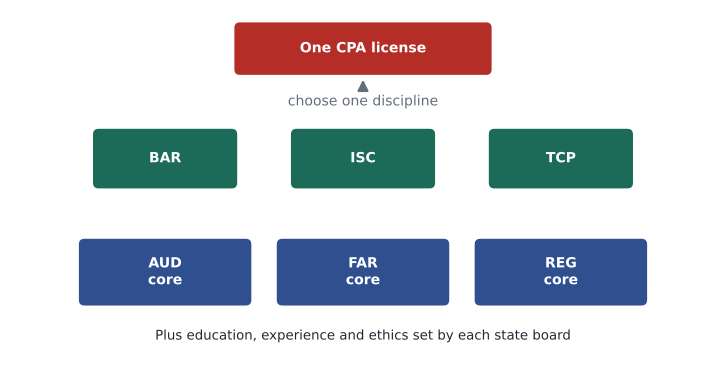
Since January 2024, the exam has followed the CPA Evolution model developed by the AICPA and NASBA. Every candidate takes three core sections and one discipline section of their choice. The core sections are Auditing and Attestation (AUD), Financial Accounting and Reporting (FAR), and Taxation and Regulation (REG). The disciplines are Business Analysis and Reporting (BAR), Information Systems and Controls (ISC), and Tax Compliance and Planning (TCP). Each section is four hours long, for sixteen hours in total. Passing all four sections, with any one discipline, leads to the same license; the discipline you choose does not limit the work you may do afterward. The old Business Environment and Concepts (BEC) section, and the written communication tasks it contained, were retired at the end of 2023.
The model reflects a view about what newly licensed CPAs need: a strong common core in accounting, audit and tax, plus deeper knowledge in one area where practice is changing quickly. BAR deepens financial reporting and adds data analytics and managerial topics; ISC covers information systems, security, and SOC engagements; TCP deepens individual and entity tax planning. Lesson 9 discusses how to choose.
| Section | Type | Length | Main content |
|---|---|---|---|
| AUD | Core | 4 hours | Ethics and independence, risk assessment, procedures, reports, attestation |
| FAR | Core | 4 hours | Financial reporting, select accounts and transactions, governmental and not-for-profit |
| REG | Core | 4 hours | Ethics and tax procedures, business law, federal taxation of individuals, entities and property |
| BAR | Discipline | 4 hours | Business analysis, technical accounting, state and local government |
| ISC | Discipline | 4 hours | Information systems and data management, security and privacy, SOC engagements |
| TCP | Discipline | 4 hours | Individual and entity tax compliance and planning, property transactions |
Question formats and scoring
Each section has five testlets. The first two contain multiple-choice questions (MCQs); the last three contain task-based simulations (TBSs), which present a realistic situation with exhibits and ask you to complete a schedule, fill in a journal entry, choose options from lists, review a document or research the authoritative literature. Under the 2024 blueprints, the core sections contain 50 MCQs and 7 TBSs in FAR, 78 MCQs and 7 TBSs in AUD, and 72 MCQs and 8 TBSs in REG, and MCQs and TBSs are each weighted 50 percent of the score. These counts are worth confirming on the current blueprint, because the AICPA adjusts them. Some questions in each section are pretest items that do not count toward your score, and you cannot tell which ones they are.
Scores are reported on a scale of 0 to 99, and 75 is the passing score in every section. The score is not a percentage of questions answered correctly. The exam uses item response theory: the MCQ testlets are multistage, so a candidate who does well on the first testlet receives a more difficult second testlet, and harder questions carry more weight. The practical lessons are that you should not try to estimate your score during the exam, and that a second testlet that feels hard is usually good news.
The AICPA updates the blueprints regularly. Blueprint updates took effect on January 1, 2026, clarifying tasks and references across sections without changing the format. Tax law changes become testable on a published schedule; for example, the provisions of the 2025 federal tax act became testable in REG and TCP from July 1, 2026. Before you start studying a section, download its current blueprint from the AICPA and check the testable dates for recent legislation and standards.
Scheduling, score release and continuous testing
The core sections are offered year-round on a continuous testing basis, so you can sit for them whenever a testing center has space. The discipline sections are offered only in the first month of each calendar quarter, January, April, July and October, because candidates are scored together after each window. Core scores are released on a rolling schedule of target dates; discipline scores take about six to seven weeks after the window closes. For 2026 the published target release dates for the discipline windows were March 13, June 16, September 11 and December 15. These are targets and can change.
Continuous testing means there is no longer a blackout period between attempts. After receiving a failing score you may apply to retake the section, but you need a new notice to schedule (NTS) for each attempt, and NASBA's candidate guide published in September 2026 says you must wait at least 72 hours after your score is released before you re-register for the same section. The cost and the effort of each attempt are real, so the practical advice is to schedule a retake while the material is fresh but only after you have diagnosed what went wrong.
The credit window
Passing a section gives you credit that lasts for a limited time, called the credit window, within which you must pass the other sections. The rules are set by each state board. In April 2023 NASBA's model rules adopted a 30-month window measured from the date the score is released, and many boards have adopted it. Some boards still use an 18-month window, which may be measured from the exam date, and at least one uses a different period. Because the starting point and the length both vary, the safe practice is to read your own board's rule and track every passed section's expiry date. The program below does that for a candidate who passed FAR, AUD and TCP in 2026.
# Credit window tracker: how long each passed section stays valid.
# Many boards now use 30 months from the score release date (NASBA model rule,
# April 2023); some still use 18 months from the exam date. Check your board.
from datetime import date
def add_months(d, m):
    y, mo = divmod(d.month - 1 + m, 12)
    day = min(d.day, [31, 29 if (d.year + y) % 4 == 0 else 28, 31, 30, 31, 30, 31, 31, 30, 31, 30, 31][mo])
    return date(d.year + y, mo + 1, day)
passed = [("FAR", date(2026, 2, 10)), ("AUD", date(2026, 6, 16)), ("TCP", date(2026, 9, 11))]
today = date(2026, 11, 1)
print(f"{'Section':8}{'Score released':>16}{'Expires (30 mo)':>17}{'Months left':>13}")
for sec, rel in passed:
    exp = add_months(rel, 30)
    left = (exp.year - today.year) * 12 + (exp.month - today.month)
    print(f"{sec:8}{rel.isoformat():>16}{exp.isoformat():>17}{left:>13}")
first = min(add_months(r, 30) for _, r in passed)
print()
print("REG must be passed and its score released by", first.isoformat())
print("Under an 18-month rule the FAR credit would lapse around", add_months(date(2026, 1, 20), 18).isoformat())Section Score released Expires (30 mo) Months left FAR 2026-02-10 2028-08-10 21 AUD 2026-06-16 2028-12-16 25 TCP 2026-09-11 2029-03-11 28 REG must be passed and its score released by 2028-08-10 Under an 18-month rule the FAR credit would lapse around 2027-07-20
The earliest expiry controls the plan. If FAR's credit lapses in August 2028, REG must be passed, and its score released, before then; otherwise the candidate must retake FAR. Under an 18-month rule measured from the exam date, the same FAR credit would lapse in July 2027, a full year earlier. That single difference changes how much risk the candidate can take with REG, which is why you should confirm your board's rule before you plan.
Licensure: the three Es
Passing the exam is one of three requirements for a CPA license, often called the three Es: education, examination and experience. Most states also require an ethics examination or course. Licensing is a state matter, and the requirements are changing. For decades almost every state required 150 semester hours of education. In 2025 the AICPA and NASBA approved changes to the model Uniform Accountancy Act that add a pathway based on a bachelor's degree, usually 120 hours, plus two years of experience, alongside the 150-hour pathway with one year. The model also moves interstate mobility from a state-based substantial equivalency test toward an individual practice privilege. According to a September 2026 summary of state legislation, 42 states had enacted a 120-hour pathway as of August 2026, and eight of them had effective dates still to come. Check your own state's law, its effective date and its experience rules.
Experience requirements also vary: whether the work must be supervised by a licensed CPA, whether industry and government experience count, and how hours are measured. Education rules vary in how many accounting credits are needed and whether you may sit for the exam before you finish your degree. Many states allow candidates to sit with 120 hours. Plan your exam timing around these rules, not around a friend's experience in another state.
Studying for the exam is a project
Treat the exam as a project with a scope, a schedule and resources. The scope is the blueprint. The schedule is set by your credit window, testing windows for the discipline and your work commitments; most candidates plan two to three months of study per section, more for FAR. The resources are a review course, practice questions, the blueprint and your own notes from this program. Lesson 2 builds a study plan and a time budget for exam day, and lessons 3 to 10 work through the sections. Lessons 11 and 12 bring the sections together in integrated cases and a final practice set.
Worked problem
Choosing a section order
Maya Okafor works in audit at a regional firm. She plans to start in January 2027 and wants to finish within her board's 30-month window. She is choosing between starting with FAR, AUD or her discipline.
Show solution
- FAR is the broadest section and supports AUD and BAR; many candidates take it first while their coursework is recent.
- AUD is closest to her daily work, which makes it a good confidence builder, but its content is easier to learn once FAR is done.
- Her discipline can only be taken in January, April, July or October, so it should be placed in a testing window that fits around the core sections.
- A sensible plan is FAR in March, AUD in June, the discipline in October and REG in early 2028, leaving a cushion for one retake within the window.
Answer: FAR first, then AUD, then the discipline in a quarterly window, then REG, with time for one retake.
Common mistakes
MistakeTreating 75 as 75 percent correct.
InsteadThe score is a scaled score from 0 to 99 based on item response theory; 75 is the passing score, not a percentage.
MistakeAssuming the credit window is the same everywhere.
InsteadBoards set the window; many use 30 months from score release, others 18 months or a different period.
MistakeScheduling a discipline section in any month.
InsteadDisciplines are offered only in January, April, July and October.
MistakeStudying from an old outline.
InsteadUse the current blueprint and check testable dates for new standards and tax law.
MistakeAssuming the 150-hour rule still applies everywhere.
InsteadMost states have adopted or are adopting a 120-hour pathway with two years of experience; check your state.
MistakeThinking the discipline limits your practice.
InsteadAll three disciplines lead to the same license.
Summary and key terms
- Under CPA Evolution, candidates take three core sections, AUD, FAR and REG, and one discipline, BAR, ISC or TCP; each section is four hours.
- Each section has two MCQ testlets and three TBS testlets; MCQs and TBSs are weighted equally in the core sections.
- Scores range from 0 to 99 and 75 passes; scoring uses item response theory, not a percentage of correct answers.
- Core sections are offered year-round; disciplines only in the first month of each quarter, with later score release.
- Credit windows are set by state boards; many now allow 30 months from score release.
- Licensure requires education, examination and experience, and most states have adopted a 120-hour pathway with two years of experience alongside the 150-hour rule.
- Blueprints, testable dates and rules change; check the AICPA, NASBA and your state board before you plan.
- CPA Evolution
- The licensure model in effect since 2024: three core sections plus one discipline.
- Core section
- AUD, FAR or REG, which every candidate must pass.
- Discipline section
- BAR, ISC or TCP, of which each candidate chooses one.
- Task-based simulation (TBS)
- An exam question based on a realistic case with exhibits, requiring a schedule, entries, a document review or research.
- Testlet
- A group of questions presented together; each section has five.
- Credit window
- The period during which a passed section remains valid while the candidate passes the others.
- notice to schedule (NTS)
- The authorization a candidate needs before booking a section with the testing provider.
- Uniform Accountancy Act (UAA)
- Model licensing legislation developed by the AICPA and NASBA for states to adapt.
Practice problems
Work each problem on paper first, then reveal the answer to check.
Name the three core sections and the three disciplines.
Show answer
Core: AUD, FAR, REG. Disciplines: BAR, ISC, TCP.
Why might a hard second MCQ testlet be good news?
Show answer
The second testlet's difficulty depends on performance in the first; a harder one suggests you did well.
When can you sit for a discipline section?
Show answer
Only in the first month of each calendar quarter: January, April, July or October.
Rerun the credit-window program with AUD released on 2027-01-12 instead. Does the REG deadline change?
Show answer
No. FAR still expires first, in August 2028, so the deadline is unchanged.
What are the three Es of licensure?
Show answer
Education, examination and experience; most states also require ethics.
What did the 2025 change to the model Uniform Accountancy Act add?
Show answer
A pathway of a bachelor's degree plus two years of experience, alongside the 150-hour pathway, and an individual-based mobility approach.
A candidate passed FAR with a score of 74. What should they do first?
Show answer
Diagnose weak areas from the score report and practice data, then schedule a retake after the required wait, while the material is fresh.
Why should you check testable dates for tax law?
Show answer
New provisions become testable on announced dates; the 2025 tax act was testable in REG and TCP from July 1, 2026.
Explain to a friend in one paragraph why 'any discipline gives the same license' matters.
Show answer
Because the choice can be made on interest and strength rather than fear of limiting a career; the license is the same and work can change later.
What is the risk of following another candidate's study plan from a different state?
Show answer
Credit windows, education rules and experience requirements differ by state, so the timing may not work under your board's rules.
Lesson quiz · 5 questions
Score 60% or more to complete this lesson.
Create a free account to save your progress, take quizzes and earn a certificate.