
ACCT-412 · Lesson 9 of 12 · 23 min
Not-for-profit organizations I: ASNPO and contributions
We now turn from governments to private sector not-for-profit organizations. Canada has more than 85,000 registered charities and many more non-profit organizations that are not registered, from food banks and arts groups to sports associations and private schools. Most prepare statements under ASNPO, Part III of the CPA Canada Handbook, which combines the not-for-profit sections in the 4400 series with the Part II standards for private enterprises (ASPE) for matters they do not address. This lesson covers the defining issue of not-for-profit accounting, contributions, and the two methods ASNPO allows for restricted contributions, using Riverbend Community Pantry's 2027 transactions.
What a contribution is
Section 4410 Contributions: Revenue Recognition defines a contribution as a non-reciprocal transfer to a not-for-profit organization of cash or other assets, or a non-reciprocal settlement or cancellation of its liabilities. Government funding is a contribution under ASNPO, unlike under PSAS, where it is a government transfer to a government. Contributions are classified as restricted, when externally imposed stipulations specify the purpose for which they must be used, or unrestricted. Endowment contributions are a special kind of restricted contribution that must be maintained permanently. Restrictions imposed by the board, called internal restrictions, do not make a contribution restricted; they are allocations of net assets.
Contributions receivable are recognized if the amount can be reasonably estimated and ultimate collection is reasonably assured; pledges are often not recognized until received because collection is not assured. Contributed materials and services may be recognized at fair value, as an accounting policy choice, but only when fair value can be reasonably estimated and when they are used in the normal course of operations and would otherwise have been purchased. Many organizations do not recognize volunteer services at all because they would not otherwise be purchased. Food banks differ in practice; Riverbend recognizes donated food at estimated fair value because it buys food when donations fall short and its funders want to see the full scale of its operations.
Two methods for restricted contributions
ASNPO allows a choice of two methods for restricted contributions, and the choice shapes the statements. Under the deferral method, restricted contributions are recognized as revenue in the period in which the related expenses are incurred. Restricted contributions for future expenses are deferred contributions, a liability; contributions for the purchase of capital assets that will be amortized are deferred and recognized as revenue at the same rate as the amortization; and endowment contributions are recognized as direct increases in net assets, never as revenue. Unrestricted contributions are revenue when received or receivable.
Under the restricted fund method, an organization reports a general fund and one or more restricted funds, and endowment funds, on the face of its statements, usually in columns. Restricted contributions for which a corresponding restricted fund is presented are recognized as revenue of that fund when received or receivable; restricted contributions for which no restricted fund is presented are recognized in the general fund using the deferral method. Endowment contributions are revenue of the endowment fund. The method shows clearly which resources are restricted, but the total excess of revenue over expenses can be hard to interpret because it includes restricted resources not yet used.
# Riverbend Community Pantry (invented registered charity), year ended
# 31 December 2027: the same contributions under the deferral method and the
# restricted fund method of ASNPO Section 4410 (thousands of dollars).
unrestricted_donations = 1_200
donated_food = 2_400                 # contributed materials, fair value
breakfast_grant, breakfast_spent = 250, 210   # restricted for a school breakfast program
truck_grant, truck_life = 184, 8     # restricted for a refrigerated truck bought 1 January
endowment_gift = 100                 # to be held permanently
endowment_income = 4                 # restricted for programs, not yet spent
expenses = 2_400 + 950 + 180 + 140 + truck_grant / truck_life   # food, programs, fundraising, admin, amortization

# Deferral method: restricted contributions match the related expenses
deferral_rev = (unrestricted_donations + donated_food + breakfast_spent
                + truck_grant / truck_life)
print("DEFERRAL METHOD")
print(f"  Revenue {deferral_rev:,.0f}  Expenses {expenses:,.0f}  Excess {deferral_rev - expenses:,.0f}")
print(f"  Deferred contributions: breakfast {breakfast_grant - breakfast_spent}, endowment income {endowment_income}, "
      f"capital {truck_grant - truck_grant / truck_life:.0f}")
print(f"  Endowment gift {endowment_gift} goes directly to net assets")

# Restricted fund method: restricted contributions are revenue of the restricted fund
general = unrestricted_donations + donated_food - (2_400 + 950 + 180 + 140 - breakfast_spent)
restricted = breakfast_grant - breakfast_spent
capital_fund = truck_grant - truck_grant / truck_life
endow_fund = endowment_gift + endowment_income
print("\nRESTRICTED FUND METHOD (excess of revenue over expenses by fund)")
for k, v in (("General fund", general), ("Restricted program fund", restricted),
             ("Capital asset fund", capital_fund), ("Endowment fund", endow_fund)):
    print(f"  {k:26}{v:>7,.0f}")
print(f" {'Total':26}{general + restricted + capital_fund + endow_fund:>7,.0f}")DEFERRAL METHOD Revenue 3,833 Expenses 3,693 Excess 140 Deferred contributions: breakfast 40, endowment income 4, capital 161 Endowment gift 100 goes directly to net assets RESTRICTED FUND METHOD (excess of revenue over expenses by fund) General fund 140 Restricted program fund 40 Capital asset fund 161 Endowment fund 104 Total 445
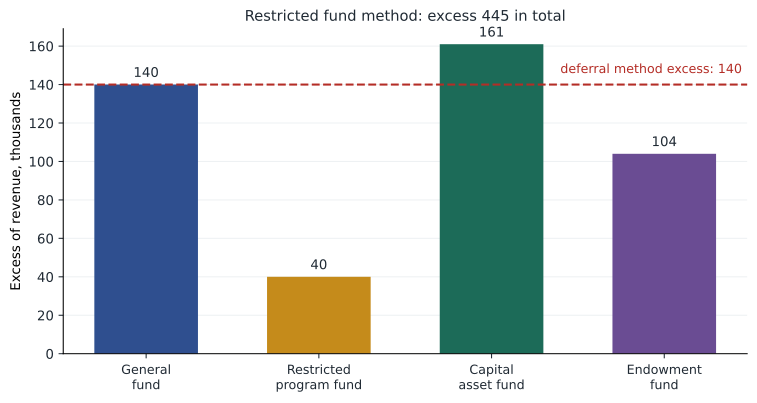
The program applies both methods to Riverbend's 2027 contributions: $1.2 million of unrestricted donations, $2.4 million of donated food, a $250,000 provincial grant restricted to the school breakfast program of which $210,000 was spent, a $184,000 grant restricted to a refrigerated truck amortized over eight years, a $100,000 endowment gift and $4,000 of endowment income restricted to programs and not yet spent. Under the deferral method, revenue is $3,833,000 and expenses $3,693,000, an excess of $140,000; $205,000 of restricted contributions are deferred, and the endowment gift goes directly to net assets. Under the restricted fund method, all restricted inflows are revenue of their funds, and the excess totals $445,000: $140,000 in the general fund, $40,000 in the restricted program fund, $161,000 in the capital asset fund and $104,000 in the endowment fund.
Comparing the methods
The difference of $205,000 between the two totals is exactly the restricted contributions deferred under the deferral method: $40,000 for the breakfast program, $4,000 of endowment income and $161,000 for the truck. The general fund result is $140,000 under both methods, because unrestricted resources are treated the same way. Which method is better? The deferral method matches restricted revenue with the expenses it pays for, so the statement of operations shows whether the organization covered its costs; it is simpler for organizations with few restricted contributions. The restricted fund method shows restricted and unrestricted activity separately, which suits organizations with large endowments or many restricted programs, but it requires fund-by-fund presentation and its total is less meaningful. An organization may also present funds under the deferral method, for example internally restricted funds, as long as it presents the required information.
The AcSB has studied changes to the contribution standards for years. A 2023 exposure draft proposed replacing the choice between the two methods with a single approach, but after reviewing feedback the board changed direction and is now exploring ways to improve both existing methods: clarifying key definitions, improving the accounting for special types of contributions and enhancing presentation and disclosure. Field testing took place in 2025, and the timing of a new exposure draft has not been set. A narrow amendment to Section 4410, effective in 2026, addresses contributions of life insurance policies with a cash surrender value, which are measured at that value when the organization becomes both owner and beneficiary.
| Item | Deferral method | Restricted fund method |
|---|---|---|
| Unrestricted donations | Revenue when received | General fund revenue when received |
| Restricted for future expenses | Deferred; revenue as expenses are incurred | Revenue of the restricted fund when received |
| Restricted for amortizable capital assets | Deferred; revenue at the amortization rate | Revenue of the capital fund when received |
| Endowment contributions | Direct increase in net assets | Revenue of the endowment fund |
| Restricted, no matching fund presented | Deferral method | Deferral method in the general fund |
Pledges, bequests and multi-year grants
Timing questions are common. A pledge is a promise to give; ASNPO requires a contribution receivable only if the amount can be reasonably estimated and ultimate collection is reasonably assured, and because pledges to charities are generally not legally enforceable, most organizations recognize them only when received, disclosing significant outstanding pledges. Bequests are recognized when the estate's executor confirms the amount and collection is reasonably assured, which may be long after the donor's death. Multi-year grants from governments and foundations are recognized as each year's funding becomes receivable and, under the deferral method, matched with the related expenses. Riverbend received a three-year commitment from a regional foundation in late 2027 for $60,000 a year starting in 2028; it recognizes nothing in 2027 and discloses the commitment.
Contributions in kind other than food also need judgment. Riverbend receives donated warehouse shelving worth about $15,000 and free use of office space from a church. The shelving is a contributed capital asset that may be recognized at fair value, as an accounting policy choice, if fair value can be reasonably estimated; under the deferral method, it is recognized with a deferred capital contribution amortized over its life. The free office space is a contributed service that Riverbend would otherwise have purchased; it may choose to recognize it, but like most charities it does not, and it discloses the arrangement. Consistency matters: once a policy is chosen, it should be applied to similar items in each period.
Contributions also bring obligations to donors beyond accounting. A charity that accepts a restricted gift must use it as the donor specified; if the purpose becomes impossible, it may need the donor's consent or a court order to vary the restriction. The accounting records, by tracking restricted contributions and their use, provide the evidence that the charity has honoured its commitments, which matters to donors, funders and, for registered charities, the CRA.
Disclosures about contributions complete the picture. Organizations disclose their method of accounting for contributions, the policy for contributed materials and services, the nature of restrictions on deferred contributions and net assets, and changes in deferred contribution balances during the year. Riverbend's note shows deferred contributions rising from nil to $205,000 in 2027 as the breakfast grant, endowment income and truck grant were received but not yet fully used.
Worked problem
Choosing a method
A community arts organization receives in 2027: $500,000 of unrestricted donations; a $300,000 three-year grant restricted to a youth program, of which $90,000 is spent in 2027; a $60,000 gift restricted to buying a kiln, bought in July and amortized over 10 years (half a year in 2027); and a $200,000 endowment gift. Expenses, including the kiln amortization, are $620,000. Compute the 2027 excess under the deferral method and the total excess under the restricted fund method.
Show solution
- Deferral method revenue: $500,000 + $90,000 (youth program spent) + $3,000 (kiln: $60,000 ÷ 10 × ½) = $593,000.
- Excess: $593,000 − $620,000 = a deficiency of $27,000; the $200,000 endowment gift increases net assets directly.
- Restricted fund method: general fund $500,000 − ($620,000 − $90,000 − $3,000) = −$27,000; restricted fund $300,000 − $90,000 = $210,000; capital fund $60,000 − $3,000 = $57,000; endowment fund $200,000.
- Total excess under the restricted fund method: $440,000.
- The deferral method shows that the organization did not cover its costs with unrestricted revenue, which the restricted fund total obscures.
Answer: Deferral method: deficiency $27,000; restricted fund method total excess $440,000.
Common mistakes
MistakeTreating board-designated funds as restricted contributions.
InsteadInternal restrictions are allocations of net assets, not external restrictions.
MistakeRecognizing an endowment gift as revenue under the deferral method.
InsteadEndowment contributions are direct increases in net assets.
MistakeRecognizing a capital grant as revenue when received under the deferral method.
InsteadIt is deferred and recognized at the amortization rate.
MistakeRecognizing volunteer hours as contributed services by default.
InsteadRecognize only by policy choice and when criteria are met.
MistakeRecognizing uncollectible pledges as receivables.
InsteadRecognize only when the amount is estimable and collection reasonably assured.
Summary and key terms
- ASNPO (Part III) applies to most private Canadian not-for-profits, with ASPE for other matters.
- A contribution is a non-reciprocal transfer; restrictions are external; internal restrictions are not.
- Contributed materials and services may be recognized by policy when criteria are met.
- Deferral method: restricted revenue matches expenses; capital at amortization rate; endowments to net assets.
- Restricted fund method: restricted contributions are revenue of their funds.
- The AcSB is improving both methods; a 2026 amendment covers life insurance contributions.
- Riverbend: deferral excess $140,000; restricted fund total $445,000.
- The $205,000 difference equals deferred restricted contributions.
- Restricted contribution
- A contribution subject to externally imposed stipulations on its use.
- Deferral method
- A method recognizing restricted contributions as revenue when the related expenses are incurred.
- Restricted fund method
- A method recognizing restricted contributions as revenue of the related restricted fund.
- Deferred contributions
- Restricted contributions received but not yet recognized as revenue under the deferral method.
- Internally restricted net assets
- Net assets allocated by the board for a purpose.
- Contributed materials
- Goods donated to the organization, which may be recognized at fair value by policy.
- Contribution
- A non-reciprocal transfer of assets to a not-for-profit organization, or cancellation of its liabilities.
- Endowment contribution
- A restricted contribution that must be maintained permanently, with only income available for use.
Practice problems
Work each problem on paper first, then reveal the answer to check.
Is a government grant to a charity a contribution under ASNPO?
Show answer
Yes; government funding is a contribution under Section 4410.
Under the deferral method, how is a capital contribution for an amortizable asset recognized?
Show answer
Deferred and recognized as revenue at the same rate as the amortization of the asset.
In the program, what is the deferral method excess?
Show answer
$140,000.
Why does the restricted fund total exceed the deferral total by $205,000?
Show answer
Restricted contributions of $205,000 are revenue of restricted funds under one method and deferred under the other.
When can contributed materials be recognized?
Show answer
By policy choice, when fair value can be reasonably estimated and they are used in normal operations and would otherwise have been purchased.
What is the status of the AcSB's contributions project?
Show answer
It is exploring improvements to both methods after field testing in 2025; no exposure draft date is set.
How is an endowment gift reported under the restricted fund method?
Show answer
As revenue of the endowment fund.
Are internally restricted net assets restricted contributions?
Show answer
No; they are board allocations of unrestricted resources.
Lesson quiz · 5 questions
Score 60% or more to complete this lesson.
Create a free account to save your progress, take quizzes and earn a certificate.