
ACCT-412 · Lesson 3 of 12 · 23 min
Financial statement presentation under PS 1202
PS 1202 Financial Statement Presentation is PSAB's new reporting model. It builds on PS 1201, which it replaces, and applies to fiscal years beginning on or after 1 April 2026; early adoption is allowed only if the revised conceptual framework is adopted at the same time, and prior-year figures must be restated to the new presentation. For Aspen Ridge, with a calendar year, the 2027 statements are the first under PS 1202, with restated 2026 comparatives. This lesson walks through the required statements, shows how Aspen Ridge's 2027 results appear in them, and explains what changed from the old model and why.
The statements required by PS 1202
A complete set of financial statements under PS 1202 consists of a statement of financial position; a statement of net financial assets or net financial liabilities; a statement of operations; a statement of changes in net assets or net liabilities; a statement of cash flow; and notes and schedules. The statement of change in net debt that governments presented under PS 1201 is removed, and the statement of remeasurement gains and losses is absorbed into the new statement of changes in net assets, which reconciles each component of net assets from the opening to the closing balance.
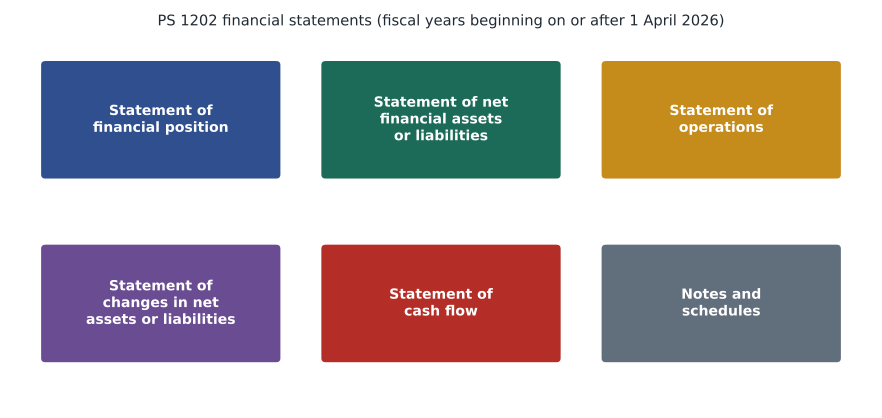
The statement of financial position reports assets, liabilities and net assets. Its layout has been restructured: assets are presented as financial and non-financial, liabilities are classified as financial or non-financial, and net assets are shown with their three components. The statement of net financial assets or net financial liabilities then computes the indicator from financial assets and financial liabilities only. PS 1202 allows an entity to present the indicator at the bottom of the statement of financial position as well, with a cross-reference, but the separate statement is required.
The statement of operations reports revenues by source and expenses by function or major program, the annual surplus or deficit, and the comparison with the original budget, which the standard requires to be presented on the same basis and with the same classifications as actual results. The statement of cash flow is restructured to show cash from operating activities, capital activities and investing activities before financing, then financing activities separately, so users can see the net cash available or the cash deficiency before financing.
Aspen Ridge's 2027 statements
The program builds the key parts of Aspen Ridge's first PS 1202 statements. The statement of operations shows revenue of $54.0 million against a budget of $52.8 million, expenses of $48.9 million against $50.2 million, and an annual surplus of $5.1 million against $2.6 million budgeted. The statement of changes in net assets shows the three components: accumulated surplus rises from $178.5 million to $183.6 million by the annual surplus, and accumulated remeasurements rise by $150,000 of unrealized gains on the city's equity fund units, giving net assets of $184.0 million. The last part analyses why net financial assets of $350,000 at the start of the year became net financial liabilities of $700,000.
# PS 1202 statements for the invented City of Aspen Ridge, Saskatchewan,
# year ended 31 December 2027 (thousands of dollars).
revenue = {"Property taxes": 31_200, "User fees and sales of services": 9_600,
           "Government transfers, operating": 4_100, "Government transfers, capital": 6_000,
           "Development levies": 1_200, "Investment income": 900, "Other": 1_000}
expenses = {"General government": 6_200, "Protective services": 11_400,
            "Transportation": 12_800, "Environmental and utility": 9_900,
            "Recreation and culture": 6_500, "Planning and development": 2_100}
budget = {"revenue": 52_800, "expenses": 50_200}

R, E = sum(revenue.values()), sum(expenses.values())
print("STATEMENT OF OPERATIONS               Budget    Actual")
print(f"Total revenue                        {budget['revenue']:>7,}  {R:>7,}")
print(f"Total expenses                       {budget['expenses']:>7,}  {E:>7,}")
surplus = R - E
print(f"Annual surplus                       {budget['revenue'] - budget['expenses']:>7,}  {surplus:>7,}")
print()
# Statement of changes in net assets: one column per component
opening = {"accumulated surplus": 178_500, "accumulated remeasurements": 250, "accumulated other": 0}
change = {"accumulated surplus": surplus, "accumulated remeasurements": 150, "accumulated other": 0}
print("STATEMENT OF CHANGES IN NET ASSETS    Opening  Change  Closing")
for k in opening:
    print(f"{k:36} {opening[k]:>7,} {change[k]:>7,} {opening[k] + change[k]:>8,}")
net_assets = sum(opening.values()) + sum(change.values())
print(f"{'Net assets':36} {sum(opening.values()):>7,} {sum(change.values()):>7,} {net_assets:>8,}")
print()
# Drivers of the change in net financial assets (liabilities)
drivers = [("Annual surplus", surplus), ("Acquisition of tangible capital assets", -14_300),
           ("Amortization", 7_600), ("Net book value of disposals", 300),
           ("Increase in inventories and prepaids", -100),
           ("Remeasurement gains", 150), ("Increase in non-financial liabilities", 200)]
delta = sum(v for _, v in drivers)
for k, v in drivers:
    print(f"{k:40} {v:>7,}")
print(f"{'Change in net financial assets':40} {delta:>7,}")
print(f"Opening net financial assets {350:,}; closing {350 + delta:,}")STATEMENT OF OPERATIONS Budget Actual Total revenue 52,800 54,000 Total expenses 50,200 48,900 Annual surplus 2,600 5,100 STATEMENT OF CHANGES IN NET ASSETS Opening Change Closing accumulated surplus 178,500 5,100 183,600 accumulated remeasurements 250 150 400 accumulated other 0 0 0 Net assets 178,750 5,250 184,000 Annual surplus 5,100 Acquisition of tangible capital assets -14,300 Amortization 7,600 Net book value of disposals 300 Increase in inventories and prepaids -100 Remeasurement gains 150 Increase in non-financial liabilities 200 Change in net financial assets -1,050 Opening net financial assets 350; closing -700
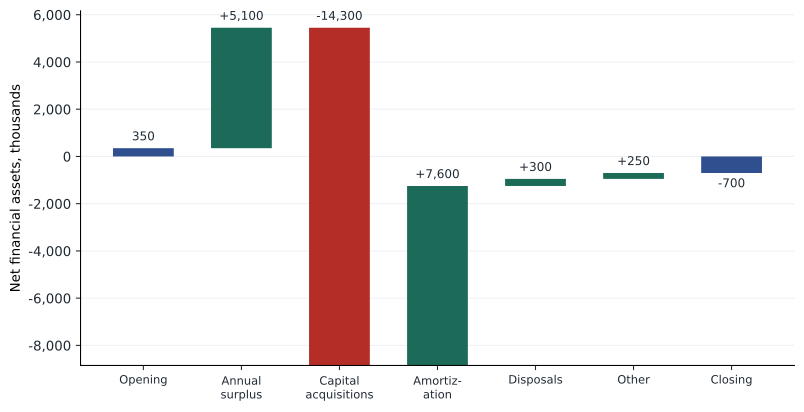
Reading the analysis, the capital program dominates: $14.3 million of acquisitions consumed financial resources, partly offset by the $5.1 million surplus, which includes the capital transfers, and by $7.6 million of amortization, an expense that does not use financial assets in the year. The $250,000 of other items combines the remeasurement gains, a small increase in inventories and prepaids, and the increase in non-financial liabilities. Under PS 1201 this analysis was a required statement; under PS 1202, users can rebuild it from the statements and notes, and many governments are expected to continue presenting it as a schedule.
What changed and why
PSAB's review of the reporting model, which began with a consultation paper in 2016, found that users struggled with the old presentation: the net debt indicator was not well understood, remeasurement gains and losses were in a separate statement that many governments rarely used, and the statement of change in net debt duplicated information. It also found inconsistent budget practices. The main changes respond to those findings:
- A new statement of net financial assets or liabilities computes the indicator from financial items only, replacing the statement of change in net debt.
- A new statement of changes in net assets reconciles accumulated surplus, accumulated remeasurements and the new accumulated other component.
- Liabilities are classified as financial or non-financial, and the statement of financial position is restructured.
- The statement of cash flow separates financing activities, showing cash available or deficient before financing.
- New budget requirements apply, including disclosure when a budget is not prepared or approved, and amended budgets are permitted only in limited circumstances, such as a change in governance.
| Statement | Purpose | Aspen Ridge 2027 |
|---|---|---|
| Statement of financial position | Assets, liabilities and net assets by component | Net assets $184.0 million |
| Statement of net financial assets or liabilities | Future revenue needed for past transactions | Net financial liabilities $0.7 million |
| Statement of operations | Cost of services and how financed; budget comparison | Annual surplus $5.1 million (budget $2.6 million) |
| Statement of changes in net assets | Reconciles each component of net assets | Increase $5.25 million |
| Statement of cash flow | Sources and uses of cash; financing separated | Capital spending $14.3 million; new debt $3.0 million |
Transition
Transition to PS 1202 requires work. Governments must decide how to classify each liability, identify any items that belong in accumulated other, update their budget documents so that the budget is prepared on a basis comparable with the statements, change financial statement templates and software, and restate the prior year. Consequential amendments touch other sections, including PS 1300 on the government reporting entity. Auditors will look closely at the first-year classification judgments, particularly the line between financial and non-financial liabilities, because it directly affects the headline indicator.
Reading the statements together
The PS 1202 statements are designed to be read together, each answering a different question. The statement of operations asks whether revenues covered the cost of services in the year. The statement of net financial assets or liabilities asks how much of the future's revenue is already committed. The statement of financial position shows what the government owns and owes, including its service capacity in tangible capital assets. The statement of changes in net assets explains movements that do not pass through the annual surplus. And the statement of cash flow shows how the capital program was financed. For Aspen Ridge, the story is consistent across the statements: a surplus driven by capital funding, a capital program that consumed financial resources, new borrowing of $3.0 million for the water plant, and a small decline in the city's financial cushion.
Analysts often go further and compute ratios from the statements, such as net financial liabilities as a share of revenue, debt charges as a share of revenue and the ratio of net book value to cost of tangible capital assets. Lesson 12 develops these indicators of financial condition. At this stage, notice that every one of them needs information from more than one statement, and several need notes, such as the debt schedule and the tangible capital asset schedule. Under PS 1202, the notes also explain the classification of liabilities as financial or non-financial, so an analyst who disagrees with a classification can recompute the indicator.
Comparatives also matter. Because PS 1202 requires prior-year figures to be restated to the new presentation, Aspen Ridge's 2027 statements show 2026 under the same structure, including a restated statement of net financial assets: net financial assets of $350,000 at the end of 2026 under the new definition, compared with the net debt of about $1.75 million that the city's 2026 statements originally reported. Users comparing the city's history must therefore be careful to use restated figures; ratios computed from older statements under PS 1201 are not directly comparable with those under PS 1202.
Finally, PS 1202 asks preparers to think about the order and wording of the statements from the user's point of view. Line items should be aggregated where detail would obscure the main messages and disaggregated where users need it, for example separating government transfers from taxes, and separating financial from non-financial liabilities. Subtotals should be clearly labelled and consistent from year to year. The board's intention is that a council member or resident can open the statements and quickly see the annual surplus, the net financial position and how net assets changed, with notes and schedules providing the detail analysts need.
Notes to the PS 1202 statements also change. Governments must describe the components of net assets, explain the classification of liabilities as financial or non-financial, describe any items recognized in accumulated other, and explain budget practices, including any amendment presented. Aspen Ridge's first-year notes include a transition note showing how each 2026 figure was restated, which is a useful bridge for readers familiar with the old statements.
Worked problem
Classifying a liability under PS 1202
Aspen Ridge has three items at 31 December 2027: (a) $480,000 received for annual recreation passes, of which $320,000 relates to 2028; (b) $500,000 of unspent capital transfer under an agreement that requires repayment if not spent on eligible projects by 2029; (c) a $250,000 developer deposit refundable in cash. How might each affect net financial liabilities?
Show solution
- (a) The $320,000 of deferred pass revenue will be settled by providing recreation services, so it is a non-financial liability; it does not increase net financial liabilities.
- (b) The unspent transfer is more difficult: the city expects to satisfy the obligation by delivering eligible projects, but the agreement requires repayment in cash if it does not. The city must use judgment and disclose its policy; the program assumes non-financial classification.
- (c) The deposit will be settled with cash and is a financial liability, increasing net financial liabilities.
- Classification does not change net assets, only the indicator.
- A government that classified all three as financial would report net financial liabilities about $820,000 higher.
Answer: (a) non-financial; (b) judgment, assumed non-financial; (c) financial.
Common mistakes
MistakePresenting a statement of change in net debt as a required statement under PS 1202.
InsteadIt is removed; the new statement of net financial assets or liabilities replaces it.
MistakeShowing remeasurement gains in a separate statement.
InsteadThey are now shown in the statement of changes in net assets.
MistakeComparing actual results with an amended budget without justification.
InsteadAmended budgets are permitted only in limited circumstances.
MistakeForgetting to restate comparatives on transition.
InsteadPrior-year figures must be restated to the PS 1202 presentation.
MistakeAssuming net financial liabilities measure solvency on their own.
InsteadRead them with debt charges, transfers dependence and capital needs.
Summary and key terms
- PS 1202 applies to fiscal years beginning on or after 1 April 2026 with restated comparatives.
- Six components: financial position, net financial assets or liabilities, operations, changes in net assets, cash flow, notes.
- The statement of change in net debt is removed.
- Net assets are reconciled by component in the statement of changes in net assets.
- The statement of operations compares results with the original budget.
- The cash flow statement shows cash available or deficient before financing.
- Aspen Ridge: surplus $5.1 million; net financial assets fell $1.05 million.
- Transition requires liability classification, budget and template changes.
- Statement of net financial assets or liabilities
- A PS 1202 statement computing financial assets minus financial liabilities.
- Statement of changes in net assets
- A PS 1202 statement reconciling each component of net assets.
- Annual surplus
- Revenue minus expenses for the year on the statement of operations.
- Original budget
- The budget first approved by the governing body for the year.
- Remeasurement gain or loss
- A change in the carrying amount of an item measured at fair value or a foreign currency item, before derecognition.
- Major program or function
- A significant area of service for which expenses and related revenues are reported.
Practice problems
Work each problem on paper first, then reveal the answer to check.
List the six components of a PS 1202 set of statements.
Show answer
Statement of financial position, statement of net financial assets or liabilities, statement of operations, statement of changes in net assets or liabilities, statement of cash flow, and notes and schedules.
Which old statement is removed?
Show answer
The statement of change in net debt.
In the program, what is Aspen Ridge's budget variance on expenses?
Show answer
Expenses were $1.3 million below the budget of $50.2 million.
How much did acquisitions of tangible capital assets reduce net financial assets?
Show answer
$14.3 million, before offsetting items.
When can a government early adopt PS 1202?
Show answer
Only if it adopts the revised conceptual framework at the same time.
Why might classification of deferred revenue matter to rating agencies?
Show answer
It changes the net financial liabilities indicator, a key measure of financial position.
What does the statement of cash flow now highlight?
Show answer
The net cash available or the cash deficiency before financing activities.
Which section on the reporting entity has consequential amendments?
Show answer
PS 1300, Government Reporting Entity.
Lesson quiz · 5 questions
Score 60% or more to complete this lesson.
Create a free account to save your progress, take quizzes and earn a certificate.