
ACCT-412 · Lesson 9 of 12 · 23 min
Not-for-profit organizations I: ASC 958, net assets and contributions
We now turn from governments to private not-for-profit organizations. The United States has about 1.5 million registered nonprofits, of which a large majority are section 501(c)(3) charities, from food pantries and arts groups to private universities and hospitals. They prepare statements under FASB ASC Topic 958, which applies to not-for-profit entities in addition to the other topics of the Codification. This lesson covers the defining issue of not-for-profit accounting, contributions, including the classification of net assets introduced by ASU 2016-14 and the guidance on conditional contributions in ASU 2018-08, using Riverbend Community Pantry's 2027 transactions.
Contributions and exchange transactions
ASC 958-605 defines a contribution as an unconditional transfer of cash or other assets, or a settlement or cancellation of liabilities, to an entity in a voluntary nonreciprocal transfer by another entity acting other than as an owner. ASU 2018-08 clarified how to distinguish contributions from exchange transactions: a transfer is an exchange if the resource provider receives commensurate value in return, and grants from governments are contributions unless the government receives direct benefit, such as goods or services it uses itself. The public benefit of a program does not count as commensurate value to the grantor. Exchange transactions are accounted for under ASC 606 or other topics.
ASU 2018-08 also clarified when a contribution is conditional. A contribution is conditional if the agreement contains both a barrier that must be overcome and either a right of return of assets transferred or a right of release from the obligation. Indicators of a barrier include a measurable performance-related barrier, such as a required level of service or matching funds; limited discretion over how to conduct the activity; and stipulations related to the purpose of the agreement. Conditional contributions are not recognized as revenue until the barrier is overcome; cash received in advance is a refundable advance, a liability. Unconditional contributions are recognized when received or promised, including promises to give (pledges), which are recognized at present value net of an allowance.
Net assets with and without donor restrictions
ASU 2016-14, effective since 2018 for most entities, simplified the presentation of net assets into two classes: net assets without donor restrictions and net assets with donor restrictions, replacing the former unrestricted, temporarily restricted and permanently restricted classes. Donor-restricted contributions are reported as increases in net assets with donor restrictions. When a restriction expires, because the time has passed or the purpose has been fulfilled, the organization reports a reclassification, net assets released from restrictions, which increases net assets without donor restrictions and decreases net assets with donor restrictions. Expenses are always reported in net assets without donor restrictions.
Donors can restrict contributions for long-lived assets. ASU 2016-14 requires the placed-in-service approach: absent explicit donor stipulations, a contribution restricted to buying or building a long-lived asset is released when the asset is placed in service, not over its useful life. Endowment gifts that the donor requires to be held in perpetuity remain in net assets with donor restrictions, as do accumulated investment returns on donor-restricted endowments until appropriated for spending by the board, under the state's version of the Uniform Prudent Management of Institutional Funds Act (UPMIFA). Board-designated amounts, such as an operating reserve, are net assets without donor restrictions.
# Riverbend Community Pantry (invented 501(c)(3) public charity), year ended
# 31 December 2027, under FASB ASC 958 (thousands of dollars).
without = {"Contributions": 1_200, "Contributed nonfinancial assets (food)": 2_400,
           "State grant recognized as costs incurred (conditional)": 210}
with_dr = {"Truck grant (purpose restriction)": 184, "Endowment gift (perpetual)": 100,
           "Endowment return (restricted until appropriated)": 4}
release = 184                         # truck placed in service: restriction met
expenses = 2_400 + 950 + 180 + 140 + 23   # food, programs, fundraising, management, depreciation

wo_change = sum(without.values()) + release - expenses
wd_change = sum(with_dr.values()) - release
print("WITHOUT DONOR RESTRICTIONS")
for k, v in without.items():
    print(f"  {k:52}{v:>7,}")
print(f"  {'Net assets released from restrictions':52}{release:>7,}")
print(f"  {'Expenses':52}{-expenses:>7,}")
print(f"  {'Change':52}{wo_change:>7,}")
print("WITH DONOR RESTRICTIONS")
for k, v in with_dr.items():
    print(f"  {k:52}{v:>7,}")
print(f"  {'Released':52}{-release:>7,}")
print(f"  {'Change':52}{wd_change:>7,}")
print(f"TOTAL CHANGE IN NET ASSETS {wo_change + wd_change:,}")
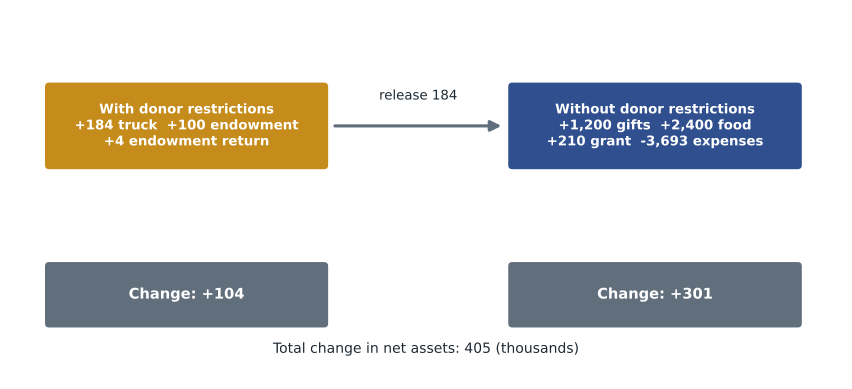
print("Conditional grant not yet earned (refundable advance): 40")WITHOUT DONOR RESTRICTIONS Contributions 1,200 Contributed nonfinancial assets (food) 2,400 State grant recognized as costs incurred (conditional) 210 Net assets released from restrictions 184 Expenses -3,693 Change 301 WITH DONOR RESTRICTIONS Truck grant (purpose restriction) 184 Endowment gift (perpetual) 100 Endowment return (restricted until appropriated) 4 Released -184 Change 104 TOTAL CHANGE IN NET ASSETS 405 Conditional grant not yet earned (refundable advance): 40
The program applies ASC 958 to Riverbend's 2027 contributions: $1.2 million of unrestricted donations, $2.4 million of donated food, a state grant for the school breakfast program that is a conditional contribution, a $184,000 grant restricted to a refrigerated truck, a $100,000 perpetual endowment gift and $4,000 of endowment return not yet appropriated. The breakfast grant reimburses allowable costs and must be returned if not spent on the program, so it has a barrier and a right of return; revenue equals the $210,000 of costs incurred, and the $40,000 received in advance is a refundable advance. The truck grant is released when the truck is placed in service. Net assets without donor restrictions increase by $301,000; net assets with donor restrictions by $104,000; total net assets by $405,000.
Conditional or restricted?
The distinction between conditions and restrictions is the most important judgment in not-for-profit revenue recognition. A restriction limits how resources may be used but does not prevent recognition: the truck grant is revenue when received, in net assets with donor restrictions. A condition prevents recognition until met: the breakfast grant is revenue only as costs are incurred. Many government grants are conditional because they reimburse allowable costs and require return of unspent funds. Organizations may adopt a simultaneous release policy, reporting restricted contributions whose restrictions are met in the same period as without donor restrictions, and conditional contributions that are also restricted can be reported as without donor restrictions when the condition and restriction are met together, if the policy is applied consistently and disclosed.
Other contribution topics recur. Contributed services are recognized only if they create or enhance nonfinancial assets or require specialized skills, are provided by people with those skills and would typically need to be purchased; general volunteer work, such as sorting food, is not recognized. Contributed nonfinancial assets, such as donated food, are recognized at fair value, and ASU 2020-07 requires them to be presented as a separate line item in the statement of activities, disaggregated by category in the notes with information about how they were used, any donor restrictions and the valuation techniques. Federal commodities distributed through a food program raise their own question: they are often treated as contributions, but organizations should evaluate the agreement terms, and lesson 12 shows that they count as federal awards expended for Single Audit purposes.
| Item | Classification | Recognition |
|---|---|---|
| Unrestricted gift | Without donor restrictions | When received or promised unconditionally |
| Purpose or time restricted gift | With donor restrictions | When received or promised; released when met |
| Conditional contribution | Refundable advance until barrier overcome | When the barrier is overcome |
| Gift for a long-lived asset | With donor restrictions | Released when placed in service |
| Perpetual endowment | With donor restrictions | When received; remains restricted |
Pledges, bequests and split-interest gifts
Timing questions are common. Unconditional promises to give are recognized when made, at fair value (often the present value of expected cash flows for multi-year pledges), with an allowance for uncollectible amounts; conditional promises are disclosed but not recognized. Bequests are recognized when the probate court declares the will valid and the amount can be estimated, which may be long after the donor's death. Split-interest agreements, such as charitable remainder trusts and charitable gift annuities, in which the organization shares benefits with the donor or another beneficiary, are recognized under ASC 958-30 at the fair value of the organization's interest, with a liability for amounts payable to other beneficiaries. Riverbend received an unconditional three-year pledge from a regional foundation in late 2027 for $60,000 a year starting in 2028; it recognizes a receivable and contribution revenue, with donor restrictions as to time, at the present value of about $164,000.
Contributions in kind other than food also need judgment. Riverbend receives donated warehouse shelving worth about $15,000 and free use of office space from a church. The shelving is a contributed nonfinancial asset recognized at fair value as contribution revenue and a capital asset, and disclosed under ASU 2020-07. The free use of office space is a contribution of the right to use facilities, which ASC 958 treats as a contribution recognized at the fair value of the rental each year, with an equal rent expense, if the arrangement is unconditional; if the church can cancel at any time, the contribution is recognized as the space is used. Consistency and disclosure matter for both.
Contributions also bring obligations to donors beyond accounting. An organization that accepts a restricted gift must use it as the donor specified; if the purpose becomes impossible or impracticable, it may need the donor's consent or a court order under the cy pres doctrine or UPMIFA to modify the restriction. The accounting records, by tracking restricted net assets and releases, provide the evidence that the organization has honored its commitments, which matters to donors, grantors and state attorneys general.
Disclosures about contributions complete the picture. Organizations disclose the nature and amounts of donor restrictions, conditional promises not yet recognized, refundable advances, the policy on contributed nonfinancial assets and services, and their release policies. Riverbend's note shows net assets with donor restrictions of $104,000 at year-end: the $100,000 endowment held in perpetuity and $4,000 of endowment return awaiting appropriation.
Worked problem
Reading a grant agreement
A foundation awards a community arts organization $300,000 for a three-year youth program. The agreement says the organization will receive $100,000 a year after submitting a report showing the program served at least 150 young people in the prior year, and unspent funds must be returned. In 2027 the organization receives the first $100,000 in advance and serves 160 young people, spending $90,000. How much revenue is recognized in 2027, and in which class?
Show solution
- The agreement has a measurable barrier (serving 150 young people) and a right of return, so each year's $100,000 is a conditional contribution.
- The first $100,000 is paid in advance; the barrier for it is overcome when the organization serves 150 young people and spends the funds as agreed, which occurs in 2027.
- Revenue for 2027 is limited by the right of return on unspent funds: $90,000 spent, with $10,000 remaining a refundable advance unless the agreement allows it to be kept once the barrier is met.
- Because the purpose (the youth program) is met in the same period, the organization may report the $90,000 as without donor restrictions under a simultaneous release policy.
- The remaining $200,000 of the award is a conditional promise, disclosed but not recognized.
Answer: Revenue of $90,000, reported without donor restrictions under a simultaneous release policy; $10,000 refundable advance.
Common mistakes
MistakeTreating board-designated funds as donor-restricted.
InsteadBoard designations are net assets without donor restrictions.
MistakeRecognizing a conditional grant in full when awarded.
InsteadRevenue waits until the barrier is overcome.
MistakeReleasing a capital gift over the asset's useful life without donor stipulation.
InsteadASU 2016-14 requires release when the asset is placed in service.
MistakeRecognizing general volunteer services.
InsteadOnly specialized services meeting ASC 958 criteria are recognized.
MistakeTreating public benefit as commensurate value to a grantor.
InsteadPublic benefit does not make a grant an exchange.
Summary and key terms
- ASC 958 applies to private US not-for-profits.
- Contributions are nonreciprocal; exchanges give commensurate value to the provider.
- A contribution is conditional if it has a barrier and a right of return or release.
- Two classes: net assets with and without donor restrictions.
- Releases reclassify net assets when restrictions expire; long-lived asset gifts are released when placed in service.
- ASU 2020-07 requires separate presentation and disclosure of contributed nonfinancial assets.
- Riverbend: change in net assets $405,000 ($301,000 without and $104,000 with restrictions).
- Riverbend's breakfast grant is conditional: $210,000 revenue, $40,000 refundable advance.
- Net assets with donor restrictions
- Net assets subject to donor-imposed restrictions on time or purpose, or held in perpetuity.
- Net assets released from restrictions
- A reclassification when a donor restriction expires.
- Conditional contribution
- A contribution with a barrier and a right of return or release.
- Refundable advance
- A liability for conditional contributions received before the condition is met.
- Promise to give
- A written or oral agreement to contribute in the future, recognized if unconditional.
- UPMIFA
- The Uniform Prudent Management of Institutional Funds Act, adopted by most states, governing endowments.
- Contribution
- A non-reciprocal transfer of assets to a not-for-profit organization, or cancellation of its liabilities.
- Endowment contribution
- A restricted contribution that must be maintained permanently, with only income available for use.
Practice problems
Work each problem on paper first, then reveal the answer to check.
Is a government grant to a charity a contribution under ASC 958?
Show answer
Usually yes, unless the government receives commensurate value, such as services it uses itself.
When is a gift restricted to a long-lived asset released?
Show answer
When the asset is placed in service, absent donor stipulations.
In the program, what is the change in net assets without donor restrictions?
Show answer
$301,000.
Why is the breakfast grant conditional?
Show answer
It reimburses allowable costs (a barrier) and unspent funds must be returned (a right of return).
When are contributed services recognized?
Show answer
When they create or enhance nonfinancial assets, or require specialized skills provided by people with those skills and would otherwise be purchased.
What does ASU 2020-07 require?
Show answer
Separate presentation of contributed nonfinancial assets and disaggregated disclosures about their use and valuation.
Where are perpetual endowment gifts reported?
Show answer
In net assets with donor restrictions.
Is a board-designated reserve donor-restricted?
Show answer
No; they are board allocations of unrestricted resources.
Lesson quiz · 5 questions
Score 60% or more to complete this lesson.
Create a free account to save your progress, take quizzes and earn a certificate.