
ACCT-412 · Lesson 12 of 12 · 23 min
Public sector audit, accountability and capstone
Financial statements are only part of public accountability. Governments and charities are also audited, by external auditors who give opinions on their statements and, in the public sector, by legislative auditors who examine whether programs deliver value for money and comply with authorities. This lesson outlines the public sector audit landscape in Canada, the indicators of financial condition that bring the course's numbers together, and a capstone review of Aspen Ridge and Riverbend. ACCT-331 covered audit methodology; here we focus on what is distinctive about the public and not-for-profit sectors.
Who audits the public sector
Each legislature in Canada has an independent auditor: the Auditor General of Canada for Parliament and provincial auditors general (in Saskatchewan, the Provincial Auditor) for the provinces. They audit the government's summary financial statements and those of many agencies, and they conduct performance audits, examining whether programs are managed with due regard for economy, efficiency and effectiveness, and whether governments complied with legislative authorities. Municipalities are audited by public accounting firms appointed by council under provincial law; some large cities also have an auditor general or internal auditor who carries out performance audits for council. Charities with significant revenue are audited, often because funders or provincial statutes require it, while smaller charities may have a review engagement.
Public sector auditing standards build on the CPA Canada Handbook: the Canadian Auditing Standards (CAS) apply to financial statement audits, and the Canadian Standards on Assurance Engagements, including CSAE 3001 for direct engagements, underpin performance audits by legislative auditors. Public sector auditors must also consider legislative authorities: whether spending was authorized by appropriation, whether borrowing was within limits, and whether transfers were used as their agreements required. Funders often require special-purpose reports or audits of compliance with agreements, such as Riverbend's report on its provincial school breakfast grant, prepared under CAS 805 or CSAE 3530 and 3531.
Indicators of financial condition
PSAB's Statement of Recommended Practice SORP-4, Indicators of Financial Condition, suggests that governments report on three dimensions. Sustainability is the degree to which a government can maintain its programs and meet its obligations without increasing its debt or tax burden relative to the economy; indicators include net financial assets or liabilities relative to revenue or to the tax base. Flexibility is the degree to which it can change its debt or tax burden to meet commitments; indicators include debt charges as a share of revenue and the net book value of capital assets relative to their cost, which signals future renewal needs. Vulnerability is the degree to which it depends on sources of funding outside its control; the main indicator is government transfers as a share of total revenue.
# Capstone: indicators of financial condition for the invented City of Aspen
# Ridge, Saskatchewan (sustainability, flexibility, vulnerability), 2026-2027,
# and two charity measures for Riverbend Community Pantry (thousands of dollars).
city = {2026: dict(fa=26_900, fl=26_550, tca=179_600, debt=16_800, own=43_000, rev=51_100,
                   debt_charges=1_950, taxable_assessment=1_480_000, amort=7_300, cost=272_000),
        2027: dict(fa=27_000, fl=27_700, tca=186_000, debt=18_200, own=43_900, rev=54_000,
                   debt_charges=2_020, taxable_assessment=1_525_000, amort=7_600, cost=290_200)}
print(f"{'Indicator':52}{'2026':>9}{'2027':>9}")
def row(name, f, fmt="{:>9.2f}"):
    print(f"{name:52}" + "".join(fmt.format(f(city[y])) for y in (2026, 2027)))
row("Sustainability: net financial assets / own revenue", lambda c: (c['fa'] - c['fl']) / c['own'], "{:>9.1%}")
row("Sustainability: net financial assets / tax base", lambda c: (c['fa'] - c['fl']) / c['taxable_assessment'], "{:>9.3%}")
row("Flexibility: debt charges / revenue", lambda c: c['debt_charges'] / c['rev'], "{:>9.1%}")
row("Flexibility: TCA net book value / cost", lambda c: c['tca'] / c['cost'], "{:>9.1%}")
row("Vulnerability: transfers / total revenue", lambda c: (c['rev'] - c['own']) / c['rev'], "{:>9.1%}")
row("Debt per resident ($)", lambda c: c['debt'] / 24.3, "{:>9,.0f}")

pantry = dict(program=3_373, total=3_693, cash_and_inv=1_790, cash_expenses=1_270)
print(f"\nPantry: program share {pantry['program'] / pantry['total']:.1%}; "
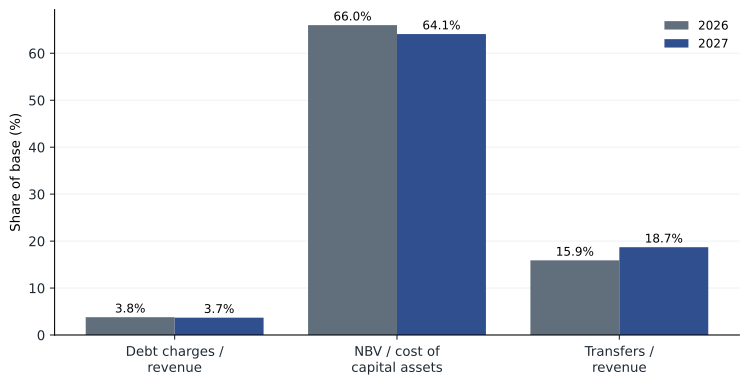
f"months of cash expenses held {pantry['cash_and_inv'] / (pantry['cash_expenses'] / 12):.1f}")Indicator 2026 2027 Sustainability: net financial assets / own revenue 0.8% -1.6% Sustainability: net financial assets / tax base 0.024% -0.046% Flexibility: debt charges / revenue 3.8% 3.7% Flexibility: TCA net book value / cost 66.0% 64.1% Vulnerability: transfers / total revenue 15.9% 18.7% Debt per resident ($) 691 749 Pantry: program share 91.3%; months of cash expenses held 16.9
The program computes SORP-4 style indicators for Aspen Ridge for 2026 and 2027. Sustainability weakened: net financial assets equal to 0.8 per cent of own-source revenue became net financial liabilities of 1.6 per cent, because the capital program outpaced the surplus. Flexibility is stable on debt, with debt charges at 3.7 per cent of revenue, well within typical limits, but the ratio of net book value to cost of capital assets fell to 64.1 per cent, showing that assets are ageing faster than they are renewed. Vulnerability rose: transfers grew from 15.9 to 18.7 per cent of revenue, reflecting the large capital transfers of 2027. Debt per resident rose from $691 to $749 with the new water plant debenture. For Riverbend, the program share of expenses is 91.3 per cent and cash and investments cover about 17 months of cash expenses, although part is endowment and an internally restricted reserve.
A capstone review of Aspen Ridge
Pulling the course together, imagine you are the auditor's senior reviewing Aspen Ridge's first PS 1202 statements. You would check that the statement of net financial liabilities uses financial liabilities only and that the classification of the $2.3 million of deferred revenue as non-financial is supported by the transfer agreements and pass terms (lessons 2 and 3). You would test that property tax revenue excludes the $12.9 million of education tax, and that unspent stipulated capital transfers of $500,000 are deferred (lesson 4). You would review the tangible capital asset continuity, the ARO's discount rate and estimate, and whether the contributed subdivision infrastructure was recorded (lesson 5). You would confirm that the budget presented is the original budget converted to the PSAS basis (lesson 6), that reserves and the accumulated surplus note reconcile (lesson 7), and that the multi-employer pension plan is correctly treated as defined contribution and the debenture was within the debt limit (lesson 8).
For Riverbend, the review would test the deferral method: that the $40,000 unspent breakfast grant and the $161,000 deferred capital contribution are supported by agreements, that the $100,000 endowment went directly to net assets, and that donated food is valued reasonably (lessons 9 and 10). It would check the Section 4470 allocation disclosures and the economic dependence note, and that the T3010 is consistent with the statements and shows the disbursement quota correctly (lesson 11). The auditor would also consider going concern: Riverbend's reliance on one food donor and on provincial funding are risks to disclose, though its reserves are healthy.
Accountability beyond the statements
Financial statements answer only some of the questions citizens and donors ask. Many governments publish annual reports with service performance information, and PSAB has issued a Statement of Recommended Practice on public performance reporting (SORP-2) and is working on a broader project on reporting service performance information. Charities increasingly publish impact reports alongside their statements. These reports are not audited in the same way, but legislative auditors' performance audits and funders' evaluations provide some assurance. The accountant's role is to make the numbers in the statements reliable, comparable and clearly explained, so that they can support the wider conversation about what public and charitable resources achieve.
| Dimension | Indicator | Aspen Ridge 2026 to 2027 |
|---|---|---|
| Sustainability | Net financial assets ÷ own-source revenue | 0.8% to −1.6% |
| Sustainability | Net financial assets ÷ taxable assessment | 0.024% to −0.046% |
| Flexibility | Debt charges ÷ revenue | 3.8% to 3.7% |
| Flexibility | Net book value ÷ cost of capital assets | 66.0% to 64.1% |
| Vulnerability | Transfers ÷ total revenue | 15.9% to 18.7% |
Course synthesis
Looking back over the course, a pattern emerges. Each topic answers the same accountability question from a different angle: what resources did the entity have, where did they come from, how were they used, what obligations does it carry, and can it continue to deliver services? For a government, PSAS answer with the annual surplus, net financial assets or liabilities, net assets by component, reserves and indicators of financial condition. For a charity, ASNPO answer with contributions recognized in a way that respects donors' restrictions, expenses that show what programs cost, and net assets that distinguish what the board controls from what donors have restricted. Tax and regulatory filings, such as the T3010, and audits add the oversight that keeps the system honest.
The standards will keep changing. PSAB is finalizing its employee benefits and intangible assets standards and reviewing the not-for-profit series for government organizations; the AcSB is working on contributions and controlled entities for ASNPO; and both boards respond to emerging issues such as cloud computing, climate-related obligations and new financing arrangements. The skills this course has emphasized, reading the standards carefully, reasoning from the conceptual framework when standards are silent, and explaining the numbers to non-specialist users, will remain valuable whatever the next changes bring.
For a student preparing for professional practice, the course also connects to the CPA competency map. Public sector and not-for-profit reporting appear in the financial reporting competency area, audit of public sector entities in the assurance area, and charity taxation in the taxation area. The capstone exercises in this lesson, reviewing a government's first PS 1202 statements and a charity's statements and T3010, mirror the integrated case questions that combine these areas.
A final word on judgment. Many of the issues in this course, classifying a liability as financial or non-financial, deciding whether a transfer stipulation creates a liability, choosing between the deferral and restricted fund methods, valuing donated food, or estimating an asset retirement obligation, require professional judgment rather than mechanical application of rules. Good judgment rests on understanding the purpose of each standard, documenting the reasoning, applying policies consistently and disclosing them clearly. Auditors and oversight bodies evaluate those judgments, and users rely on them to understand the numbers.
Public trust in governments and charities depends on reliable information about how they use public and donated money. The accountants who prepare, audit and analyse that information play a quiet but essential part in democratic accountability and in the health of the charitable sector. The technical rules covered in this course are the tools; the purpose is trust.
Worked problem
Interpreting indicators
A neighbouring town of 9,000 people reports for 2027: net financial assets of $4.2 million; own-source revenue of $14 million; total revenue of $18 million; debt charges of $1.1 million; tangible capital assets with cost $160 million and net book value $72 million. Compute the indicators and compare with Aspen Ridge.
Show solution
- Net financial assets ÷ own-source revenue: $4.2 million ÷ $14 million = 30 per cent, a strong sustainability position compared with Aspen Ridge's −1.6 per cent.
- Debt charges ÷ revenue: $1.1 million ÷ $18 million = 6.1 per cent, higher than Aspen Ridge's 3.7 per cent, so less flexibility on debt.
- Net book value ÷ cost: $72 million ÷ $160 million = 45 per cent, much lower than Aspen Ridge's 64.1 per cent, suggesting older assets and large renewal needs.
- Transfers ÷ revenue: $4 million ÷ $18 million = 22 per cent, more vulnerable than Aspen Ridge.
- The town has financial assets but an ageing asset base; its net financial assets may soon be needed for renewal, which an asset management plan should address.
Answer: NFA ratio 30%; debt charges 6.1%; NBV to cost 45%; transfers 22%.
Common mistakes
MistakeAssuming a legislative auditor audits every municipality.
InsteadMunicipalities are audited by firms appointed by council; some large cities have their own auditor general.
MistakeReading one indicator in isolation.
InsteadSORP-4 asks for sustainability, flexibility and vulnerability together, with trends.
MistakeIgnoring compliance with legislative authorities.
InsteadPublic sector audits consider whether spending and borrowing were authorized.
MistakeTreating a review engagement as an audit.
InsteadA review gives limited assurance; funders may require an audit.
MistakeThinking performance reporting is audited like the statements.
InsteadIt usually receives less assurance; performance audits fill part of the gap.
Summary and key terms
- Legislative auditors audit governments and conduct performance audits; firms audit municipalities.
- CAS govern financial statement audits; CSAE 3001 underpins direct engagements.
- Public sector auditors consider compliance with legislative authorities.
- SORP-4 groups indicators into sustainability, flexibility and vulnerability.
- Aspen Ridge's sustainability weakened and vulnerability rose in 2027.
- Aspen Ridge's net book value to cost fell to 64.1 per cent.
- Riverbend: program share 91.3 per cent; about 17 months of cash expenses held.
- Statements are one part of accountability; performance and impact reporting complete it.
- Legislative auditor
- An auditor reporting to a legislature, such as the Auditor General of Canada or a provincial auditor.
- SORP-4
- PSAB's Statement of Recommended Practice on indicators of financial condition.
- Sustainability
- The ability to maintain programs and meet obligations without increasing the debt or tax burden relative to the economy.
- Flexibility
- The ability to change the debt or tax burden to meet commitments.
- Vulnerability
- Dependence on funding sources outside the government's control.
- Direct engagement
- An assurance engagement in which the practitioner measures or evaluates the subject matter, as in many performance audits.
- Performance audit
- An audit of whether programs are managed with economy, efficiency and effectiveness.
- Compliance audit
- An audit of adherence to laws, regulations and agreements.
Practice problems
Work each problem on paper first, then reveal the answer to check.
Who audits a Saskatchewan city?
Show answer
A public accounting firm appointed by council under provincial law.
Name the three dimensions of SORP-4.
Show answer
Sustainability, flexibility and vulnerability.
In the program, what was Aspen Ridge's transfers-to-revenue ratio in 2027?
Show answer
18.7 per cent.
What does a falling ratio of net book value to cost signal?
Show answer
That assets are ageing faster than they are renewed, implying future renewal needs.
What special report might a funder require from Riverbend?
Show answer
A report on compliance with its grant agreement, under CAS 805 or CSAE 3530 and 3531.
What is a performance audit?
Show answer
An examination of whether programs are managed with economy, efficiency and effectiveness.
Why does Aspen Ridge's sustainability indicator worsen in 2027?
Show answer
Capital spending exceeded the surplus plus amortization, turning net financial assets into net financial liabilities.
What PSAB recommended practice covers performance reporting?
Show answer
SORP-2, Public Performance Reporting.
Lesson quiz · 5 questions
Score 60% or more to complete this lesson.
Create a free account to save your progress, take quizzes and earn a certificate.