
ACCT-412 · Lesson 1 of 12 · 24 min
Why public sector and not-for-profit accounting is different
Most of the accounting you have studied so far was built for businesses: entities that raise capital from owners and lenders, sell goods and services at prices customers accept, and are judged by the profit they earn and the cash they generate for investors. Governments and not-for-profit organizations do not fit that model. A city levies taxes that residents must pay whether or not they use the services; a food bank gives food away to people who pay nothing; neither has owners who expect a return. This course explains how accounting adapts to those differences in Canada, under the Public Sector Accounting Standards (PSAS) issued by the Public Sector Accounting Board (PSAB) and the Accounting Standards for Not-for-Profit Organizations (ASNPO) in Part III of the CPA Canada Handbook, and how registered charities meet their obligations under the Income Tax Act.
The course builds on ACCT-211 and ACCT-212, where you learned intermediate financial reporting for businesses, and it refers to ACCT-331 for the audit concepts that lesson 12 applies to the public sector. The standards and dates in this course were checked in October 2026. Public sector standards are changing quickly: a revised conceptual framework and a new financial statement presentation section, PS 1202, apply to fiscal years beginning on or after 1 April 2026, so many governments with calendar year-ends will apply them for the first time in 2027. Where a rule depends on a project that PSAB or the AcSB has not finished, the lesson says so.
Two running examples
Throughout the course we follow two invented organizations. The first is the City of Aspen Ridge, Saskatchewan, a city of about 24,300 people with a calendar fiscal year. It provides policing through a contract and its own fire service, roads, water and wastewater, recreation facilities and planning. Its 2027 statements are the first it prepares under PS 1202. The second is Riverbend Community Pantry, a registered charity in Aspen Ridge that collects donated food, buys food with cash donations, runs a school breakfast program funded by a provincial grant and, in 2027, buys a refrigerated truck with a capital grant. It prepares financial statements under ASNPO and files the T3010 information return. All names, people and figures are invented; they are chosen to be realistic for organizations of this size and are consistent from lesson to lesson.
What makes these entities different
Four features shape the accounting of governments and not-for-profit organizations. First, there is no profit motive and no owner. The residual interest in a city's assets belongs to no one who can sell it, and the residual interest in a charity's assets must be used for its purposes. The bottom line of the operating statement is therefore not a measure of success: a city that runs a large surplus may simply have taxed more than it needed, and a charity that runs a deficit may have spent reserves on exactly what donors wanted.
Second, many resources arrive in nonexchange transactions. Taxes, government transfers and donations are not payments for services received by the payer, so the matching of revenue with the cost of goods sold that drives business accounting does not apply. Accounting must decide when a tax or a gift is earned, and how to treat conditions and restrictions attached by the giver. Third, the budget matters more. A government's budget is a legal authority to spend, approved by elected officials, and the financial statements are expected to show how actual results compare with it. Fourth, the users differ. Instead of investors and lenders, the main users are citizens, legislators and councils, donors, grantors, rating agencies and oversight bodies, who want to know whether resources were used as intended, whether services can be sustained and whether the entity complied with legal and contractual limits.
| Question | A business | A government (PSAS) | A not-for-profit (ASNPO) |
|---|---|---|---|
| Main resource providers | Customers, owners, lenders | Taxpayers, other governments, lenders | Donors, grantors, members |
| Bottom line of operating statement | Net income | Annual surplus or deficit | Excess of revenue over expenses |
| Residual interest | Owners' equity | Net assets (accumulated surplus, remeasurements, other) | Net assets (unrestricted, internally or externally restricted, endowment) |
| Key indicator besides the bottom line | Cash flow, return on capital | Net financial assets or liabilities | Restrictions, liquidity, program spending |
| Budget in the statements | Rarely | Required comparison on the statement of operations | Not required |
Standard setters and the entities they serve
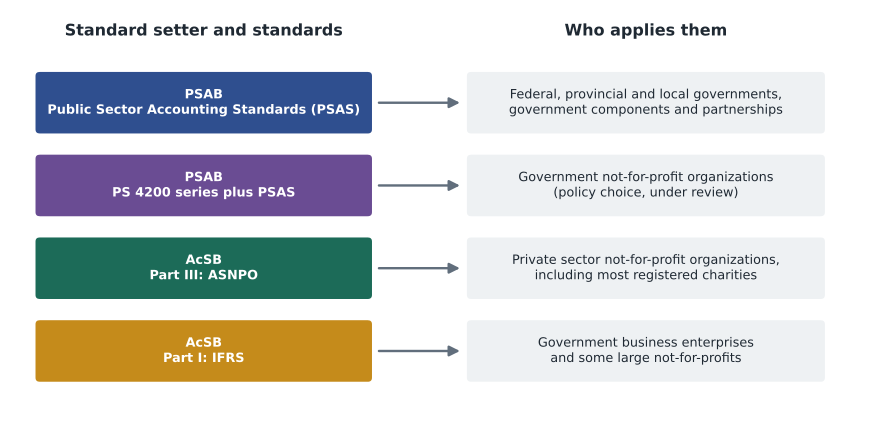
In Canada, PSAB sets PSAS for federal, provincial, territorial and local governments, and for government components such as school boards, health authorities and government partnerships. Government business enterprises, such as a provincial power corporation that sells to the public at commercial rates, apply IFRS instead. Government not-for-profit organizations, such as many hospitals, colleges and universities controlled by a government, apply PSAS and may choose to add the PS 4200 series, which contains not-for-profit rules for contributions and endowments; PSAB is reviewing that series and expects to issue an exposure draft in 2027. Private sector not-for-profit organizations, including most registered charities, choose between ASNPO in Part III and IFRS in Part I; nearly all choose ASNPO. Both boards operate under the Financial Reporting and Assurance Standards Canada framework, and provincial laws make the Handbook authoritative for many entities.
Accountability and interperiod equity
The central idea in public sector reporting is accountability: the government must account to the public for the resources entrusted to it and for how it used them. PSAB's conceptual framework expresses this as a duty to report on the government's financial position, the cost of its services and how it financed them, whether it lived within its approved budget, and whether its finances are sustainable. A related idea is intergenerational equity: if today's taxpayers enjoy services paid for with borrowing, tomorrow's taxpayers will pay for them. The net financial assets or liabilities indicator, which lesson 2 develops, measures how much future revenue is already committed to paying for past transactions.
Not-for-profit organizations are accountable too, but to a narrower group: donors, grantors, members and the regulators who protect the public interest in charitable assets. Their statements must show what resources they hold, which of those resources are restricted by donors and therefore not available for any purpose the board chooses, what programs they ran and what those programs cost, and whether they can continue. Because donated resources often come with conditions, the accounting for restrictions is the defining technical feature of not-for-profit reporting, and lessons 9 and 10 are devoted to it.
The table below summarizes what each user group of Aspen Ridge's statements wants to know. Few of the questions concern a single bottom line. A council member reviewing the 2027 statements wants to compare spending with the budget the council approved; a provincial official wants to see whether the city respects its debt limit; a rating agency analyst wants to see the trend in net financial liabilities and debt charges; a resident wants to know what the city spends on roads and whether taxes will rise. The pantry's board and donors want different answers again.
| User | Main questions | Where in the statements |
|---|---|---|
| Council and residents | Did spending follow the budget? What do services cost? | Statement of operations with budget; expenses by function |
| Province and oversight bodies | Is debt within limits? Are reserves adequate? | Debt note; reserves note; financial position |
| Lenders and rating agencies | Can the city service its debt and sustain services? | Net financial liabilities; debt charges; cash flow |
| Donors and grantors (pantry) | Was my gift used as I asked? | Restricted contributions; deferred contributions; notes |
| CRA (pantry) | Does the charity meet registration rules? | T3010 return and supporting statements |
A first look at the numbers
The program computes a few headline indicators for Aspen Ridge at 31 December 2027. Read them as a preview: each is explained later in the course. Net financial liabilities of $700,000 mean the city's financial liabilities exceed the financial assets available to settle them, so future revenue will be needed; under the old presentation, which included all liabilities, the same calculation showed net debt of $3.0 million. Net assets of $184 million are dominated by tangible capital assets, which cannot be spent. The annual surplus of $5.1 million largely reflects capital transfers and taxes used to buy assets rather than money left over.
# Key financial indicators for the invented City of Aspen Ridge, Saskatchewan,
# for the year ended 31 December 2027 (thousands of dollars).
population = 24_300
financial_assets = {"cash": 8_400, "portfolio investments": 14_000,
                    "taxes receivable": 1_600, "other receivables": 3_000}
financial_liabilities = {"accounts payable and accrued": 6_200,
               "employee benefit obligations": 1_900,
               "asset retirement obligations": 1_400, "long-term debt": 18_200}
non_financial_liabilities = {"deferred revenue to be earned by providing services": 2_300}
non_financial = {"tangible capital assets": 186_000, "inventories": 600, "prepaids": 400}
revenue, expenses = 54_000, 48_900

fa, nfa = sum(financial_assets.values()), sum(non_financial.values())
fl, nfl_ = sum(financial_liabilities.values()), sum(non_financial_liabilities.values())
li = fl + nfl_
nfl = fa - fl
print(f"Financial assets            {fa:>9,}")
print(f"Financial liabilities       {fl:>9,}")
print(f"Net financial assets (liab.){nfl:>9,}")
print(f"Non-financial liabilities   {nfl_:>9,}")
print(f"Non-financial assets        {nfa:>9,}")
print(f"Net assets                  {fa + nfa - li:>9,}")
print(f"Annual surplus              {revenue - expenses:>9,}")
print()
print(f"Debt per resident ($)       {financial_liabilities['long-term debt'] * 1000 / population:>9,.0f}")
print(f"Net financial liabilities per resident ($) {-nfl * 1000 / population:,.0f}")
print(f"Financial assets / financial liabilities  {fa / fl:.2f}")
print(f"Own-source revenue share {(54_000 - 4_100 - 6_000) / revenue:.1%}")Financial assets 27,000 Financial liabilities 27,700 Net financial assets (liab.) -700 Non-financial liabilities 2,300 Non-financial assets 187,000 Net assets 184,000 Annual surplus 5,100 Debt per resident ($) 749 Net financial liabilities per resident ($) 29 Financial assets / financial liabilities 0.97 Own-source revenue share 81.3%
These figures already show why public sector analysis needs its own indicators. Aspen Ridge earned a surplus, yet its net financial position worsened during 2027 because it spent more on capital assets than its surplus and amortization provided; lesson 3 shows the reconciliation. Its own-source revenue share of 81.3 per cent means it depends on provincial and federal transfers for under a fifth of its revenue, a measure of vulnerability that lesson 12 returns to.
Worked problem
Is a surplus good news?
Aspen Ridge reports a 2027 annual surplus of $5.1 million against a budgeted surplus of $2.6 million. A councillor says the city has $5.1 million to spend on tax relief. Is she right?
Show solution
- The surplus is measured on the full accrual basis and includes $6.0 million of capital transfers, which are revenue when eligibility criteria are met even though they must be spent on capital projects.
- Expenses include amortization of $7.6 million but not the $14.3 million spent on new tangible capital assets, which were added to non-financial assets.
- The city also repaid debt principal and transferred money to reserves, which are not expenses.
- Net financial assets fell by $1.05 million during the year, from $350,000 to net financial liabilities of $700,000, so the city has less, not more, financial capacity than a year earlier.
- A surplus in PSAS statements shows that revenues covered the cost of services including amortization; it is not cash available for tax relief.
Answer: No. The surplus reflects capital funding and the accrual measurement of services; the city's net financial position actually declined.
Common mistakes
MistakeJudging a government by its annual surplus as if it were profit.
InsteadThe goal is services and accountability, not profit; look at budget comparisons, financial position indicators and service costs.
MistakeAssuming a government not-for-profit follows ASNPO.
InsteadGovernment not-for-profit organizations apply PSAS, optionally with the PS 4200 series.
MistakeTreating all tangible capital assets as resources available to pay debts.
InsteadTangible capital assets are non-financial assets held to provide services; net financial liabilities exclude them.
MistakeIgnoring restrictions when reading a charity's statements.
InsteadRestricted resources can be used only for the purposes the donor specified; read the notes on restrictions before judging liquidity.
MistakeThinking the budget is outside the financial statements.
InsteadPSAS require the original budget on the statement of operations.
Summary and key terms
- Governments and not-for-profits have no owners, and many of their resources come from nonexchange transactions.
- In Canada, PSAB sets PSAS for governments; the AcSB sets ASNPO for private not-for-profits.
- Government business enterprises apply IFRS; government not-for-profits apply PSAS with optional PS 4200 series.
- Accountability is the main objective of reporting; budgets and restrictions are central.
- PS 1202 and a revised conceptual framework apply to fiscal years beginning on or after 1 April 2026.
- Net financial assets or liabilities measure the future revenue needed to settle past transactions.
- Users include councils, citizens, lenders, donors, grantors and regulators.
- Aspen Ridge: net assets $184.0 million, net financial liabilities $0.7 million, annual surplus $5.1 million.
- PSAB
- The Public Sector Accounting Board, which sets Canadian Public Sector Accounting Standards.
- ASNPO
- Accounting Standards for Not-for-Profit Organizations, Part III of the CPA Canada Handbook.
- Government business enterprise
- A government organization that sells goods and services to outsiders as its main activity and can sustain itself from that revenue; it applies IFRS.
- Net financial assets (liabilities)
- Financial assets minus financial liabilities; a negative amount shows future revenue is needed to pay for past transactions.
- Nonexchange transaction
- A transaction in which an entity receives resources without directly giving equal value in return, such as a tax or a donation.
- Accountability
- The obligation to explain how entrusted resources were obtained and used.
- Not-for-profit organization
- An entity, normally without transferable ownership interests, organized for social, educational, religious, charitable or similar purposes.
Practice problems
Work each problem on paper first, then reveal the answer to check.
Name the standard setter for a provincial hydro utility that sells power at commercial rates.
Show answer
It is a government business enterprise, so it applies IFRS, set by the IASB and adopted by the AcSB.
Give two reasons why a not-for-profit's bottom line does not measure success.
Show answer
It has no owners seeking a return, and its goal is to deliver programs; restricted contributions and spending of reserves can make the bottom line move for reasons unrelated to performance.
What does a net financial liability of $700,000 tell a reader?
Show answer
That financial liabilities exceed the financial assets available to settle them, so future revenue will be needed to pay for past transactions.
When does PS 1202 first apply to a city with a 31 December year-end?
Show answer
To its fiscal year beginning 1 January 2027.
Why are nonexchange transactions a challenge for revenue recognition?
Show answer
The payer receives no direct goods or services in return, so the timing of revenue must be based on legal claims, eligibility criteria, conditions and restrictions rather than on delivery to a customer.
In the program, what share of Aspen Ridge's revenue is from its own sources?
Show answer
81.3 per cent.
Name three groups that use a charity's financial statements.
Show answer
For example donors, grantors, the board, regulators, beneficiaries and lenders.
Which Handbook part applies to most registered charities?
Show answer
Part III, ASNPO.
Lesson quiz · 5 questions
Score 60% or more to complete this lesson.
Create a free account to save your progress, take quizzes and earn a certificate.