
ACCT-412 · Lesson 4 of 12 · 24 min
Revenue: taxes, transfers and user fees
Revenue is where public sector accounting departs most clearly from business accounting. A city's largest revenue, property tax, is imposed by law; its second largest, government transfers, comes from other governments that receive nothing in return; and only part of its revenue, such as water rates and recreation fees, comes from exchanges with customers. PSAS deal with these sources in three sections: PS 3510 Tax Revenue, PS 3410 Government Transfers and PS 3400 Revenue, which applies to fiscal years beginning on or after 1 April 2023 and covers revenue other than taxes, transfers and some other items. This lesson applies each to Aspen Ridge.
Tax revenue
Under PS 3510, a government recognizes tax revenue when the tax has been authorized by legislation or bylaw and the taxable event has occurred. For property taxes, the taxable event is the period for which the tax is levied, so a 2027 levy is revenue of 2027 even if some of it is collected in 2028. Taxes are measured at the amount levied, net of tax concessions that are not expenses; uncollectible amounts are expenses or allowances. Tax revenue includes payments in lieu of taxes, called grants in lieu, from the federal and provincial governments and their enterprises, which do not pay municipal taxes directly. Crucially, taxes a government collects for another government are not its revenue: Saskatchewan municipalities collect education property taxes on behalf of the province and remit them, so those amounts flow through receivables and payables only.
Saskatchewan, like other provinces, uses an assessment system set by a provincial agency, the Saskatchewan Assessment Management Agency, which values property periodically. The taxable assessment is the assessed value multiplied by a percentage of value set by the province for each property class, and the city sets a uniform mill rate and mill rate factors that vary the burden among classes. The program uses illustrative percentages and mill rates to compute Aspen Ridge's 2027 levy; real rates vary by municipality and year.
# Property tax levy and revenue recognition for the invented City of Aspen Ridge,
# Saskatchewan, 2027. Percentages of value and mill rates are illustrative.
assessment = {               # fair value assessment, thousands of dollars
    "Residential": 3_480_000,
    "Commercial and industrial": 900_000,
    "Agricultural": 60_000,
}
pct_of_value = {"Residential": 0.45, "Commercial and industrial": 1.00, "Agricultural": 0.45}
uniform_mill_rate = 11.43    # dollars per 1,000 of taxable assessment
mill_rate_factor = {"Residential": 0.95, "Commercial and industrial": 1.25, "Agricultural": 0.80}
education_mills = {"Residential": 4.27, "Commercial and industrial": 6.86, "Agricultural": 1.42}

muni = edu = 0.0
print(f"{'Class':28}{'Taxable':>11}{'Municipal':>11}{'Education':>11}")
for c, fv in assessment.items():
    taxable = fv * pct_of_value[c]
    m = taxable * uniform_mill_rate * mill_rate_factor[c] / 1000
    e = taxable * education_mills[c] / 1000
    muni += m; edu += e
    print(f"{c:28}{taxable:>11,.0f}{m:>11,.0f}{e:>11,.0f}")
grants_in_lieu = 1_090
print(f"{'Total':28}{'':>11}{muni:>11,.0f}{edu:>11,.0f}")
print(f"\nMunicipal tax revenue incl. grants in lieu: {muni + grants_in_lieu:,.0f}")
print(f"Education tax collected for the province (not revenue): {edu:,.0f}")
# Capital transfer received with a stipulation: spend on eligible projects
received, spent = 3_400, 2_900
print(f"\nCapital transfer received {received:,}; eligible spending {spent:,}")
print(f"Revenue {spent:,}; deferred revenue (liability) {received - spent:,}")
# Annual recreation passes sold on 1 September 2027 for 12 months: an exchange
passes = 480
print(f"Passes sold {passes}; revenue for 2027 {passes * 4 / 12:.0f}; deferred {passes * 8 / 12:.0f}")Class Taxable Municipal Education Residential 1,566,000 17,004 6,687 Commercial and industrial 900,000 12,859 6,174 Agricultural 27,000 247 38 Total 30,110 12,899 Municipal tax revenue incl. grants in lieu: 31,200 Education tax collected for the province (not revenue): 12,899 Capital transfer received 3,400; eligible spending 2,900 Revenue 2,900; deferred revenue (liability) 500 Passes sold 480; revenue for 2027 160; deferred 320
The program computes the municipal levy by class. Residential property, assessed at $3.48 billion, has a taxable assessment of about $1.57 billion at the 45 per cent percentage of value and produces about $17.0 million of municipal tax at the uniform rate of 11.43 mills and a factor of 0.95. Commercial and industrial property is taxed on 100 per cent of value with a factor of 1.25, so it pays $12.9 million on a much smaller assessment, a common pattern in Canadian cities. With $1.09 million of grants in lieu, municipal tax revenue is $31.2 million. The $12.9 million of education tax is excluded from revenue. The last lines apply PS 3410 and PS 3400 to two other items explained below.
Government transfers
PS 3410 defines government transfers as transfers of monetary assets or tangible capital assets from a government to an individual, organization or another government for which the transferor does not receive any goods or services directly in return, expect to be repaid or expect a direct financial return. A recipient recognizes a transfer as revenue when it is authorized and all eligibility criteria are met, except when, and to the extent that, the transfer gives rise to an obligation that meets the definition of a liability. Stipulations, the terms specifying how the transfer must be used, create a liability when they, together with the recipient's actions and communications, establish an obligation; the liability is then reduced and revenue recognized as the stipulations are met. This is why many municipalities report unspent federal and provincial capital transfers, such as Canada Community-Building Fund allocations, as deferred revenue until eligible spending occurs.
In the program, Aspen Ridge received $3.4 million of capital transfers with stipulations requiring spending on eligible infrastructure projects and spent $2.9 million on such projects during 2027. It recognizes revenue of $2.9 million and deferred revenue of $500,000. Had the agreement contained no stipulation creating a liability, for example a general unconditional grant for capital purposes, the full amount would have been revenue when authorized and eligibility criteria were met. The wording of each agreement therefore matters, and auditors routinely read transfer agreements.
Revenue from exchange transactions: PS 3400
PS 3400 applies to revenue from transactions with performance obligations, called exchange transactions, and from transactions without them, other than taxes and transfers. A performance obligation is an enforceable promise to provide goods or services to a payor. Revenue from an exchange is recognized as the government satisfies the obligation, at a point in time or over time. Examples include water and sewer charges, recreation passes, building permits (the obligation is often the review and inspection service), and sales of land held for resale. Revenue from transactions without performance obligations, such as fines and penalties, is recognized when the government has the authority to claim or retain the inflow and a past event gives rise to the claim. Aspen Ridge sold $480,000 of annual recreation passes on 1 September 2027; it recognizes $160,000 in 2027 and defers $320,000 until 2028, as the services are delivered.
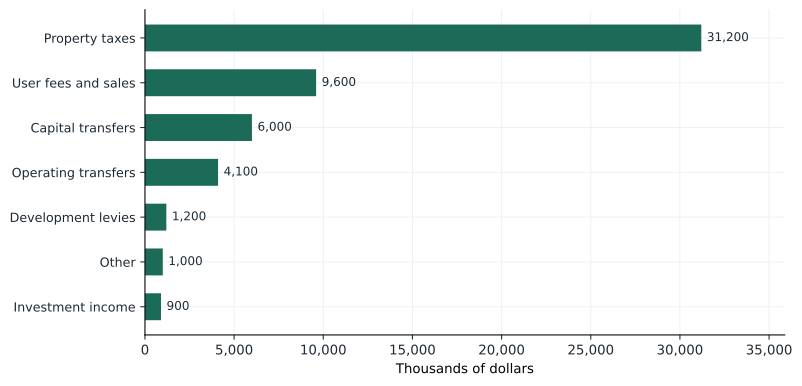
| Source | Standard | When revenue is recognized | Aspen Ridge 2027 |
|---|---|---|---|
| Property taxes | PS 3510 | When authorized and the taxable period occurs | $31.2 million incl. grants in lieu |
| Education taxes collected | PS 3510 | Never: collected for the province | $12.9 million passed through |
| Government transfers | PS 3410 | When authorized and eligibility met, unless a stipulation creates a liability | $10.1 million ($4.1 operating, $6.0 capital) |
| User fees and passes | PS 3400 (exchange) | As performance obligations are satisfied | $9.6 million |
| Development levies | Levy bylaw and agreements | When restricted use requirements are met | $1.2 million |
| Fines | PS 3400 (no performance obligation) | When there is authority to claim and a past event | In other revenue |
Development levies and other restricted inflows
Municipalities in Saskatchewan and other provinces charge developers levies, under servicing agreements or development levy bylaws, to pay for the growth-related infrastructure their projects require. Because the levies can be used only for specified capital purposes, they are usually recorded as deferred revenue when received and recognized as revenue when the related expenditures are made, consistent with PS 3100 Restricted Assets and Revenues, which requires externally restricted inflows to be recognized as revenue in the period the resources are used for the purpose specified. Developers also contribute infrastructure such as roads and pipes in new subdivisions; these contributed tangible capital assets are recognized at fair value as revenue when received, which can make a growing municipality's surplus large in a year of heavy development.
Tax concessions, write-offs and appeals
Several practical issues affect tax revenue measurement. Property owners may appeal their assessments to a board of revision; if an appeal succeeds, the municipality refunds part of the tax. PS 3510 requires the government to estimate the effect of outstanding appeals and reduce revenue when a refund is probable and can be estimated, so Aspen Ridge records an allowance of $180,000 for 2027 appeals still before the board at year-end. Tax concessions, such as exemptions or discounts granted under bylaw, reduce revenue rather than being recorded as expenses when they are concessions on the tax itself, while grants paid to taxpayers out of other resources are expenses. Taxes that prove uncollectible are written off against an allowance; in Saskatchewan, unpaid taxes eventually lead to tax enforcement proceedings, and the municipality may take title to the property, which is then recorded at the lower of cost and net realizable value as property held for resale.
Revenue recognition also interacts with the budget. Because the tax levy balances the funding budget, a municipality that receives an unexpected transfer or recovery may decide to reduce next year's levy or put the money in a reserve. The accounting does not change: revenue is recognized when the standards say so, regardless of how council plans to use it. But the notes and the variance analysis explain the effect, and readers should not assume that a revenue windfall reduces taxes automatically.
| Item | Treatment | Aspen Ridge 2027 |
|---|---|---|
| Assessment appeals outstanding | Reduce revenue when refund probable and estimable | Allowance $180,000 |
| Tax exemption under bylaw | Reduces tax revenue (concession) | Non-profit housing exemptions |
| Grant to a business to offset taxes | Expense, not a reduction of revenue | None in 2027 |
| Uncollectible taxes | Written off against allowance | Small; tax enforcement in progress |
| Property acquired for unpaid taxes | Held for resale at lower of cost and net realizable value | Two vacant lots |
A final point concerns disclosure. Governments disclose their revenue recognition policies for each major source, the amount of taxes collected for other governments, significant deferred revenue balances with their expected timing, and contractual rights to future revenue such as long-term leases of city land. These disclosures help users understand how much of next year's revenue is already secured and how much depends on future decisions by council, other governments and taxpayers. For Aspen Ridge, the notes show $2.3 million of deferred revenue, of which $500,000 relates to stipulated capital transfers expected to be spent on eligible projects in 2028.
Comparing the two years shows how revenue mix shapes risk. Property taxes are stable but politically sensitive; user fees depend on consumption and weather; transfers depend on decisions by other governments and on program rules; and investment income depends on interest rates. A city that relies heavily on transfers, as lesson 12's vulnerability indicator measures, faces more uncertainty than one funded mainly by its own taxes and fees.
Worked problem
Recognizing transfer and fee revenue
In 2027, Aspen Ridge (a) receives a $900,000 provincial operating grant for policing with no stipulations beyond being a municipality; (b) is notified in December 2027 of a $1.2 million federal transit capital transfer for 2028 spending, authorized by the federal government in January 2028; (c) collects $360,000 of building permit fees, with inspections 70 per cent complete at year-end on average; (d) issues $85,000 of parking fines, of which $20,000 are uncollectible.
Show solution
- (a) The grant is authorized and eligibility criteria are met; with no stipulations creating a liability, $900,000 is revenue of 2027.
- (b) The transfer is not authorized by the transferor until 2028, so no revenue or receivable is recognized in 2027; it is disclosed if significant.
- (c) Under PS 3400, permit revenue is recognized as the inspection service is delivered: about $252,000 in 2027 and $108,000 deferred, if the city's policy uses the stage of completion.
- (d) Fines have no performance obligation; revenue of $85,000 is recognized when issued, with an allowance or expense for the $20,000 uncollectible, depending on policy.
- Note the contrast between (a) and (b): authorization by the transferor is the trigger, not notification.
Answer: (a) revenue $900,000; (b) nothing in 2027; (c) about $252,000 revenue; (d) $85,000 revenue with a $20,000 allowance.
Common mistakes
MistakeRecording education taxes collected for the province as municipal revenue.
InsteadTaxes collected for other governments are not the collector's revenue.
MistakeDeferring every transfer until spent.
InsteadDefer only to the extent stipulations create a liability.
MistakeRecognizing a transfer when notified rather than when authorized.
InsteadAuthorization by the transferor and eligibility are required.
MistakeRecognizing annual passes as revenue when sold.
InsteadRecognize exchange revenue as the performance obligation is satisfied.
MistakeIgnoring contributed infrastructure from developers.
InsteadContributed tangible capital assets are revenue at fair value.
Summary and key terms
- PS 3510 covers taxes, PS 3410 transfers and PS 3400 other revenue, including exchanges.
- Tax revenue is recognized when authorized and the taxable event occurs.
- Taxes collected for other governments are not revenue.
- Transfers are revenue when authorized and eligibility criteria are met, unless stipulations create a liability.
- PS 3400 recognizes exchange revenue as performance obligations are satisfied.
- Development levies are deferred until used for their purpose.
- Aspen Ridge: municipal tax revenue $31.2 million; education tax $12.9 million passed through.
- Unspent stipulated capital transfers: $500,000 deferred.
- Government transfer
- A transfer of monetary or tangible capital assets for which the transferor receives no goods or services directly in return, expects no repayment and no direct financial return.
- Stipulation
- A term in a transfer agreement specifying how the transfer must be used or what the recipient must do.
- Eligibility criteria
- Criteria the recipient must meet to receive a transfer.
- Performance obligation
- An enforceable promise to provide goods or services to a payor.
- Mill rate
- The tax rate per 1,000 dollars of taxable assessment.
- Development levy
- A charge on new development to pay for growth-related infrastructure.
- Exchange transaction
- A transaction in which each party receives and gives up essentially equal value.
- Payment in lieu of taxes
- A payment by a government or enterprise exempt from property tax, made instead of the tax.
Practice problems
Work each problem on paper first, then reveal the answer to check.
Why are education taxes excluded from Aspen Ridge's revenue?
Show answer
The city collects them on behalf of the province, which sets the rates and receives them.
What is a grant in lieu of taxes?
Show answer
A payment by a federal or provincial entity exempt from municipal taxes, made instead of tax; it is tax revenue.
In the program, what is the taxable assessment of commercial and industrial property?
Show answer
$900 million: 100 per cent of value.
When does a stipulation create a liability?
Show answer
When, with the recipient's actions and communications, it creates an obligation meeting the definition of a liability.
How much of the recreation pass revenue is deferred at 31 December 2027?
Show answer
$320,000.
How are developer-contributed roads recorded?
Show answer
As tangible capital assets and revenue at fair value when received.
Which section covers fines?
Show answer
PS 3400, as revenue without performance obligations.
Why might a growing municipality report a large surplus?
Show answer
Contributed infrastructure and development levies are revenue when received or used, though they bring future costs.
Lesson quiz · 5 questions
Score 60% or more to complete this lesson.
Create a free account to save your progress, take quizzes and earn a certificate.